
Sign up to save your podcasts
Or

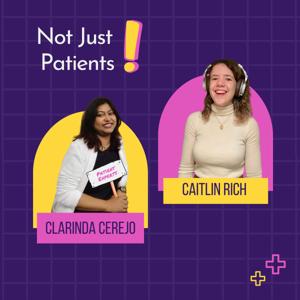


Welcome to this episode focused on the LGBTQIA+ Community as an Underserved Community in Healthcare!
In this episode, Caitlin and Clarinda are joined by Carter Hemion, a rare disease patient advocate, author, and artist, and Simon Stones, a patient and caregiver advocate and healthcare communication specialist.
Carter lives with a connective tissue disorder and multiple intersecting identities, including being transgender, non-binary, queer, and asexual. Their advocacy began in childhood with everyday battles associated with identity and grew into a broader mission to tackle systemic barriers in healthcare.
Simon has lived with multiple immune-mediated inflammatory diseases since childhood and has also been a caregiver for parents with pancreatic cancer and dementia. Having come out as gay only in his late twenties, he brings an acute understanding of what it means to hide a core part of yourself in healthcare and beyond and the challenges associated with that.
In this powerful conversation, Carter and Simon join our hosts to explore
This episode is a hard-hitting but hopeful deep dive into the healthcare experiences of the LGBTQIA+ community and what each of us can do to make care safer and more equitable for people everywhere.
Chapters
00:00:00 - Introductions and episode overview
00:01:19 - Carter's and Simon's journeys into advocacy
00:05:57 - Why the LGBIQIA+ community is underserved in healthcare
00:13:07 - How healthcare experiences differ among community members
00:17:55 - Challenges across disease areas
00:22:49 - Role of stigma and culture in healthcare experiences
00:28:20 - What equitable care would look like
00:33:02 - Initiatives driving change
00:39:03 - Patient involvement shaping community outcomes
00:43:45 - Call to action for community members and healthcare leaders
Resources and abbreviations
Let us know what you thought of this episode
Follow us or subscribe wherever you get your podcasts
Website: notjustpatients.com
LinkedIn: Not Just Patients
Instagram: @notjustpatients
Substack: https://notjustpatients.substack.com/
Have feedback or suggestions? We'd love to hear from you.
Email: [email protected]
Welcome to the launch episode of our special new series on Underserved Communities in Healthcare. On this episode, Caitlin and Clarinda are joined by Ashish Rishi, Founder and CEO of Unwritten Health.
Ashish has dedicated his career to making healthcare more inclusive, not as a moral cause, but as a practical necessity. He serves as a member of the Scientific Advisory Board for IHI-READI, a Horizon Europe initiative on health equity and research infrastructure. By consistently asking 'WHO ISN'T IN THE DATA?', Ashish's work examines how healthcare decisions break, not at the point of failure, but long before it.
In this important conversation, we set the scene for our whole series by defining the terms 'underserved' and 'under-represented', which are often used interchangeably in healthcare. Sharing real personal stories from his life and work, Ashish delves into why certain communities are consistently underserved, what that experience looks like, and how it shakes the foundations of healthcare for society at large. Ashish also shares his vision for the future and a call to action for healthcare decision-makers.
Our thanks to our Conversation Partner, Unwritten Health for making this episode possible. Unwritten Health offer a patient experience data platform that can be used to generate evidence that your healthcare products work safely and equitably across the populations they serve.
Note: While this conversation was developed in collaboration with Unwritten Health, Not Just Patients retained final control over the content, questions, and editorial direction of the episode.
Abbreviations
GCSE - General Certificate of Secondary Education (UK)
Resources
Chapters
00:00:00 - Introductions and episode overview
00:01:59 - What makes a community underserved in healthcare?
00:07:36 - Ashish's motivations for his work in health equity
00:14:55 - How being underserved plays out across the healthcare journey
00:25:35 - Why are some communities underserved?
00:39:51 - Impact of health inequities on communities and the health system
00:45:26 - What should healthcare leaders do differently?
00:52:39 - Tough questions this series should keep asking
00:53:20 - Ashish's vision for an ideal health system
Let us know what you thought of this episode
Follow us or subscribe wherever you get your podcasts
Website: notjustpatients.com
LinkedIn: Not Just Patients
Instagram: @notjustpatients
Substack: https://notjustpatients.substack.com/
Have feedback or suggestions? We'd love to hear from you.
Email: [email protected]
📣 COMING SOON ⌛
Very excited to announce that our new podcast series on Underserved Communities in Healthcare will be reaching you soon!
For this series, we are getting bigger and bolder and having tougher conversations that we can't wait to share with you.
Here's a little preview, featuring our own Caitlin Rich and Clarinda Cerejo as well as a few of our series guests and partners:
Ashish Rishi from Unwritten Health, Simon Stones, Benjamin AKILIMALI, Carter Hemion, Everline Konyo Mjømen, Sumaira Ahmed from The Sumaira Foundation, and Cory Inglis from BOOM! Healthcare Communications.
Watch this space and gear up to join us as we break barriers in healthcare ✊
+++
References:
1. Unwritten Health
The Frequency of Exclusion, 2026. Survey of 1,204 people from underrepresented UK communities. Reported findings include 82% having felt their health concerns dismissed by a healthcare professional.
2. KFF
LGBT Adults’ Experiences with Discrimination and Health Care Disparities: Findings from the KFF Survey of Racism, Discrimination, and Health. Published April 2024. Among LGBT adults who had used healthcare in the previous three years, 33% reported unfair or disrespectful treatment by a doctor or healthcare provider, versus 15% of non-LGBT adults.
Let us know what you thought of this episode
Follow us or subscribe wherever you get your podcasts
Website: notjustpatients.com
LinkedIn: Not Just Patients
Instagram: @notjustpatients
Substack: https://notjustpatients.substack.com/
Have feedback or suggestions? We'd love to hear from you.
Email: [email protected]
Join us for a compelling conversation with Dr. Dheepa Rajan, who serves as a Health Systems Advisor at the European Observatory on Health Systems and Policies, as we explore what social participation means and how it can transform health policy and health system performance.
Prior to joining the European Observatory, Deepa spent over 15 years at the World Health Organization (WHO) headquarters in various health system roles, covering national health planning, health system performance, participatory governance, and primary health care. She has led landmark publications including the WHO Handbook on Social Participation, the Primary Healthcare Primer, and Health System Performance Assessment: A Framework for Policy Analysis. Trained as a medical doctor, followed by acquiring advanced degrees in health economics and policy in Europe and a doctorate on traditional medicine in India, she brings a uniquely global, grounded, and systems-focused lens to the conversation.
In this episode, we unpack the WHO resolution on social participation, its goals and objectives, and what it means for governments in practice. While acknowledging barriers and challenges to achieving social participation in practice, Dheepa also shares inspiring real-world examples of the value social participation can have and how it can effectively influence health policy.
Note: Dheepa's reflections here draw on her time at WHO headquarters and her current work at the European Observatory. They represent her personal views and experiences and are not an official WHO or Observatory view, position, or decision.
Resources and Abbreviations
Chapters
Let us know what you thought of this episode
Follow us or subscribe wherever you get your podcasts
Website: notjustpatients.com
LinkedIn: Not Just Patients
Instagram: @notjustpatients
Substack: https://notjustpatients.substack.com/
Have feedback or suggestions? We'd love to hear from you.
Email: [email protected]
Join us for a powerful conversation with Stacy Hurt as we dive into what patient safety really means in clinical trials and everyday medical practice.
Stacy is Chief Patient Officer at Parexel, where she leads efforts to embed the patient voice across clinical research and drug development. A patient, survivor, and caregiver herself, Stacy brings both professional expertise and lived experience to her work—advocating for more inclusive, patient‑centred trials and meaningful engagement throughout the research journey. She is a widely respected leader and speaker dedicated to improving how research is designed, conducted, and experienced by patients worldwide.
In this episode, Stacy draws on both her professional expertise and deeply personal experiences as a patient and caregiver to help us unpack patient safety: what it is; why it’s so poorly understood; and how fear, blame, and broken feedback loops stop patients and clinicians from reporting what’s really happening.
Note: The example Clarinda shared about a patient on psychiatric medication was inspired by a LinkedIn post from a Patient Safety Expert
Chapters:
Resources and abbreviations:
Let us know what you thought of this episode
Follow us or subscribe wherever you get your podcasts
Website: notjustpatients.com
LinkedIn: Not Just Patients
Instagram: @notjustpatients
Substack: https://notjustpatients.substack.com/
Have feedback or suggestions? We'd love to hear from you.
Email: [email protected]
Joining Caitlin and Clarinda for this episode of Not Just Patients is Emma Doble, Patient and Public Strategy Editor at The BMJ, for a powerful conversation about what it really means to embed patients in medical publishing in more than just name.
Emma leads the BMJ’s patient partnership strategy across the journal and BMJ Group, including the What Your Patient Is Thinking series, patient and public partnership at BMJ events, and support for over 70 BMJ Group journals. She was awarded a Made with Patients Award by the Patient Engagement Open Forum for her work, is a visiting lecturer at King’s College London, and an independent patient advocate advising universities, governments, and NGOs on patient partnership.
Drawing on both her professional experience and her personal journey living with type 1 diabetes since childhood, Emma offers an inside look at how one of the world’s leading medical journals has shifted from “managing informed patients” to recognizing patients as experts and partners in research, governance, and editorial decision-making.
Join us as we demystify medical publications, explore the BMJ’s patient partnership strategy, discuss the culture change required to bring patients into an “ivory tower” space, and break down what true patient involvement could look like for both patients and publishers.
Chapters
00:00:00 - Introductions and episode overview
00:01:55 - Understanding the medical publishing process
00:08:00 - The BMJ's Patient Partnership Programme
00:12:31 - Breaking into the 'ivory tower'
00:15:33 - Value of patient involvement in medical publishing
00:20:08 - Emma's personal story and career path
00:27:36 - Avenues and qualifications for patient involvement
00:34:32 - Increased acceptance of patients as authors
00:39:52 - Barriers to patient involvement
00:44:17 - Initiatives to help patients get involved
00:48:25 - Emma's long-term dream for medical publishing
00:52:00 - Emma's advice for patients, journals, and publishers
00:54:50 - Reflections with Caitlin and Clarinda
Resources and abbreviations
Let us know what you thought of this episode
Follow us or subscribe wherever you get your podcasts
Website: notjustpatients.com
LinkedIn: Not Just Patients
Instagram: @notjustpatients
Substack: https://notjustpatients.substack.com/
Have feedback or suggestions? We'd love to hear from you.
Email: [email protected]
Join us for an enlightening conversation with Dr Richard Fitton, retired GP and long-time champion of patient access to electronic medical records, as we explore what it really means to share data, power, and responsibility with patients.
Richard’s journey spans more than four decades of pioneering work: from early computerised records in the 1980s, to leading one of the first NHS pilots for online patient record access, moderating the WHO working group that drafted the 8th Patient Right of the WHO Patient Safety Charter – the right to access your own records.
In this episode, we unpack what medical records are, who they serve, and how they can enable genuine patient-clinical partnership. We also explore global barriers digitization and how they can be overcome, sharing hopeful stories of how small efforts have scaled to influence national guidance and international policy.
This episode offers a practical and deeply human vision for how medical records can support patients in becoming informed partners in their own care.
Chapters:
Resources and abbreviations:
Let us know what you thought of this episode
Follow us or subscribe wherever you get your podcasts
Website: notjustpatients.com
LinkedIn: Not Just Patients
Instagram: @notjustpatients
Substack: https://notjustpatients.substack.com/
Have feedback or suggestions? We'd love to hear from you.
Email: [email protected]
Join us for an enlightening conversation with Jennifer Bright, President and CEO of the International Consortium for Health Outcomes Measurement (ICHOM), where we talk about redefining value in healthcare by measuring what truly matters to patients.
Jennifer is a long-time leader in patient-centered health policy and outcomes, with past executive roles at the Innovation and Value Initiative, the Society for Healthcare Epidemiology of America, and Mental Health America. She is also Founder and President of Momentum Health Strategies, Chair of the Board at Mental Health America, and an editor for the American Journal of Accountable Care and the Journal of Patient Experience. Drawing on both her professional expertise and deeply personal experiences with her parents’ cancer journeys, she brings a powerful perspective on why patients must be at the center of every health decision.
In this episode, we unpack the world of outcomes and outcomes measures—what they are, why traditional survival-focused metrics are not enough, and how patient-centered outcomes can transform clinical care, research, and policy. Jennifer shares her personal story, explains how ICHOM co-creates standardized outcome sets with patients and clinicians worldwide, and explores the barriers and opportunities in making outcomes-based, patient-centered care the global norm.
Whether you’re a patient, clinician, policymaker, or researcher, this episode offers a hopeful, practical vision for measuring and delivering better health for all.
Chapters:
0:00 - Introductions and episode overview
1:30 - Defining outcomes and outcomes measures
6:50 - What really matters to patients
9:26 - Jennifer's personal story and motivations
14:23 - An overview of ICHOM's work
17:09 - Patient involvement in developing outcomes measures sets
19:03 - The ICHOM process for outcomes measures sets
26:57 - Value and real-life applications of outcomes measures
29:52 - Eligibility criteria for patient involvement
34:30 - Using outcomes measures for shared decision-making
39:54 - Global adoption of outcomes measures
43:32 - Overcoming barriers and challenges
50:52 - Vision for the future
53:25 - Advice for patients looking to get involved
55:38 - Reflections with Caitlin and Clarinda
Resources and abbreviations:
Let us know what you thought of this episode
Follow us or subscribe wherever you get your podcasts
Website: notjustpatients.com
LinkedIn: Not Just Patients
Instagram: @notjustpatients
Substack: https://notjustpatients.substack.com/
Have feedback or suggestions? We'd love to hear from you.
Email: [email protected]
Join us for this special Rare Disease Day episode with Emily Reubin OBE, Co‑founder and CEO of Duchenne UK, as we talk about transforming grief into impact and reshaping rare disease care through patient advocacy.
Emily co-founded Duchenne UK after her son was diagnosed with Duchenne muscular dystrophy (DMD). Emily launched the Duchenne Children’s Trust in 2012, which later merged with Joining Jack to become Duchenne UK. Emily is a leading advocate for patients, representing the community at the FDA, EMA, MHRA, NICE, and SMC. Emily was awarded an OBE in 2023 for her services to people with DMD.
In this episode, we delve into the realities of rare disease — the underappreciated “cluster bomb” impact on families, the emotional toll of diagnosis, and why current systems are not built for complex paediatric conditions. Emily shares her personal story of her son Eli’s diagnosis, the early years of devastation, and how she and co‑founder Alex Johnson built Duchenne UK into international force in disrupting clinical trials, standards of care, and health technology assessment for rare disease.
Emily offers deeply honest reflections, practical insight, and tangible examples for rare disease patients, caregivers, advocates, and all stakeholders involved in rare disease care.
Chapters
Resources & abbreviations
Let us know what you thought of this episode
Follow us or subscribe wherever you get your podcasts
Website: notjustpatients.com
LinkedIn: Not Just Patients
Instagram: @notjustpatients
Substack: https://notjustpatients.substack.com/
Have feedback or suggestions? We'd love to hear from you.
Email: [email protected]
Join us for an inspiring conversation with Derick Mitchell, Executive Director of Patient Focused Medicines Development (PFMD), adjunct professor at Trinity College Dublin, and a dedicated leader in patient engagement and multistakeholder healthcare innovation.
Derick’s journey has taken him from translational research to his previous role as CEO of IPPOSI—the largest patient network in Ireland—where he spent close to a decade championing partnerships between patients, government, academia, and industry to shape patient-centered health policy. At PFMD, he now leads international efforts to bring all stakeholders together to transform healthcare for and with patients.
In this episode, we delve into why multistakeholder collaboration is so crucial for patient engagement (and tough to do well!), and how we can move beyond good intentions to lasting change.
Derick shares practical examples from Ireland and globally; tackles the barriers that keep patients’ voices from truly shaping decisions; and offers actionable steps for building more inclusive, impactful partnerships. Whether you’re a patient, professional, or changemaker, this episode is packed with insights on turning collaboration from a talking point into real, everyday practice.
Chapters
Resources & abbreviations
Let us know what you thought of this episode
Follow us or subscribe wherever you get your podcasts
Website: notjustpatients.com
LinkedIn: Not Just Patients
Instagram: @notjustpatients
Substack: https://notjustpatients.substack.com/
Have feedback or suggestions? We'd love to hear from you.
Email: [email protected]
From the publisher's feed
Hi! We’re Caitlin Rich and Clarinda Cerejo, Co-Hosts of Not Just Patients, a global podcast that aims to bring stakeholders together and break barriers to meaningful patient involvement in…
Have feedback or suggestions for us? We'd love to hear from you! Email us at [email protected] or find us on LinkedIn.