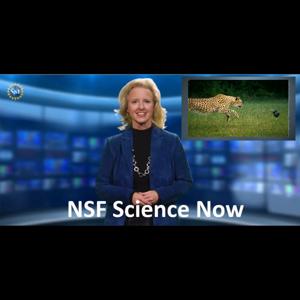
NSF Science Now

NSF Science Now

By National Science FoundationScience
Download on the App Store

NSF Science Now episodes

  • A powered ankle exoskeleton could make running easier
    Feeling a little slow on that run?  What if there was a device you strap on to your ankle that could help give you a boost?   Engineers at Stanford University, with funding from the National Science Foundation, are studying ways to improve the runners’ experience.  The team investigated two different modes of running assistance:  motor-powered and spring-based.   Eleven experienced runners strapped on this ankle exoskeleton and took to the treadmill to test the two assistance types.    The energy savings the researchers observed indicate that a runner using the powered exoskeleton could boost their speed by as much as 10 percent. The team thinks it should be possible to turn the powered skeleton into an effective untethered device to give runners a little kick to their step, without breaking a sweat.  While more research is required, the team is thrilled about how well the device has performed.
    2 min
  • Catching early signs of autism in infants
    About, one in fifty-nine children in the U.S. has an Autism Spectrum Disorder or ASD. Diagnosis usually takes place on or after the age of three. Is it possible to spot ASD earlier? A new study by researchers at the University of Miami, with funding from the National Science Foundation, has found that infants who exhibit early signs of social difficulty and have older siblings with Autism Spectrum disorder are at high risk of being diagnosed with ASD when they are older. Building on earlier research, in Daniel Messinger’s lab, PhD. Candidate Katherine Martin and others studied 95 15-month old infants, both high and low risk. They examined how the infants react to being separated briefly from a parent. While most children will cry, they eventually calm down. In the study, the high-risk infants who later were diagnosed with autism had trouble calming down, even when the parent returned. The team says this indicates that the infants are not confident in their ability to be soothed. The researchers determined that these high-risk infants with insecure-resistant attachments were later more than nine times more likely to receive an ASD diagnosis than high-risk infants with secure attachments.

    2 min
  • Protecting Soldiers from Chemical Warfare
    Northwestern University scientists, using nanotechnology facilities funded by the National Science Foundation, have successfully combined textile fibers with a nanomaterial referred to as metal-organic-framework or MOF. The team found that this type of MOF-coated textiles efficiently neutralizes toxic nerve agents under battlefield-relevant conditions. The material also lasts a long time under degrading conditions, such as sweat and pollutants. The team believes this new composite material could one day be used in protective suits and face masks for people facing hazards such as chemical warfare.
    1 min
  • Fruit Flies In Living Color
    Did you know that fruit flies can see in color? No wonder our food looks so good! Columbia scientists, with funding from the National Science Foundation, have identified the circuit of color-sensitive nerve cells in the retina of fruit flies that drives their ability to see in color, and it's surprisingly similar to the circuitry we use to see color. The team hopes that a better understanding of how the brain perceives color could also lead to new computer-based technologies for those with vision impairments.
    1 min
  • Escaping the flood
    How to know where flood waters will flow? Texas A&M researchers, with funding from the National Science Foundation, have developed an algorithm that can predict the flow of floodwater during hurricanes and other weather events in almost real-time. Knowing where the floodwater will go next will help first responders better gauge the level of flooding for their evacuation and rescue operations.
    2 min
  • NSF Science Now-Episode 66
    In this week’s episode, we explore earthquake-resistant bridge columns, track the path of cancer cells, and finally, we examine the biology of bat wings. Check it out!
    5 min
  • NSF Science Now-Episode 65
    Heart disease is the leading cause of death in the United States, killing approximately 610,000 people yearly. The electrocardiography machine-EKG-the current method for monitoring the heart has been the standard for decades. Now NSF-funded engineers at the University of Texas at Austin have developed a wearable technology made from stretchy, lightweight material that could make monitoring heart health easier and more accurate than existing EKG machines.
    2 min
  • NSF Science Now-Episode 65
    In this week's episode, we examine e-tattoo technology for more accurate heart health monitoring; explore increased sliding of the Greenland Ice Sheet, and finally, we test ultrasound technology for prosthetics. Check it out!
    6 min
  • NSF Science Now-Episode 64
    In this week’s episode, We examine barnacles and the wealth of information they hold; we explore our brains and perception, and finally, we test pseudo-LiDAR for self-driving cars. Check it out!
    4 min
  • NSF Science Now-Episode 63
    In this week’s episode, We learn about developable mechanisms that reside in curved surfaces of structures; we explore wrist bone motion using 3D technology, and finally, we examine Adélie penguins’ past and future. Check it out!
    8 min

About NSF Science Now

From the publisher's feed

Hosted by the NSF's Dena Headlee, NSF Science Now is a newscast covering some of the latest in NSF-funded innovation and advances across all areas and disciplines, from astronomy to zoology.