Sign up to save your podcastsEmail addressPasswordRegisterOrContinue with GoogleAlready have an account? Log in here.
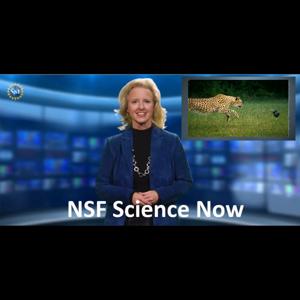
Hosted by the NSF's Dena Headlee, NSF Science Now is a newscast covering some of the latest in NSF-funded innovation and advances across all areas and disciplines, from astronomy to zoology.... more
FAQs about NSF Science Now:How many episodes does NSF Science Now have?The podcast currently has 90 episodes available.
February 22, 2013NSF Science Now-Episode 8In this week’s episode of NSF Science Now we explore spiders’ silk, a bionic eye, coral reefs, and finally the sense of touch....more6minPlay
February 08, 2013NSF Science Now-Episode 7In this week’s episode of NSF Science Now we explore BigFoot, body language, and finally Antarctic subglacial lakes.Provided by the National Science Foundation...more4minPlay
January 25, 2013NSF Science Now-Episode 6In this week’s episode of NSF Science Now we explore climate change and the Colorado River, helping children with disabilities, porcupine’s quills, and finally the decline of chinstrap penguins....more4minPlay
January 07, 2013NSF Science Now-Episode 5In this week’s episode of NSF Science Now we explore negative thoughts, robotic fish, sensitive alligators and finally the discovery of a camp used by explorers a century ago during the “Heroic Age” of Antarctic exploration....more4minPlay
December 14, 2012NSF Science Now-Episode 4In this week’s episode of NSF Science Now we explore Arctic walrus habitats, Cave2, Pandas and finally Algae and biofuels....more4minPlay
November 29, 2012NSF Science Now-Episode 3In this week’s episode of NSF Science Now we explore NSF’s Harvard Forest Long-Term Ecological Site, phytoplankton and climate change, how silver turns people blue and finally why math hurts....more3minPlay
November 15, 2012NSF Science Now-Episode 2In this week’s episode of NSF Science Now we explore Hawaiian volcanoes, smart homes, robot locomotion and finally novel engineering ideas on the tiny wings of butterflies.Provided by the National Science Foundation...more4minPlay
November 08, 2012NSF Science Now-Episode 1In this week’s episode of NSF Science Now we explore “Yellowstone”, one of the world’s most powerful supercomputers, acidification of McMurdo Sound, a living laboratory and finally EcoATM.Provided by the National Science Foundation...more4minPlay
January 01, 1990How to increase recall with digital storybooksFrom tablets to computers to smartvphones, children today are surrounded by digital tools for learning. Traditional book reading with children has always been a quiet moment that provides a child with a fundamental foundation for developing reading and language skills. Recently, researchers at Carnegie Mellon University, with funding from the National Science Foundation, have found that children learn better when they are more involved in the learning process. The team conducted three tests involving children ages 3-5 using both traditional static books and animated digital books. The team found that each time the child could interact with an animated digital book, their recall improved dramatically. They say this kind of contingent positive reinforcement from a book or parent or teacher is rewarding and has positive effects on learning. The team feels this type of reading could be particularly beneficial for children who have difficulty focusing....more1minPlay
January 01, 1990Dry lakebeds become dustpansResearchers from Brigham Young University, with funding from the National Science Foundation, predict the amount of dust in Utah’s Wasatch Front is only going to increase as water levels decline, turning lakebeds into dustpans. The team feels the amount of dust blown into urban areas could be lowered by preserving lakes through water conservation, allowing more water to flow into the lakes....more2minPlay
FAQs about NSF Science Now:How many episodes does NSF Science Now have?The podcast currently has 90 episodes available.