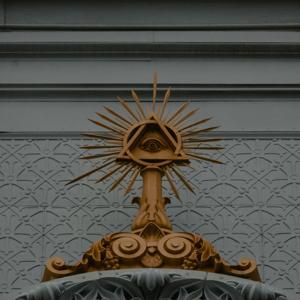
In this episode, we step into the hallowed circle of the ancient alchemists—those early philosophers who cloaked their wisdom in riddles, parables, and flame. Known as The Turba Philosophorum or The Assembly of the Sages, this mysterious text stands as one of the oldest and most cryptic records of Western alchemical thought. Preserved and translated by Arthur Edward Waite, the Turba is far more than a treatise on transmuting metals—it is a spiritual symposium, where legendary minds like Pythagoras, Anaxagoras, and Zosimos debate the nature of the cosmos, the soul, and the philosopher's stone.
This book does not teach through exposition; it teaches through dialogue. Each dictum is a voice—sometimes poetic, sometimes combative—contributing to a larger, spiraling meditation on the four elements, the structure of matter, and the hidden principles of transformation. Fire, water, air, and earth are not merely physical substances but living symbols, each carrying an arcane charge. The elements are not just components of nature—they are carriers of divine order and chaos, enemies and lovers, destroying and reconciling through secret laws. The text likens the cosmos to an egg: the yolk is fire, the white is water, the shell is earth, and the membrane between them—air—unites what would otherwise be hostile. Through such metaphors, the Turba invites us into a holistic vision where nature, spirit, and art are interwoven.
What emerges is a worldview steeped in sacred correspondence, one where material and spiritual truths mirror one another. The "corpus," the physical body, is not simply inert matter—it is the battleground of opposites, of inner fire and outer dampness, of fixity and volatility. The alchemist is called not merely to observe, but to participate—to become both the operator and the operated upon, the vessel and the fire. This is why the Turba speaks as much about character, ethics, and divine grace as it does about substances. Without moral purification and spiritual readiness, the work will fail, regardless of technical precision.
The Turba also preserves a sacred language—a grammar of light and shadow, of dissolution and coagulation, of blackening and whitening. These stages of the alchemical opus are not just laboratory procedures; they are psychological and spiritual trials. The blackening (nigredo) is the descent into chaos and death; the whitening (albedo) is the revelation of inner purity; the reddening (rubedo) is the birth of gold, the perfected soul, the divine marriage of spirit and matter. In this way, the alchemical process reflects the mystic’s path of death, purification, and resurrection.
Amidst its cryptic poetry, the Turba Philosophorum warns against arrogance, envy, and haste. It was never meant to be a recipe book for profit-hunters. It was, and remains, a sacred text—guarded by the Wise, revealed only to the humble. Its teachings are esoteric, meant for the “Sons of the Doctrine,” those initiates willing to approach the Great Work not as a transaction, but as a transformation. Every element in this text is saturated with layers of meaning—philosophical, spiritual, mythic, and practical—and its paradoxes are invitations to contemplate, not contradictions to resolve.
In this episode, we explore the voices of the sages and the mystical discourse they preserved for future generations. We decode their metaphors, walk through their stages, and ask: what truth is hidden in their enigmas? Can we, in this age of hyper-materialism, still learn from their alchemical vision—a vision that saw nature as divine, the soul as alchemical matter, and wisdom as fire clothed in silence?
Join us as we open the circle of the ancient sages and listen to their timeless dialogue—where fire, water, air, and earth meet in sacred assembly, and where the philosopher’s stone may still be found in the crucible of the self.