
Sign up to save your podcasts
Or

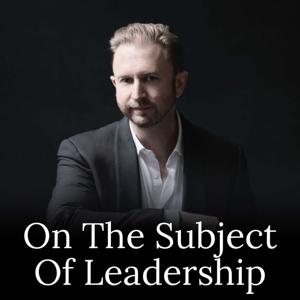


Charisma is the most overrated quality in an executive, says Malcolm Duncan, and it is usually confused with leadership. After nearly four decades in executive search, and years spent assessing boards and leadership teams that are not hiring anyone, he explains why a search shows what an organisation would like to be, while an assessment shows what it is.
In this episode:
Takeaways
Chapters
Guest Links & References
About the Show
On the Subject of Leadership is a series of conversations about how organisations are actually led, managed, and governed—the kind usually held behind closed doors, here held out loud.
Each episode is an unhurried conversation with an executive, director, founder, or scholar who has carried real responsibility, about what they have seen: the decisions nobody takes, what becomes of frameworks when they meet real organisations, and the gap between what is said in the boardroom and what is said in the corridor afterwards. The conversations are curious rather than combative, and grounded in the research where the research has something to say.
A seat in the room for the conversations that shape organisations but are rarely heard. For people who are sceptical of easy answers.
Hosted by Dr Robert N. Winter.
Subscribe / Follow
Newsletter / Website: robert.winter.ink
LinkedIn: dr-robert-winter
X: @DrRobertWinter
Instagram: DrRobertWinter
Mastodon: social.winter.ink/@robert
YouTube: @OnTheSubjectOfLeadership
Credits
Recorded remotely via Riverside
Music: The Hidden Thread by Roberto Prado / Artlist
In 2007 the directors of Centro approved accounts that classified some $1.5 billion of short-term liabilities as non-current. They had a chief financial officer, a finance team, and PricewaterhouseCoopers as auditors, yet the Federal Court found that they had failed in their duty of care, because the reading was the one task the law would not let them hand to anyone else. A survey by OnBoard, a vendor of board software, now reports that 92 per cent of directors use AI for board work, and the obvious use—having a model digest the pack—hands that reading to a machine. In this essay, released in audio format, I argue that an AI summary is the newest proxy for a director’s judgement, and that the remedy is an order of operations rather than abstinence.
In this article:
A thought to sit with: ‘Using AI well means questioning it after the reading, not before it—much less in place of it.’
Further reading:
Management has a long habit of inventing instruments to turn intention into action, and an equally long habit of watching each one harden into paperwork. When it happens, we blame the organisation rather than the instrument. Tim Newbold, founder of OKR Quickstart, has spent the better part of a decade coaching organisations through Objectives and Key Results, and he has watched more of these rollouts succeed and fail than most people will see in a career.
His view is that the tool is rarely the problem. What fails is the organisation around it: leaders who use goals to tighten control, teams run so close to capacity that nothing can improve, and a culture in which nobody will put their name to a decision. From his first internship, writing specifications that never became working systems, to the clients he now turns away, Tim explains why busy organisations get less done, why people set low targets on purpose, and why the most useful thing a manager can give a team is permission to say no.
It is a practitioner's account, frank about its own failures, and it leaves open a question worth sitting with: if every failure belongs to the culture, what would it look like for the instrument itself to be wrong?
Takeaways
Chapters
Guest Links & References
About the Show
On the Subject of Leadership is a long-form interview series, with a written companion, on governance, organisational culture, and how decisions are actually made. Guests are challenged rather than affirmed, and the argument continues in writing after the recording stops. For people who are sceptical of easy answers.
Hosted by Dr Robert N. Winter.
Subscribe / Follow
Newsletter / Website: robert.winter.ink
LinkedIn: dr-robert-winter
X: @DrRobertWinter
Instagram: DrRobertWinter
Mastodon: social.winter.ink/@robert
YouTube: @OnTheSubjectOfLeadership
Credits
Recorded remotely via Riverside
Music: The Hidden Thread by Roberto Prado / Artlist
Australia’s National Microcredentials Framework obliges a provider to disclose fifteen things about a short course, down to the learner’s hours spent reading and on assessment, yet depth of learning—the mastery a learner actually reaches—is merely recommended, and may be estimated. The hours are compulsory; the mastery is optional. In this essay, released in audio format as the first in The Gate and the Room series, I argue that a certificate records the completion of a process rather than the formation of judgement, and that organisations which appoint on it have mistaken a legible signal for the thing it was meant to signal.
In this article:
A thought to sit with: ‘You do not have judgement. You do it, repeatedly, usually in front of someone who will tell you when you have got it wrong.’
Further reading:
No organisation matches the brochure. The question is what you do about the gap — and whether you have any right to.
International development runs on a settled principle: reform must be owned by the government that enacts it, or it will not survive the funding. The outsider advises. The sovereign decides. Adaptation is the professional virtue and imposition the professional sin.
The difficulty is that the sector is also, unavoidably, in the business of changing things. My guest this week has spent a career on both sides of that contradiction — and, in the course of an hour, states a principle of deference and then describes several occasions on which she overruled it.
Pamela Wyatt began in Australian retail banking and established ANZ's offshore operations hub in Manila. She spent close to a decade at the Asian Development Bank, six years of it negotiating governance reform with Pacific governments, with private sector work across Central Asia. She led the Bank's Gender Task Force, examining her own employer's record and reporting to its vice-presidents. She is now Head of Business Transformation for Asia-Pacific at DT Global — the delivery side of the industry she once financed.
Takeaways
Chapters
Guest Links & References
About the Show
Long-form conversations for people who carry responsibility. No slogans — clear thinking on authority, judgement, coordination, and accountability under real constraints.
Hosted by Dr Robert N. Winter.
Subscribe / Follow
Newsletter / Website: robert.winter.ink
LinkedIn: dr-robert-winter
X: @DrRobertWinter
Instagram: DrRobertWinter
Mastodon: social.winter.ink/@robert
YouTube: @OnTheSubjectOfLeadership
Credits
Recorded remotely via Riverside
Music: The Hidden Thread by Roberto Prado / Artlist
Mintzberg’s diary work found half of observed management episodes concluding inside nine minutes, and later research shows that people compensate for interruption by working faster, at a price in stress, frustration, and effort that throughput never records. A manager or board watching only velocity therefore sees no problem at all. In this essay, released in audio format, I argue that the person who takes on eight things and ruins all eight is following the organisation’s specification rather than indulging a personality, because busyness is legible whereas judgement is not.
In this article:
A thought to sit with: ‘A decision made in the eleven minutes between two other decisions is not a decision in this sense at all. It is a reflex, dressed in the clothing of authority, and the organisation will not discover the difference for eighteen months.’
Further reading:
The Commonwealth supplies less than half the revenue of Australia's universities and sets very nearly all of their terms.
We have spent a decade arguing about fees, caps, international student numbers and research funding, and each of those arguments quietly settles the larger question — what universities are actually for — without ever putting it to a vote. Price a humanities degree high enough and you have made a claim about the worth of the humanities. You have simply made it with a spreadsheet rather than an argument.
Professor Alistair Noble has worked inside almost every model this country uses to answer that question: the large public research university, the private specialist college, the regional university, and now a small independent institute. In this conversation he declines the framing I brought him — that universities are becoming trade schools — and offers a better one. Then he shuts the door on his own argument for lighter regulation, and does it honestly.
Takeaways
Chapters
Guest Links & References
About the Show
On the Subject of Leadership is a long-form interview series, with a written companion, on governance, organisational culture, and how decisions are actually made. Guests are challenged rather than affirmed, and the argument continues in writing after the recording stops. For people who are sceptical of easy answers.
Hosted by Dr Robert N. Winter.
Subscribe / Follow
Newsletter / Website: robert.winter.ink
LinkedIn: dr-robert-winter
X: @DrRobertWinter
Instagram: DrRobertWinter
Mastodon: social.winter.ink/@robert
YouTube: @OnTheSubjectOfLeadership
Credits
Recorded remotely via Riverside
Music: The Hidden Thread by Roberto Prado / Artlist
Every incentive system that fails is easy to criticise. The difficult ones are those that work.
In the late 1990s David Harvie sold for a firm that ran its Sydney floor as a concentric ring: new arrivals on the outside, moving inward as they succeeded, progressing through a hierarchy of birds toward the falcon. Individual numbers went up twice a day, visible to everyone. He reached the top tier and was flown to New York. He also, some time later, found himself unable to get out of bed. Asked to render a verdict on the system, he does not hedge: it worked.
This conversation follows what a person does with that experience. Harvie leads direct sales at Totality, formerly Saxo Australia, and has built a health venture for time-poor fathers alongside it. He and I studied leadership philosophy together as postgraduates, which makes him one of the few people I can ask which of those philosophies survived contact with a target — and which quietly died.
Takeaways
Chapters
[00:00] Cold Open — Nothing to Do With Time
[01:17] Introduction — The Least Examined Discipline
[03:32] A Method Actor, and a Country Town
[14:01] Where the Texts Met a Feeling Already Held
[21:26] Revising the Model of Self
[26:47] The Thundering Herd — A System That Worked
[31:33] Becoming Coachable, Becoming a Coach
[37:14] Three Pillars an Under-Five Team Wrote
[42:24] The Drive Home That Became DADBODZ
[48:30] The Queue in Which the Father Comes Last
[53:34] Building Without Chevrons
[59:10] Self-Command as the First Plank
[1:08:24] Lightning Round — Alignment, Arrogance, Judgement
Guest Links & References
About the Show
On the Subject of Leadership is a long-form interview series, with a written companion, on governance, organisational culture, and how decisions are actually made. Guests are challenged rather than affirmed, and the argument continues in writing after the recording stops. For people who are sceptical of easy answers.
Hosted by Dr Robert N. Winter.
Subscribe / Follow
Newsletter / Website: robert.winter.ink
LinkedIn: dr-robert-winter
X: @DrRobertWinter
Instagram: DrRobertWinter
Mastodon: social.winter.ink/@robert
YouTube: @OnTheSubjectOfLeadership
Credits
Recorded remotely via Riverside
Music: The Hidden Thread by Roberto Prado / Artlist
For the better part of a decade the surveys have promised imminent transformation, and for the same decade the earnings impact has stayed flat. Jay Fontanini's argument is that this is not evidence of a fraud but the signature of a general-purpose technology mid-adoption — the dynamo was ready long before the factory was rebuilt around it. The complementary investment that matters most, he contends, is not better software. It is human capital, and at the centre of that, judgement.
Which raises the harder question the conversation works: if the models are now a near-substitute for the quick reasoning and rapid recall that peak early in a career, then the entire human premium falls on the accumulated, seasoned kind of intelligence that cannot be hurried into existence. Jay teaches executives through the structure of the medieval trivium on the principle that no stage can be skipped — and reports that they do not give up at the difficult foundations, but at the middle, where thinking with the tool actually begins.
Takeaways
Chapters
Guest Links & References
About the Show
On the Subject of Leadership is a long-form interview series, with a written companion, on governance, organisational culture, and how decisions are actually made. Guests are challenged rather than affirmed, and the argument continues in writing after the recording stops. For people who are sceptical of easy answers.
Hosted by Dr Robert N. Winter.
Subscribe / Follow
Newsletter / Website: robert.winter.ink
LinkedIn: dr-robert-winter
X: @DrRobertWinter
Instagram: DrRobertWinter
Mastodon: social.winter.ink/@robert
YouTube: @OnTheSubjectOfLeadership
Credits
Recorded remotely via Riverside
Music: The Hidden Thread by Roberto Prado / Artlist
The second essay in the Prior Obligations series, released as articles in audio format, follows a number from birth to dashboard. When a felt condition becomes a score out of one hundred, it acquires an owner, a target, and a budget — everything except a cure — and the question of which way its correlations actually run turns out to matter more than the score itself.
In This Article:
A Thought With Which To Sit: "A number is easier to own than a failure, which is why failures are so often converted into numbers."
From the publisher's feed