
Sign up to save your podcasts
Or

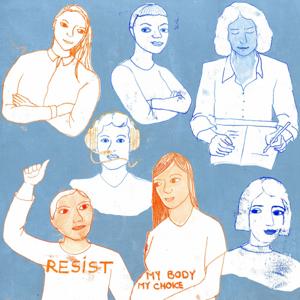


In the fourth episode of the series »Feminism and War,« Berlin migrants share their commitment to achieving a gender-just peace. Their efforts extend beyond Germany, influencing communities as far away as Colombia, Ukraine, Russia, and Japan. They serve as interviewers in the Colombian peace process, showcase stories from Ukrainian and Russian exile communities and bring the memory of sexualised violence against women worldwide into public spaces in Germany. Through their dedication, they not only help to reevaluate the impacts of past wars but also work towards preventing future conflicts. However, this form of political engagement is not universally accepted.
A podcast with:
Links:
Museum of the so-called »comfort women«
Koreaverband
Truth Commission of the Colombian Peace Process
Website of the Xochicuicatl association
»Faces of Peace« exhibition
Transnational feminist solidarities are currently under pressure. The growing anti-gender movement is restricting feminist work and queer rights. Additionally, differing – and in some cases irreconcilable – views on the war in Gaza are creating further divisions. In both cases, the pressure also has a financial dimension: feminist actors who publicly express criticism risk losing funding.
A podcast with:
Links:
Background on the debate surrounding the terms »antisemitism«, »apartheid«, »genocide« and »Zionism«
International reactions to the case of the cancelled funding for the Egyptian NGO CEWLA
Engagement of the »Urgent Action Fund for Feminist Activism« in Palestine and Lebanon
Dossier and articles on feminist foreign policy
PISSY podcast on solidarity
Reproductive violence is a targeted strategy in warfare that impacts women and individuals of childbearing age. This includes forced sterilization, forced pregnancy, rape, and the destruction of medical infrastructure. Despite international agreements such as the UN Convention on the Elimination of All Forms of Discrimination against Women (CEDAW) and the Rome Statute, the prosecution of such crimes remains infrequent.
A podcast with:
Links:
Kvinna till Kvinna
CARE International
Médecins Sans Frontières
Policy brief from Kvinna till Kvinna on reproductive violence in Gaza
UN special rapporteur Reem Alsalam on reproductive violence in palestine
»The Womb as a Weapon in Palestine« from the Friedrich-Ebert-Stiftung
taz article on medical care for pregnant women in Gaza
Sudan, Syria, former Yugoslavia and currently Israel and Gaza: sexualised violence in conflicts is prohibited by international law and yet it occurs again and again. It affects millions of women and girls. The causes are deeply rooted in patriarchal social systems. The long-term consequences of sexualised violence are serious for the survivors concerned. In most cases, the perpetrators do not have to answer to court, and their actions remain without consequence. This podcast episode shows how sexualised violence can destroy entire societies and why a feminist view of war is essential for sustainable peace.
A podcast with:
Links:
Article on sexualised violence against women and girls in Sudan
Info page from medica mondiale on sexualised violence in conflicts
Study by medica mondiale on the long-term effects of sexualised violence in Kosovo
Report of the UN Special Representative Pramila Patten on sexualised violence in Israel and during the subsequent conflict on 7 October
Controversial New York Times article on sexualised violence by Hamas on 7 October
Article by Palestinian feminist activist Samah Salaime on 7 October
Join us for the grand finale of our 3-part series, where we shift our focus to feminist leadership on an individual level. This episode explores the personal challenges faced by those in leadership positions who strive to lead differently. Our journey begins with Helene, co-founder of Fair Share of Women Leaders, and continues with Vandita Morarka, CEO of One Future Collective. Vandita reveals the internal struggles and guilt that can accompany feminist leadership but offers a refreshing perspective on how to navigate them. Their stories showcase the incredible courage and compassion it takes to be a feminist leader, illuminating the path towards a more equitable future for all.
A podcast with:
Links:
Video with Vandita Morarka talking about Feminist Leadership
In episode two it’s all about feminist leadership in practice. We'll dive deep into organizations and institutions that embrace feminist leadership. And we find out that it's not a one-size-fits-all model but rather a dynamic, often context-specific approach. Our discussions feature insights from three remarkable women with extensive experience in feminist leadership on an institutional level: Lysa John, Secretary-General of CIVICUS; Leila Billing, a leading advocate for 'We Are Feminist Leaders'; and Serap Altinisik, CEO of Oxfam Germany. They share their wisdom, experiences, and thoughts on feminist leadership in practice, showcasing its transformative power to shape a more equitable and just world.
A podcast with:
Links:
In the first episode of our 3-part series, we embark on an exploration of feminist leadership. What exactly is it, and what is it not? Join us as we uncover the beliefs and principles that underpin this transformative leadership approach. For this, we’ll hear from two remarkable women who've dedicated their lives to feminist causes. Srilatha Batliwala, a lifelong feminist activist and scholar from South India, shares her insights, emphasizing that feminist leadership goes beyond mere gender identity. Elena Ghizzo, co-founder of the Feminist Hiking Collective, reveals how feminist leadership challenges existing power structures and offers a fresh perspective on leadership.
A podcast with:
Links:
Downloads and more info about Feminist Leadership
Article about Collective Feminist Leadership
Videos and Materials about Feminist Leadership
A Pathway Towards Feminist Global Collaboration
What is the goal of representation and how can it be most meaningful within a process of Feminist Global Collaboration? In this final episode of the series, our host, Samie Blasingame, and three incredible guests discuss what representation is and what it is not, what it looks like to achieve representation in different spaces, and the dominant structures that start to shift when representation is done well.
Tune in to hear thoughts and examples as to why representation can’t just be about how things look; it must move beyond that by allowing new perspectives to help shift the collective worldview and bring positive changes for the whole of society.
A podcast with:
This series was initiated by an emerging network of practitioners aiming to re-think
Download the transcript here.
Shownotes:
2. Care and GDP: Report by Roula Seghaier, IDWF Strategic Program Coordinator “Following the Money: The Kafala system and chain of domestic worker’s migration”:
https://idwfed.org/wp-content/uploads/2022/07/following_the_money_en.pdf
3. Cathleen Clerkin “Why defining BIPOC-led is harder than you think”:
https://blog.candid.org/post/the-importance-of-talking-about-and-collec…
4. FAIR SHARE Monitor by FAIR SHARE of Women Leaders
5. “Gender composition and progress on implementation” Report by the UNFCCC secretariat 2022: https://unfccc.int/sites/default/files/resource/cp2022_3_adv.pdf
6. Maria Tanyag “We need more female leaders in the fight against climate change”: https://www.theguardian.com/commentisfree/2021/nov/11/female-leaders-cl…
7. Olúfémi O. Táíwò “Elite Capture: How the Powerful Took Over Identity Politics (And Everything Else)”
8. Dr. Sherily MacGregor “A stranger silence still: the need for feminist social research on climate change”: https://onlinelibrary.wiley.com/doi/abs/10.1111/j.1467-954X.2010.01889.x
9. Taqadum Al-Khatib “Greenwashing Tyranny at COP 27”:
https://www.boell.de/en/2022/11/14/greenwashing-tyranny-at-cop27
Funds are constantly flowing but are they reaching the people and initiatives they should be? This episode we explore questions such as: how does funding reflect our priorities as a society; how can we build more trust between donor and grantees; and where do we need to be looking to ensure we are supporting feminist movements for social change? Tune in to hear some important critiques and valuable best practices to move the funding landscape toward more Feminist Global Collaboration.
A podcast with:
This series was initiated by an emerging network of practitioners aiming to re-think development policy from a feminist perspective; FAIR SHARE of Women Leaders, a feminist non-profit initiative to advance gender equity in the in civil society sector; and the Heinrich Böll Foundation.
Audio production by Grettch.
Download the transcript here.
Shownotes:
2. Astraea Lesbian Foundation for Justice: Feminist Funding Principles.
https://astraeafoundation.org/microsites/feminist-funding-principles/
3. Dolker T. et al.: Where is the money for Feminist Organizing? AWID
https://www.awid.org/sites/default/files/2022-01/AWID_Research_WITM_Bri…
4. Equality Fund
https://equalityfund.ca/
5. FRIDA: No Straight Lines, Transformations with Young Feminist Organiser, A resource for INGOS and Funders.
http://nostraightlines.youngfeministfund.org/section.html#background
6. CIVICUS: Grassroots Solidarity Revolution
https://civicus.org/grassrootsrevolution/
7. Investigate Europe: Europe’s love affair with fossil fuels
https://www.investigate-europe.eu/en/2020/europes-love-affair-with-foss…
8. Leading from the South
https://www.leadingfromthesouth.org/about-us
9. Lever, E., Miller, K. and Staszewska, K.: Moving More Money to the Drivers of Change: How Bilateral and Multilateral Funders Can Resource Feminist Movements. AWID and Mama Cash with support from the Count Me In! Consortium
https://www.mamacash.org/media/publications/movingmoremoney_mama_cash_a…
10. Staszewska, K. et al.: Only 1% of gender equality funding is going to women’s organisations – why? AWID
https://www.awid.org/news-and-analysis/only-1-gender-equality-funding-g…
11. Transnational Institute: Climate Collateral: How military spending accelerates climate breakdown
https://www.tni.org/en/publication/climate-collateral
W7 stands for Women 7 and is a global alliance of NGOs working for more gender justice at the G7. The Women 7 works every year in parallel with the G7. And because Germany holds the G7’s presidency for 2022, the Women 7 was organized this year by the National Council of German Women’s Organizations.
For one year, 64 activists* from 24 countries considered the question: what must policymakers do to ensure greater gender justice worldwide? They then condensed their demands onto two pages before handing it over to this year's G7 President, German Chancellor Olaf Scholz, who accepted it on behalf of the heads of all the G7 countries. The question then is, did the G7 listen? And, if so, what did the W7 achieve with its work?
A podcast with:
Shownotes:
W7 communiqué and implementation plan: https://women7.org/wp-content/uploads/2022/09/W7-Communique%CC%81.pdf
W7 Summit: video stream of the two-day conference with the handover of the communiqué to this G7 President, German Chancellor Olaf Scholz: https://women7.org/w7summit2022/
From the publisher's feed