
Sign up to save your podcasts
Or



In this episode of Parenting Advice You Can't Google, psychologist and mum of three neurodivergent children Emma Richards shares the story of an ordinary afternoon with far too many tabs open, and a moment she could see coming and still couldn't head off.
Using this everyday moment, Emma explores the gap between knowing the strategies and having the capacity to use them. Parenting advice can tell us what to do. What it can't account for is the full day already behind us, the mental load we're carrying, and the fact that our own capacity fluctuates just as much as our children's does, sometimes on the very same afternoon.
If you've ever known exactly what might have helped and still not been able to get there, this episode offers a different way of thinking about those moments. Rather than asking what strategy you're missing, it invites you to consider what life is asking of you right now, and what might actually be possible today.
In this episode of Parenting Advice You Can't Google, psychologist and mum of three neurodivergent children Emma Richards shares the story of an ordinary afternoon tea that turned out to have more to do with emotional regulation than any regulation strategy did.
Using this everyday moment, Emma explores why the most useful question often isn't "what's the biggest problem here", but "what's sitting underneath this, and where do we start". Generic parenting advice can offer plenty of strategies for the thing everyone is focused on. What it can't do is see what life feels like in your household, or tell you whether that thing is the best place to begin.
If you've ever worked hard at the strategy that seemed like the obvious one and still watched the afternoons unravel, this episode offers a different way of thinking about starting points. Rather than reaching straight for the biggest goal, it invites you to look for the smaller thing that might make the harder thing a little more possible.
In this episode of Parenting Advice You Can't Google, psychologist and mum of three neurodivergent children Emma Richards explores one of the most common parenting recommendations: "Try a routine chart."
After using routine charts in her own family for more than eight years, Emma reflects on what she's learnt about why they sometimes work, why they sometimes don't, and why downloading the chart is often the easiest part. The real work lies in shaping it to fit your child's needs, your family's routines and the everyday moments you're trying to support.
If you've ever tried a strategy that worked for a week before quietly falling apart, this episode offers a different perspective. Rather than asking whether the strategy is good, it invites you to consider what it might take for that strategy to become a genuine fit for your family over time.
In this episode of Parenting Advice You Can't Google, psychologist and mum of three neurodivergent children Emma Richards explores why the same strategy can have completely different effects for different people.
Using the simple example of a bedtime audiobook that helps one brain drift off to sleep while keeping another wide awake, Emma unpacks why generic parenting advice can only ever be a starting point. The real challenge isn't finding the "right" strategy, but finding the right match for your child's unique strengths, sensitivities and everyday life.
If you've ever wondered why a strategy that worked beautifully for another family didn't work for yours, this episode offers a different way of thinking about support, one that begins with understanding your child, your household and the specific moments where things become difficult.
In this first episode of Parenting Advice You Can't Google, psychologist and mum of three neurodivergent children Emma Richards shares the story of an ordinary bath plug that became part of solving a surprisingly tricky transition.
Using this everyday moment, Emma explores why generic parenting advice often falls short for neurodivergent families. Real life is shaped by the specific details of each child, each household and each moment, and the strategies that are most helpful are often the ones that grow from understanding those details rather than applying one-size-fits-all advice.
If you've ever found yourself thinking, "I know the strategies, but they just don't seem to work for my child," this episode offers a different way of thinking about support, curiosity and the small changes that can sometimes make a meaningful difference in everyday family life.
From the publisher's feed
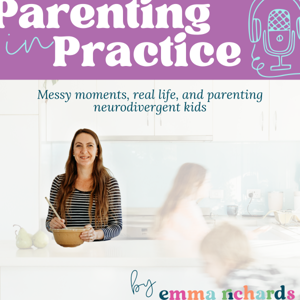
Parenting in Practice is a podcast for parents of neurodivergent kids about messy moments, real life, and the everyday ways growth takes shape.
Hosted by Emma Richards,…