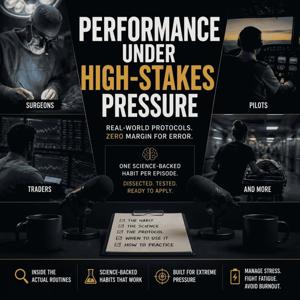
Performance Under High-Stakes Pressure

Performance Under High-Stakes Pressure

Download on the App Store

All Performance Under High-Stakes Pressure episodes

  • Bomb Technicians and Attention Control During Explosive Ordnance Disposal
    A bomb technician's attention cannot waver for 4–6 hours while performing explosive ordnance disposal—a single lapse in focus, a moment of fatigue-induced inattention, or a distraction from environmental noise could trigger a detonation and death. Unlike surgeons who can hand off a case or traders who can step back from markets, bomb technicians work alone with no safety net. This final episode examines the attention control and fatigue management protocols that elite bomb technicians use to maintain laser focus under conditions that would cause most people to collapse into tunnel vision or cognitive shutdown. The hosts explore the neuroscience of sustained attention, the specific way fatigue degrades fine motor control and decision-making, and the training protocols that build the neurological resilience to maintain focus for hours without degradation. You'll learn about the exact pre-mission routines bomb technicians use, the specific environmental controls they employ (managing noise, temperature, visual clutter), the physiological monitoring systems they use to detect early signs of fatigue, and the precise moment-to-moment attention techniques they employ during disposal. The episode includes the recovery protocols technicians use between missions and why this profession has some of the most rigorous performance standards in any field. This episode synthesizes lessons from previous episodes—breathing, stress inoculation, cognitive offloading, emotion regulation—and shows how they integrate into a comprehensive performance system for the highest-stakes profession covered in this series.
    11 min
  • Emergency Room Physicians and Cognitive Offloading During Peak Census
    When an emergency room is slammed—multiple critical patients, incomplete information, interruptions every 30 seconds—a physician's working memory overloads and decision quality collapses. Yet the best ER physicians somehow maintain clarity and avoid the catastrophic errors that happen when cognitive load exceeds capacity. This episode reveals the cognitive offloading strategies that emergency physicians use to protect their decision-making from the chaos of peak census, including the specific documentation practices, the external memory systems they build into their workflow, and the communication protocols that prevent critical information from being lost. The hosts explore the neuroscience of working memory limits and cognitive load, then present the actual protocols: the precise way top ER physicians structure their patient tracking (not just electronic records, but physical and mental systems), the communication patterns they use to hand off information without losing critical details, and the environmental design choices that reduce decision-making burden. You'll learn why physicians who use these offloading strategies make fewer diagnostic errors and miss fewer critical findings, even during the most chaotic shifts. The episode includes the one documentation habit that prevents the most common ER errors and the team communication pattern that keeps critical information from falling through the cracks during handoffs.
    10 min
  • Hostage Negotiators and Emotion Regulation During Extended Standoffs
    A hostage negotiator can spend 8, 12, or even 24 hours on the phone with someone in acute psychological crisis, trying to de-escalate a situation that could end in tragedy. The emotional labor is immense—the negotiator must stay calm, empathetic, and strategic while managing their own stress response and the weight of knowing that a single wrong word could be catastrophic. This episode examines the emotion regulation protocols that professional negotiators use to maintain psychological stability and decision-making clarity across extended standoffs, including the specific breathing and grounding techniques they use between calls, the cognitive reframing strategies that prevent empathetic overwhelm, and the team support structures that keep negotiators from burning out. The hosts explore the neuroscience of empathy fatigue and how it degrades negotiation effectiveness, then present the actual protocols negotiators use: the precise moment-to-moment techniques they employ during a call to manage their own emotional response, the handoff protocols between negotiators on long standoffs, and the post-incident psychological recovery routines. You'll learn why negotiators who use these protocols have higher success rates and lower PTSD symptoms compared to those who rely on willpower alone. The episode includes the specific language patterns negotiators use to create psychological safety (not manipulation tactics, but genuine de-escalation), and the one routine that prevents secondary trauma in this profession.
    11 min
  • Anesthesiologists and Crisis Resource Management During Equipment Failure
    An anesthesiologist's job is to keep a patient unconscious and alive while a surgeon operates—and the moment something fails (ventilator malfunction, unexpected blood loss, allergic reaction), the anesthesiologist must diagnose and correct it in minutes while maintaining composure and coordinating a team. Unlike surgeons who can sometimes call for help, anesthesiologists often work alone at the head of the table. This episode reveals the crisis resource management (CRM) protocols that anesthesiologists use to manage equipment failures and unexpected complications, including the specific communication patterns, the mental checklists they follow, and the pre-case preparation routines that keep them from panicking when something goes wrong. The hosts explore why standard emergency protocols often fail under real pressure (information overload, tunnel vision, communication breakdown), then present the exact CRM framework anesthesiologists train on: the specific call-outs they use, the way they delegate tasks, and how they maintain situational awareness during chaos. You'll learn about the role of simulation training in building automaticity for crisis responses, the psychology of speaking up in a hierarchical operating room environment, and why anesthesiologists who train on CRM protocols have measurably better outcomes during actual crises. The episode includes the pre-case mental checklist and the one communication pattern that prevents most OR disasters.

    11 min
  • Combat Medics and Triage Decision Making Under Extreme Time Pressure
    A combat medic has minutes to decide who lives, who dies, and who waits—with incomplete information and no time for deliberation. Unlike civilian triage, battlefield triage happens under fire, with sensory overload, adrenaline, and the weight of impossible choices. This episode focuses on the decision-making protocols that military medics use to make accurate triage calls under these conditions, including the specific cognitive frameworks they memorize, the way they structure information gathering to avoid analysis paralysis, and the pre-deployment mental preparation that lets them act decisively without second-guessing. The hosts explore the neuroscience of decision-making under extreme time pressure and incomplete information, then present the actual triage protocols medics use (not just the clinical criteria, but the mental sequencing that prevents freeze responses). You'll learn why experienced medics make better decisions faster than novices—it's not intuition, it's pattern recognition built on specific training. The episode includes the pre-deployment visualization and decision-tree rehearsal that special operations medics use, the exact moment-to-moment cognitive steps they follow during mass casualty scenarios, and how they manage the psychological aftermath of triage decisions they know were imperfect. This is about how the brain makes life-or-death choices when perfection is impossible.
    14 min
  • Options Traders and the Micro Break Protocol Under Market Volatility
    A trader's decision-making ability collapses under sustained attention and market noise—yet the pressure to stay glued to screens during volatile sessions is intense and culturally rewarded. The top performers at major trading firms use a counterintuitive protocol: structured micro breaks (60–90 seconds, precisely timed) that actually improve decision quality and reduce catastrophic losses compared to continuous monitoring. This episode examines the neuroscience of attention restoration, decision fatigue, and why traders who take these breaks outperform those who don't, then presents the exact protocol: when breaks are taken (tied to specific market conditions, not arbitrary time), what happens during them (not scrolling news or email), and how traders measure whether a break improved their next trade. The hosts explore the cognitive science behind why sustained attention creates a tunnel vision that blinds traders to risk, and how even 90 seconds of genuine disengagement resets the brain's threat-detection system. You'll learn about the specific market conditions that trigger the highest decision fatigue (high volatility + high volume + unclear trend direction), the recovery metrics traders track, and why this protocol is still controversial among old-school traders who see breaks as weakness. The episode closes with the exact 90-second routine a trader can implement tomorrow.
    10 min
  • Trauma Surgeons and Controlled Stress Inoculation Before Shift
    A trauma surgeon never knows when a multi-casualty incident will arrive, yet must perform at peak capacity the moment it does. Unlike cardiac surgeons with scheduled cases, trauma teams face unpredictable chaos—and the best performers don't wait for the crisis to practice their stress response. This episode reveals the pre-shift stress inoculation protocols that Level 1 trauma centers use, including controlled exposure to high-intensity scenarios, specific visualization techniques, and the physiological priming routines that keep surgeons from being ambushed by adrenaline when the emergency actually hits. The hosts explain why traditional 'mental rehearsal' is vague and often ineffective, then present the exact protocol: the specific scenarios trauma surgeons visualize, the precise moment they trigger this visualization (typically 30 minutes before shift), and how they calibrate the intensity to match real-world chaos without overshooting into anxiety. You'll learn about stress inoculation theory, the role of predictive coding in the brain, and why surgeons who practice this protocol show measurably lower cortisol spikes during actual trauma activations. The episode includes the one-page pre-shift routine that trauma teams use before their highest-risk shifts.
    12 min
  • Commercial Pilots Managing Fatigue Across Time Zones
    Fatigue is the silent killer in commercial aviation—a pilot's reaction time degrades measurably after 16 hours awake, yet schedules routinely push crews to that edge. This episode focuses on the strategic napping and light-exposure protocols that airline captains and first officers use to stay sharp across multiple time zones without relying on stimulants or sleeping pills. The hosts break down the science of sleep inertia (why waking up groggy is actually dangerous), circadian phase shifting, and the precise timing of 26-minute naps that reset alertness without triggering deep sleep. You'll hear about the specific light wavelengths pilots use to reset their circadian rhythm, the meal timing strategies that support wakefulness, and the recovery protocols used between 12-hour transatlantic flights. The episode includes the actual checklist pilots follow before a critical flight segment and why the FAA quietly endorses these methods despite not formally advertising them. This is not about 'getting more sleep'—it's about strategic sleep architecture under real operational constraints.
    11 min
  • Cardiac Surgeons and the Pre-Incision Breathing Sequence
    When a cardiac surgeon's hand hovers over a patient's open chest, heart rate elevation and tremor can mean the difference between a clean repair and a catastrophic complication. This episode examines the precise breathing protocol that top cardiac surgeons employ in the 90 seconds before making their first incision—a technique grounded in vagal tone management and parasympathetic activation. The hosts explore why standard 'deep breathing' advice fails under real surgical pressure, then walk through the exact cadence, breath holds, and count sequences that surgeons actually use in operating rooms at major medical centers. You'll learn the neurophysiology behind why this works (vagus nerve stimulation, heart rate variability, and cerebral blood flow stability), then get the step-by-step protocol you can practice this week. The episode closes by testing whether this same sequence translates to other high-stakes moments in your own life.
    10 min