
Sign up to save your podcasts
Or



Often, when philosophical questions are asked about pregnancy, they concern ethical problems about abortion, surrogacy or assisted conception. But the answers to these questions might depend in part on answers to metaphysical questions. One of these metaphysical questions concerns the relationship between the mother and her fetus. Is the mother a biological container for her developing baby, or is the fetus a part of the mother? It’s a question that may have important implications, but it’s also one of the big existential questions of life, a question about what it is to be human.
Today’s consultation is with philosopher Elselijn Kingma, Associate Professor in Philosophy at the University of Southampton.
In recent years, physicians and health scientists have become increasingly concerned about overdiagnosis, the problem of diagnosing too many people as having a disease, be it breast or thyroid cancer, diabetes or pulmonary embolism. When considering who or what is at fault, the list of suspects often includes overly expansive screening programs, increasingly sensitive diagnostic tests, and unnecessary test-ordering. But should the list of the accused also include our definition of disease? And can philosophers studying disease concepts help to clear up our definition of disease – and even the problem of overdiagnosis itself?
Today’s consultation is with philosopher Mary Walker, Research Fellow in Philosophy at Monash University.
I had a cold last winter, and so did countless other people. We had sore throats and runny noses and maybe even a cough. At first glance, it seems hard to deny that the common cold is real. But that’s exactly what a disease antirealist would deny, and there are some philosophical arguments to back them up. Not to be outdone, the disease realist has some philosophical arguments at their disposal too. But what does it mean ask whether diseases are real? And are diseases real or not?
Today’s consultation is with philosopher Jeremy Simon, Associate Professor at the Columbia University Medical Center.
This episode is published jointly with the Canadian Medical Association Journal. Visit the Journal website to read an accompanying article by Dr. Simon, “Conceptualizing diseases” (2019, 191: E507-E508).
Vaccine hesitancy is a cautious or critical stance towards vaccines. By some estimates, it is on the rise among the public. Medicine and public health have responded to this state of affairs partly by communicating the evidence on vaccines to the public. But some believe that this approach ignores important aspects of the nature of medical evidence, the values of the public and public health, and the conditions needed to foster trust in our healthcare institutions. These are the kinds of topics with which philosophers interested in the social dimensions of medicine and medical science grapple.
Today’s consultation is with philosopher Maya Goldenberg, Associate Professor of Philosophy at the University of Guelph.
This episode is published jointly with the Canadian Medical Association Journal. Visit the Journal website to read an accompanying article by Dr. Goldenberg, “Vaccines, values and science” (2019, 191: E397-E398).
Evidence-based medicine. Narrative medicine. Precision medicine. Are these the names of new schools of medicine? Or of new models for medical research or practice? Or are they simply a clever (and in some cases, lucrative) rebranding of older ideas? What do they have to offer medicine? What’s all the fuss about? In part, these recent and influential movements in medicine concern medical knowledge and medical evidence, so what might philosophers studying medical knowledge and evidence have to say about these three ‘medicines’?
Today’s consultation is with philosopher Miriam Solomon, Professor of Philosophy at Temple University.
This episode is published jointly with the Canadian Medical Association Journal. Visit the Journal website to read an accompanying article by Prof. Solomon, “On ways of knowing in medicine” (2016, 188 (4): 289-290).
What is medicine? That question certainly has the ring of a paradigmatic philosophical problem. Yet surprisingly few contemporary philosophers have devoted sustained attention to it. Nonetheless, potentially underlying the question ‘what is medicine?’ are problems concerning the goals of medicine, about medical expertise, and about what counts as health and what counts as disease, problems that determine the very scope of medicine and medical practice. So perhaps it’s time to get paradigmatically philosophical about medicine.
Today’s consultation is with philosopher Alex Broadbent, Professor of Philosophy at the University of Johannesburg.
This episode is published jointly with the Canadian Medical Association Journal. Visit the Journal website to read an accompanying article by Prof. Broadbent, “The inquiry model of medicine” (2019, 191: E105-E106).
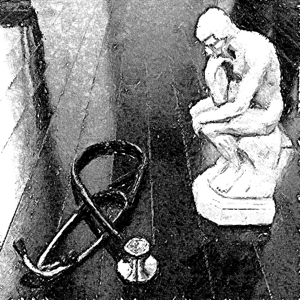
The Best Physician is also a Philosopher. This is the title of a book by Galen, the famous physician of Antiquity. Was Galen right? Or is it that for many problems in healthcare, philosophy is the best medicine? One thing is for certain: medicine is a new frontier for philosophy, and philosophy for medicine.
In this episode, I’ve enlisted Dorian Deshauer, psychiatrist at the University of Toronto and Associate Editor of the Canadian Medical Association Journal, to help me speak more about the philosophy of medicine.
From the publisher's feed