
Sign up to save your podcasts
Or

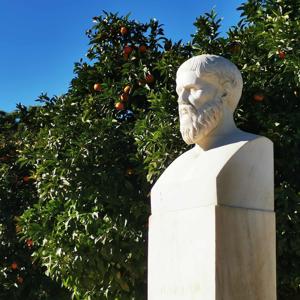


What can we learn about emotional resilience from Plutarch’s classic On Peace of Mind? Practical advice from Plutarch on putting values into action, cognitive distancing, cultivating gratitude, and more.
This is the full audio recording of Donald’s presentation from the Plato’s Academy Centre Philosophy and Resilience event on 20th May 2023. As there were some glitches with the streaming software, Donald re-recorded the whole presentation and the sound has been edited and quality improved. The recording also includes Lalya Lloyd’s reading of a passage from Plutarch, which contains a verse from Euripides’ lost tragedy, Bellerophon, read by Lalya in ancient Greek.
Plato's Academy Centre Newsletter is a reader-supported publication. To receive new posts and support my work, consider becoming a free or paid subscriber.
Watch the slides that accompany this presentation (optional). We are making the recording available to everyone in this way to make up for the difficulty some had watching the presentation during the event.
Thank you for reading Plato's Academy Centre Newsletter. This post is public so feel free to share it.
William O. Stephens is Professor Emeritus of Philosophy at Creighton University in Nebraska. His interests include ancient Greek and Roman philosophy, Stoicism as a way of life, Stoicism and popular culture, ethics, animals, and the environment. He is the author of several books on philosophy, including Marcus Aurelius: A Guide for the Perplexed, Stoic Ethics: Epictetus and Happiness as Freedom and, more recently, Epictetus’s 'Enchiridion': A New Translation and Guide to Stoic Ethics.
He will be speaking at the forthcoming Plato’s Academy Centre virtual conference commemorating Marcus Aurelius’ birthday, Marcus Aurelius Anniversary, alongside Donald Robertson and Dr. John Sellars on Wed April 26th. We’re also honored to have him speak on Philosophy and Resilience at our Sat May 29th virtual conference.
Highlights
* What do you think Marcus thought of Epictetus?
* Why do you believe Stoicism has gone through a resurgence in popularity in recent decades?
* Were the Stoic unemotional — the role of love.
* Why has Stoicism become more popular than Epicureanism?
* What do you think we can learn from the Stoics about developing psychological resilience?
* Stoicism on animal rights and the environment.
Links
* “Stoicism and Food Ethics.” Symposion 9, no. 1, Special Issue on Stoicism and Contemporary Thought, S. Aikin and W. O. Stephens, eds. (May 2022): 105–124.
* “Midwest Stoicism, Agrarianism, and Environmental Virtue Ethics.” In Environmental Ethics in the Midwest: Interdisciplinary Approaches, I. A. Smith and M. Ferkany, eds. East Lansing: Michigan State University Press, Dec. 2022: 1–42.
* William O. Stephens’ website
Books
* Epictetus’s 'Encheiridion': A New Translation and Guide to Stoic Ethics
* Stoic Ethics: Epictetus and Happiness as Freedom
* Marcus Aurelius: A Guide for the Perplexed
Matthew Sharpe is Associate Professor of philosophy at Deakin University, Australia. He has taught philosophy for over two decades, and is the author of multiple books, including most recently Stoicism, Bullying, and Beyond (in press, 2022), The Other Enlightenment (in press, 2022), and (with Michael Ure), Philosophy as a Way of Life: History, Dimensions, Directions (Bloomsbury, 2021). He is also the cotranslator of Pierre Hadot, Selected Writings: Philosophy as Practice (Bloomsbury, 2021), and someone whose work continues to centre upon ancient philosophy as a way or ways of life, and the ways it can still speak to people transformatively today.
Plato's Academy Centre Newsletter is a reader-supported publication. To receive new posts and support our work, consider becoming a free or paid subscriber.
Highlights
* “Consider the consequences if we make politics war. In war, it is wise to lie and deceive the enemy…The point of war after all is to win by destroying one’s foes, not to engage in a shared searched for something higher of larger.”
* “To understand why there is so much anger in our communities, we have to put ourselves in the shoes of those who feel defeated, excluded, cheated, or at risk…What reason do they have to admire their leaders?”
* “The Stoics believed in the natural equality of all peoples…Zeno defined the city (polis) in such a way as to include any citizen or non-citizen who resided in the place.”
* “Teach them better and make it appear better to them, but don't you be angry with them.” —Marcus Aurelius
This episode is part of the Plato’s Academy Centre course on the Socratic Method. In this lesson, we will be learning about the central techniques of the Socratic Method. We’ll begin by looking at how Socrates acquired definitions and evaluated them in order to refine important philosophical concepts. We’ll also learn about a simple “two-column method” found in the Socratic dialogues.
Plato's Academy Centre Newsletter is a reader-supported publication. To receive new posts and support my work, consider becoming a free or paid subscriber.
Socrates' trademark method was sometimes described as the "question and answer" approach. There's more to it than just asking lots of questions, though! It typically involved asking certain types of question, in a certain way, about certain topics.
Definitions
Socrates was known for insisting on definitions. We often waste our time arguing at cross-purposes when we disagree on the meaning of key terms being taken for granted in an argument. It can require surprisingly hard work to define familiar concepts – what, for instance, is time? Indeed, throughout history, a great deal of philosophy has involved the clarification of abstract concepts such as goodness, justice, and knowledge. Each of Plato's Socratic dialogues tends to focus on the task of defining a word, e.g., The Laches explores what the concept of "courage" means, The Symposium tries to define "love" and The Republic focuses in the definition of “justice”. If we can't pin down the meaning of these words adequately enough how can we hope to build more complex arguments employing them?
Socrates' method therefore typically begins by asking the other person to give a short verbal definition of the most important concept underlying their conversation. For example, in The Laches Socrates is asked, by two Athenian generals, about training young men in the art of hand-to-hand combat wearing heavy armour. Socrates uncovers that his friends are really asking, more fundamentally, about how to make their sons more courageous in battle. So he asks them to begin by defining courage.
The first definition he receives is that courage means standing your ground in the face of the enemy. To an Athenian officer that would have been the most obvious example of courage. A great deal of effort went into training soldiers to remain in their phalanx formation, and having the discipline to do so was one of the Athenian infantry's greatest strengths.
Broadening the Definition
Socrates often points out that the first definition offered is too narrow. He reminds his friends, for instance, that soldiers also show courage when engaged in an orderly retreat from the enemy. Moreover, unlike infantrymen, cavalry units charge at the enemy, rather than standing their ground. His friends agree that they'd overlooked such examples. Socrates therefore asks them how the definition of courage should be revised. This process of raising fresh examples and rewriting the definition can continue indefinitely. For instance, Socrates also reminds his friends that they're only thinking of courage in battle and have overlooked the fact that courage can take a different form during peacetime. "What is that common quality," asks Socrates, "which is the same in all these cases, and which is called courage?” Notice that Socrates is asking his partners in dialogue to provide a general definition, which is bound to end up being somewhat abstract. That tends to make it relatively easy for him to refute whatever they say as he merely has to come up with specific examples that conflict with it.
Narrowing the Definition
Eventually, the revised definition will be broad enough to encompass all of the relevant examples that can be identified. Socrates realized, though, that it would often now be too broad, meaning that it would also include some things that are not courage. His friends end up defining courage, basically, as a sort of persistence or fearlessness. Socrates now points out, though, that not all examples of fearlessness can be called courageous. Suppose someone walks fearlessly into a dangerous situation without even realizing they're taking a risk. If anything, that's a form of stupidity or recklessness, not courage. The definition needs to be reconsidered, this time it should be narrowed more, to exclude examples everyone agrees are not courageous.
The Socratic Method therefore often proceeds either by narrowing a definition, and introducing more fine-grained distinctions, or by broadening a definition, and grouping ideas together into greater generalizations.
Now I myself, Phaedrus, am a lover of these processes of division and bringing together, as aids to speech and thought; and if I think any other man is able to see things that can naturally be collected into one and divided into many, him I follow after and "walk in his footsteps as if he were a god." – Socrates in Plato's Phaedrus 266bc
The Two-Column Method
Xenophon, another of his students, actually said Socrates explained his method by using a two-column technique, similar to those found in modern cognitive therapy. One column might be headed "justice" and the other "injustice". We might list the key examples under injustice like "lying" or "stealing", etc. Socrates would then ask his students whether they could imagine a situation where these examples would belong under the other column — being classed not as unjust but as just. This is an easy way to practice clarifying our own definitions today. Lying might be a good example of injustice, for instance, but can you think of a situation where it might be considered appropriate and just to tell a lie? Socrates, for instance, gives the example of an elected general deceiving the enemy during a war. How might that lead us to revise our definition of justice?
The Socratic Method was carried out in a civil manner, as discussed in a previous lesson. The goal is to get closer to the truth, rather than to persuade anyone of anything by trying to make the false appear to be true. Some people found it infuriating to be questioned in this way, although Socrates' friends said it was also a liberating and enlightening experience.
If you're interested in discussing online you can join our Twitter chat about "How can we best define the virtue of justice?" using #SocraticMethod, and follow @PlatoAcademyCen.
Regards,
Donald Robertson
President of The Plato's Academy Centre
This is a talk given by Donald at the original location of Plato’s Academy, in what is now Plato’s Academy Park, near the centre of Athens. He discusses the history of the park from Socrates, through Plato, to the Stoics, and what the future may hold, describing the plans of the Plato’s Academy Centre to create a conference centre near the original location of Plato’s school.
Transcript
This is a talk that I delivered in the grounds of Plato’s Academy Park in Athens, in September 2022, as part of a four-day event organized by the Aurelius Foundation and YPO or Young Presidents Organization. The mayor of Athens also spoke that day about the importance of celebrating this historic location, near the city centre. Our nonprofit startup, The Plato’s Academy Centre was created in Greece in order to raise awareness of the area, and we hope, ultimately, to help create a new conference centre there so people can come from all over the world to do philosophy and benefit from ancient wisdom, at the original location of Plato’s Academy.
Philosophy at Plato’s Academy Park
Behold
That’s how the English poet, John Milton, envisages this place in his epic Paradise Regained.
According to legend this area, known as Akadimia, originally belonged to, and was therefore named after, the Greek hero Akademos. He reputedly saved Athens from being sacked by the Spartans, when Helen of Troy was still a child, according to legend. So the land became sacred to his memory. Over the years it was cultivated into a public area of pleasant olive groves, and gardens, with streams, running-tracks and popular walks shaded under the trees. Over time, a palaestra or wrestling school was built here, the ruined foundations of which can still be seen in the grounds of the park. It could perhaps be described as an ancient Athenian recreational ground, although in addition to sports facilities, there would have been shrines and libraries here. Young men exercised here in the nude, and older men walked among the groves, discussing politics and philosophy.
The Academy was destined, as you know, to become synonymous with philosophy, and more famous than Coca Cola because, ever since, down to the present day, every other academy in the world bears its name. Every single one of you has heard of this place. And every thinker, every politician, every psychologist, that you admire, thinks and speaks as they do, at least in some small part, because a few hundred of their ancient predecessors were schooled where you’re now standing.
Socrates
The Academy is justifiably famous for being the home of Plato’s school, the first institute of higher learning in European history. However, as we walk here, we’re following in the footsteps of many other great philosophers, not just Plato. Perhaps most importantly of all, from time to time, Socrates himself walked here, long before Plato, his most famous student, was even born, posing questions about the nature of wisdom and what it means to live well. Plato’s dialogue named Lysis opens with Socrates walking from the Academy to the Lyceum, and we’re told he often discoursed on philosophy in the gymnasia of Athens as well as in the Agora, and in the homes of his friends. We’re bound to imagine Socrates strolling under the trees here, casually discussing philosophy with his acquaintances.
Plato
Plato was a young man about twenty years old when he first encountered Socrates. He became his devoted student and remained so for eight years, until Socrates was executed, forced to drink hemlock, in 399 BC. Plato must have felt utterly disillusioned by Athenian politics and the way his mentor had been treated. He left Athens, travelling to other regions where he studied with other philosophers. On his return to Athens, about twelve years later, his friend and patron, Dion of Syracuse, it is said, “bought for Plato the little garden which is in the Academy”, where he made his home, and based his school, consecrated with a shrine to the nine Muses. We’re therefore told that Plato “lived in the Academy, which is a gymnasium outside the walls, in a grove named after a certain hero, [Akademos]” (Diogenes Laertius).
Plato spent the next four decades teaching philosophy here. He had many students. The most famous was, of course, Aristotle, who came here aged seventeen, and studied at Plato’s Academy for twenty years, although he would later set up his rival school in a gymnasium at the other side of the city, called the Lyceum, part of which is now a pleasant garden, open to visitors. Can you imagine Plato and Aristotle, the two most brilliant minds of antiquity, walking among these trees, talking most intensely with one another, about the nature of wisdom, for two whole decades?
When Plato died we’re told he was buried in the Academy, and a huge procession of his students turned out for the funeral ceremony. A statue of him was erected here by his friends, and a tomb, which bore the following epitaph:
Earth hides Plato’s body in her bosom,
Later another epitaph was composed for him, which reads as follows…
Eagle, why do you swoop over this tomb? Tell me,
The eagle replying, says,
I am an image of the soul of Plato, which has flown to Olympus,
This is the resting place, in other words, of the most celebrated philosopher in history. His remains may still be beneath our very feet.
Zeno
For centuries, the Academy remained a centre for the study of philosophy, and, indeed, a beacon of civilization in the ancient world. It had quite a colourful history. For instance, a generation or so after Plato’s death, so the story goes, there was a wayward youth called Polemon who would hide bags of money in the grounds of the Academy “to procure”, we’re told, “the immediate gratification of his desires”.
Polemon was a drunkard, perhaps an alcoholic. One day he burst into a lecture on philosophy, intoxicated and reeking of wine, with a garland on his head. The lecture on temperance, being delivered by one of Plato’s successors, was so persuasive, though, that young Polemon abandoned his hedonistic lifestyle and adopted the ways of a model student. After years of industrious study, he actually became himself the head of the Academy. His self-control became so legendary that it was said he remained unmoved even when bitten on the thigh by a rabid dog, though his friends were panicked on his behalf.
Polemon’s story is that of an intemperate young man who managed to turn his life around and ended up becoming renowned as a philosopher and a role model to others. We’re told that he chose to withdraw from society and, it is said, to “confine himself to the Garden of the Academy, while close by his scholars made themselves little huts and lived not far from the shrine of the Muses and the lecture-hall.”
The Academy’s name is synonymous with the philosophy of Plato but it also plays an important part in the history of the Stoic philosophy, which you came here to learn about. Around the same time that Polemon staggered drunk into the Platonic Academy, a Phoenician merchant, called Zeno of Citium, was shipwrecked at the nearby port of Pireaeus. Having reputedly lost his entire fortune at sea, Zeno turned to the study of philosophy. He began as a Cynic ph…
This episode is part of the Plato’s Academy Centre course on the Socratic Method. In this lesson, we will be learning about the role of civility in the Socratic Method. We’ll also begin looking at how Socrates coped with insults and how the concept of the “principle of charity” can help us preserve civility and reason in a debate.
Plato's Academy Centre Newsletter is a reader-supported publication. To receive new posts and support my work, consider becoming a free or paid subscriber.
Socrates' philosophical method appealed to reason, trying to get to the real truth rather than accepting the superficial appearance of truth. The Sophists, by contrast, were professional orators who dominated Greek education at the time. They typically persuaded audiences to agree with them by using rhetoric to appeal to their emotions. Although the Sophists sometimes sounded like they were talking about the same things as philosophers, Socrates thought theirs was a dangerously misleading approach, which distorted reason. He also made a sharp distinction between dialectic, the pursuit of truth by means of reason, and eristics, which means trying to win arguments for amusement or to look clever – like those who always want to be right.
Questions and Answers
Dialectic was also known as the “question and answer” method. The first change required, to genuinely get at the truth, was simple. No more long-winded speeches. Socrates felt the Sophists were being allowed to speak far too long. They needed someone to interrupt them and actually question the premises upon which their argument was supposedly built. A Spartan king once quipped after listening to a Sophist that he couldn't remember the start of his speech, so didn't understand the middle, and therefore couldn't agree with the conclusion.
Socrates likewise insisted that we should be concise and unambiguous in our speech, and critically evaluate our assumptions each step of the way. It's easy to be deceived if we allow ourselves or others to go on without pausing to question the assumptions made in our reasoning. Long speeches are entertaining, though, and interruptions every few minutes can feel tedious. Socrates realized that this needed to be done without any hint of hostility, otherwise it risked degenerating into a squabble. Sometimes he would even claim to have a bad memory, forcing an orator to pause so that he could question the assumptions made at the beginning of their speech.
Epictetus on Socrates
The famous Stoic teacher, Epictetus, was still urging his students to look first and foremost to Socrates as their role model in life, over five centuries after the latter's execution. It may surprise you to learn that Epictetus didn't think it was Socrates' philosophical doctrines that his students were most in need of studying. Rather, it was his ability to tolerate disagreement over extremely important questions, such as the nature of justice, without getting into a heated argument.
Now this was the first and chief peculiarity of Socrates, never to be irritated in argument, never to utter any thing abusive, any thing insulting, but to bear with abusive persons and to put an end to the quarrel. – Discourses, 2.12
Epictetus says that when most people try to debate such lofty things they tend to confuse both themselves and the other person, get frustrated, argue, take offense, and then end up storming off in a huff. Socrates was adept, though, at getting people to examine their own assumptions. He never took offense at others, although occasionally they did become angry at his questions and insulted him.
Socrates on Coping with Insults
We're told that because Socrates sometimes questioned people too keenly, they were known to fly at him, punching him with their fists or even tearing his hair out. Although he was frequently "despised and laughed at", he bore their insults and even their physical assaults, patiently and with great temperance. Indeed, he is depicted by his friends as exhibiting tireless patience and courtesy.
Once, when a man became angry and kicked Socrates, an onlooker said he was shocked that the philosopher seemed unfazed by such abuse. Socrates replied that there was no more point getting upset at the angry man than at a donkey, if one had kicked him. His point is that the stranger who lost his temper didn't really understand what he was doing, and behaved like an animal lacking reason. So why get upset in response? That would make us no better than him.
On another occasion, Socrates was asked why he wasn't more offended at some outrageous insult. He replied simply that he chose not to take offense, reasoning that it needs two to make a quarrel. During Socrates’ lifetime, the playwright Aristophanes and other comic poets put on satirical plays, mocking him before all of Athens and countless foreign visitors. Socrates said he didn't mind because if they had genuinely pinpointed his faults, they'd be doing him a favour, whereas if their criticisms turned out to be groundless, they were of no consequence to him. We should follow his example, learn to be tolerant of disagreement, and refuse to take offense even at the worst insults. We gain nothing by doing so but merely harm ourselves.
Adopt the Principle of Charity
On social media people often comment on posts quickly and try to be brief, so their arguments often aren't expressed well. They tend to simplify their reasoning, leave their assumptions unstated, and make sweeping generalizations. It's good etiquette in a philosophical debate to assume a stance known as "the principle of charity" and this can be especially helpful online. It means giving people the benefit of the doubt, as we say, and placing the most favourable interpretation possible on their words, rather than jumping to a more negative conclusion. For instance, if someone were to say that "other philosophers admire Plato", it would be charitable to assume that they meant some philosophers rather than all of them. We can avoid a lot of unnecessary quarrels online by checking our understanding based on the most favourable interpretation: "Did you mean that some but not all philosophers admire Plato?"
Socrates typically helped his opponents in dialogue to clarify what they meant, even if this required considerable patience. Actively listening to others in this way, paraphrasing what we think they're trying to communicate, in order to make sure we've understood, can help both parties, and everyone else. It does take patience, though. Sometimes it's better simply to ignore comments if responding to them seems unlikely to help anyone. As Winston Churchill reputedly said, “You will never reach your destination if you stop and throw stones at every dog that barks.” If we're to expend more time and energy responding constructively, we have to learn to respond more selectively.
Socratic Questioning
Socrates did not typically appeal to what other people might say or think in order to persuade his partners in dialogue. He doesn't say "You should view things this way because that's what others say is true." Rather, he looks to the individual to stand on their own two feet, as it were, by rationally evaluating their own beliefs. Indeed, while he was awaiting execution, he reputedly wrote a poem about Aesop’s Fables, which began with the words:
"Judge not, ye men of Corinth," Aesop cried,
Socrates meant that we should never appeal to the opinion of the majority, as if they were a jury, when it comes to matters as important as the nature of virtue. We have to reason for ourselves.
Socrates tended likewise to avoid lecturing his companions didactically, as though he were an expert. Rather than telling them they're wrong, he preferred to ask questions, which forced them to acknowledge errors in their own thinking. He trusts them to realize when they've contradicted themselves rather than directly forcing his own opinion on them. His whole style of inquiry, therefore, embodies…
Dr. Tom Morris is a former professor of philosophy at the University of Notre Dame, Indiana. He’s also the founder of the Morris Institute for Human Values, and the author of The Stoic Art of Living, If Aristotle Ran General Motors, and The Everyday Patriot.
We’re delighted to welcome Dr. Morris back as a guest speaker at our March 11th virtual event, How Can We Save Rational Discourse: Philosophy & Politics.
Highlights
* There is much to be learned about leadership from ancient epic poems
* The Epic of Gilgamesh, an epic poem from ancient Mesopotamia, and regarded as the earliest surviving notable literature, is a great example of a bad leader transformed into a good leader.
* Leaders can learn from Homer’s works, The Iliad and The Odyssey, about the power of collaboration and purpose
* Wisdom consists in “guidance and guardrails”
* The Aesthetic Dimension (one of 4 dimensions of your experience): “People do not flourish in conditions of ugliness…There are two kinds of beauty: there’s the beauty we perceive and performance beauty—everyone needs to feel creative…”
Thanks for reading Plato's Academy Centre Newsletter! Subscribe for free to receive new posts and support my work.
This episode features Simon J. Drew, founder of The Walled Garden podcast and community, and author of The Poet & The Sage.
Thank you for reading Plato's Academy Centre Newsletter. This post is public so feel free to share it.
Highlights
* Simon’s podcast transitioned into community with Sharon Lebell, Kai Whiting and more modern day philosophy influencers in tow
* The Poet and the Sage
* Inspirations from Epictetus and Seneca
* The early journey to Stoicism
* The expanded journey to helping others learn to “live well”
Events in The Walled Garden - The Walled Garden
Thanks for reading Plato's Academy Centre Newsletter! Subscribe for free to receive new posts and support my work.
This episode features Nancy Sherman, distinguished university professor and professor of philosophy at Georgetown University. She was also the inaugural Distinguished Chair in Ethics at the United States Naval Academy. Prof. Sherman is the author of several books including Stoic Wisdom: Ancient Lessons for Modern Resilience and Stoic Warriors, The Untold War.
Thanks for reading Plato's Academy Centre Newsletter! Subscribe for free to receive new posts and support our work.
Highlights
* How Aristotle defines courage
* Courageous leaders must defy norms
* The story of Army Major Ian Fishback, whose documenting and protest of systematic torture led to the US amendment that banned the practice
* The story of Susan L. Solomon who co-founded the New York Stem Cell Foundation (NYSCF) after her son was diagnosed with Type I Diabetes.
See our EventBrite profile page for details of forthcoming events.
Thank you for reading Plato's Academy Centre Newsletter. This post is public so feel free to share it.
This episode features Mick Mulroy, co-founder of Lobo Institute, former Deputy Assistant Secretary of Defense, retired CIA Paramilitary Officer and U.S. Marine, ABC News Analyst, and MEI Fellow.
Mick will be featured at our March 11th event, Stoicism and Politics.
Highlights
* A revisit to Lycurgus’ leadership
* His direction influenced the establishment of American democracy
* Hoplite training began at 7 years of age, endurance and resilience training
* Women had more rights in Sparta under Lycurgus’ leadership than anywhere in the world at that time
See our EventBrite profile page for details of forthcoming events.
Thanks for reading Plato's Academy Centre Newsletter! Subscribe for free to receive new posts and support our work.
From the publisher's feed