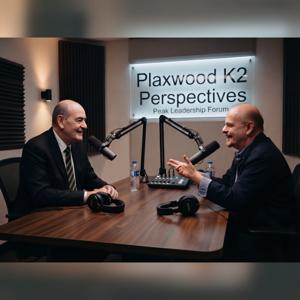
Plaxwood K2 Perspective

Plaxwood K2 Perspective

By Mike Plaxton and Gordon WoodBusinessManagement
Download on the App Store

All Plaxwood K2 Perspective episodes

  • Step 5/10 in "Change Decades of Agency Failure into Agency Success" writen by Mike Plaxton

    Got something to say to this podcast? Send a voicemail, and you might hear yourself on the next episode!

    Welcome back. Today we're looking at Mike Plaxton’s article, Change Decades of Agency Failure into Agency Success — The Full “How To”.

    If you don't have the time to sit down and read through the whole thing, this is for you. We’re going to walk through the core arguments, the actual numbers, and what it all means without any of the fluff.

    Full article

    8 min
  • Collaborate for progress and SUCCESS

    Got something to say to this podcast? Send a voicemail, and you might hear yourself on the next episode!

    Companies collect mountains of data, yet many leaders still struggle to turn monthly reports into strategic action. In this episode, hosts Dr. Kitipan Kitbamroong and Gordon Wood talk with Mike Plaxton about moving past surface-level metrics to uncover what actually drives performance.

    Using examples from the insurance sector, Mike explains how to evaluate training outcomes, spot early policy lapses, and balance hard data (the numbers) with soft data (human motivation). Instead of using analytics for "fame and shame," he introduces "WE Leadership"—connecting teams across the organization to collaborate on solutions.

    15 min
  • Step 4/10 in "Change Decades of Agency Failure into Agency Success" writen by Mike Plaxton

    Got something to say to this podcast? Send a voicemail, and you might hear yourself on the next episode!

    Welcome back. Today we're looking at Mike Plaxton’s article, Change Decades of Agency Failure into Agency Success — The Full “How To”.

    If you don't have the time to sit down and read through the whole thing, this is for you. We’re going to walk through the core arguments, the actual numbers, and what it all means without any of the fluff.

    Full article

    8 min
  • The hidden roadblocks to leadership in Asia’s life insurance sector.

    Got something to say to this podcast? Send a voicemail, and you might hear yourself on the next episode!

    Key Takeaways

    • The Talent vs. Leadership Gap: Asian teams are exceptionally sharp, but corporate structures often suffer because CEOs feel pressured to have all the answers rather than empowering the room.
    • East vs. West Dynamics: While Western leadership often rewards loud self-promotion, quiet humility defines Asian teams. Once given the space to speak up, ego-free Asian teams frequently generate superior, practical ideas.
    • Share the Success: True leaders champion a "We" culture. Career growth comes from the team, and CEOs must pass accolades down rather than hoarding them.
    • Listen to the Back Row: Mike shares a classic story from FWD where a massive consulting report of 100+ ideas was completely upended when a quiet woman in the back of a 300-person room asked the simplest question of all: "Why don't we go ask the customer?"
    • Data In, Judgment Out: Data should serve as a springboard for discussion and long-term vision—spanning the 5-to-10-year horizon—rather than an excuse for micromanagement.
    17 min
  • Step 3/10 in "Change Decades of Agency Failure into Agency Success" writen by Mike Plaxton

    Got something to say to this podcast? Send a voicemail, and you might hear yourself on the next episode!

    Welcome back. Today we're looking at Mike Plaxton’s article, Change Decades of Agency Failure into Agency Success — The Full “How To”.

    If you don't have the time to sit down and read through the whole thing, this is for you. We’re going to walk through the core arguments, the actual numbers, and what it all means without any of the fluff.

    Full article

    9 min
  • Step 2/10 in "Change Decades of Agency Failure into Agency Success" writen by Mike Plaxton

    Got something to say to this podcast? Send a voicemail, and you might hear yourself on the next episode!

    Welcome back. Today we're looking at Mike Plaxton’s article, Change Decades of Agency Failure into Agency Success — The Full “How To”.

    If you don't have the time to sit down and read through the whole thing, this is for you. We’re going to walk through the core arguments, the actual numbers, and what it all means without any of the fluff.

    Full article

    6 min
  • Step 1/10 in "Change Decades of Agency Failure into Agency Success" writen by Mike Plaxton

    Got something to say to this podcast? Send a voicemail, and you might hear yourself on the next episode!

    Welcome back. Today we're looking at Mike Plaxton’s article, Change Decades of Agency Failure into Agency Success — The Full “How To”.

    If you don't have the time to sit down and read through the whole thing, this is for you. We’re going to walk through the core arguments, the actual numbers, and what it all means without any of the fluff.

    Full article

    6 min
  • The Executive Perspective — Why Do Good Strategies Fail?

    Got something to say to this podcast? Send a voicemail, and you might hear yourself on the next episode!

    This inaugural 8–9 minute episode of The Executive Perspective features a two-host executive discussion between Gordon and Mike exploring a common business dilemma: why companies with well-researched, expensive strategies often fail to deliver expected results.

    The core takeaway is that a good strategy is not enough; success depends heavily on leadership, employee ownership, and consistent execution.

    Key Takeaways: The Four Major Barriers to Strategy Success

    Mike outlines four critical organizational barriers that derail good strategies:

    1. Autocratic Leadership (When Everything Depends on the Boss):
      • The Problem: Top-down, individual-centered leadership stifles innovation, discourages employees from challenging assumptions, and reduces engagement.
      • The Solution: WE Leadership—maintaining clear direction and accountability while involving others, listening to diverse perspectives, and building collective ownership.
    2. Outsourced Strategy (When People Don't Own the Plan):
      • The Problem: Relying completely on external consultants to create a plan without involving the employees who must actually deliver it. The organization "purchases" a strategy but builds zero internal ownership.
      • The Solution: Involve people across all departments (sales, operations, customer service) in shaping the strategy from the bottom up.
    3. Selective Execution (When the Plan is Only Half Delivered):
      • The Problem: Implementing only the convenient, comfortable, or visible parts of a strategy while abandoning difficult initiatives, thereby breaking the chain of interconnected activities (e.g., buying new CRM tech without training staff).
      • The Solution: Execute the complete plan and maintain discipline through regular monthly milestone reviews.
    4. Intermittent Supervision (When Leaders Disappear):
      • The Problem: Initial excitement fades into a lack of follow-up, leaving priorities unclear and employees unsure if management is still committed.
      • The Solution: Daily two-way dialogue, supportive coaching, and asking supportive questions ("What challenges are you facing?" rather than just "Are you done?").

    The Guiding Principle: "Follow the Data and Engage Everyone"

    • The Numbers: Tell you what is happening in the business.
    • The People: Tell you why it is happening.

    Leaders must look beyond surface metrics and actively engage employees to fix underlying processes, improve execution, or rethink the strategy.

    Conclusion

    Successful execution requires shifting the mindset from a top-down command structure to WE Leadership. Ultimately, a business strategy cannot just belong to the executives or consultants who created it—it needs to belong to the people who deliver it.

    10 min
  • Mike Plaxton, reflecting on leadership lessons drawn from history and his own career.

    Got something to say to this podcast? Send a voicemail, and you might hear yourself on the next episode!

    Two Extremes of Leadership (to avoid):

    1. The Autocrat / "The Boss" — Leadership through control and fear. One person dominates, the team lacks ownership, and employees leave for competitors. No single person has all the answers.
    2. The Approval Seeker — Leadership through consensus alone. The leader wants to be liked, averages opinions instead of setting direction, and prevarication stalls progress.

    The Proposed Model: "We Leadership"

    • A people-centered approach modeled on strong families: respect, trust, love, and sharing.
    • The CEO must balance four key stakeholders:
      • Shareholders — expect financial growth, dividends, and brand pride
      • Customers — want products that meet their needs, quality service, and a company they can respect
      • Business partners — distributors, agents, brokers, banks, and specialists who need confidence in the company and fair compensation
      • The team — employees who need fair rewards, development opportunities, and a positive workplace
    • Serious dissatisfaction in any group threatens the entire company.

    How to Achieve Balance: "Data and Dialogue"

    1. Data — Build a shared evidence base. Stakeholders gather data, validate each other's findings, and share it openly.
    2. Dialogue — Transparent discussion where everyone is heard and every idea can be challenged. The CEO contributes personal views but doesn't rule by majority vote. Constructive debate builds shared ownership of decisions.

    Practical Example: Value of New Business (VNB)

    • VNB is an actuarial estimate of goodwill from sales, based on assumptions about the future.
    • Two strategic options: (1) grow sales by meeting customer needs, or (2) push high-margin products regardless of customer need.
    • Plaxton advocates the needs-led approach — it aligns with the brand promise and keeps all stakeholders balanced, whereas the high-margin approach prioritizes shareholders at the expense of customers, partners, and the team.

    On AI in Leadership

    • AI is valuable for providing data and supporting decisions, but leaders who hand decision-making to AI are avoiding accountability.
    • AI must operate with human-approved checks and balances — it should support human judgment, not replace it.

    Track Record: Plaxton cites 39% annual compound sales growth over a 45-year leadership career as evidence the "We Leadership" approach works.

    17 min
  • "Everyone wants to be heard—no matter where you are in the world."

    Got something to say to this podcast? Send a voicemail, and you might hear yourself on the next episode!

    In this episode, we explore the stark contrast between the self-promoting culture of the West and the quiet, hidden talent often found across Asia. Learn how to bridge the gap through trust, encouragement, and total leadership support, turning overlooked potential into high-performing teams.

    #Leadership #GlobalLeadership #Management #WorkplaceCulture #TeamBuilding #Podcast #BusinessLeadership

    2 min