
Sign up to save your podcasts
Or



“If you’re getting different messages, you’re going to choose the one you like.” That’s what Dr. Cheryl Holder of Florida International University said this morning on the news as COVID-19 cases in Florida are increasing among people averaging 37 years of age.
Welcome all to the blog post of Peachtree Baptist Church for June 23, 2020, my name is Paul Capps, pastor. As we prepare to open our doors to worshipers on Sunday, June 28, I am increasingly aware that COVID-19 is not only still around, it is increasing here in the US, and especially in states that were the first to relax restrictions such as Florida and here in Georgia. And so I just have one message: I don’t want you to be here in person on Sunday if you are at a higher risk or if you’re not going to follow the protocols we’ll have in place.
You’ll have to get your temperature checked with an infrared thermometer, and if it’s over 99.5, you’ll have to go home.
You’ll have to use provided hand sanitizer.
You’ll have to wear a mask during the entire service. If you don’t bring one with you, one will be provided.
You’ll have to sit in assigned seating where there is a pre-placed worship guide and communion cup.
There will no childcare, so plan accordingly.
If that is still the message you want to hear, I want you to be here. But remember that a virtual option will still be available through zoom.
All that seems a bit harsh sounding, but understand that I am also speaking to myself. I have found myself feeling a bit relaxed about my movements, but I need to remain vigilant. I need to remember that God is not confined to a building and the Spirit is even now indwelling in you and me by faith in Jesus wherever we are. We are strengthened for the work of healing Christ calls us to by our shared experience of worshipping together, and that will happen whether you’re here in person or online. I am so grateful for how firm and consistent so many of you have been in your support of this family of faith over the past 14 weeks. As we make another shift and adapt to another new way of worshipping together, I hope and pray that we will be safe, but that we will also remember to practice our fruits of the Spirit: love, joy, peace, patience, kindness, goodness, gentleness and self-control.
See you Sunday!
Click for detail on each state and lots more information from Johns Hopkins.
Today is the five year anniversary of the martyrdom of the Emanuel AME nine. They opened their doors and hearts to everyone as witnesses to good news of Jesus and they paid the ultimate price. But today, I wonder about the survivors. Welcome all to the June 17, 2020 post of Peachtree Baptist Church, my name is Paul Capps, pastor.
This post today may cause considerable discomfort for those who have lost loved ones through violence. This challenge is for those of us who haven’t experienced such loss. We must learn to grieve and mourn with survivors is such a way that we live further into the justice God calls us to through Christ. As those nine took up their crosses, we must do the same.
My family and I were living in Beaufort, South Carolina when this tragedy occurred just north of us in Charleston. As the details unfolded, it became more clear that these people were simply being obedient to the call they had to express the harmony of Christ as they knew it. They were having a Wednesday night Bible Study. I think back to the studies we’ve had at PBC recently and there were at least two separate occasions when visitors came and sat in on the study. That’s what we are supposed to do. It’s on our sign.
And so I can’t imagine the horror and the terror those congregants experienced as the self proclaimed white supremacist who had sat with them in Bible Study for over an hour stood and shot the gun he had chosen and shouldn’t have been allowed to purchase 77 times. And I can’t imagine surviving. But amazingly, five did survive, including a five-year old girl whose grandmother shielded her and told her to play dead. And that grandmother, Felecia Sanders, was also a mother to Tywanza Sanders, whom she couldn’t shield, and who died near her calling her name.
Felecia Sanders speaks often about the trauma she continues to experience, how her church didn’t know how to deal with her post-traumatic stress and how she is learning how to express hope despite the pain.
There were other survivors as well and their stories are important. While we remember the nine that died, we must also remember those left behind. We must ask ourselves serious questions about our faith and whether we are willing to face the evil of this world with the hope of resurrection found in Jesus Christ. If we claim that faith, if we say we want to follow Jesus, we are saying that we want to not only welcome the stranger, but we also want to walk with the grieving.
If we believe that God desires well-being for all creation, then we, as people of that harmony, must be the kind of family that is willing to reflect Jesus, regardless of the risks. Even today, Felecia Sanders receives threats on her life by people trapped in hatred. It doesn’t always take a shooting to realize that being a witness to the gospel of Jesus stirs up the hearts of those that hate the idea of equity, justice, harmony and goodness for all. All you have to do is go on Facebook to see the vitriol spewing from those that hate God’s plans of restoration. But by faith we believe that this world will be transformed into a place where the Emanuel nine and all the survivors are restored and hatred will be no more.
I think the real challenge for me today is whether I’m willing to risk working for that reality now. Yesterday I shared a short piece that to Howard Thurman seemed to really express a real sense of harmony. I think, however, that unless we are actually using our full selves to express God’s peace and well-being, we are on the outside of God’s plans. As we remember the tragedy that happened five years ago today, my prayer is that we will not only remember, but carry their witness forward so that we can be on the inside of God’s plans.
Nine palmetto roses in remembrance of the lives lost
For the past several weeks I’ve been reading books by Howard Thurman, to whom I was introduced in seminary. I’m embarrassed to say that in a way, because I feel that I should have been introduced to him much earlier in life. But what I realized then is that there are very few times in my academic life that I was introduced to minority voices within theology. I am slowly trying to correct that, and maybe my sharing with you will help.
I recently read “Jesus and the Disinherited” and offered a brief excerpt in the May 29 blog post. Right now I’m reading “The Search for Common Ground.” Thurman wrote it in the aftermath of the assasination of Martin Luther King, Jr. in an attempt to reconcile what he felt was an increasing polarization in American society. Kind of ironic, isn’t it? It feels to me like we are only now living in the most polarizing time since the Civil War. Reading about white militia groups that are stockpiling weapons and planning for a race war makes it feel like we are closer than ever to another one. Along with that, social distancing creates a literal forced separation and this entire virus fallout feels pretty apocalyptic. But the demonstrations we have seen across this country over the past weeks have brought me renewed hope. I see people coming together, maybe not as safely as they should at times, but coming together around ways to find common ground.
I read this book and I am stunned by how prophetic it is. It is just more affirmation that God uses the voices of those perceived by humanity as weak to say and do the strongest things. We take comfort that when Christ returns, all the human power and wealth that people have so carefully built up will be transformed into beauty that can be shared equally by all.
In the preface, Thurman has an excerpt from a poem that I want to leave with you today. I was unfamiliar with the words and the writer, Olive Schriener, so I looked her up. A complicated figure, she was born in colonized South Africa in 1855, received no formal education but wrote a very successful novel called “The Story of An African Farm'' which was published in 1883. She was a strong advocate for African civil rights and her brother was Prime Minister of the Cape Colony for a brief time. She wrote several other works as well including a book of dreams simply titled “Dreams” in 1890 from which this poem comes. It is from Chapter Five: Three Dreams in a Desert.
And I awoke; and all about me was the yellow afternoon light: the sinking sun lit up the fingers of the milk bushes; and my horse stood by me quietly feeding. And I turned on my side, and I watched the ants run by thousands in the red sand. I thought I would go on my way now—the afternoon was cooler. Then a drowsiness crept over me again, and I laid back my head and fell asleep.
And I dreamed a dream.
I dreamed I saw a land. And on the hills walked brave women and brave men, hand in hand. And they looked into each other’s eyes, and they were not afraid.
And I saw the women also hold each other’s hands.
And I said to him beside me, “What place is this?”
And he said, “This is heaven.”
And I said, “Where is it?”
And he answered, “On earth.”
And I said, “When shall these things be?”
And he answered, “IN THE FUTURE.”
And I awoke, and all about me was the sunset light; and on the low hills the sun lay, and a delicious coolness had crept over everything; and the ants were going slowly home. And I walked towards my horse, who stood quietly feeding. Then the sun passed down behind the hills; but I knew that the next day he would arise again.
Some personal thoughts today and a challenge as I sit with what I see as a positive shift in our culture over the past few weeks. Welcome all to the post for Wednesday, June 10, 2020, my name is Paul Capps, pastor. As a missionary kid, I feel more at home here at Peachtree Baptist Church than almost any church I’ve been to in the United States. But I am white. And I grew up in Singapore and Malaysia not only with privilege, but as a privileged minority. When my mother strolled me through the wet market in Penang, Malaysia as an infant, people would stop and not only coo over me, but want to touch and rub my blond hair, apparently for good luck. I think since 1973 those kinds of customs have shifted some, but at the time, I stood out for all the right reasons. And yes, I had blond hair until I was about three, when my mom finally decided to give me a haircut.
From Malaysia to Singapore was not too different, especially from the outside looking in, but it was in my teen years there that I began to realize that I was not only different but that I was treated differently. But I never really did anything about it. It was just the way things were. My high school friends from Singapore American School would go out on weekends to the hawker centers as young as 14 and order beer without worry. Though 18 is the legal drinking age, whatever the reason, no ID was needed. And let’s talk about the school. While my youth group friends in Singaporean schools struggled mightily with some of the highest standards in the world, I had a pretty easy time in my private school surrounded by not only about 40% other white kids, but majority international kids of diplomats and business people.
The only time I ever remember being called out for being white was at an ice cream store, and that was only after returning to Singapore for the summer in between freshmen and sophomore college years. And even then it was probably only because they didn’t think that I knew the slur because they were speaking Hokkien. When ordering, the cashier called to the back saying, among other words I didn’t understand, ‘ang mo,’ which literally translates, ‘red hair.’ Sometimes they tack on ‘kui’ at the end, which means devil. It was a term that was developed during the 17th century by people in Fujian, China when the Dutch East India Company was doing some pretty devilish colonialist things. And it has stuck all these years.
It’s something I’m still working out, my white privilege. I know I have it here in the US, and I know I had it growing up in Southeast Asia. What makes it harder for me personally is that I never really recognized it much. I believe I was raised without racial bias, and I was definitely educated about respecting differences. I distinctly remember in 7th grade making a derogatory stereotype about an Indian man who was walking down the sidewalk talking to himself. This was before mobile phones and ear pieces. My father was very quick to give me a lesson about not only stereotyping but the sin of racial stereotyping. It’s a lesson I still carry.
There’s a lot more I could say about the complexities of cultural difference in my own experience, but suffice it to say that I am so grateful to be the pastor of this international church. And yet I so often feel completely unworthy of the role. As we work out our time together, I would want everyone to know that I am still learning what it means to be a faithful representative of Jesus. I hope we all are, but I think it’s more important than ever for me and those of us who are white to be constantly aware of our privilege so that we can be more open to God’s leadership. Global Christianity is shifting, and shifting fast, and that’s a good thing. I really hope you’ll read the article I’ve attached today from the Center for the Study of Global Christianity at Gordon-Conwell. It is a reminder for me that all churches need to be working harder for racial justice and that we all need to be learning from those that God is now using to reach the world with the love of Jesus, mostly in the global south. It is important to me that we not only look like the world, but that we strive to understand it. As a person of privilege, it is a task I do not take lightly and most of the time, it feels as exciting as it does overwhelming. But I believe we need to be witnesses in our Jerusalem as a global congregation and that in part means a responsibility to live into our context here in Atlanta. We need to better understand the African-American experience, as an example. At the same time, we must look at ourselves and see the trail that leads back so often to colonialism, sometimes even of the missionary variety. We need to remember that starting in the 16th century, four out the six continents in the world were colonized by white people. That means that even as an international congregation, we bear the stain of that trail. We need to acknowledge that much of the Chrisitan witness over the centuries has been harmed and that God is doing new things in other places as Global Christianity shifts away from Europe and North America. As Dr. Zurlo said, “Despite the demographic reality, many White Protestant Evangelical Christians in this country think they’re the center of the story. American history has indeed been written this way up until very recently.”
Sometimes I fear that when Christ returns he will tell me, ‘Truly I tell you, whatever you did not do for one of the least of these, you did not do for me.’ In the article, Dr. Zurlo has a list of recommended books for the purposes of better understanding and living into the redemption to which we are called. I am sorting through the books, but I think it would be a good idea to study one of them together. If you have any preferences, let me know and we’ll get started, even if it’s just two or three of us.
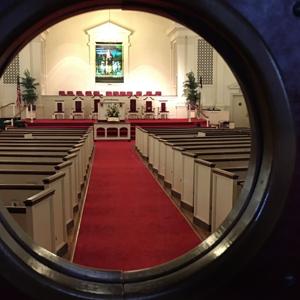
Good news! We plan to resume in-person worship on June 28! Welcome all to the Peachtree Baptist Church post for June 9, 2020, my name is Paul Capps, pastor. We are getting the house ready for guests and I hope that includes you, because you are invited. It will certainly feel different than before, but we are making every effort to make sure that you will feel confident about being protected from the spread of COVID-19 while you’re here. Between now and the 28th, we hope to have a virtual service from the sanctuary, but we have a a lot of work to do before going ‘live,’ like getting internet access into the sanctuary and figuring out what kind of equipment we need to buy and setup. But on the 28th, here’s what you can expect:
On the 28th, we will gather in the sanctuary for a group adult Bible Study at 10:00 AM while Leslie conducts Godly Play virtually as she has been doing. As schools adjust to in-person and hybrid models, we will adjust as well for in-person children’s classes. At 11:00 AM, we will have a worship service in the sanctuary as well.
We know that not everyone will feel comfortable being present in the sanctuary and we also know that not everyone should be here due to increased risk, so we will continue to provide a live virtual option going forward. I imagine that more folks will attend virtually than in-person at first, but I think there is a permanent need for a virtual option even when that attendance flips to being mostly in-person.
In terms of physical logistics for those that choose to be present in-person on the 28th, there will be one entrance and exit from the Lavista Rd elevator access. At the portico everyone with have a touchless temperature check then go through a sanitation station and receive a mask if you didn’t bring one from home. Once inside, it will be one person or family at a time in the elevator, or six feet apart in the stairwell. On the second floor, all rooms will be closed off except for the bathrooms and the sanctuary. Unfortunately, there won’t be breakfast, so be sure to eat before you come. Water bottles, however, will be available. There will be ways to clean/wipe down in the bathrooms and everyone will need to follow six-feet separation guidelines. The pews will be marked by worship guides and ready-use communion cups.
This is a work in progress! We are all learning to coexist with this new reality. We will need to be patient with ourselves and each other.
Don’t hesitate to reach out to me if you have other concerns or suggestions. There’s no playbook for this but we are striving for best practices. Finally, watch carefully near the end of the week for information about what worship and Bible study will look like for the 14th and 21st. I hope to see you for all of our upcoming services, whether through a screen or in person!
Welcome all to the Peachtree Baptist Church post for Friday, June 5, 2020, my name is Paul Capps, pastor. Yesterday, Shauw Chin and I voted. Unless you used an absentee ballot, today, Friday, is the last day for early voting in person. The final date to vote in the upcoming presidential preference primary, general primary election, nonpartisan general election and special election is in person on June 9. I share all this because I’m still fairly new to Georgia. I have had to a lot of searching online to educate myself about not only how and when to vote but also the ballot itself and the various races. As Baptist people of faith, we are all over the spectrum when it comes to the role of the church, the role of the state, and where they might intersect. Though Baptists have a reputation of believing in freedom from religion and freedom for religion, Ironically, Baptists might be considered to be some of America’s first politicians. Baptist evangelists in Virginia during the late 1700s lobbied this country’s founders to the point of being an influence in the establishment of the First Amendment in 1791. The reason they did this is because of what history had taught them when human power in the form of government and religious power come together as one. And we know it too: Roman Christendom in the 3rd century led to the Holy Roman Empire as one example. Recently, I read a post about how we need to remember the Protest part of the Protestant Reformation. Much of that protest was about corruption of power too. But soon states, like England, married the new movement with the state. When Puritans came from England to America, they were escaping that corruption, but then they also denied others who didn’t think like them, such as Roger Williams, an earlier Baptist who had to escape to Rhode Island to avoid Puritan persecution.
So where does that leave us today? As Baptist people of faith, it is our faith that should drive us to the ballot box but it is also our faith that doesn’t seek to impose our faith on others through the ballot box. Our faith informs the way we engage in the realm of living within the confines of human statehood, but it also informs our divine understanding that all people everywhere, regardless of religion or government are images of God. As Baptists, when we see injustice from the state, we vote for those that represent justice. We do this not so that they become Baptists or even Christians, or even come to our particular interpretation of what justice looks like, but so that we are being obedient to living out our understanding that through faith in Christ, God desires goodwill for this entire world. Living as a human waiting for Christ’s return to restore all things, people of faith choose to practice well-being for all people: in politics, in governance, at home, at work, at school and everywhere we have been placed to be a witness to the good news of Jesus. We’re not going to get it right most of the time, but we try to be faithful. So go and make decisions informed by your faith, and vote!
Once again, I am so thankful to say that PBC is part of a larger body with whom we can cooperate and work for the well-being of all people. And Cooperative Baptist Fellowship has recently published insightful and challenging words that can help us continue that work. So today, June 3, 2020, I hand over the post to them so that those words can be more widely disseminated. Just as Deena’s post yesterday was shared, I hope you’ll share these as well so that we might be better equipped to do justice, love mercy, and walk humbly with our God.
First is a joint statement from CBF and CBF GA in support of hate crime legislation in Georgia (HB 426) that has already been passed by the Georgia House of Representatives but has been stuck in Senate Judiciary Committee since March 8 of 2019. I was pleased to represent PBC as a quoted signatory to this statement.
Next is a powerful statement from CBF Executive Coordinator Dr. Paul Baxley. As we hold both violence against our brother-in-Christ George Floyd that took his life and violence against other persons of color in one hand, we hold Pentecost in the other. What are people of faith, indwelt by the very Spirit of God, to do? Paul suggests actions needed by the church, by government and by the CBF.
Finally, a very challenging blog post from Rev. Kasey Jones, Associate Coordinator of Strategic Operations & Outreach for CBF. She recounts how the the torture and murder of Emmett Till catalyzed the Civil Rights Movement and connecting both the death of George Floyd and the risk Queen Esther took in confronting power she says, “It is time for the separate system of justice for black and brown men and women to be altered to a fair and just system for All.”
It does seem that we are at a new crossroads in God’s movement of redemption. Are we willing to find common ground so that we might have everything in common?
For today’s post, Tuesday, June 2, 2020, Rev. Deena Wingard offers us a challenge both in the form of words and imagery. Deena ministered alongside us last year, leading in worship and providing leadership to our youth among other things. I asked Deena if she would be willing to speak into the current work being done to address racial disparities in this nation, she agreed and I am every grateful. In addition to being dedicated to her family, and working full-time for the Department of Veteran Affairs, Deena is the founder of Your Reasonable Service Ministries and has been published in The Wait of Success, a collection of stories about achieving success.
~
I identify as a black woman in America. It is disturbing in and of itself that in 2020 we are still trying to figure out how to achieve civil rights for black Americans. We survived nearly 400 years of slavery in a land we were taken to against our will. We were then supposedly set free by the Emancipation Proclamation signed on January 1, 1863. My ancestors quickly realized, however, that slavery continued in many ways under the guise of a corrupt criminal justice system that unjustly and disproportionately incarcerated black people. Under that same criminal "justice" system, those in power and authority continued to use my ancestors as forced labor. On our backs, much of the country was built and financially sustained. We then endured Jim Crow laws that were present from 1870 to 1965 and lynching that we still hear about today. Despite the gains of the Civil Rights Movement from 1954 to 1968, as I type, there are protests, demonstrations and riots in many cities across America purposed to address the murderous killing of my black brothers and sisters.
Some may say, "where are the Christians?" Well, keep in mind, many slave owners and leaders in the system of slavery purported to be Christians. That does not mean, however, that white Christians are to do nothing and remain silent. While many have remained silent in the past as black men and women were unjustifiably killed and unfairly treated, time is now up for staying quiet. Your silence loudly speaks volumes as to where your sentiments fall regarding race relations today. In other words, saying nothing is loudly saying something. That something is that you either agree with how black people are being treated in America today or that you are unconcerned. Either way, since the Bible is clear that racism and discrimination are sinful acts, your silence shines a light on your heart. We don't expect you to move mountains, but we do want to hear and see your support.
In this fight for justice and fundamental human rights, we need allies. We need brave black and non-black men and women like the abolitionists, the freedom fighters and Atlanta Police Chief, Erika Shields, who are not afraid to take a stand against the plight of black people in America today.
I encourage you to say something to show that you are an ally in this battle. We see your stand against injustice, and we see your silence. Your silence speaks loudly. Let your support be louder.
Welcome friends near and far to the Friday, May 29, 2020 podcast from Peachtree Baptist Church, my name is Paul Capps, pastor. For the past month or so I’ve been reading Howard Thurman’s short book titled “Jesus and the Disinherited.” Thurman was a mentor to Martin Luther King, Jr. Published in 1949, the book grew out of an essay he wrote in 1935, and for me it has been both important history and inspiration even as this nation continues to fight against human unity. I can’t recommend it enough. Using the overarching concepts of Fear, Deception and Hate as weapons used to maintain division, he bookends these with the first chapter, Jesus, and the last chapter, Love.
If you were able to read between the lines of yesterday’s post, you’d know that I was responding to the ways we have seen people not treating people the way they would want to be treated these past several weeks, but using fear, deception and hatred as weapons to maintain all kinds of division. In the midst of this kind of rebellion against God, Christians must be willing to speak the gospel of God’s desire for perfect well being through Jesus in the language that will be heard by all people. What we know is true is that the rich speak a different language from the poor, the documented speak a different language from the undocumented, the privileged speak a different language than the underprivileged. It is hard work, but if we submit to the Spirit, we can express a future hope that as Thurman writes, Jesus projected with his very life, where “There would be room for all, and no man would be a threat to his brother.”
I offer these two excerpts from the first chapter without further comment.
--
The basic fact is that Christianity as it was born in the mind of this Jewish teacher and thinker appears as a technique of survival for the oppressed. That it became, through the intervening years, a religion of the powerful and the dominant, used sometimes as an instrument of oppression, must not tempt us into believing that it was thus in the mind and life of Jesus. “In him was life; and the life was the light of men.” Wherever his spirit appears, the oppressed gather fresh courage; for he announced the good news that fear, hypocrisy, and hatred, the three hounds of hell that track the trail of the disinherited, need have no dominion over them.
Living in a climate of deep insecurity, Jesus, faced with so narrow a margin of civil guarantees, had to find some other basis upon which to establish a sense of well-being. He knew that the goals of religion as he understood them could never be worked out within the then-established order. Deep from within that order he projected a dream, the logic of which would give to all the needful security. There would be room for all, and no man would be a threat to his brother. “The kingdom of God is within.” “The Spirit of the Lord is upon me, because he hath anointed me to preach the gospel to the poor.”
The basic principles of his way of life cut straight through to the despair of his fellows and found it groundless. By inference he says, “You must abandon your fear of each other and fear only God. You must not indulge in any deception and dishonesty, even to save your lives. Your words must be Yea—Nay; anything else is evil. Hatred is destructive to hated and hater alike. Love your enemy, that you may be children of your Father who is in heaven.”
Thurman, Howard. Jesus and the Disinherited. Beacon Press.
Howard Thurman in 1963. Photo by Boston University.
Welcome friends to the Thursday, May 28, 2020 post from Peachtree Baptist Church, my name is Paul Capps, pastor. On Tuesday, I talked about adaptation and how early Christians had to adapt to living in a world not yet fully redeemed. Today, I want to challenge us as people of faith to remember that it is through the adaptive work of the Spirit that we are being transformed.
You have likely heard me say before how much I love this church for its representation of various cultures. It reminds me daily of the multicultural mission of the church. As we come up on Pentecost this Sunday, I’m also reminded of the connection we have with that movement of the Spirit and how important it continues to be for our world today. There’s a reason that the first thing the Spirit did was cause believers in Jesus to speak in a variety of languages. It was a way of honoring the beauty of culture and uniting humanity at the same time. It was a miracle. It doesn’t always help to think in hypotheticals, but it would be a fair question to wonder why God didn’t just use one language that everyone understood. Instead, it was a variety of languages. Though the speaker couldn’t normally speak it, the hearer heard their own language. It was a kind of divine empathy but also a celebration of diversity, equality and equity all being accomplished at the same time.
The goal of the gospel is not that we all end up in the same culture but that we are united by Christ. On Sunday we looked at 1 Peter 5 verses 6-10. But in the rest of 1 Peter we read about how early Christians were resisting the dominant culture of the day by representing the way of Jesus. Roman culture did not represent the way of Jesus in how people were treated. Slavery, for example, was not only accepted but was an unquestioned cultural norm. Class structures between rich and poor were enforced. Equality, much less equity, was a ridiculous notion that could even be considered criminal. Lives were less important than the growth of the Roman Empire. It was easy for most people to fall into the trap of thinking that this worldview was not only part of the proper order but the divine order. Much of the advice of Paul and Peter in the early church letters was written to help Christians from being locked up or killed for living out their understanding of the kingdom of God as described at the end of Acts 2.
In a tremendously sad and perverted twist, dominant cultures ended up co-opting Christianity and using it to maintain their dominance. Rome weaponized Christianity and for centuries other cultures were colonized under this style of power. In this country, slavery was defended by preachers using the very words of Peter. But that’s what rebellion does. It corrupts and perverts the truth. I can’t tell you how many times I’ve heard people talk about their distrust of “the media” as if it is one singular force, or how often I hear people reject history just because it doesn’t line up with their biases. One of the ways we can combat the rebellion against the truth of the past is by studying it. And again, even in that study, rebellion takes root as distrust is so very rampant.
And so what are we to do? We are to put our trust in the Spirit of God. What if the Spirit of God gave you the language of a culture that has been misrepresented by the dominant culture and you were able to speak to them in such a way that they understood the gospel? To hear that they can have the voice of prophecy to speak of God’s justice for the poor? Or what if the Spirit of God gave you the language of the dominant culture so that they could hear the gospel? To hear that by giving up their pride they are being humble before a God who loves and rewards humility?
When those believers were filled with the Spirit, it wasn’t an easy thing. It was the beginning of the hardest thing they could ever do - they lost their language so that God could show the world the truth. They had to give up their language to celebrate and begin practicing with their lives a unity that goes beyond language and culture. Before they could do it, they couldn’t have known what it was like to hear the gospel in a language other than their own. We must be open to the Spirit to do things in us that will pull us out of our worldviews so that we can speak the language of Jesus to others. And that can be hard when we look at others and don’t see them as images of God. That can be hard when we are taught to believe that a human culture should be enforced with some kind of order. But I believe that if we submit ourselves to God, the one who practiced healing and restoration, who taught what true reconciliation looks like, who despite humanity’s failures laid down his life for all people, that submission will empower us to love God and love others by his Spirit. We will see others as God sees them. As images of God. Through Jesus, the reality of perfect well-being for all creation is made available. And when we see images in this world that distort that reality, it should not only hurt, it should call us to speak in the language that is needed for the gospel to be heard.
As we continue to see human power exercised all over this world, may we speak the language of true power, the power of the Spirit transforming us into true representatives of Jesus.
From the publisher's feed
Sunday sermons and weekday posts designed to encourage and challenge.