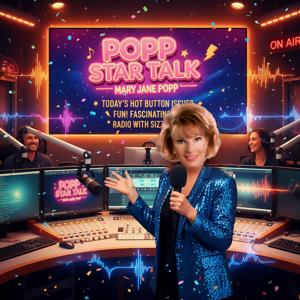
Popp Star Talk
Download on the App Store

All Popp Star Talk episodes

  • Popp Star Talk, November 14, 2026
    Popp Star Talk with Mary Jane Popp
    Psychic Intuition, Animal Communication, and Lifelong Love with Nancy Orlen Weber and Warren Farrell
    Mary Jane Popp explores psychic intuition and animal communication with detective Nancy Orlen Weber before diving into couples communication and lifelong relationship secrets with Dr. Warren Farrell.
    Exploring Psychic Intuition and the Soul's Journey
    Mary Jane Popp opens the broadcast by questioning what intuition and psychic awareness truly mean in everyday life. She welcomes badge-carrying psychic detective Nancy Orlen Weber, author of The Life of a Psychic Detective, who explains her foundational belief that every living person possesses innate psychic capacity because everyone has an enduring soul. Weber traces the linguistic origin of psychic to the Greek word psyche, emphasizing that people become more aware of inner guidance when they seek purpose rather than worldly achievements. Addressing mediumship and spirit guides, Weber describes her pragmatic habit of demanding evidence and questioning spiritual entities rather than accepting visions blindly. She details her childhood awareness of songs from the nineteen thirties and recalls her experience with an apparition who claimed to be the Archangel Michael, delivering precise records that resolved a community crisis. Weber also shares her own near-death medical emergency at age twenty-five, explaining how quiet inner peace brought her back to raise her newborn infant.
    Investigating Violent Crimes Through Psychic Eyewitness Work
    The conversation turns to criminal investigations as Popp invites Weber to recount how she began assisting law enforcement. Weber explains that her involvement started unexpectedly in a small New Jersey town after enrolling her four-year-old child in karate classes. The instructor, who served as the municipality's first female police officer, noticed Weber's reputation for intuitive perception and asked whether she would consult on a local sexual assault case. Upon hearing of the crime, Weber immediately received vivid mental impressions and provided detailed descriptions of a suspect to investigating detectives. When officers revealed that two separate individuals matched the physical profile, Weber abruptly stood up, limped across the office floor, and identified the culprit by adopting his physical gait. She informed the astonished detectives that the perpetrator had committed murder rather than simple assault. Armed with her psychic testimony, investigators confronted the limping suspect, presenting her impressions as eyewitness evidence, which prompted a full confession from the guilty man.
    Communicating Soul to Soul with Animals and Nature
    Weber elaborates on her techniques for communicating with household pets and wildlife, emphasizing that successful interaction requires looking past physical bodies. She strips away biological nouns such as fur or paws, viewing animals as distinct spiritual beings sharing an interconnected universe. Weber explains that entering an emotional state of love creates a telepathic bridge, allowing human brains to translate natural intuitive signals. She illustrates this connection by recalling the rescue of a missing Doberman puppy described in her book, Nature Speaks. Despite never visiting the owner's property, Weber envisioned buried historical landmarks and correctly predicted the dog would return to a barn seven days later at ten in the morning. Years afterward, the grown dog recognized Weber at a kennel club gathering and laid its head in her lap. Popp discusses her own pair of beloved Samoyeds, prompting Weber to confirm that attentive pet owners naturally develop communication abilities through genuine care, mutual empathy, and routine observation.
    Redefining Soulmates and Defusing Defensive Reactions
    After a musical interlude, Popp welcomes couples communication expert Dr. Warren Farrell to discuss his book, Role Mate to Soul Mate: The 7 Secrets of Lifelong Love. Farrell defines a true soulmate as a partner with whom one can share vulnerabilities and constructive feedback without triggering defensive reactions or walking on eggshells. Popp reflects on her fifty-three years of marriage to her late husband, Rick, highlighting their daily habit of holding hands and noting how his steady composure balanced her fiery Romanian temper during disagreements. Farrell explains that couples often find themselves initially drawn to complementary or opposite personalities, such as a spiritual seeker pairing with a pragmatic financial provider. Over time, however, partners frequently begin criticizing the very traits that originally attracted them. Farrell points out that primitive biological survival instincts cause humans to perceive personal criticism as an enemy attack, making defensiveness natural for physical survival yet deeply destructive to marital harmony.
    Mastering the Seven Secrets to Lifelong Love
    Farrell outlines the structured methodology he developed over thirty years of relationship counseling to help couples transcend instinctive defensiveness. Central to this approach is a weekly two-hour caring and sharing practice, during which partners express specific appreciations and meditate using six distinct psychological mindsets. One key concept, the love guarantee, reframes listening to harsh complaints as a profound opportunity to build lasting emotional security rather than defeat. To protect the remaining hours of the week, Farrell instructs couples to establish conflict-free zones that prevent casual grievances from escalating into bitter arguments. He reviews the broader framework of his seven relationship secrets, which includes transforming the four depleting behaviors of criticism, complaining, complacency, and controlling into deeper affection. Furthermore, Farrell stresses mastering essential soulmate wisdoms, noting that feeling understood is the fundamental root of feeling loved. He also emphasizes regular shared play, asserting that couples who maintain joyful recreational activities together sustain enduring commitments.
    Building Win-Win Compromises and Fostering Civil Dialogue
    In the final segment, Farrell and Popp explore practical strategies for resolving deeply entrenched disagreements, ranging from vacation preferences to deciding whether to raise children. Farrell explains that his book outlines approximately four hundred common domestic challenges, providing a structured negotiation system where couples brainstorm creative compromises. Because intellectual reading alone rarely alters entrenched habits, Farrell incorporates an eleven-hour online video course accessed through a book code to guide partners through interactive behavioral drills. The discussion broadens to contemporary social polarization and political acrimony, prompting Farrell to highlight his chapter titled From Civil War to Civil Dialogue. Describing his own politically diverse family, which includes both ardent partisans and office seekers, Farrell urges listeners to seek the underlying positive intent behind opposing viewpoints rather than labeling adversaries as enemies. Popp closes the hour by encouraging her audience to question information independently, think critically, and cherish love and lifelong dreams.
    1 hr
  • Popp Star Talk, November 19, 2025
    Ep10, Michael Learned, American actress, known for her role as Olivia Walton in the long-running CBS drama series The Waltons
    Beyond the Walton House: An Intimate Conversation with Michael Learned
    This episode of Pop Star Talk features an extensive interview with Michael Learned, the iconic matriarch of the television classic The Waltons. Host Mary Jane Pop explores Learned's personal journey from "rock bottom" to stardom, her unconventional childhood, and her enduring perspectives on aging and advocacy.
    The Walton Legacy and Personal Resilience
    Michael Learned is best known for her role as Olivia Walton, a character that defined the American mother figure for a generation during the show's run from 1971 to 1982. However, Learned reveals that her casting came at a time of profound personal crisis. She describes reaching "rock bottom" during a divorce from her first husband, whom she married at 17, while struggling with financial instability and alcohol as a coping mechanism for depression. She credits a woman named Mrs. Blair for helping her survive this period, describing the role in The Waltons as a spiritual "gift" that arrived when she was a "wreck".
    The Waltons: Cultural Impact
    A series that bridged generations by addressing universal family struggles.
    1971-1982 Original Run
    Olivia Walton Iconic Role
    Earl Hamner Jr. Series Creator
    Learned's time on the show was not without professional friction. Initially, she felt her character was relegated to the background, often "just ironing," and she eventually demanded more substantial lines to showcase her acting range. Her producer notes that she even left the show at one point because she disagreed with the direction of the themes. Despite these challenges, she remains deeply connected to the show's legacy, noting that the issues faced by the Walton family—such as raising children through hardship—remain relevant to modern audiences.
    Career Pivots and the "Michael" Mystery
    Learned’s path to acting was accidental. As a child attending a boarding school in England during the early 1950s, she lived in a "Dickensian" environment characterized by post-war rations and intense homesickness. She originally aspired to be a ballet dancer, but a teacher bluntly told her she wasn't talented enough for dance and suggested acting instead. This pivot proved successful when she unexpectedly won the school’s drama cup. Her unique name, "Michael," often caused confusion in the industry, with some casting agents expecting a man to walk through the door, though she believes the name ultimately helped her stand out.
    Michael Learned: Personal Philosophy
    Growth through Pain: Believes emotional pain is often a necessary catalyst for personal development.
    Constructive Anger: Views anger as a positive force if recognized and used to help others.
    Literature over Media: Prefers escaping into novels like Zola’s Nana rather than watching television.
    Advocacy and Modern Life
    Beyond The Waltons, Learned has been a staunch advocate for abused and orphaned children, a passion reflected in her film work like Crossroads. She shares poignant stories of taking children into her own home who had suffered extreme abuse, emphasizing that the cycle of neglect is a tragedy that continues today. Now in her late 70s, Learned maintains a "youthful spirit" through a Mediterranean diet and a love for reading, though she admits the COVID-19 pandemic disrupted her long-time habit of taking jazz dance classes.
    Key Data
    The Waltons Era: Aired from 1971 to 1982.
    Film Debut: Touched By Love (1980).
    Other Notable Credits: Power (1986), Dragon: The Bruce Lee Story (1993).
    Current Age: 78 at the time of the recording.
    To-Do / Next Steps
    Mary Jane Pop will call Michael Learned to get an update on her current activities for the new year.
    Kenneth Segura Noll and Mary Jane Pop plan to visit the Walton Museum on their next trip back east.
    Conclusion
    The interview paints a portrait of a woman far more complex and vulnerable than her "Number One Mom" persona suggested. Michael Learned’s story is one of transformation—turning childhood sadness and mid-life "rock bottom" into a career defined by empathy, advocacy, and a refusal to succumb to the traditional expectations of retirement.
    52 min
  • Popp Star Talk, November 12, 2025
    Ep9, Deepak Chopra, Finding Joy and the Science of the Soul
    Visualizing Key Highlights...
    In this episode of Pop Star Talk, host Mary Jane Pop engages in a profound dialogue with world-renowned alternative medicine advocate Deepak Chopra. The discussion traverses the landscape of spiritual optimism, the biological necessity of laughter, and a radical redefinition of the soul and death.
    The Internal Architecture of Happiness
    Deepak Chopra challenges the societal "hypnosis" that external success—money, fame, or health—leads to happiness. Instead, he posits that happiness is the precursor to success. According to Chopra, scientific studies suggest that external circumstances account for only about 7% of a person's happiness, while the remaining 93% is generated internally through the release of limiting beliefs, creativity, and compassion. He emphasizes that the most effective way to cultivate personal joy is by focusing on making others happy, thereby moving away from the "separate self" that leads to loneliness and fear.
    The 93/7 Happiness Principle
    93%
    Internal Factors
    Gratitude, Creativity, Letting go of Ego
    7%
    External Factors
    Wealth, Status, Possessions
    Spirituality vs. Outmoded Religion
    The conversation delves into the divisive nature of organized religion, which Chopra describes as "primitive" and "ethnocentric." He argues that traditional religious structures have failed to keep pace with modern scientific understanding, leading to conflict and "tribal" wars. Chopra advocates for an "evolving spirituality"—a domain of awareness beyond personality where one experiences the universal self. He famously uses the analogy of a finger pointing at the moon: most religious people are "holding onto the finger" (the dogma) rather than looking at the moon (the experience of the divine).
    The Soul as a Non-Local Instrument
    Addressing the mystery of death, Chopra clarifies that the soul is not "in" the body but is a non-local consciousness utilizing the body as an instrument. He compares the body to a radio set; while the music appears to come from the radio, the broadcast itself exists as energy and information elsewhere. Consequently, death is not the end of existence but a "disruption in the line of communication." He defines God not as energy, but as the "infinite intelligence" that organizes energy and matter into the biological laws of the universe.
    Biological Impact of Consciousness
    Your state of mind dictates your body's chemistry. Laughter and joy act as natural antidepressants and immune boosters.
    Stress State
    War with self/world → Cardiovascular disease, Cancer, Infection
    Joyful State
    Laughter/Connection → Dopamine, Serotonin, Oxytocin
    Humor as the Path to Enlightenment
    Chopra’s recent work, including the book Why God Is Laughing and his cameo in Mike Myers' film The Love Guru, highlights his belief that humor is essential for spiritual health. He asserts that fanaticism is merely a "cover-up for insecurity" and that those who are easily offended lack true religious depth. By laughing at ourselves, we move beyond the ego’s need for approval and open the door to genuine creativity and insight.
    Key Data
    Happiness Composition: 93% internal vs. 7% external.
    Global Conflict: 35 active wars currently fought in the name of religion.
    Audience Reach: Over 500,000 customers for Audien Hearing Aids (sponsor data).
    To-Do / Next Steps
    Mary Jane Pop will research the connection between Artificial Intelligence and spiritual enlightenment for a potential follow-up interview.
    Kenneth Signorino plans to review the interview recording to take detailed notes on Chopra's insights.
    Listeners are encouraged to visit deepakchopra.com to explore his latest work and upcoming book on Jesus.
    Conclusion
    Deepak Chopra’s message is one of profound simplicity: by shifting our consciousness from external gratification to internal joy and laughter, we not only improve our biological health but also connect with an eternal, universal intelligence. As he concludes, the only way to truly eliminate an enemy is to make them a friend through emotional intelligence and mutual respect.
    52 min
  • Popp Star Talk, November 5, 2025
    Ep8, Rip Taylor, Charles Elmer "Rip" Taylor Jr. was an American actor and comedian, known for his exuberance and flamboyant personality, including his wild moustache, toupee, and his habit of showering himself with confetti
    The King of Camp and Confetti: Remembering Rip Taylor
    Pop Star Talk: Rip Taylor
    The King of Camp & Confetti: A legacy of flamboyant resilience and "clean" comedy.
    Core Narrative
    "It’s a gift... there’s no mean-spiritedness in it, it just pops out."
    The Confetti Origin: Born from a moment of frustration on the Merv Griffin Show where Rip tore up his "bad" jokes and threw them—launching an iconic trademark.
    Resilience Through Humor: Overcame a traumatic childhood and severe bullying by finding solace in making others laugh.
    The "Clean" Philosophy: A staunch advocate for wit and delivery over "F-bombs," believing that true talent doesn't require vulgarity.
    KEY CAREER MILESTONES
    Army Special ServicesHollywood SquaresIndecent Proposal"It Ain't All Confetti" (One-Man Show)
    RT
    Rip Taylor
    Charles Elmer Taylor
    1930s — 2019
    Host & Guests
    Mary Jane Pop, Derek Zemrak, Kenneth Segura Noll
    Legacy Labels
    #ComedyIcon#Broadway#TVHistory#Resilience
    Archive Episode 8 • Recorded 2014 • 51:59 Duration
    "Live simply, laugh often, love deeply."
    This episode of Pop Star Talk features host Mary Jane Pop, producer Kenneth Segura Noll, and film critic Derek Zemrak as they revisit a poignant 2014 archival interview with the legendary comedian Rip Taylor. The discussion explores Taylor's flamboyant public persona, his unexpected career origins, and the deep-seated vulnerabilities that fueled his comedy.
    Detailed Point Summary
    The Persona: More Than Just Confetti
    Rip Taylor was widely celebrated as the "King of Camp and Confetti," a title earned through his high-energy performances, iconic mustache, and the trademark habit of fanning himself with his own toupee.While many saw him as a "one of a kind" entertainer who was "always on," his peers ranked him alongside comedy greats like Charles Nelson Reilly and Dom DeLuise for his innate ability to find humor in any situation. Interestingly, his signature confetti act was born out of a moment of professional frustration; after "bombing" on the Merv Griffin Show, Taylor ripped up his joke cards and threw them into the air in a fit of pique, only to find that the audience loved the chaotic gesture.
    Rip Taylor: Career Profile
    TRADEMARKS
    Confetti, Toupee-fanning, Facial Expressions
    NOTABLE FILMS
    Indecent Proposal, Alex & Emma
    STAGE ROLES
    Captain Hook, Pseudolus, The Wizard
    From Military Pantomime to Dramatic Acting
    Taylor’s path to stardom was unconventional, beginning during his service in the Army. While on a troop ship, he started "mouthing the words" to Mario Lanza records to entertain fellow soldiers, a pantomime act that eventually led him to Special Services in Tokyo. Despite his reputation as a "shtick" comedian, Taylor was a legitimate actor who appeared in dramatic roles, such as Demi Moore’s surly boss in Indecent Proposal. He took great pride in his versatility, noting that while he enjoyed the "camp" labels, he was capable of "walking and chewing gum at the same time"—a metaphor for balancing comedy with serious performance.
    The Vulnerability Behind the Laughs
    Beneath the exuberant exterior lay a history of significant personal hardship. Taylor spoke candidly about a "horrendous" childhood and the severe bullying he endured during high school, which often brought him to tears even decades later. He viewed his comedy not as a desire for fame, but as a "gift" and a necessary emotional outlet. His one-man show, It Ain't All Confetti, was designed to share this more serious side of his life, moving beyond simple jokes to tell a "terribly sad" yet "funny" story of survival in show business.
    Personal Philosophy
    "It isn't the desire to be loved, or seen, or heard, I just have to do it. It just comes out automatically... There's no mean-spiritedness in it, it just pops out."
    — Rip Taylor
    Reflections and Corrections
    In the post-interview discussion, the hosts clarified several details about Taylor’s life. His birth name was Charles Elmer Taylor, and he joked that his epitaph should simply read "R.I.P. RIP". The team also issued a "mea culpa" regarding an anecdote about the film Easy Rider; the incident involving a knife and Dennis Hopper actually concerned actor Rip Torn, not Rip Taylor. Although Taylor passed away in 2019, his legacy as a pioneer who opened doors for other flamboyant and LGBTQ+ performers remains a central theme of his life story.
    Key Data
    Birth Name: Charles Elmer Taylor.
    Interview Date: Originally recorded in 2014.
    Passing: Rip Taylor passed away in 2019.
    Signature Show: It Ain't All Confetti.
    TV History: Frequent guest on Hollywood Squares and host of The $1.98 Beauty Show.
    To-Do / Next Steps
    Derek Zemrak to check the status of the unfinished documentary about Rip Taylor's life.
    Listeners are invited to email or message Mary Jane Pop’s Facebook page if they know the specific origin story of the nickname "Rip".
    Derek to continue curating programs and producing cabaret shows at his theaters.
    Conclusion
    Rip Taylor was a complex entertainer who used the "insanity" of his stage persona to mask and process the traumas of his youth. By blending campy humor with a genuine talent for dramatic acting, he left an indelible mark on American entertainment, proving that there is often a profound depth behind the falling confetti.
    52 min
  • Popp Star Talk, October 29, 2025
    Ep7, George Chakiris, American actor and dancer
    From the Silver Screen to Silver Jewelry: A Conversation with George Chakiris
    George Chakiris: Beyond the West Side
    A journey from the leader of the Sharks to the artistry of silver jewelry design.
    The Iconic Persona
    "You will savor the story of a Greek boy in America who did well, very well indeed."
    — Rita Moreno on George's Memoirs
    1961
    The Breakthrough
    Won acclaim as Bernardo in West Side Story after playing Riff in London.
    93
    Current Age
    Still active, sharp-witted, and continuing his legacy of creative artistry.
    Key Career Transitions
    The Chorus: Started in White Christmas with Rosemary Clooney.
    TV Era: Iconic roles in Dallas, Hawaii Five-O, and Murder She Wrote.
    New Craft: Professional jewelry designer with a Tokyo-based distributor.
    The "Backstory"
    #WestSideStory#Bernardo#JewelryDesign#HollywoodHistory#Memoirs
    Legacy Highlights
    Grauman's Chinese: Hand & footprints cemented in 2012 for the 50th Anniversary.
    The "Company": Deep artistic bond with Elaine Stritch during national tours.
    Global Reach: Filmed series in Japan (NHK) and the UK (BBC).
    Official Memoir
    "My West Side Story" — Available on Amazon and Independent Bookstores.
    Hosted by Mary Jane Poppe • Pop Star Talk
    51 min listen Audience: Film Historians & Fans
    In this retrospective episode of Pop Star Talk, host Mary Jane Poppe interviews legendary actor and dancer George Chakiris. They explore his iconic role in West Side Story, his extensive career in episodic television, and his current creative pursuit as a high-end jewelry designer.
    The Legacy of West Side Story
    George Chakiris remains most recognized for his Academy Award-winning portrayal of Bernardo, the leader of the Sharks, in the 1961 film West Side Story. Interestingly, Chakiris originally played the role of Riff, leader of the rival Jets, in the London stage production before being cast as Bernardo for the film due to his "Puerto Rican look." He attributes the film's enduring "magic" to the extraordinary collaboration between Jerome Robbins, Leonard Bernstein, Stephen Sondheim, and Arthur Laurents, noting that the themes of star-crossed lovers and social discrimination remain as relevant today as they were in the 1960s.
    In 2012, celebrating the film's 50th anniversary, Chakiris, Rita Moreno, and Russ Tamblyn were honored with a hand and footprint ceremony at Grauman’s Chinese Theater. This was a full-circle moment for Chakiris, who recalled walking past those same footprints every night in 1952 while working as an office boy to pay for his dance classes.
    The "Magic Four" of West Side Story
    George Chakiris credits the film's immortality to this specific creative collaboration:
    Jerome Robbins Choreography/Direction
    Leonard Bernstein Musical Score
    Stephen Sondheim Lyrics
    Arthur Laurents Script/Book
    A Versatile Career: From Musicals to TV
    Before his breakout role, Chakiris appeared in the chorus of several classic films, most notably dancing alongside Rosemary Clooney in White Christmas. He reflects fondly on the generosity of stars from that era, noting that performers like Clooney were remarkably open to helping young talent. As the industry shifted in the 1970s and 80s, Chakiris transitioned into episodic television, appearing in iconic series such as Hawaii Five-O, Dallas, and Murder, She Wrote. He emphasizes that "episodic TV" was vital for actors to remain relevant and visible to the public during that period.
    Artistic Evolution: Singing and Jewelry Design
    Beyond acting, Chakiris had a successful recording career with Capitol Records, driven by his primary love for singing. In more recent years, he has channeled his creativity into jewelry design. What began as a hobby at an art school in Los Angeles—learning soldering and waxing—evolved into a professional brand. Influenced by Egyptian culture and the "King Tut" exhibition, his collections, featuring pieces like the "Lotus Charm Pendant," are now distributed internationally, including at the prestigious Mitsukoshi Department Store in Tokyo.
    Creative Milestones
    Jewelry: Hand-sculpted designs including the "Silver Heart" and "Scarab" collections.
    Memoir: Author of "My West Side Story," detailing his life in and out of the spotlight.
    Music: Multiple albums recorded under contract with Capitol Records.
    Key Data
    Current Age: George Chakiris is 93 years old.
    Memoir Title: My West Side Story (available on Amazon and via independent bookstores).
    Notable TV Credits: Medical Center, Hawaii Five-O, Dallas, Murder, She Wrote.
    To-Do
    Mary Jane Poppe will coordinate with Harlan to schedule a follow-up interview with George Chakiris to discuss his current life and perspectives.
    The production team will launch a subscription-based podcast tier offering exclusive, ad-free interviews and extended "second-half" stories.
    Mary Jane intends to read George's memoir, My West Side Story, to prepare for their next conversation.
    Conclusion
    George Chakiris embodies the classic Hollywood transition from a disciplined song-and-dance man to a versatile actor and, finally, a dedicated artisan. His reflections offer a rare glimpse into the "golden age" of movie musicals and the enduring importance of staying creatively active across different mediums.

    52 min
  • Popp Star Talk, October 22, 2025
    Ep6, Guest, Loretta Swit
    Loretta Jane Swit was an Emmy-winning actress, artist, and animal activist. She was best known for her role as Major Margaret "Hot Lips" Houlihan on the CBS series MASH from 1972 to 198
    Title: Remembering Loretta Swit: MASH, Animal Advocacy, Art, and a Life of Purpose
    Six-Paragraph Summary
    A Tribute to Loretta Swit
    Mary Jane Popp opens the episode by remembering Loretta Swit, best known to many listeners as Major Margaret “Hot Lips” Houlihan on MASH*. Mary Jane and Ken reflect on how Swit’s character evolved over the course of the series, moving from a more limited role into a deeper, more emotionally complex figure. They also emphasize that Swit’s public legacy extended beyond acting, especially through her advocacy for animals, women’s rights, and gender equality.
    Art, Animals, and the SwitHeart Mission
    The archived interview with Loretta Swit focuses heavily on her artwork and her book SwitHeart, which contains watercolor paintings and supports animal protection efforts. Swit explains that although she began sketching and doodling as a child, the work in the book came from a deeper artistic gift she never formally trained for. She describes the SwitHeart Animal Alliance Foundation as a way to collect donations and direct support toward shelters, especially small rescues and local groups that need help.
    The Emotional Bond Between People and Animals
    A central theme of the interview is the emotional and healing bond between people and animals. Swit speaks about the unconditional love animals provide and shares her belief that animals offer comfort, companionship, and healing in ways human beings do not always fully recognize. Mary Jane shares her own experiences with beloved family dogs, and the conversation becomes a personal reflection on memory, loss, care, and the lasting presence of animal companions in people’s lives.
    Advocacy, Awareness, and Personal Change
    Swit also discusses animal-rights activism, including opposition to fur and the importance of public awareness. Mary Jane shares that her father once designed fur coats, but says her own views changed over time because of people like Swit. Swit frames this kind of change as consciousness-raising, saying people can only act on what they know, and that learning more can lead them to make different choices. The conversation presents activism not as condemnation, but as education, growth, and individual responsibility.
    Mindset, Purpose, and Human Goodness
    In the interview, Swit describes her personal philosophy as rooted in mindset, resilience, and belief in the goodness of people. She talks about exercise, veganism, walking, and the importance of mental discipline, but she places special emphasis on the mind as the most important part of the body. She also reflects on public life, democracy, Eleanor Roosevelt, feminism, and the importance of moral courage, while making clear that her outlook is grounded in the belief that goodness can overcome harm.
    Remembering a Legacy Beyond MASH
    After the archived interview, Mary Jane and Ken return to reflect on Swit’s warmth, humility, and lasting influence. They discuss her many television appearances, the enormous cultural impact of the MASH* finale, and the way Swit’s interviews revealed her as a deeply caring person. Mary Jane closes the episode by honoring Swit as someone who carried her heritage, talent, advocacy, and compassion with grace, while encouraging listeners to live simply, laugh often, love deeply, and dare to dream.
    SEO Keywords
    Loretta Swit, Pop Star Talk, Mary Jane Popp, MAS*H, Major Margaret Houlihan, Hot Lips Houlihan, SwitHeart, animal rights, animal rescue, women’s rights, classic television, celebrity interview
    52 min
  • Popp Star Talk, October 15, 2025
    Ep5, Anson Williams, American Actor, Happy Days sitcom supporting actor role
    Title: Anson Williams on Happy Days, Drowsy Driving, Healing, and Living With Purpose
    Six-Paragraph Summary
    Remembering Happy Days and Anson Williams
    Mary Jane Popp opens the episode by looking back at Happy Days and the emotional connection many viewers still have with the show. She and Ken discuss how the series reflected friendship, family, and growing up, while introducing Anson Williams, who played Potsie. The conversation frames Williams not only as a familiar television personality, but also as someone whose later life and work extended into directing, public safety advocacy, and personal resilience.
    The Heimlich Connection and Drowsy Driving
    In the archived interview, Anson Williams explains that his birth name was Anson William Heimlich and that Dr. Henry Heimlich was his second cousin, though he called him uncle. Williams says Heimlich’s philosophy was that people should leave something positive behind that continues after death. This leads into Williams’ main public-safety message: drowsy driving. He presents it as a serious danger and describes his efforts, inspired by Dr. Heimlich, to create Alert Drops as a possible way to help drivers wake up long enough to get safely off the road.
    A Personal Near-Miss Becomes a Mission
    Williams describes a frightening experience in which he fell asleep at the wheel while driving back from a filming location in the California desert. He says Dr. Heimlich advised him to bite into lemons if he felt drowsy, explaining that the tongue’s response to strong sour taste could trigger alertness. Williams later helped develop Alert Drops, a lemon-based spray or drop intended to create a similar reaction. The discussion presents the product as Williams’ attempt to turn a personal near-miss into a broader effort to prevent accidents, though Mary Jane later notes she could not find the product available anymore.
    Cancer, Clarity, and Purpose
    The interview also turns to Williams’ experience with colon cancer. He says he was fortunate, that doctors were able to treat it, and that the diagnosis gave him a strong sense of clarity rather than fear. Williams describes the experience as a wake-up call that helped him focus on his purpose, his remaining years, and what mattered most. Mary Jane connects this to other interviews she has done with people who survived major illnesses and came away with a renewed appreciation for life.
    Challenges, Failure, and Personal Strength
    Williams and Mary Jane discuss the importance of mindset, resilience, and refusing to be defined by obstacles. Williams says he does not like the word failure and prefers to see setbacks as lessons or challenges. He also talks about competing on Battle of the Network Stars after his health scare, describing the experience as a way to regain strength and encourage others facing medical problems. Mary Jane shares her own experience with atrial fibrillation, and both speakers emphasize the idea that people should not automatically accept limitations placed on them by fear or outside expectations.
    Love, Family, and Looking Forward
    After the interview, Mary Jane and Ken reflect on Williams’ career, his friendships with fellow Happy Days cast members, and his later marriage to Sharon MaHarry. Mary Jane presents their relationship as an example of healing, connection, and the possibility of finding love later in life. The episode closes by linking the past to the present, with Mary Jane suggesting that interviews like this provide hope and remind listeners that people can make it through difficult times. She ends by encouraging listeners to live simply, laugh often, love deeply, and dare to dream.
    SEO Keywords
    Anson Williams, Happy Days, Potsie Weber, Mary Jane Popp, Pop Star Talk, drowsy driving, Alert Drops, Dr Henry Heimlich, Heimlich maneuver, colon cancer recovery, classic television, celebrity interview
    52 min