
Sign up to save your podcasts
Or



THE PSALMIST BEGINS this prayer with a beatitude, "Blessed is the one" who is forgiven. In verse 3 he takes us to the notion that as long as he kept silent and did not repent, he wasted away. When we continue in sin, we waste away; but when we repent, how blessed we are to walk in the knowledge that God forgives us.
Psalm 32 is a good place to recognize that the voice of the Psalms often changes. We begin with the penitent's voice in verses 1 to 5 telling us about the reasons to repent. In verse 6 he transitions to a teacher, instructing that "...everyone who is godly (should) offer prayer to you (to God) at a time when you (God) may be found."
In verse 8 and 9, God is actually the speaker and tells us that he will instruct us and teach us how to live.
Please read this Psalm in its entirety with the idea of watching for the change of "voice." When you become comfortable with voice changes in the Psalms, it will diminish some of the confusion we sometimes have as to who is speaking in any given psalm.
THE VERSE in the Cruciform Beads is core to our faith: " The Lord is my light and my salvation, whom shall I fear?" (Psalm 27:1). Place your fears in Jesus's hands. Imagine yourself doing that. After you put your fear in his hands, watch. What does Jesus do with your fear?
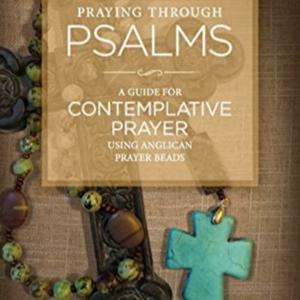
If you are new to praying with beads you can learn more about them by returning to the introduction in this podcast or in the book "Praying through Psalms: A Guide to Contemplative Prayer Using Anglican Prayer Beads."
Also on the YouTube channel "Cindy Hamilton, Praying Psalms." You will find videos praying the Psalms and how to make prayer beads.
WHAT A GREAT WAY TO BEGIN THE NEW YEAR, CRYING OUT TO GOD FOR HELP!! Nothing is left out of this magnificent lament: to you I lift up my soul, let me not be put to shame, teach me your paths, make me to know your ways, remember your mercy, bring me out of my distresses, consider my affliction and my trouble, and forgive all my sins. Amen.
What part of this psalm will you carry with you today? Will it be to remember that the friendship of the Lord belongs to those who fear him? Or to beseech the Lord to guard your soul, or to ask him to deliver you? Or will it be that integrity will preserve you as you wait upon the Lord? Or another? All good prayer requests to guide your New Year.
PSALM 24 BEGINS with the reminder that "the earth is the Lord's;" he created it, he sustains it, he saves it, and he is the earth's owner. He is also the Creator of all who live on the earth. We depend on the Lord of heaven and earth because we live in his world.
The gates and the "everlasting doors" the writer of this psalm is referring to are both the entrance to the temple on Mt. Zion and the spiritual gates to God's heavenly kingdom. The gates are opened in recognition that the king of the earth has arrived.
Although this imagery is of a city and its gates, we can personalize this. Are there gates or entrances in your life that you joyfully open to let in the King of Glory? Is there a gate you have locked that the Lord is asking you to open for him? (Mays 119, 122).
What a great reminder on this Christmas Day that the earth is the Lord's! Let each of us open the gates of our hearts to let him come in.
PSALM 23 IS WRITTEN IN METAPHOR. When we look with our Christian lens, we easily see Jesus in this poem written so long ago. This poem can be both personal and a remembrance of how God cared for the nation of Israel.
In John 10:11 Jesus says, "I am the good shepherd." Christians know that Jesus restores our souls and leads us in the way of righteousness. Jesus is with us in our troubles, and it is he who prepares a (Eucharist) table for us in the presence of evil, even as he cares for us with his steadfast love all the days of our lives.
A softcover of the book 'PRAYING THROUGH PSALMS A Guide for Contemplative Prayer Using Anglican Prayer Beads' can be found HERE.
BOTH PSALM 19 AND PSALM 119 instruct us that the Word of the Lord is the best place to learn the sacred way of living.
James L. Mays says of this psalm, "The world (gives witness) to God. The creation manifests the glory of its creator. The psalm offer us...a vision of poetic imaginative personification. It is based on the notion, not uncommon in biblical thinking, that every created thing has the capacity of a creature to acknowledge its originator" (20).
In support of Mays' interpretation, Romans 1:19-20 says, "For what can be known about God is plain to them, because God has shown it to them. For his invisible attributes, namely, his eternal power and divine nature have been clearly perceived, ever since the creation of the world, in the things that have been made. So they are without excuse."
THIS IS ONE of my favorite psalms. I hope you will read the whole psalm and savor the hyperbole.
Consider the second set of beads: "He sent from on high, he took me; he drew me out of many waters. He rescued me from my strong enemy." Your strong enemy could be a life event, emotions that are disproportionate to the circumstances in your life, or even a spiritual power of darkness. Imagine the Lord reaching down and rescuing you from the waters of your strong enemy. Let the Lord embrace you, hold you, and breathe rescue into your soul.
Look also at the third set of beads: "He brought me out into a broad place; he rescued me, because he delighted in me." Do you believe that God delights in you? Spend some time with the Lord and ask him to help your unbelief. Ask the Lord what he thinks of you and how he describes you. Listen. Write in your journal.
You can find the book PRAYING THROUGH PSALMS: A Guide for Contemplative Prayer Using Anglican Prayer Beads HERE:
https://www.amazon.com/Praying-Through-Psalms-Contemplative-Anglican/dp/0999290436/ref=sr_1_1?crid=1UY5HLVNKQ17Q&keywords=praying+through+psalms+cindy+hamilton&qid=1700326707&sprefix=cindy+hamilto%2Caps%2C126&sr=8-1
THE THIRD SET of seven beads in the psalm says, "keep me as the apple of your eye." Do you have trouble believing you are the apple of the Father's eye? If so, begin journaling phrases and verses in the following meditations that confirm this is true. Remember that Christ died for you and allow yourself to enjoy the truth that God has deemed you worthy of that sacrifice. Indeed, only for the "apple of God's eye" would Christ die.
If the Psalmist teaches us anything, it is that we will have trouble. Jesus confirms this reality in John 16:33. In the midst of the trouble, the writers of the Psalms show us how to cry out to God in our grief and our sorrow, and God answers. David Muyskens writes, "Prayer did not deliver me from grief but grief became my prayer." This pathway of consolation is what the Psalmist expresses, as well as the hope of glory in God's presence.
PSALM 13 is the shortest prayer for help in the Psalter. It provides a wonderful framework for our cries to the Lord. It begins with "How long, O Lord?" I find I often approach the Lord in this way Usually my enemy is my own sin, sin I have struggled with in varying degrees for years. The Psalmist continues with what will happen if the Lord does not rescue him. He closes with wonderful statements of faith and expectation:
"But I trust in your unfailing love; my heart rejoices in your salvation. I will sing to the Lord, for he has been good to me." These true statements of faith make my heart soar.
Let's join the writer of the psalm and trust God's unfailing love and salvation. Let us remember all his goodness to us.
Dear Friends,
I am re-releasing the psalms from 'Praying through Psalms...' Thank you for praying with me in this selection prayers.
In Psalm 6 you will find the psalmist describing flooding his bed with tears, you may or may not relate to this particular description of being woken in the middle of the night. But anxious thoughts may wake you in the night and cause your heart to mourn, then with the Psalmist pray, "Save my life; deliver me for the sake of your steadfast love."
From the publisher's feed