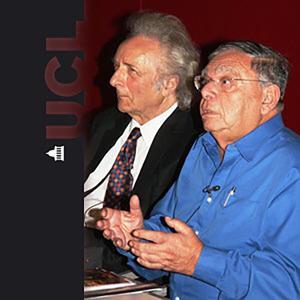
Professor Salvador Moncada - Audio

Professor Salvador Moncada - Audio

By UCL
Download on the App Store

Professor Salvador Moncada - Audio episodes

  • 1. Growing up in Central America
    From 1975 to 1995, Professor Moncada worked at the Wellcome Research Laboratories, first as Head of Prostaglandin Research and then as Director of Research. He described the structure of prostacyclin, which acts as an effective vasodilator and also prevents blood platelets from clumping. In 1980 came the discovery by Robert Furchgott of ‘endothelium-derived relaxing factor’ (EDRF) which causes smooth muscle in the vessel walls to relax. Moncada and his team showed that EDRF was, in fact, Nitric oxide, which has since become appreciated as a neurotransmitter, a modulator of inflammation and a sensor of cellular distress as well as a regulator of vessel tone. Nitric oxide is both the target and effector of a range of compounds now being used for the treatment of cardiovascular and rheumatic diseases. Professor Moncada was appointed Director of the Wolfson Institute for Biomedical Research at University College in 1995. He has won numerous awards from the international scientific community including a Dart/NYU Biotechnology Achievement Award, the Prince of Asturias Scientific and Technological Research Award and the Dr AH Heineken Prize for Medicine from the Royal Netherlands Academy of Arts and Science.

    3 min
  • 23. Mitochondria: new ideas about the way cells use energy sources
    From 1975 to 1995, Professor Moncada worked at the Wellcome Research Laboratories, first as Head of Prostaglandin Research and then as Director of Research. He described the structure of prostacyclin, which acts as an effective vasodilator and also prevents blood platelets from clumping. In 1980 came the discovery by Robert Furchgott of ‘endothelium-derived relaxing factor’ (EDRF) which causes smooth muscle in the vessel walls to relax. Moncada and his team showed that EDRF was, in fact, Nitric oxide, which has since become appreciated as a neurotransmitter, a modulator of inflammation and a sensor of cellular distress as well as a regulator of vessel tone. Nitric oxide is both the target and effector of a range of compounds now being used for the treatment of cardiovascular and rheumatic diseases. Professor Moncada was appointed Director of the Wolfson Institute for Biomedical Research at University College in 1995. He has won numerous awards from the international scientific community including a Dart/NYU Biotechnology Achievement Award, the Prince of Asturias Scientific and Technological Research Award and the Dr AH Heineken Prize for Medicine from the Royal Netherlands Academy of Arts and Science.
    4 min
  • 22. Mitochondria: nitric oxide as modulator of oxygen consumption
    From 1975 to 1995, Professor Moncada worked at the Wellcome Research Laboratories, first as Head of Prostaglandin Research and then as Director of Research. He described the structure of prostacyclin, which acts as an effective vasodilator and also prevents blood platelets from clumping. In 1980 came the discovery by Robert Furchgott of ‘endothelium-derived relaxing factor’ (EDRF) which causes smooth muscle in the vessel walls to relax. Moncada and his team showed that EDRF was, in fact, Nitric oxide, which has since become appreciated as a neurotransmitter, a modulator of inflammation and a sensor of cellular distress as well as a regulator of vessel tone. Nitric oxide is both the target and effector of a range of compounds now being used for the treatment of cardiovascular and rheumatic diseases. Professor Moncada was appointed Director of the Wolfson Institute for Biomedical Research at University College in 1995. He has won numerous awards from the international scientific community including a Dart/NYU Biotechnology Achievement Award, the Prince of Asturias Scientific and Technological Research Award and the Dr AH Heineken Prize for Medicine from the Royal Netherlands Academy of Arts and Science.
    4 min
  • 6. Blood platelet function - why aspirin causes bleeding
    From 1975 to 1995, Professor Moncada worked at the Wellcome Research Laboratories, first as Head of Prostaglandin Research and then as Director of Research. He described the structure of prostacyclin, which acts as an effective vasodilator and also prevents blood platelets from clumping. In 1980 came the discovery by Robert Furchgott of ‘endothelium-derived relaxing factor’ (EDRF) which causes smooth muscle in the vessel walls to relax. Moncada and his team showed that EDRF was, in fact, Nitric oxide, which has since become appreciated as a neurotransmitter, a modulator of inflammation and a sensor of cellular distress as well as a regulator of vessel tone. Nitric oxide is both the target and effector of a range of compounds now being used for the treatment of cardiovascular and rheumatic diseases. Professor Moncada was appointed Director of the Wolfson Institute for Biomedical Research at University College in 1995. He has won numerous awards from the international scientific community including a Dart/NYU Biotechnology Achievement Award, the Prince of Asturias Scientific and Technological Research Award and the Dr AH Heineken Prize for Medicine from the Royal Netherlands Academy of Arts and Science.
    3 min
  • 4. Prostaglandins and Aspirin - the importance of bioassay
    From 1975 to 1995, Professor Moncada worked at the Wellcome Research Laboratories, first as Head of Prostaglandin Research and then as Director of Research. He described the structure of prostacyclin, which acts as an effective vasodilator and also prevents blood platelets from clumping. In 1980 came the discovery by Robert Furchgott of ‘endothelium-derived relaxing factor’ (EDRF) which causes smooth muscle in the vessel walls to relax. Moncada and his team showed that EDRF was, in fact, Nitric oxide, which has since become appreciated as a neurotransmitter, a modulator of inflammation and a sensor of cellular distress as well as a regulator of vessel tone. Nitric oxide is both the target and effector of a range of compounds now being used for the treatment of cardiovascular and rheumatic diseases. Professor Moncada was appointed Director of the Wolfson Institute for Biomedical Research at University College in 1995. He has won numerous awards from the international scientific community including a Dart/NYU Biotechnology Achievement Award, the Prince of Asturias Scientific and Technological Research Award and the Dr AH Heineken Prize for Medicine from the Royal Netherlands Academy of Arts and Science.
    5 min
  • 7. Discovering thromboxane synthase, and a new enzyme
    From 1975 to 1995, Professor Moncada worked at the Wellcome Research Laboratories, first as Head of Prostaglandin Research and then as Director of Research. He described the structure of prostacyclin, which acts as an effective vasodilator and also prevents blood platelets from clumping. In 1980 came the discovery by Robert Furchgott of ‘endothelium-derived relaxing factor’ (EDRF) which causes smooth muscle in the vessel walls to relax. Moncada and his team showed that EDRF was, in fact, Nitric oxide, which has since become appreciated as a neurotransmitter, a modulator of inflammation and a sensor of cellular distress as well as a regulator of vessel tone. Nitric oxide is both the target and effector of a range of compounds now being used for the treatment of cardiovascular and rheumatic diseases. Professor Moncada was appointed Director of the Wolfson Institute for Biomedical Research at University College in 1995. He has won numerous awards from the international scientific community including a Dart/NYU Biotechnology Achievement Award, the Prince of Asturias Scientific and Technological Research Award and the Dr AH Heineken Prize for Medicine from the Royal Netherlands Academy of Arts and Science.
    4 min
  • 3. Professor Salvador Moncada - Starting work in John Vane's_laboratory, 1971
    From 1975 to 1995, Professor Moncada worked at the Wellcome Research Laboratories, first as Head of Prostaglandin Research and then as Director of Research. He described the structure of prostacyclin, which acts as an effective vasodilator and also prevents blood platelets from clumping. In 1980 came the discovery by Robert Furchgott of ‘endothelium-derived relaxing factor’ (EDRF) which causes smooth muscle in the vessel walls to relax. Moncada and his team showed that EDRF was, in fact, Nitric oxide, which has since become appreciated as a neurotransmitter, a modulator of inflammation and a sensor of cellular distress as well as a regulator of vessel tone. Nitric oxide is both the target and effector of a range of compounds now being used for the treatment of cardiovascular and rheumatic diseases. Professor Moncada was appointed Director of the Wolfson Institute for Biomedical Research at University College in 1995. He has won numerous awards from the international scientific community including a Dart/NYU Biotechnology Achievement Award, the Prince of Asturias Scientific and Technological Research Award and the Dr AH Heineken Prize for Medicine from the Royal Netherlands Academy of Arts and Science.
    3 min
  • 24. Wellcome's important characteristics
    From 1975 to 1995, Professor Moncada worked at the Wellcome Research Laboratories, first as Head of Prostaglandin Research and then as Director of Research. He described the structure of prostacyclin, which acts as an effective vasodilator and also prevents blood platelets from clumping. In 1980 came the discovery by Robert Furchgott of ‘endothelium-derived relaxing factor’ (EDRF) which causes smooth muscle in the vessel walls to relax. Moncada and his team showed that EDRF was, in fact, Nitric oxide, which has since become appreciated as a neurotransmitter, a modulator of inflammation and a sensor of cellular distress as well as a regulator of vessel tone. Nitric oxide is both the target and effector of a range of compounds now being used for the treatment of cardiovascular and rheumatic diseases. Professor Moncada was appointed Director of the Wolfson Institute for Biomedical Research at University College in 1995. He has won numerous awards from the international scientific community including a Dart/NYU Biotechnology Achievement Award, the Prince of Asturias Scientific and Technological Research Award and the Dr AH Heineken Prize for Medicine from the Royal Netherlands Academy of Arts and Science.
    3 min
  • 21. Septic shock
    From 1975 to 1995, Professor Moncada worked at the Wellcome Research Laboratories, first as Head of Prostaglandin Research and then as Director of Research. He described the structure of prostacyclin, which acts as an effective vasodilator and also prevents blood platelets from clumping. In 1980 came the discovery by Robert Furchgott of ‘endothelium-derived relaxing factor’ (EDRF) which causes smooth muscle in the vessel walls to relax. Moncada and his team showed that EDRF was, in fact, Nitric oxide, which has since become appreciated as a neurotransmitter, a modulator of inflammation and a sensor of cellular distress as well as a regulator of vessel tone. Nitric oxide is both the target and effector of a range of compounds now being used for the treatment of cardiovascular and rheumatic diseases. Professor Moncada was appointed Director of the Wolfson Institute for Biomedical Research at University College in 1995. He has won numerous awards from the international scientific community including a Dart/NYU Biotechnology Achievement Award, the Prince of Asturias Scientific and Technological Research Award and the Dr AH Heineken Prize for Medicine from the Royal Netherlands Academy of Arts and Science.
    5 min
  • 20. Inflammation, rheumatoid arthritis and tissue damage
    From 1975 to 1995, Professor Moncada worked at the Wellcome Research Laboratories, first as Head of Prostaglandin Research and then as Director of Research. He described the structure of prostacyclin, which acts as an effective vasodilator and also prevents blood platelets from clumping. In 1980 came the discovery by Robert Furchgott of ‘endothelium-derived relaxing factor’ (EDRF) which causes smooth muscle in the vessel walls to relax. Moncada and his team showed that EDRF was, in fact, Nitric oxide, which has since become appreciated as a neurotransmitter, a modulator of inflammation and a sensor of cellular distress as well as a regulator of vessel tone. Nitric oxide is both the target and effector of a range of compounds now being used for the treatment of cardiovascular and rheumatic diseases. Professor Moncada was appointed Director of the Wolfson Institute for Biomedical Research at University College in 1995. He has won numerous awards from the international scientific community including a Dart/NYU Biotechnology Achievement Award, the Prince of Asturias Scientific and Technological Research Award and the Dr AH Heineken Prize for Medicine from the Royal Netherlands Academy of Arts and Science.
    5 min

About Professor Salvador Moncada - Audio

From the publisher's feed

From 1975 to 1995, Professor Moncada worked at the Wellcome Research Laboratories, first as Head of Prostaglandin Research and then as Director of Research. He described the structure of prostacyclin,…

More shows like Professor Salvador Moncada - Audio

#MadeAtUCL by UCL

#MadeAtUCL

1 Listeners

What Darwin got wrong - Audio by UCL

What Darwin got wrong - Audio

0 Listeners

Angels & Demons: The Real Physics - Audio by UCL

Angels & Demons: The Real Physics - Audio

0 Listeners

Angels, Putti, Dragons and Fairies: A Biological Dissection - Video by UCL

Angels, Putti, Dragons and Fairies: A Biological Dissection - Video

0 Listeners

Climate Change: The biggest global threat of the 21st century? - video by UCL

Climate Change: The biggest global threat of the 21st century? - video

0 Listeners

UCL-China Research Festival - Audio by UCL

UCL-China Research Festival - Audio

0 Listeners

City Visions: UCL Urban Laboratory Launch - Audio by UCL

City Visions: UCL Urban Laboratory Launch - Audio

0 Listeners

UCL Grand Round - Bench to Bedside - Audio by UCL

UCL Grand Round - Bench to Bedside - Audio

0 Listeners

Boxing: A Cultural History - Video by UCL

Boxing: A Cultural History - Video

0 Listeners

Cosmological significance and Detection of Gravitational Waves - audio by UCL

Cosmological significance and Detection of Gravitational Waves - audio

0 Listeners

Conversations in Applied Studies and Global Citizenship - Audio by UCL

Conversations in Applied Studies and Global Citizenship - Audio

0 Listeners

UCL: The Provost’s View - Audio by UCL

UCL: The Provost’s View - Audio

0 Listeners

Genomics, Identity and Health: Challenges and Opportunities for Interdisciplinary Discussion - Video by UCL

Genomics, Identity and Health: Challenges and Opportunities for Interdisciplinary Discussion - Video

0 Listeners

Practicing 18th-Century Science Today - Audio by UCL

Practicing 18th-Century Science Today - Audio

0 Listeners

Seedcamp 2008 - Audio by UCL

Seedcamp 2008 - Audio

0 Listeners

The Fragile Democracy of Somaliland - Audio by UCL

The Fragile Democracy of Somaliland - Audio

2 Listeners

Patent Claim Interpretation - Audio by UCL

Patent Claim Interpretation - Audio

0 Listeners

Emotion in Literature and the Brain - Audio by UCL

Emotion in Literature and the Brain - Audio

0 Listeners

Assisted Suicide in Britain - UCL & Bindman Debate 2009 - Video by UCL

Assisted Suicide in Britain - UCL & Bindman Debate 2009 - Video

0 Listeners

Pragmatic Approaches to the Problems of the Homeless - Making Things Better - Audio by UCL

Pragmatic Approaches to the Problems of the Homeless - Making Things Better - Audio

0 Listeners