
Sign up to save your podcasts
Or



When was the last time life actually slowed down?
In this episode, I want you to imagine that somebody gives you $1,000 every single morning. The catch? Whatever you don't spend by midnight disappears. You can't save it, you can't borrow against it, and you can't get back what you wasted the day before. Now imagine spending that money without ever looking at where it goes. Sounds ridiculous, right? But we do something remarkably similar with our time.
We tell ourselves we'll do it when we find the time. When work slows down. When the business is more established. When there are fewer responsibilities. But life rarely sends you an invitation saying it's finally convenient to start living differently. Cut off one head of the Hydra and three more grow back.
We get into the difference between finding time and making time, why your calendar and your credit card statement would tell a stranger your real priorities, and why every yes is also a no. I talk about opportunity cost and extreme ownership. Why rest matters, but unconsciously giving away hours you meant to spend is something else. And why most of the biggest progress in my life came from what I let go of, not what I added.
Then something practical you can try. Look at your last seven days. Not what you intended to do. What you actually did. What did you repeatedly make room for? What did you keep postponing?
We don't find time for the things that matter. We make decisions that give them a place in our lives. So what's the one thing you say matters that hasn't been getting your attention?
Are you waiting to feel motivated before you start?
In this episode, I want you to imagine two people standing at the bottom of the same mountain. Both want the summit. Both know it's going to be hard. One of them decides to wait until they feel motivated. The other one doesn't feel it either, but they start climbing anyway. The view changes. They see progress. And the motivation they didn't have at the bottom shows up on the way up. The first one? Still at the bottom. Still waiting.
We treat motivation like something we need before we can start. Most of the time, it shows up after we start. I grew up with a saying in the dojo: motion creates emotion.
We get into why motivation is an emotion that comes and goes, and why waiting on it might be the very thing keeping you stuck. There's a concept in psychology called behavioral activation: meaningful action can improve your mood and motivation without waiting for those feelings to improve first.
I also get into the difference between making a commitment and expressing a preference. Why the plateaus are the real test. And why discipline isn't doing the maximum no matter what. It's taking ownership of the appropriate action. Then we talk about time, the great equalizer. Show me where you spend your time and your money, and I'll tell you your real priorities.
If you've already decided something matters, why are you asking your emotions for permission every single day?
Have you ever been furious at somebody and then found out there was more to the story?
In this episode, I go back to an old Taoist story about a man crossing a river in a small boat. Another boat crashes into his and he gets furious. He's yelling, demanding to know what kind of idiot would be so careless. Then he looks inside. The boat's empty. Nothing about the collision changed. The only thing that changed was the story he was telling himself about who was responsible.
How often do we do that? The guy who cuts you off on the freeway. The text that doesn't get answered. The person in the bunk next to you. The people closest to you.
We talk about the fundamental attribution error, and why we give ourselves context and give everybody else a character judgment. I get into why curiosity is such an underrated leadership skill, the frog and the scorpion, what my instructor taught me about four-year-olds, and the difference between anger that's valid and anger that's useful.
Sometimes people really are careless, and you can still set a boundary. But not everything that affects you is about you.
The next time somebody frustrates you, what would change if you imagined that boat was empty?
Have you ever wanted something so badly that the wanting started getting in the way?
In this episode, I go back to a story from Zen archery about a student who keeps aiming for the bullseye, and the harder he tries, the more tense he gets. His teacher keeps bringing him back to the same lesson. Stop obsessing over where the arrow lands and learn to shoot the arrow.
I share where I first found this idea, growing up in a martial arts school and reading Zen in the Art of Archery, and why the target gives you direction while the process decides whether you get there. We talk about flow, mushin, and wu wei, why overthinking something you've already trained can make you worse, and how the same thing shows up with the scale, your business, your confidence, and even your conversations with the people closest to you.
Goals still matter. The archer still needs a target. But most of your time is spent in the ordinary days getting your reps in, and that's where you actually have control.
What's one goal you're chasing right now, and what would it look like to give your full attention to the next rep?
If you could sit across from the person you were 10 years ago, would they recognize you?
In this episode, I start with an ancient Greek thought experiment called the Ship of Theseus. Every plank, sail, and mast gets replaced over time until nothing original is left. Is it still the same ship?
I use that question to look at identity. Your body, your beliefs, your relationships, and your priorities all change, and yet you still call yourself the same person. I share what it was like to step away from the fire service after years of it being a big part of who I was, what I carried forward into Reclaim, and why your values can stay while the way you live them keeps evolving.
Life is going to change you no matter what. The question is whether you're going to participate in that change.
What would you want to tell the version of you from 10 years ago?
What good is building a life you’re proud of if you’re too exhausted to enjoy it?
In this episode, I’m talking about how taking care of your body changes the way you experience your life. Your patience, your relationships, your ability to handle stress, and the way you see yourself all come into it.
I share what my time in the fire service taught me about trying to solve a recovery problem with more effort, and why training harder wasn’t the answer I needed. We get into the minimum effective dose, the lessons fitness can teach you about yourself, and what it means to build habits that support the rest of your life.
Taking care of yourself should give you more capacity to live, connect, and show up for the people you love. That’s the reason to do it.
What do you want your body to help you experience?
What happened to all the real men?
A question I was asked on a service trip to Oaxaca turned into a much bigger conversation about masculinity, responsibility, and the examples we pass down.
In this episode, I share my perspective on four things shaping men today: our environment, our upbringing, the messages we absorb from society, and the life skills we were never taught. I also talk about what martial arts, fitness, and service taught me about becoming grounded, capable, and willing to lead.
Getting older doesn't automatically teach us how to handle conflict, keep our word, or take responsibility. Those are things we have to practice.
What are you teaching the next generation through the way you live?
Why is it so hard to sit with ourselves? Sometimes the hardest part of slowing down is having to hear what we’ve been avoiding.
In this episode, I use Plato’s cave to look at the stories we carry about who we are. We talk about why meditation can feel uncomfortable, how our beliefs shape our decisions, and what happens when we realize we can change.
One of my students asked what to do with the years spent believing something that wasn’t true. That question gets at something I think a lot of us struggle with: how to hold the lesson without treating the time as wasted.
What comes up for you when you sit still long enough to listen?
How many things have you already decided ruined your life when you haven’t seen how the story ends?
In this episode, I explore the story of the Chinese farmer and why we’re so quick to label what happens to us as success, failure, good luck or bad luck.
I share how my experience in the fire service shaped the work I do today, and how reaching a business goal I’d spent years pursuing gave me a life I didn’t actually want.
We talk about the need for certainty, the pressure to put a positive spin on painful experiences, and how to take the next useful step when you don’t know what comes next.
What’s one chapter of your life you might be judging before it’s finished?
How many times have we started something meaningful, made a little progress, and then decided one difficult day meant we needed to begin again?
In this episode of Project RECLAIM, we explore why a fresh start can feel so appealing, and how perfection can keep us dismantling work that still matters. Through the story of a man who never finishes his boat, we look at the difference between fixing a problem and turning it into a judgment about who we are.
We talk about flexible consistency, honest adjustments, and learning to return after an interruption. We also consider when changing course is the responsible choice, and how to take a useful next step with the time and energy we actually have.
What is one thing in your life that needs a repair rather than another beginning?
From the publisher's feed
You are the project. And the project is never finished.
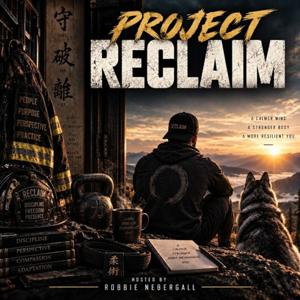
Project Reclaim is a podcast about becoming someone you’re proud to be physically, mentally, and personally.
Hosted by Robbie…
Drawing from the fire service, martial arts, Eastern philosophy, Stoicism, coaching, and his own mistakes along the way, Robbie challenges the idea that becoming better means constantly doing more.
Sometimes growth means pushing harder. Sometimes it means letting go. Sometimes it means rebuilding your standards, taking care of your body, changing the way you think, or finally admitting that the life you’ve built isn’t the life you want.
There is no final version of you waiting at the finish line.
It's time to reclaim it.