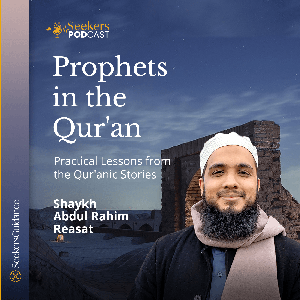
Prophets in the Qur'an: Practical Lessons from the Qur'anic Stories

Prophets in the Qur'an: Practical Lessons from the Qur'anic Stories

By SeekersGuidance.orgReligion & SpiritualityIslam
Download on the App Store

Prophets in the Qur'an: Practical Lessons from the Qur'anic Stories episodes

  • Embracing Excellence: 30 Steps on the Straight Path – 04–Inner and Outer Self , from Imam Haddad’s Book of Assistance –Ustadh Amjad Tarsin
    Ustadh Amjad continues exploring Imam Haddad's Book of Assistance, a concise manual on the path to the Divine. In this section, he explains how the outward and inward aspects of faith fuse together. He highlights a prayer of the Prophet Muhammad (Allah bless him and give him peace) that Allah make his inward be better than his outward and his outward virtuous. He cautions against adorning one's outward while neglecting to purify oneself inwardly. In the same vein, he warns against occupying oneself with one's public appearance rather than aiming for the sincerity of devotion, for instance in our recitation of the Qur'an.


    This is part of the series presented by SeekersGuidance Canada in Ramadan 2019.
    28 min
  • Embracing Excellence: 30 Steps on the Straight Path – 03 –Vigilance , from Imam Haddad’s Book of Assistance – Shaykh Faraz Rabbani
    Shaykh Faraz Rabbani continues the series "Embracing Excellence: 30 Steps on the Straight Path" covering Imam Haddad’s manual The Book of Assistance. In this session, he looks at the third chapter, on Vigilance (muraqaba), which, he explains, is consciousness that Allah sees you, is with you, and is constantly aware of everything you do. Shaykh Faraz offers an explanation of the six solutions given by Imam Haddad for laziness in performing acts of worship and leaving sin. In addition, he explains how the awareness that God sees one leads to the beholding of the Divine.


    This is part of the series presented by SeekersGuidance Canada in Ramadan 2019
    45 min
  • Embracing Excellence: 30 Steps on the Straight Path – 02 – Intention , from Imam Haddad’s Book of Assistance – Ustadh Amjad Tarsin
    Ustadh Amjad Tarsin continues the series "Embracing Excellence: 30 Steps on the Straight Path" covering Imam Haddad’s manual The Book of Assistance. In this session, he looks at the second chapter, on Intention. He sheds light on the centrality of intention, its virtues, and how it can be used to bring life to our actions. Ustadh Amjad gives a "spiritual pro tip" on how to magnify one's actions through multiple intentions. He reminds of the great opportunity of the reward granted by Allah through intentions for good works. He also sheds light on the different types of intention.

    This is part of the series presented by SeekersGuidance Canada in Ramadan 2019
    32 min
  • Embracing Excellence: 30 Steps on the Straight Path – 01 – Certainty, from Imam Haddad’s Book of Assistance – Ustadh Amjad Tarsin
    Ustadh Amjad Tarsin covers the first chapter of Imam Haddad’s manual The Book of Assistance, on Certainty. He explains how we can nurture sincerity through the reflection in our lives and to our how this applies to our recitation of the Quran in Ramadan. Ustadh Amjad explains why certainty is seen as the first step, not the final, in this outline of the path to Allah. He also describes the three levels of certainty of believers outlined in the text.
     

    This is part of the series presented by SeekersGuidance Canada in Ramadan 2019, “Embracing Excellence - 30 Steps on the Straight Path” based on Imam Haddad’s Book of Assistance
    47 min
  • 02- The Art of Reading- Shaykh Ahmed Hussein El Azhary
    In this new podcast series, Shaykh Ahmed Hussein El Azhary will discuss why the art of reading is critical for students of knowledge to master. One of the greatest barriers in mastering a science is the inability to read with structure and comprehension. In this series, Shaykh Ahmed will provide students with a detailed approach to rectifying this problem.
    In addition to offering practical tips and guidance in improving one’s reading and learning skills, Shaykh Ahmed will also elaborate on the development of the instrumental (foundational) sciences within the Islamic tradition and how they compare to medieval and modern theories of literary comprehension.
    In this second episode of The Art of Reading, Nabiel Mohamed asks Shaykh Ahmed El Azhary to discuss the historical development of Adab al Muṭāla' as a genre within the classical tradition, and the various factors which resulted in its emergence as a science. Furthermore, Shaykh Ahmed El Azhary discusses the various theories related to deep reading within the Islamic tradition, and he elaborates on two methodological examples of how to read and approach texts.


    Biography of Shaykh Ahmed Hussein El Azhary:

    Shaykh Ahmed El Azhary is a researcher in Islamic intellectual history and a teacher of Islamic traditional sciences. He’s currently a teacher of Hadith, Usūl, Logic, and Kalam at Rawdatul-Na`īm under the supervision of Habib `Ali al-Jifrī; and at Madyafat Shaykh Ismaīl Sadiq al-`Adawī (RA), a prominent learning center by al-Azhar Mosque in Cairo.

    Formerly, Shaykh Ahmed worked as a Lead Researcher at Tabah Foundation. He was appointed by Habib `Ali al-Jifrī to architect the philosophical framework of Suaal initiative – an initiative concerned with modeling an Islamic philosophical response to contemporary existential questions, supervised by Shaykh `Ali Jumu`ah, Habib `Umar and Shaykh Usama al-Azhary. Shaykh Ahmed continues to participate in Suaal initiative through essays, public lectures, and workshops.

    Shaykh Ahmed studied Anthropology at American University in Cairo and received his training in Leadership Communication from Tulane University and The University of Alabama at Birmingham. He is also a life-long learner. He holds a diversified portfolio of almost 50 certificates in a variety of subjects – extending from Teaching Character and Clinical Psychology of Children and Young People to Complexity Theory, Model Thinking and Conflict Analysis.

    Shaykh Ahmed began his journey of studying traditional sciences about 20 years ago. In addition to studying with scholars from al-Azhar, he had the privilege of studying with visiting scholars from Algeria and India in a one-on-one format and was thus given an exceptional opportunity to study and discuss advanced-level texts of different sorts and over a long period of time. Shaykh Ahmed has more than 70 Ijazas from scholars from all over the Muslim world.02-
    34 min
  • Fasting is for Me, 11 Lessons on the Virtues of Fasting – Shaykh Faraz Rabbani
    In this talk and presentation, Shaykh Faraz Rabbani expands on the various virtues and rewards of fasting. Shaykh Faraz bases his presentation on the seminal work (Siraj al – Talibeen) of the great Andalusian scholar, Qadi Abū Bakr ibn al-'Arabī.


    In this work, Qadi Abū Bakr discusses and describes the numerous qualities of a believer. One of these qualities is the state of fasting. Fasting is considered a prime act of the believer because it is a station of gratitude. Its reward is known only to Allah.


    Abu Hurairah (may Allah be pleased with him) narrated that the Messenger of Allah (peace be upon him) said: “Every deed of the son of Adam will be multiplied, a Hasanah(good deed) will be multiplied from ten to seven hundred times. Allah, the Mighty and Sublime, said: ‘Except fasting. It is for Me and I shall reward for it. He gives up his desires and his food for my sake.’ The fasting person will have two moments of joy: Joy when he breaks his fast, and joy when he meets his Lord. And indeed the smell of his mouth is better to Allah than the fragrance of musk.” [The Book of Fasting: Sahih Muslim]

     Based on the above narration, Qadi Abū Bakr lists 11 virtues and merits of fasting. Shaykh Faraz expounds on these 11 virtues and why fasting has a unique station with Allah. Furthermore, he reminds the audience that the station of fasting can be elevated if one refrains from backbiting, trivial discussions, and vulgar talk. The aspiration of a believer should be to attain complete consciousness of Allah.


    In closing, Shaykh Faraz advises the audience of increasing in supererogatory fasts, and the importance of being consistent when trying to achieve a worthy goal and objective.
    59 min
  • When Was the First Ramadan? Shaykh Hamza Karamali
    Fasting became obligatory in stages -- first, the Prophet (peace be upon him) commanded his Companions (Allah be pleased with them) to fast the day of 'Ashura; then, Allah Most High revealed the verses that made it obligatory to fast Ramadan, but He gave the Companions (Allah be pleased with them) the option to pay a fidya; then, He revealed the verses that removed this option to pay a fidya.
    8 min
  • Answering a Call to Prayer and Its Lessons- Shaykh Faraz Rabbani
    In this Khutba talk, Shaykh Faraz Rabbani reminds us of the importance of showing gratitude and thanks for the immense blessings that Allah has bestowed upon us. The call of prayer (athan) is one such blessing which is laden with meanings.


    Our nature is such that we tend to focus on past events or to preoccupy ourselves with assumptions of the future. We end up forgetting the importance of the present and the innumerable blessings Allah has placed within it for each of us. With Ramadan on our doorsteps, it is incumbent that we change our mindsets and become mindful of what Allah has provided for us, and then show sincere gratitude in our actions. Become mindful of what you have now, as there is no guarantee that you will live to see the immediate or distant future.


    “If you want to make the most of life then know that the greatest moment that you have is the moment that you are in.”

    Shaykh Faraz emphasizes that one of the greatest blessings that we ignore is the call to prayer (athan). The call to prayer has rights upon us that we have to fulfill. It is a gift from Allah that we should not refuse at any cost. However, many Muslims in today’s time tend to ignore its call and importance. By fulfilling the rights of the call of prayer, we have an opportunity to benefit from its external and internal realities, and to manifest the epitome of its call – success.


    Shaykh Faraz reiterates that whatever Allah has obligated us within our daily lives is only in reality a pathway to Paradise for us. Do not look at religious obligations as a burden, rather realize that God obligates success for us through his religious commands.


    Shaykh Faraz concludes the Khutba by advising the congregation to make the most of the month of Ramadan by learning about its virtues and benefits.
    Delivered during the SeekersGuidance Tour of Vancouver, British Columbia, Canada.
    26 min
  • 01- The Art of Reading – Shaykh Ahmed Hussein El Azhary
    In this new podcast series, Shaykh Ahmed Hussein El Azhary will discuss why the art of reading is critical for students of knowledge to master. One of the greatest barriers in mastering a science is the inability to read with structure and comprehension. In this series, Shaykh Ahmed will provide students with a detailed approach to rectifying this problem.
    In addition to offering practical tips and guidance in improving one's reading and learning skills, Shaykh Ahmed will also elaborate on the development of the instrumental (foundational) sciences within the Islamic tradition and how they compare to medieval and modern theories of literary comprehension.
    In this episode, Dr. Yusuf Patel asks Shaykh Ahmed Hussein El Azhary why many students of knowledge are not able to read and master texts that they have studied.
    In addition to answering the above question, Shaykh Ahmed discusses the various phases of mastery that students should attain during their studies, and how the science of learning developed in the classical Islamic period and in modern times.
    Biography of Shaykh Ahmed Hussein El Azhary:

    Shaykh Ahmed El Azhary is a researcher in Islamic intellectual history and a teacher of Islamic traditional sciences. He’s currently a teacher of Hadith, Usūl, Logic, and Kalam at Rawdatul-Na`īm under the supervision of Habib `Ali al-Jifrī; and at Madyafat Shaykh Ismaīl Sadiq al-`Adawī (RA), a prominent learning center by al-Azhar Mosque in Cairo.

    Formerly, Shaykh Ahmed worked as a Lead Researcher at Tabah Foundation. He was appointed by Habib `Ali al-Jifrī to architect the philosophical framework of Suaal initiative – an initiative concerned with modeling an Islamic philosophical response to contemporary existential questions, supervised by Shaykh `Ali Jumu`ah, Habib `Umar and Shaykh Usama al-Azhary. Shaykh Ahmed continues to participate in Suaal initiative through essays, public lectures, and workshops.

    Shaykh Ahmed studied Anthropology at American University in Cairo and received his training in Leadership Communication from Tulane University and The University of Alabama at Birmingham. He is also a life-long learner. He holds a diversified portfolio of almost 50 certificates in a variety of subjects – extending from Teaching Character and Clinical Psychology of Children and Young People to Complexity Theory, Model Thinking and Conflict Analysis.

    Shaykh Ahmed began his journey of studying traditional sciences about 20 years ago. In addition to studying with scholars from al-Azhar, he had the privilege of studying with visiting scholars from Algeria and India in a one-on-one format and was thus given an exceptional opportunity to study and discuss advanced-level texts of different sorts and over a long period of time. Shaykh Ahmed has more than 70 Ijazas from scholars from all over the Muslim world.

    29 min
  • Ready for Ramadan: The Lessons of Mindfulness, Gratitude, Qur’an, Glorification, and Closeness in the Month of Fasting-Shaykh Faraz Rabbani
    Shaykh Faraz Rabbani shared five key spiritual lessons related to fasting and the month of Ramadan. These same lessons are a means to prepare for Ramadan and reflection upon changing our relationship with Allah.

    These lessons of fasting and Ramadan are taken from verses 183-187 of Sura al-Baqara, and are nurturing:

    (1) A living relationship with the Qur'an;
    (2) Mindfulness (taqwa) of Allah;
    (3) Gratitude (shukr);
    (4) Magnifying Allah (takbir), by making Allah the greatest concern in our lives; and
    (5) the most important--and ultimate--aim of fasting: realizing the reality of Allah's Closeness.

    This khutba was delivered at the Bosnian Islamic Centre, as part of SeekersGuidance Canada's community outreach and engagement.
    18 min

About Prophets in the Qur'an: Practical Lessons from the Qur'anic Stories

From the publisher's feed

This podcast looks at the lives of the Prophets, Allah bless them all and give them peace, with a focus on the practical lessons and benefit Allah placed within them for us. The series gives a brief…

More shows like Prophets in the Qur'an: Practical Lessons from the Qur'anic Stories

Nouman Ali Khan by Muslim Central

Nouman Ali Khan

887 Listeners

Stories of the Prophets by General Iq

Stories of the Prophets

241 Listeners