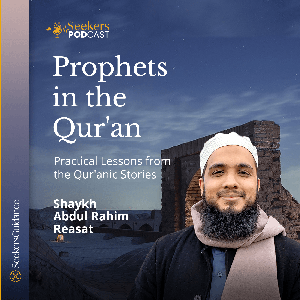
Prophets in the Qur'an: Practical Lessons from the Qur'anic Stories

Prophets in the Qur'an: Practical Lessons from the Qur'anic Stories

By SeekersGuidance.orgReligion & SpiritualityIslam
Download on the App Store

Prophets in the Qur'an: Practical Lessons from the Qur'anic Stories episodes

  • The True Eid – Ustadh Amjad Tarsin
    Ustadh Amjad Tarsin gives some perspective of what Muslims should look forward to at the end of Ramadan. Eid is a celebration of having completed the month of Ramadan in a state of worship, and having drawn closer to Allah. In that sense, every day that passes by where one abstains from sin is Eid. Sayyidina Ali ibn Abi Talib (may God be pleased with him) is reported to have said: "Eid is not merely wearing new garments, Eid is for the one who's worship increases."
    Ultimately the true Eid celebration for a believer is realized in the hereafter, when they are entered into paradise are in the company of the Prophet Muhammad (peace and blessings be upon him).
    ---

    This is part of the series presented in Ramadan 2018 at SeekersHub Toronto: "Branches of Faith: The Virtues and Fruits of Faith".

    ---

    For more SeekersHub podcasts and podcast shows, visit seekersguidance.org/podcasts.

    Help SeekersHub build a Global Islamic Seminary and spread the light of guidance to millions around the world by supporting us through monthly donation by going to https://seekersguidance.org/donate - your donations are tax-deductible in the US and Canada.
    27 min
  • Lessons From the Battle of Badr – Shaykh Faid Mohammed Said
    Shaykh Faid Mohammed Said starts the khutba by explaining how the battle of Badr was a blessing. He goes on to explain how prophetic practice is guidance. The greatest blessing is deen, which is how we implant the teaching of the Messenger of God (peace and blessings be upon him). The battle of Badr has many lessons for those who reflect. Allah grants success to those who call on him. The life of the Prophet Muhammad (peace and blessings be upon him) is timeless learning.
     

    For more SeekersHub podcasts and podcast shows, visit seekersguidance.org/podcasts.

    Help Seekershub build a Global Islamic Seminary and spread the light of guidance to millions around the world by supporting us through monthly donation by going to https://seekersguidance.org/donate – your donations are tax deductible in the US and Canada.
    24 min
  • Attaining Sabr – Shaykh Faid Mohammmed Said
    Shaykh Faid Mohammed Said begins by explaining the name of Allah as-Sabur. Sabr (patience) is the highest of strength and ability. Sabr is at the beginning of the test. Sabr is mentioned over 90 times in the Qur’an. The only way to submit to God is by having sabr. With Sabr one will be rewarded. If one trusts Allah they will have sabr.
    Shaykh Faid delivered a lecture upon Patience (Sabr) on Saturday 28th April, at the University of Westminster (Harrow). This is was an exclusive lecture which consisted of engaging and pondering upon the the verse ''Verily Allah Is With Those Who Are Patient.'
     

    For more SeekersHub podcasts and podcast shows, visit seekersguidance.org/podcasts.

    Help Seekershub build a Global Islamic Seminary and spread the light of guidance to millions around the world by supporting us through monthly donation by going to https://seekersguidance.org/donate – your donations are tax deductible in the US and Canada.
    1 hr 33 min
  • The Ramadan of the Beloved Messenger: A Month of Pure Gratitude – Shaykh Faraz Rabbani
    In this khutbah Shaykh Faraz begins by speaking about the great gifts the month of Ramadan has. This entire life is a gift. Allah chose to create mankind and treat them on the basis of mercy. Everything about this life is mercy. Shaykh Faraz goes on to explain what drove the Messenger of Allah (peace and blessings be upon him) to be upon great character, as he was described in the Qur'an. The Prophet's (peace and blessings be upon him) yearning for Allah, love of Allah, fear of Allah, and deep gratitude to Allah are what made his character greater. He (peace and blessings be upon him) showed excellence in slavehood to Allah. Everything about the sunna is beauty, virtue, and excellence. The Prophet Muhammad (peace and blessings be upon him) didn’t take anything for granted. Everything he did was an expression of thankfulness. Shaykh Faraz calls everyone to fast out of gratitude. Shaykh Faraz ends by showing the believers how to express one’s gratitude, especially in the month of Ramadan.
     

    For more SeekersHub podcasts and podcast shows, visit seekersguidance.org/podcasts.

    Help Seekershub build a Global Islamic Seminary and spread the light of guidance to millions around the world by supporting us through monthly donation by going to https://seekersguidance.org/donate – your donations are tax deductible in the US and Canada.
    37 min
  • Branches of Faith – 13: Belief in the Afterlife – Shaykh Muhammad Abu Bakr Ba-Dhib
    Shaykh Muhammad Abu Bakr Ba-Dhib closes Imam Zabidi's treatise on the Branches of Faith “ʿIqd al-Juman fi Bayan Shuʿab al-Iman" (The Necklace of Pearls in Clarifying the Branches of Faith), looking at the root relating to belief in the next life.
    Shaykh Ba-Dhib vividly explains the branches of faith relating to the Afterlife which Imam Zabidi highlights in his work, which are believing in: (1) the Resurrection, (2) the Standing before Allah Most High, (3) the Reckoning, (4) the Scale, (5) the Path, (6) the intercession, (7) Paradise and all which pertains to it, (8) and the Fire and that which relates to it.
    ---
    This is part of the series presented in Ramadan 2018: "Branches of Faith: The Virtues and Fruits of Faith".

    It is narrated that Prophet Muhammad (peace and blessings be upon him) said: "Faith is seventy some branches". In this series some of the leading scholars will cover and explain the different branches of faith, as they have come in the works of the Islamic tradition. The branches of faith include (1) branches of belief and certitude, (2) branches of spiritual works, and (3) branches of social excellence.

    ---

    For more SeekersHub podcasts and podcast shows, visit seekersguidance.org/podcasts.

    Help Seekershub build a Global Islamic Seminary and spread the light of guidance to millions around the world by supporting us through monthly donation by going to https://seekersguidance.org/donate - your donations are tax deductible in the US and Canada.

    To learn more about becoming a SeekersHub Helper please email: [email protected]
    51 min
  • (Part 5 of 5) The Foremost Way of Seeking Forgiveness: Sayyid al-Istighfar Explained – Shaykh Muhammad Ba-Dhib
    In this session, Shaykh Muhammad Abu Bakr Ba-Dhib concludes Imam Ahmad ibn Zayn al-Habshi's treatise on sayyid al-istighfar (the foremost way of seeking forgiveness). He continues looking at various methods of forgiveness and their virtues, first covering those narrated from the Prophet (Allah bless him and give him peace). In addition, Imam Habshi mentions other forms of supplication and formulas the saints and scholars—including his own teacher Imam Haddad—found effective. He closes by citing the “expiation for gatherings”— a particular form of seeking forgiveness used by the Prophet.
    Upon request from Shaykh Faraz Rabbani, Shaykh Ba-Dhib concludes the series by mentioning his own chain of authorization to teach the text, person by person, back to the author himself.
    ---
    This is part of the series presented in Ramadan 2018: "The Foremost Way of Seeking Forgiveness: Sayyid al-Istighfar Explained".

    In this five-part series, Shaykh Muhammad Abu Bakr Ba-Dhib covers a short treatise on explaining the foremost way of seeking forgiveness as has come to us from Prophet Muhammad (peace and blessings be upon him). The work, "Tiryaq al-Qulub w al-Absar fi Bayan al-Ulum allati Tadamanha Sayyid al-Istighfar" (The Healing of Hearts and Eyesight in Exposition of the Knowledges Contained in The Foremost Way of Seeking Forgiveness) is by Imam Ahmed bin Zain al-Habshi (d. 1145 AH).

    Text, transliteration and translation of sayyid al-istighfar can be found below.

    اللَّهُمَّ أَنْتَ رَبِّي لا إِلَهَ إِلا أَنْتَ خَلَقْتَنِي وَأَنَا عَبْدُكَ وَأَنَا عَلَى عَهْدِكَ وَوَعْدِكَ مَا اسْتَطَعْتُ أَعُوذُ بِكَ مِنْ شَرِّ مَا صَنَعْتُ أَبُوءُ لَكَ بِنِعْمَتِكَ عَلَيَّ وَأَبُوءُ لَكَ بِذَنْبِي فَاغْفِرْ لِي فَإِنَّهُ لا يَغْفِرُ الذُّنُوبَ إِلا أَنْتَ

    Allahumma anta Rabbi la ilaha illa Anta Khalaqtani wa ana abduka, wa ana ‘ala ahdika wa wa’dika mastata’tu, A’udhu bika min Sharri ma sana’tu, abu’u Laka bini’matika ‘alaiya, wa Abu’u Laka bidhanbi faghfirli fainnahu la yaghfiru adhdhunuba illa anta

    O Allah, you are my Lord. There is no god but you. You have created me, and I am your servant—and I am upon Your covenant and promise as best I can. I seek refuge in You from the worst of what I have done. I fully admit to You Your blessings upon me, and I fully admit to You all my sins. So forgive me, for there is none to forgive sins but You.

    ---

    For more SeekersHub podcasts and podcast shows, visit seekersguidance.org/podcasts.

    Help Seekershub build a Global Islamic Seminary and spread the light of guidance to millions around the world by supporting us through monthly donation by going to https://seekersguidance.org/donate - your donations are tax deductible in the US and Canada.
    To learn more about becoming a SeekersHub Helper please email: [email protected]
    57 min
  • Branches of Faith – 12: Civic Duties – Shaykh Muhammad Abu Bakr Ba-Dhib
    In this session, Shaykh Muhammad Abu Bakr Ba-Dhib continues looking at the Branches of Faith relating to civic life from Imam Zabidi's treatise “ʿIqd al-Juman fi Bayan Shuʿab al-Iman" (The Necklace of Pearls in Clarifying the Branches of Faith). In this session, he looks at the Branches which relate to preserving the Five Necessities which the Sacred Law (shariʿa) has come to protect.
    The seven Branches mentioned in the text which come under the Five Necessities are: (1) preserving religion through fighting and combat, (2-3) preserving life through abstaining from injurious crimes and establishing their penalties, (4) preserving the intellect through the prohibition of intoxicants and foul things, (5) preserving wealth through seeking rights and fulfilling them, (6-7) preservation of honour through establishing legal penalties for fornication and slander and disciplinary punishments, and through removing harm from the Muslims.
    ---
    This is part of the series presented in Ramadan 2018: "Branches of Faith: The Virtues and Fruits of Faith".

    It is narrated that Prophet Muhammad (peace and blessings be upon him) said: "Faith is seventy some branches". In this series some of the leading scholars will cover and explain the different branches of faith, as they have come in the works of the Islamic tradition. The branches of faith include (1) branches of belief and certitude, (2) branches of spiritual works, and (3) branches of social excellence.

    ---

    For more SeekersHub podcasts and podcast shows, visit seekersguidance.org/podcasts.

    Help Seekershub build a Global Islamic Seminary and spread the light of guidance to millions around the world by supporting us through monthly donation by going to https://seekersguidance.org/donate - your donations are tax deductible in the US and Canada.

    To learn more about becoming a SeekersHub Helper please email: [email protected]
    43 min
  • Branches of Faith – 11: Civic Life – Shaykh Muhammad Abu Bakr Ba-Dhib
    Shaykh Muhammad Abu Bakr Ba-Dhib continues looking at the root concerning the matters of this life from Imam Zabidi's treatise on the Branches of Faith “ʿIqd al-Juman fi Bayan Shuʿab al-Iman" (The Necklace of Pearls in Clarifying the Branches of Faith). In this session, he begins to look at the Branches of Faith which relate to the individual relating to the society at large.
    Shaykh Ba-Dhib explains the first eight branches of faith concerning civic life that Imam Zabidi highlights in his work: (1) establishing governance, (2) following the community, (3) obeying those in authority, (4) aiding one another in virtue and piety (taqwa), (5) giving life to sacred symbols, (6) and commanding good and forbidding evil.
    ---
    This is part of the series presented in Ramadan 2018: "Branches of Faith: The Virtues and Fruits of Faith".

    It is narrated that Prophet Muhammad (peace and blessings be upon him) said: "Faith is seventy some branches". In this series some of the leading scholars will cover and explain the different branches of faith, as they have come in the works of the Islamic tradition. The branches of faith include (1) branches of belief and certitude, (2) branches of spiritual works, and (3) branches of social excellence.

    ---

    For more SeekersHub podcasts and podcast shows, visit seekersguidance.org/podcasts.

    Help Seekershub build a Global Islamic Seminary and spread the light of guidance to millions around the world by supporting us through monthly donation by going to https://seekersguidance.org/donate - your donations are tax deductible in the US and Canada.

    To learn more about becoming a SeekersHub Helper please email: [email protected]
    50 min
  • Branches of Faith – 10: Domestic Life – Shaykh Muhammad Abu Bakr Ba-Dhib
    In this session, Shaykh Muhammad Abu Bakr Ba-Dhib continues looking at the Branches of Faith from Imam Muhammad Murtada al-Zabidi's text "ʿIqd al-Juman fi Bayan Shuʿab al-Iman" (The Necklace of Pearls in Clarifying the Branches of Faith). Continuing with the root that relates to the matters of this life, he moves on to look at the Branches of Faith which relate to the individual concerning the home and one's personal life.
    Shaykh Ba-Dhib explains the eight branches of faith that relate to the home that Imam Zabidi highlights in his work. They are: (1) holding back from unchastity, (2) establishing the pact of marriage (ʿaqd al-nikah), (3) fulfilling marital rights, (4) goodness to parents, (5) raising children, (6) connecting family ties, (7) obedience to masters--which, he notes, does apply today in venerating people of societal or religious status, such as the elderly, (8) and excellence towards bondservants. He ends by shedding light on the honour accorded to slaves in Islam to clarify any misunderstanding.
    ---
    This is part of the series presented in Ramadan 2018: "Branches of Faith: The Virtues and Fruits of Faith".

    It is narrated that Prophet Muhammad (peace and blessings be upon him) said: "Faith is seventy some branches". In this series some of the leading scholars will cover and explain the different branches of faith, as they have come in the works of the Islamic tradition. The branches of faith include (1) branches of belief and certitude, (2) branches of spiritual works, and (3) branches of social excellence.

    ---

    For more SeekersHub podcasts and podcast shows, visit seekersguidance.org/podcasts.

    Help Seekershub build a Global Islamic Seminary and spread the light of guidance to millions around the world by supporting us through monthly donation by going to https://seekersguidance.org/donate - your donations are tax deductible in the US and Canada.

    To learn more about becoming a SeekersHub Helper please email: [email protected]
    26 min
  • (Part 4 of 5) The Foremost Way of Seeking Forgiveness: Sayyid al-Istighfar Explained – Shaykh Muhammad Ba-Dhib
    In this session, Shaykh Muhammad Abu Bakr Ba-Dhib begins to look at the conclusion of Imam Habshi's treatise on sayyid al-istighfar (the foremost way of seeking forgiveness). He explores the key verses and hadiths on the many virtues of seeking forgiveness from Allah Most High. He explains how seeking forgiveness is a powerful means for seeking rain, children, and blessing from Allah, and how the Prophet (peace and blessings be upon him) led by example in his seeking of forgiveness.
    The text moves on to look at other formulas of seeking
    forgiveness, beginning with those in the Quran, sunna, and the prayers of previous prophets in the Quran, which, Shaykh Ba-Dhib notes, are the best methods of supplication.
    ---
    This is part of the series presented in Ramadan 2018: "The Foremost Way of Seeking Forgiveness: Sayyid al-Istighfar Explained".

    In this five-part series, Shaykh Muhammad Abu Bakr Ba-Dhib covers a short treatise on explaining the foremost way of seeking forgiveness as has come to us from Prophet Muhammad (peace and blessings be upon him). The work, "Tiryaq al-Qulub w al-Absar fi Bayan al-Ulum allati Tadamanha Sayyid al-Istighfar" (The Healing of Hearts and Eyesight in Exposition of the Knowledges Contained in The Foremost Way of Seeking Forgiveness) is by Imam Ahmed bin Zain al-Habshi (d. 1145 AH).

    Text, transliteration and translation of sayyid al-istighfar can be found below.

    اللَّهُمَّ أَنْتَ رَبِّي لا إِلَهَ إِلا أَنْتَ خَلَقْتَنِي وَأَنَا عَبْدُكَ وَأَنَا عَلَى عَهْدِكَ وَوَعْدِكَ مَا اسْتَطَعْتُ أَعُوذُ بِكَ مِنْ شَرِّ مَا صَنَعْتُ أَبُوءُ لَكَ بِنِعْمَتِكَ عَلَيَّ وَأَبُوءُ لَكَ بِذَنْبِي فَاغْفِرْ لِي فَإِنَّهُ لا يَغْفِرُ الذُّنُوبَ إِلا أَنْتَ

    Allahumma anta Rabbi la ilaha illa Anta Khalaqtani wa ana abduka, wa ana ‘ala ahdika wa wa’dika mastata’tu, A’udhu bika min Sharri ma sana’tu, abu’u Laka bini’matika ‘alaiya, wa Abu’u Laka bidhanbi faghfirli fainnahu la yaghfiru adhdhunuba illa anta

    O Allah, you are my Lord. There is no god but you. You have created me, and I am your servant—and I am upon Your covenant and promise as best I can. I seek refuge in You from the worst of what I have done. I fully admit to You Your blessings upon me, and I fully admit to You all my sins. So forgive me, for there is none to forgive sins but You.

    ---

    For more SeekersHub podcasts and podcast shows, visit seekersguidance.org/podcasts.

    Help Seekershub build a Global Islamic Seminary and spread the light of guidance to millions around the world by supporting us through monthly donation by going to https://seekersguidance.org/donate - your donations are tax deductible in the US and Canada.
    To learn more about becoming a SeekersHub Helper please email: [email protected]
    48 min

About Prophets in the Qur'an: Practical Lessons from the Qur'anic Stories

From the publisher's feed

This podcast looks at the lives of the Prophets, Allah bless them all and give them peace, with a focus on the practical lessons and benefit Allah placed within them for us. The series gives a brief…

More shows like Prophets in the Qur'an: Practical Lessons from the Qur'anic Stories

Nouman Ali Khan by Muslim Central

Nouman Ali Khan

887 Listeners

Stories of the Prophets by General Iq

Stories of the Prophets

241 Listeners