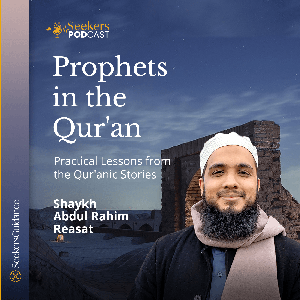
Prophets in the Qur'an: Practical Lessons from the Qur'anic Stories

Prophets in the Qur'an: Practical Lessons from the Qur'anic Stories

By SeekersGuidance.orgReligion & SpiritualityIslam
Download on the App Store

Prophets in the Qur'an: Practical Lessons from the Qur'anic Stories episodes

  • 10: Spiritual Routines – Renewal by the Book: Quran Tafsir Based on Imam Ghazali’s Ihya – Shaykh Riad Saloojee
    In the tenth lesson of Renewal by the Book we are joined by visiting scholar, Shaykh Riad Saloojee. Shaykh Riad reviews key verses of the Quran that correspond to Imam Al-Ghazali’s chapter on spiritual routines. He covers verse 28 from Surat Al-Kahf, the 18th chapter of the Quran.
    وَاصْبِرْ نَفْسَكَ مَعَ الَّذِينَ يَدْعُونَ رَبَّهُم بِالْغَدَاةِ وَالْعَشِيِّ يُرِيدُونَ وَجْهَهُ وَلا تَعْدُ عَيْنَاكَ عَنْهُمْ تُرِيدُ زِينَةَ الْحَيَاةِ الدُّنْيَا وَلا تُطِعْ مَنْ أَغْفَلْنَا قَلْبَهُ عَن ذِكْرِنَا وَاتَّبَعَ هَوَاهُ وَكَانَ أَمْرُهُ فُرُطًا
    “And keep yourself patient [by being] with those who call upon their Lord in the morning and the evening, seeking His countenance. And let not your eyes pass beyond them, desiring adornments of the worldly life, and do not obey one whose heart We have made heedless of Our remembrance and who follows his desire and whose affair is ever [in] neglect.”

    It is difficult for the nafs to focus on Allah and continue in its remembrance of Allah and so to be able to do so one needs to find the company that will push us to do so and so we can imbibe their characteristics. Allah then warns us of following those who are not righteous because the consequence of that is that your heart will be affected by your lower self. Instead of following Allah’s commands you make your own lower self your idol.

    Shaykh Riyad reminds us that even if one is doing community work or advocating on behalf the community, their work should not be devoid of remembrance of Allah. The lack of remembrance can me one more prone to mistake and to following our base self over doing what is right or most pleasing to Allah.

    Shaykh Riyad concludes with council to the listener to always prioritize the remembrance of Allah because it gives one a balanced perspective and makes one less prone to extremes of action.

    In this series Shaykh Faraz, and the other scholars and teachers will be looking at points of reflection from key verses in the Quran. The series will follow the thematic order of Imam Ghazali’s Ihya Ulum al-Din (Renewing the Religious Sciences). The aim is to connect the key verses of guidance from the Book of Allah with the blueprint of renewal, the Ihya, so that we experience a renewal by The Book.

    Join our Ramadan 2017 program: #RamadanRenewal, in-person at SeekersGuidance Toronto or online through the SeekersGuidance Global platform. For more details, visit: https://seekersguidance.org/ramadan.

    Checkout all of the SeekersGuidance podcasts by visiting https://seekersguidance.org/podcasts/
    0 min
  • 09: Remembrance & Supplication – Renewing Religion: An Overview of Ghazali’s Ihya – Shaykh Riad Saloojee
    In this lesson, we are joined by visiting scholar Shaykh Riad Saloojee. Shaykh Riad reviews the ninth chapter of Imam Al-Ghazali’s Ihya Ulum al-Din on remembrance and supplication.
    This chapter is situated at the end of the first section of the book on acts of worship. One theme that runs through this chapter is manifested in the verse of the Quran: “oh you who have attained faith, be in Allah’s remembrance plentifully”. Divine remembrance is not restricted to any time or place, as such one should be in His remembrance all the time.

    Shaykh Riyad details the functions of the heart by which one engages in remembrance, to know Allah, to experience Him and to will and desire to seek him. That is why divine remembrance is so important because it is the heart’s nourishment.

    Shaykh Riyad also speaks to the importance of supplication and the essence of duaa is the expression of one’s need, poverty and desire for Allah. The gift of supplication is Allah allowing a person to be near to Allah in the closeness of asking. Supplication should free our will, reliance and dependence from anything else but Allah. The chapter by Imam Al-Ghazali also has a comprehensive listing of the various supplications one should engage in throughout the day.

    Shaykh Riyad concludes by giving us practical steps of application:
    [1] set our goal: that we should struggle to have our heart perpetually in Divine remembrance and habitually engage in supplication.
    [2] Understand the importance of remembrance and supplication.
    [3] Ramadan is a great time to push ourselves to implementing what we learn because it fits with our daily struggle to fast from all that is wrong and good is easy. Remember, the supplication of the fasting person is accepted.
    [4] Engage in remembrance after prayer and engage in remembrance whenever you have some time.
    [5] Make a commitment to engage in supplication for five minutes at a specific time on a daily basis.

    In this brief overview of Imam Ghazali’s opus magnum, Ihya Ulum al-Din (Renewing the Religious Sciences), this series will serve as blueprint for how the believer can bring to life their religion. It will aim to help the believer to not just practice the form of the religion properly, but to also practice it with excellence.

    Join our Ramadan 2017 program: #RamadanRenewal, in-person at SeekersGuidance Toronto or online through the SeekersGuidance Global platform. For more details, visit: https://seekersguidance.org/ramadan/.

    Checkout all of the SeekersGuidance podcasts by visiting https://seekersguidance.org/podcasts/
    0 min
  • 09: Remembrance & Supplication – Renewal by the Book: Quran Tafsir Based on Imam Ghazali’s Ihya – Shaykh Faraz Rabbani
    In this lesson, Shaykh Faraz looks at the key verses in the Quran corresponding to the ninth chapter of Imam Ghazali’s Ihya: Remembrance and Supplication. He highlights the verses 151-153 from Surah Al-Baqarah, which detail the importance and virtue of the remembrance of Allah.
    كَمَا أَرْسَلْنَا فِيكُمْ رَسُولاً مِّنكُمْ يَتْلُو عَلَيْكُمْ آيَاتِنَا وَيُزَكِّيكُمْ وَيُعَلِّمُكُمُ الْكِتَابَ وَالْحِكْمَةَ وَيُعَلِّمُكُم مَّا لَمْ تَكُونُواْ تَعْلَمُونَ

    “Just as We have sent among you a messenger of your own who recites to you Our revelations, purify you, and teach you the Scripture and Wisdom; and to teach you what you did not know”

    This verse outlines the gift that Allah has bestowed upon us and that is the gift of guidance.

    فَاذْكُرُونِي أَذْكُرْكُمْ وَاشْكُرُواْ لِي وَلاَ تَكْفُرُونِ

    يَا أَيُّهَا الَّذِينَ آمَنُواْ اسْتَعِينُواْ بِالصَّبْرِ وَالصَّلاةِ إِنَّ اللَّهَ مَعَ الصَّابِرِينَ

    “So remember me and I will remember you; be thankful to Me and never ungrateful. You who believe, seek help through steadfastness and prayer, for God is with the steadfast.”

    The consequence of the gift that Allah has bestowed upon us is that we must engage in His remembrance and in thankfulness of Him. The sunnah of the Prophet, peace be upon him, is balanced on two pillars that are the foundation of it: to remember Allah and to be thankful.

    In addition, Shaykh Faraz highlights the role of the Prophet, peace be upon him, as mentioned in verse 151: to convey revelation, to purify you (and that is the purpose of revelation), explains to you the revelation and teaches you wisdom (and that is the sunnah).

    Shaykh Faraz explains that true remembrance is for your heart to be conscious of Allah without being attached to anything else and the reward for that is that Allah will grant you spiritual openings. Ultimately, this remembrance should stem from your love for Him.

    In summary, Shaykh Faraz reminds us to keep our tongue moist with the remembrance of Allah. If you would like to read more on this topic you can read the Imam Ibn Rajab’s: The Compendium of Knowledge and Wisdom.

    Resource: Tafsir al-Qushayri
    http://www.greattafsirs.com/Books/lataif.pdf

    In this series Shaykh Faraz will be looking at points of reflection from key verses in the Quran. The series will follow the thematic order of Imam Ghazali’s Ihya Ulum al-Din (Renewing the Religious Sciences). The aim is to connect the key verses of guidance from the Book of Allah with the blueprint of renewal, the Ihya, so that we experience a renewal by The Book.

    Join our Ramadan 2017 program: #RamadanRenewal, in-person at SeekersGuidance Toronto or online through the SeekersGuidance Global platform. For more details, visit: https://seekersguidance.org/ramadan.

    Checkout all of the SeekersGuidance podcasts by visiting https://seekersguidance.org/podcasts/
    0 min
  • 08: Etiquettes of Reciting Quran – Renewing Religion: An Overview of Ghazali’s Ihya – Ustadh Amjad Tarsin
    In this lesson, Ustadh Amjad Tarsin reviews the chapter on etiquettes of reciting the Quran from Imam Al-Ghazali’s book Ihya Ulum al-Din. The Chapter goes through the outward etiquettes of recitation as well as the inward implications of those practices.
    Learning the Quran and teaching the Quran is not limited to teaching, but rather should extend to an internalization of its virtues and meanings. The Prophet, peace and blessings upon him said: “the most virtuous of worship of my Ummah is the recitation of the Quran”. The virtues of reciting the Quran are many so one should strive to increase their recitation especially during Ramadan.

    Ustadh Amjad explains in this lesson the 10 internal etiquettes of the recitation of the Quran:
    [1] Knowing the greatness of these words, their exaltedness and their weightiness.
    [2] Having reverence for the One speaking. Part of that reverence is approaching the Quran in a state of purity.
    [3] Having presence of heart and leaving internal conversations
    [4] Pondering the Quran
    [5] Understanding as you recite the Quran such that you achieve a deeper understanding as you read.
    [6] You remove from yourself things that prevent you from understanding, such as continually engaging in sins.
    [7] Know that Allah is talking to you
    [8] Being affected by the Quran, both by verses of punishment and reward.
    [9] Experience the Quran and this is of many levels
    [10] Absolve yourself from anything related to yourself. Such that anything you read about the people of righteousness you don’t think that this about you and when you read about people of evil that you don’t absolve yourself from their characteristics.

    In summary, Ustadh Amjad reminds us that the Quran is the greatest form of remembrance and worship so we must strive to increase our recitation and understanding of it.

    In this brief overview of Imam Ghazali’s opus magnum, Ihya Ulum al-Din (Renewing the Religious Sciences), this series will serve as blueprint for how the believer can bring to life their religion. It will aim to help the believer to not just practice the form of the religion properly, but to also practice it with excellence.


    Join our Ramadan 2017 program: #RamadanRenewal, in-person at SeekersGuidance Toronto or online through the SeekersGuidance Global platform. For more details, visit: https://seekersguidance.org/ramadan.

    Checkout all of the SeekersGuidance podcasts by visiting https://seekersguidance.org/podcasts/
    0 min
  • 08: Recitation of the Quran – Renewal by the Book: Quran Tafsir Based on Imam Ghazali’s Ihya – Shaykh Faraz Rabbani
    In this lesson, Shaykh Faraz looks at the key verses in the Quran corresponding to the eighth chapter of Imam Ghazali’s Ihya: Etiquettes of Reciting the Quran. He highlights the verses 29-34 from Surah Fatir, which detail the merits of the people of the Quran. These verses were referred to by the early Muslims as the verses of the Quran reciters.
    Those who recite the book of Allah and act upon it, they pray, give in charity and fulfill the commands of Allah so Allah promises them a tremendous reward. Allah rewards those who recite the Quran and live it and Allah will give an increase of His from His bounty. Scholars say that that increase in bounty is that Allah allows them to gaze upon Him when they enter paradise; and they are not given a greater reward than that one.

    إِنَّ الَّذِينَ يَتْلُونَ كِتَابَ اللَّهِ وَأَقَامُوا الصَّلاةَ وَأَنفَقُوا مِمَّا رَزَقْنَاهُمْ سِرًّا وَعَلانِيَةً يَرْجُونَ تِجَارَةً لَّن تَبُورَ
    لِيُوَفِّيَهُمْ أُجُورَهُمْ وَيَزِيدَهُم مِّن فَضْلِهِ إِنَّهُ غَفُورٌ شَكُورٌ
    “Those who recite God’s scripture, keep up the prayer, give secretly and openly from what We have provided for them, may hope for a trade that will never decline; He will repay them in full, and give them extra from His bounty. He is most forgiving and most appreciative” [35. 29-30]

    Any act that one engages for the sake of Allah is rewarded, at least, in 10 fold and Allah gives extra from His bounty. In this ayah Recitation does not only refer to reading the Quran but also implementing what you have read from requirements, state of being and virtues. Lastly, this ayah calls on believers to seek Allah’s forgiveness and expect His generous reward.

    وَالَّذِي أَوْحَيْنَا إِلَيْكَ مِنَ الْكِتَابِ هُوَ الْحَقُّ مُصَدِّقًا لِّمَا بَيْنَ يَدَيْهِ إِنَّ اللَّهَ بِعِبَادِهِ لَخَبِيرٌ بَصِيرٌ
    ثُمَّ أَوْرَثْنَا الْكِتَابَ الَّذِينَ اصْطَفَيْنَا مِنْ عِبَادِنَا فَمِنْهُمْ ظَالِمٌ لِّنَفْسِهِ وَمِنْهُم مُّقْتَصِدٌ وَمِنْهُمْ سَابِقٌ بِالْخَيْرَاتِ بِإِذْنِ اللَّهِ ذَلِكَ هُوَ الْفَضْلُ الْكَبِيرُ
    “The scripture We have revealed to you [Prophet] is the Truth and confirms the scripture that preceded it. God is well informed about His servants. He sees everything. We gave the blessing of scripture as a heritage to Our chosen servants, some of them wronged their own souls, some stayed between [right and wrong] and some by God’s leave were foremost in Good deeds. That is the greatest favour...”

    These verses tell us about what matters in this life and what doesn’t. God is greater and more worthy of your concern than anything else and the next life is better for you than this one; these two are important truths. If one falls short of the above are instructed by Allah to continually repent for Allah is the all forgiving.

    جَنَّاتُ عَدْنٍ يَدْخُلُونَهَا يُحَلَّوْنَ فِيهَا مِنْ أَسَاوِرَ مِن ذَهَبٍ وَلُؤْلُؤًا وَلِبَاسُهُمْ فِيهَا حَرِيرٌ
    وَقَالُوا الْحَمْدُ لِلَّهِ الَّذِي أَذْهَبَ عَنَّا الْحَزَنَ إِنَّ رَبَّنَا لَغَفُورٌ شَكُور
    “They will enter lasting Gardens where they will be adorned with bracelets of gold and pearls, where they will wear silk garments. They will say ‘Praise be to God, who has separated us from all sorrow! Our Lord is truly most forgiving, most appreciative.”

    These verses remind us of the vastness of the next life that is open to the ones of faith. They also remind us to prioritize the next life over this one and to act accordingly. Lastly, the Quran calls us to be content with our Lord fully in this life, have gratitude to Allah and to praise Him. Reciting the Quran with reflection allows one to reach all of this.

    Resources:

    [1] [Video Lecture] Becoming People of the Qur'an - Shaykh Abdullah el-Haddad (https://youtu.be/2kLYcRzjXQY)

    [2] [On-Demand Course] Living the Quran: Ghazali’s Manners of Qur’an Recital with Shaykh Faraz Rabbani (#/)

    0 min
  • 07: Hajj – Renewing Religion: An Overview of Ghazali’s Ihya – Ustadh Amjad Tarsin
    In this lesson, Ustadh Amjad Tarsin, reviews the chapter on Hajj from Imam Al-Ghazali’s Ihya Ulum al-Din. Imam Al-Ghazali begins by outlining a general rule: that one cannot draw nearer to Allah except through letting go of their worldly attachments.
    Ustadh Amjad explains that Hajj, unlike any other forms of worship, cannot be rationalized as to the meaning behind each of its actions. The only lesson that one can derive from Hajj is that you are a servant to Allah and you need to fulfill His commands.

    Imam Al-Ghazali outlines in this chapter the etiquettes that one must have during Hajj:
    [1] Yearning for the two Holy mosques: this yearning stems from an understanding that this is the House of God, placed for you to fulfill your servitude. The reward for which is gazing upon Allah in the Hereafter.
    [2] Buying the two garments of Ihram: then the person should remember that they will be buried in this clothing and even though you have put on these garments you might not actually make it to the Hajj but you will meet Allah in them.
    [3] Talbiyyah: At your service Oh Allah, I am at your service, at your service You have no partner, I am at your service. All praise and all blessings belong to You and everything in existence belongs to You, You have no partner. This is the worldly response to what Allah has asked you to do in the spiritual realm, it is a response to the call that Allah tasked Prophet Ibrahim with making for Hajj.
    [4] You should be fearful when you enter that you are not worthy but your hope should be greater than your fear. The fear should bring upon you humility and the hope reminds you of the generosity of Allah and His generosity is given to everyone.
    [5] At 'Arafah: when you see many people of various races, backgrounds and groups; that should remind you of the Day of Judgement, each comes with their Prophet. At the end of the day of A’rafah, Allah forgives all the people there and it is a sin to think that Allah has forgiven you.

    In conclusion, Ustadh Amjad reminds us to always think of Allah’s mercy as greater than our sin and that Allah is the most forgiving.

    In this brief overview of Imam Ghazali’s opus magnum, Ihya Ulum al-Din (Renewing the Religious Sciences), this series will serve as blueprint for how the believer can bring to life their religion. It will aim to help the believer to not just practice the form of the religion properly, but to also practice it with excellence.

    Join our Ramadan 2017 program: #RamadanRenewal, in-person at SeekersGuidance Toronto or online through the SeekersGuidance Global platform. For more details, visit: https://seekersguidance.org/ramadan.

    Checkout all of the SeekersHub podcasts by visiting https://seekersguidance.org/podcasts/
    0 min
  • 07: Hajj – Renewal by the Book: Quran Tafsir Based on Imam Ghazali’s Ihya – Shaykh Faraz Rabbani
    In this lesson, Shaykh Faraz looks at the key verses in the Quran related to Hajj, corresponding to the seventh chapter of Imam Ghazali’s Ihya. He highlights the verses 27-32 from Surah Al-Hajj, which outline the meaning and purpose of Hajj.
    وَأَذِّن فِى ٱلنَّاسِ بِٱلْحَجِّ يَأْتُوكَ رِجَالًا وَعَلَىٰ كُلِّ ضَامِرٍ يَأْتِينَ مِن كُلِّ فَجٍّ عَمِيقٍ

    لِّيَشْهَدُوا۟ مَنَٰفِعَ لَهُمْ وَيَذْكُرُوا۟ ٱسْمَ ٱللَّهِ فِىٓ أَيَّامٍ مَّعْلُومَٰتٍ عَلَىٰ مَا رَزَقَهُم مِّنۢ بَهِيمَةِ ٱلْأَنْعَٰمِ ۖ فَكُلُوا۟ مِنْهَا وَأَطْعِمُوا۟ ٱلْبَآئِسَ ٱلْفَقِيرَ

    "Proclaim the pilgrimage to all people, they will come to you on foot and they’ll come on all kind of mount emerging from every deep mountain pass. In order to witness all kinds of benefits for them and in order to remember the name of Allah for a known number of days for what Allah has provided for them. So feed yourself of that livestock and give to feed the destitute and the unfortunate… “ [Quran 22, 27-28]

    In these verses Allah tells us some of the spiritual aims of Hajj. The Pilgrimage has many acts of worship each of which has its own benefits. Each act is done out of submission to Allah and to the extent to which it is done with that intention you will find benefit in it.

    People with respect to Hajj are of 3 types:

    [1] Those who go to Hajj unprepared and that is foolishness, they gain some benefit but miss out on a lot.

    [2] Those who prepare outwardly only for the Hajj, and that is important.

    [3] Those who prepare outwardly but also understand why they are doing it. One should prepare well advance to Hajj.

    One of the highly recommended resources for this is Imam Ghazali’s Chapter on Hajj (or as translated in the book Inner Dimensions of Islamic Worship) that details the spiritual benefits of Hajj.

    Imam Al-Ghazali describes Hajj as a reenactment of resurrection and the Hereafter or as a reenactment of the various challenges of life. The metaphor of tawaf is a metaphor of love so throughout our day we keep turning towards the One we love through prayer. However, the believer wants to express more fully the nature of their love to Allah and the Hajj expresses that.

    ثُمَّ لْيَقْضُوا۟ تَفَثَهُمْ وَلْيُوفُوا۟ نُذُورَهُمْ وَلْيَطَّوَّفُوا۟ بِٱلْبَيْتِ ٱلْعَتِيقِ

    ذَٰلِكَ وَمَن يُعَظِّمْ حُرُمَٰتِ ٱللَّهِ فَهُوَ خَيْرٌ لَّهُۥ عِندَ رَبِّهِۦ ۗ وَأُحِلَّتْ لَكُمُ ٱلْأَنْعَٰمُ إِلَّا مَا يُتْلَىٰ عَلَيْكُمْ ۖ فَٱجْتَنِبُوا۟ ٱلرِّجْسَ مِنَ ٱلْأَوْثَٰنِ وَٱجْتَنِبُوا۟ قَوْلَ ٱلزُّورِ

    "so let the pilgrims perform their acts of cleansing, fulfil their vows, and circle around the Ancient House.”

    “All this [is ordained by God]: anyone who honors the sacred ordinances of God will have good rewards from His Lord…” [Quran 22, 29-30]

    In these verses Allah reminds us that this is a devotional act and that we are servants to Allah as such we carry out the acts of devotion in the way He ordained not in the ways we prefer.

    حُنَفَآءَ لِلَّهِ غَيْرَ مُشْرِكِينَ بِهِۦ ۚ وَمَن يُشْرِكْ بِٱللَّهِ فَكَأَنَّمَا خَرَّ مِنَ ٱلسَّمَآءِ فَتَخْطَفُهُ ٱلطَّيْرُ أَوْ تَهْوِى بِهِ ٱلرِّيحُ فِى مَكَانٍ سَحِيقٍ

    ذَٰلِكَ وَمَن يُعَظِّمْ شَعَٰٓئِرَ ٱللَّهِ فَإِنَّهَا مِن تَقْوَى ٱلْقُلُوبِ

    “Steadfastly upright for Allah, not associating any with Him. And he who associates with Allah - it is as though he had fallen from the sky and was snatched by birds or the wind carried him down into a remote place. That [is so]. And whoever honors the signs of Allah - indeed it is from the piety of the hearts.” [Quran 22, 31-32]

    In closing, verses 31 and 32 are a description of what is at the heart of partaking in Hajj embodied by the one who built the Ka’ba, Prophet Ibrahim. He was upright in his devotion to Allah.

    0 min
  • 06: Fasting – Renewing Religion: An Overview of Ghazali’s Ihya – Shaykh Faraz Rabbani
    In this lesson, Shaykh Faraz continues his review of Imam Ghazali’s Ihya with an overview of the chapter on fasting. Imam Al-Ghazali covers both the religious guidance related to fasting as well as the spiritual meanings of fastings. This is so that we can act with intent and understanding of why we engage in the worship that we do.

    Shaykh Faraz previews Imam Ibn ‘Ajiba’s tafsir of the Fatiha. In the verse “It is You alone we worship and it is You alone we depend upon” (إِيَّاكَ نَعْبُدُ وإِيَّاكَ نَسْتَعِينُ). This verse outlines that we should only focus our intent on Allah alone when we engage in fasting. Furthermore, we should only rely on Allah to complete our fasts as well.

    Shaykh Faraz details in his talk the benefits of fasting:

    [1] One of the benefits of fasting weakens our mere humanness and the material world. Excessive eating and drinking makes heavy our attachment to the material world and the more the material world is real to us the more the subtle reality of spiritual meanings are veiled to us.

    [2] A second benefit is that it upholds the Divine characteristic of Al-Samadiyyah (Allah is free of all need). When we recognize our complete neediness to Allah through fasting we can also recognize the One who is free of all need.

    [3] It purifies and softens the heart. Fasting gets you to recognize your weakness which purifies and softens our hearts to turn to Allah.

    [4] Fasting facilitates feeling lowly and humbled and ridding oneself of arrogance. The lower self is not humbled by anything like hunger.

    [5] It breaks one’s desire for sin and diminishes the control of one’s lower self over them. Fasting restrains one from certain desires and facilitates refraining from certain sins.

    [6] Fasting facilitates one having more time for one to focus their time on the spiritual instead of the material.

    [7] Fasting directs one towards to contemplation.

    [8] It is a shield from the Shaytan. (For an answer to the question of whether the Shaytan is chained during Ramadan: https://seekersguidance.org/answers/general-counsel/chaining-of-the-devils-in-ramadan/)

    Shaykh Faraz continues to explain that there are three levels of restraint that one can strive for while fasting:

    [1] Food and Drink

    [2] All the things that are displeasing to Allah

    [3] All the things that distract us from Allah

    Lastly, the lesson concludes with a reminder that the believer should seek to be with Allah even when they are with people, such that their heart is always busied with Allah no matter what else they are doing of worldly things.

    In this brief overview of Imam Ghazali’s opus magnum, Ihya Ulum al-Din (Renewing the Religious Sciences), this series will serve as blueprint for how the believer can bring to life their religion. It will aim to help the believer to not just practice the form of the religion properly, but to also practice it with excellence.

    Join our Ramadan 2017 program: #RamadanRenewal, in-person at SeekersGuidance Toronto or online through the SeekersGuidance Global platform. For more details, visit: https://seekersguidance.org/ramadan.

    Checkout all of the SeekersGuidance podcasts by visiting https://seekersguidance.org/podcasts/
    0 min
  • 06: Fasting & Ramadan – Renewal by the Book: Quran Tafsir Based on Imam Ghazali’s Ihya – Shaykh Faraz Rabbani
    In this lesson, Shaykh Faraz highlights the verses 183-186 of Surat al-Baqara, which are the verses on fasting and Ramadan. They correspond to the sixth chapter of Imam Ghazali’s Ihya on fasting. He tells us about the aims of fasting through these verses, and gives some key meanings of those aims and tips on how to attain them.
    In verse 183 of Surat al-Baqara, Allah tells us that “Believers! Fasting is prescribed for you, as it was prescribed for those before you, so that you may be mindful of God.” (يَا أَيُّهَا الَّذِينَ آمَنُوا كُتِبَ عَلَيْكُمُ الصِّيَامُ كَمَا كُتِبَ عَلَى الَّذِينَ مِن قَبْلِكُمْ لَعَلَّكُمْ تَتَّقُونَ). First, Shaykh Faraz explains the balance and significance of corresponding with the people of book and faith before Islam. He clarifies the difference between corresponding and following, and how correspondence gives a sense of continuity of guidance.

    Shaykh Faraz then explains the concept of taqwa (mindfulness of Allah). He defines it as guarding oneself from the displeasure of Allah. He then gives some key guidance of how to attain that taqwa.

    Then in verse 185 of Surat al-Baqara, Allah tells us that “Ramadan is the month that the Quran was revealed as guidance for mankind,clear messages giving guidance and distinguishing between right and wrong...God wants ease for you, not hardship. He wants you to complete the prescribed period and to glorify Him for having guided you, so that you may be thankful.” (شَهْرُ رَمَضَانَ الَّذِي أُنزِلَ فِيهِ الْقُرْآنُ هُدًى لِّلنَّاسِ وَبَيِّنَاتٍ مِّنَ الْهُدَىٰ وَالْفُرْقَانِ... يُرِيدُ اللَّهُ بِكُمُ الْيُسْرَ وَلَا يُرِيدُ بِكُمُ الْعُسْرَ وَلِتُكْمِلُوا الْعِدَّةَ وَلِتُكَبِّرُوا اللَّهَ عَلَىٰ مَا هَدَاكُمْ وَلَعَلَّكُمْ تَشْكُرُونَ). Shaykh Faraz explains that the verses highlight that the significance of the month of Ramadan is that it is the month the Quran was revealed in, and not the month of fasting. He also highlights that it is an opportunity to recognize Divine mercy, ease and have gratitude.

    Finally, in verse 186 of Surat al-Baqara Allah tells us: “[Prophet], if My servants ask you about Me, I am near. I respond to those who call Me, so let them respond to Me, and believe in Me, so that they may be guided.” (وَإِذَا سَأَلَكَ عِبَادِي عَنِّي فَإِنِّي قَرِيبٌ ۖ أُجِيبُ دَعْوَةَ الدَّاعِ إِذَا دَعَانِ ۖ فَلْيَسْتَجِيبُوا لِي وَلْيُؤْمِنُوا بِي لَعَلَّهُمْ يَرْشُدُونَ). Shaykh Faraz tells us that this verse expresses the reality of Allah’s immediate closeness without mediation, and what that means. He also highlights the saying of one of the early imams of Islam, Imam Sahl al-Tustari, on the first of the stations of closeness to Allah. He says that it is to feel shyness and shame before Allah of how heedless one is, and how little one is putting forth for the sake of Allah.

    In this series Shaykh Faraz will be looking at points of reflection from key verses in the Quran. The series will follow the thematic order of Imam Ghazali’s Ihya Ulum al-Din (Renewing the Religious Knowledges). The aim is to connect the key verses of guidance from the Book of Allah with the blueprint of renewal, the Ihya, so that we experience a renewal by The Book.

    Join our Ramadan 2017 program: #RamadanRenewal, in-person at SeekersGuidance Toronto or online through the SeekersGuidance Global platform. For more details, visit: https://seekersguidance.org/ramadan.

    Checkout all of the SeekersGuidance podcasts by visiting https://seekersguidance.org/podcasts/
    0 min
  • 05: Zakat & Charity – Renewing Religion: An Overview of Ghazali’s Ihya – Ustadh Amjad Tarsin
    In this lesson, Ustadh Amjad Tarsin gives an overview of the chapter on zakat (alms) and charity from the Ihya Ulum al-Din (Renewing the Religious Sciences), the fifth chapter. He highlights the adaab (etiquettes) of giving charity that Imam Al-Ghazali mentions in this chapter. Ustadh Amjad also emphasizes the importance of learning the fiqh (legal rulings) of giving zakat, as well as all the other actions of worship that are personally obligatory.
    Imam Ghazali says about zakat that it is one of the tests that Allah has placed for the believers. It is also one of the foundational pillars of Islam. Imam Ghazali then says that one of the wisdoms of the obligation of zakat, is because wealth is beloved to people. So sacrificing what is beloved for the sake of Allah is a sign and indication of loving Him.

    He then goes to outline the different levels of people who give charity. The highest level is to give everything for the sake of Allah Most High, unconditionally. At that level, Ustadh Amjad recounts the example of Abu Bakr as-Siddiq (may Allah be pleased with him), who gave all of his wealth to the Prophet peace and blessings be upon him for the benefit of the Muslims.

    Ustadh Amjad then looks at some of the adaab (etiquettes) that Imam Ghazali mentions about giving out zakat and charity. The first one he mentions is giving charity secretly, and the great merit in doing so. Giving charity in private is closer to sincerity and guards from falling it showing off and ostentation. He gives the example of Imam Ali Zain al-Abidin the great grandson of the Prophet (peace and blessings be upon him), and how he used to personally carry money to the poor in the depths of the night.

    Another etiquette Ustadh Amjad highlights is to not destroy charity by holding oneself in favour over the person they gave the charity to. Allah says in the Quran that doing so, nullifies the charity and hurts the receiver of charity. Imam Ghazali mentions that cure for this, is for the one giving charity to see themselves as the ones being in need of help and favour by giving charity.

    Finally, Ustadh Amjad advises that when giving charity, one shouldn’t expect anything in return, and do it purely for the sake of Allah, as is mentioned in the Quran. He explains also that one shouldn’t fear decrease in wealth because of giving charity. Rather, the reality is that it is a means of increase and blessing in one’s wealth.

    In this brief overview of Imam Ghazali’s opus magnum, Ihya Ulum al-Din (Renewing the Religious Sciences), this series will serve as blueprint for how the believer can bring to life their religion. It will aim to help the believer to not just practice the form of the religion properly, but to also practice it with excellence.

    Join our Ramadan 2017 program: #RamadanRenewal, in-person at SeekersGuidance Toronto or online through the SeekersGuidance Global platform. For more details, visit: https://seekersguidance.org/ramadan.

    Checkout all of the SeekersGuidance podcasts by visiting https://seekersguidance.org/podcasts/
    0 min

About Prophets in the Qur'an: Practical Lessons from the Qur'anic Stories

From the publisher's feed

This podcast looks at the lives of the Prophets, Allah bless them all and give them peace, with a focus on the practical lessons and benefit Allah placed within them for us. The series gives a brief…

More shows like Prophets in the Qur'an: Practical Lessons from the Qur'anic Stories

Nouman Ali Khan by Muslim Central

Nouman Ali Khan

887 Listeners

Stories of the Prophets by General Iq

Stories of the Prophets

241 Listeners