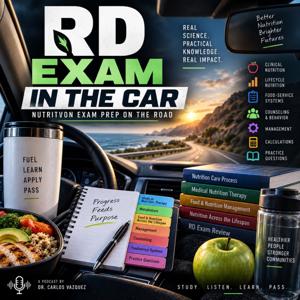
RD Exam In The Car

RD Exam In The Car

By Circle Of Insight ProductionsTV & FilmSociety & CultureEducation
Download on the App Store

All RD Exam In The Car episodes

  • Foodservice Math Made Easy: Food Cost Percentage, Yield, and Portion Calculations
    Foodservice mathematics is an important component of the Registered Dietitian examination, particularly questions involving food costs, purchasing, recipe yields, and portion control. This episode explains how to calculate food cost percentages, edible portion yields, and the number of servings produced from a recipe. Through practical examples from hospital kitchens and institutional foodservice operations, listeners will learn how to solve common calculation problems. We also review exam strategies for recognizing the correct formulas and avoiding common mathematical mistakes.
    4 min
  • Beta-Oxidation Made Simple: How Your Body Turns Fat Into Energy
    What happens when your body needs energy and begins using stored fat instead of glucose? In this episode, we break down beta-oxidation, the metabolic process that converts fatty acids into acetyl-CoA for ATP production. You’ll learn the roles of carnitine, mitochondria, NADH, and FADH2, along with how insulin and glucagon influence fat metabolism. We’ll also explore the clinical and biochemical concepts you need to understand for the Registered Dietitian examination.
    4 min
  • Enteral vs. Parenteral Nutrition — Choosing the Correct Feeding Method
    When a patient cannot eat enough to meet nutritional needs, how do clinicians decide between feeding through the gastrointestinal tract and delivering nutrients intravenously? In this episode, we examine enteral and parenteral nutrition, their clinical indications, physiological differences, and potential complications. Using real clinical scenarios, we explain how dietitians, nurses, and medical teams determine the safest and most appropriate method of nutritional support.
    5 min
  • The Krebs Cycle Made Simple: How Your Body Turns Food Into ATP
    What happens to glucose after glycolysis, and how does your body turn carbohydrates, fats, and proteins into usable energy? In this episode of RD Exam in the Car, we break down the Krebs cycle, acetyl-CoA, NADH, FADH₂, and the electron transport chain without overwhelming you with complicated biochemistry. You’ll learn where these processes occur, why oxygen matters, and which concepts are most important for the Registered Dietitian exam. We also connect cellular energy production to exercise physiology, nutrition, and clinical conditions.

    4 min
  • Glycolysis Made Understandable: How Glucose Becomes Energy
    Glycolysis is one of the most important metabolic pathways tested on the Registered Dietitian exam, yet its enzymes, reactions, and energy calculations can seem overwhelming. In this episode, we simplify how glucose is converted into pyruvate, why ATP is both consumed and produced, and what happens when oxygen availability changes. You’ll learn the key regulatory enzymes, the net energy yield, and the clinical connections that make glycolysis easier to understand and remember.
    4 min
  • Fat Digestion and Absorption: Bile, Lipase, Micelles, and Chylomicrons
    Fat digestion involves several coordinated processes that are essential for the RD exam. This episode explains how bile salts, pancreatic lipase, micelles, and chylomicrons work together to digest and transport dietary fats. We also examine the absorption of fat-soluble vitamins and the consequences of impaired fat digestion. Strengthen your understanding of gastrointestinal physiology, clinical nutrition, and nutrient metabolism.
    5 min
  • Protein Digestion, Absorption, and Metabolism: From Steak to Amino Acids
    Protein digestion is a favorite RD exam topic because it connects gastrointestinal physiology, enzymes, amino acid absorption, and nitrogen metabolism. In this episode, we follow protein from the stomach through the small intestine and explain what happens to amino acids after they enter the bloodstream. We’ll also focus on the enzymes, hormones, and metabolic pathways you’re most likely to encounter on the exam.
    5 min
  • Carbohydrate Digestion and Metabolism: From the First Bite to ATP
    Carbohydrates are one of the body’s primary energy sources, but before they can produce energy, they must be digested, absorbed, transported, and metabolized. This episode follows carbohydrates from the mouth to the bloodstream and then into the cells, connecting digestive physiology with insulin, glucagon, glycogen, and glucose metabolism. For the RD exam, the key is understanding not just where each step occurs, but what happens to glucose after absorption.
    4 min
  • Tube Feeding or IV Nutrition? Choosing EN vs. PN
    When should nutrition go through the gastrointestinal tract, and when should it go directly into the bloodstream? This episode uses two fictional patients to make the difference between enteral nutrition and parenteral nutrition easy to remember. We examine gastrointestinal function, access, clinical appropriateness, and complications rather than relying on simplistic rules. Two original practice questions help reinforce the decision-making process you’ll need for the RD exam.
    4 min
  • From Assessment to Action: Mastering the Nutrition Care Process
    The Nutrition Care Process is one of the most important frameworks to understand for the RD exam. In this episode, we follow a fictional hospitalized patient from the first nutrition assessment through diagnosis, intervention, and follow-up. You’ll learn how to distinguish assessment data from a nutrition diagnosis and how the PES statement connects the problem to its cause and evidence. Then test yourself with two original exam-style questions.
    4 min