
Sign up to save your podcasts
Or

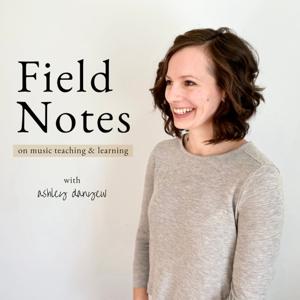

Welcome back to Music Education Basics!
Today, we’re talking about readiness for music-reading and developing proficiency.
Just like learning to read language, music-reading follows listening and responding, developing a musical vocabulary, and active musical experiences in a natural progression, as we’ve been reviewing this week.
If you’re a choir director or an elementary music teacher, I recommend introducing music-reading (as in holding a score in your hand) around 2nd or 3rd grade. We tend to introduce music-reading a little sooner in one-on-one settings — piano lessons or other beginning instrumental studies — but in choir, you can usually wait until 3rd grade and spend more time with rote-learning and gradually bridging that gap.
Start by introducing music notation in small doses: simple tonal or rhythm patterns, like we talked about in Day 2, or a short song with mostly stepwise motion to highlight direction on the staff and how the notes alternate between lines and spaces.
I’ll walk you through a simple 4-step process and a few tangible ways to do this in today's lesson.
For show notes, click here.
Looking for the workbook? You’ll find it inside the learning platform, ready to download. Sign up for free access >>
Resources mentioned:
The Art of Music Teaching & Learning — A comprehensive online course for music educators in all types of settings. It's kind of like getting a mini-music education degree in only 8 weeks.
How to Teach Solfege — An in-depth article for elementary music teachers and children’s choir directors
 View all episodes
 By Ashley Danyew

4.9
2020 ratings
Welcome back to Music Education Basics!
Today, we’re talking about readiness for music-reading and developing proficiency.
Just like learning to read language, music-reading follows listening and responding, developing a musical vocabulary, and active musical experiences in a natural progression, as we’ve been reviewing this week.
If you’re a choir director or an elementary music teacher, I recommend introducing music-reading (as in holding a score in your hand) around 2nd or 3rd grade. We tend to introduce music-reading a little sooner in one-on-one settings — piano lessons or other beginning instrumental studies — but in choir, you can usually wait until 3rd grade and spend more time with rote-learning and gradually bridging that gap.
Start by introducing music notation in small doses: simple tonal or rhythm patterns, like we talked about in Day 2, or a short song with mostly stepwise motion to highlight direction on the staff and how the notes alternate between lines and spaces.
I’ll walk you through a simple 4-step process and a few tangible ways to do this in today's lesson.
For show notes, click here.
Looking for the workbook? You’ll find it inside the learning platform, ready to download. Sign up for free access >>
Resources mentioned:
The Art of Music Teaching & Learning — A comprehensive online course for music educators in all types of settings. It's kind of like getting a mini-music education degree in only 8 weeks.
How to Teach Solfege — An in-depth article for elementary music teachers and children’s choir directors

3,958 Listeners

526 Listeners

130 Listeners

113,121 Listeners

56,944 Listeners

39 Listeners
64 Listeners
47 Listeners

24 Listeners
1,643 Listeners

8 Listeners

41 Listeners
14 Listeners
18 Listeners

4 Listeners