Is AI Making Us Smarter—or Dumbing Us Down?
AI can help us work faster, analyze information, generate ideas, create images, write code, and streamline business operations. But what happens when we start relying on it too much?
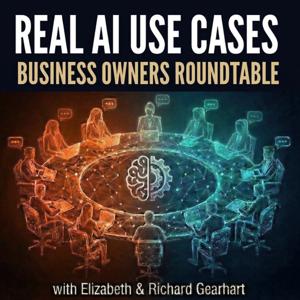
In this episode of Real AI Use Cases: Business Owners Roundtable, Elizabeth and Richard Gearhart sit down with Ryan Stana, Joey Stiver, and Ron Platt for a candid conversation about how business owners are actually using AI—and where they’re drawing the line.
Ryan explains why his creative business uses AI to enhance human creativity rather than replace it. Joey discusses why AI can be useful behind the scenes in technology and development but potentially damaging to trust in patient-facing healthcare. Ron raises an even bigger concern: if AI starts doing our thinking, writing, researching, and problem-solving for us, could those human skills begin to deteriorate?
Elizabeth shares how she uses ChatGPT, Claude, and Gemini as research and feedback partners, combining their input with her own professional experience rather than simply accepting what the AI tells her. She even describes pushing back when all three AI systems wanted her to remove a slide from a presentation—and deciding her own judgment was better.
Richard provides another real-world example of the dilemma. While evaluating candidates for a CFO position, he used an LLM to compare financial models—and then realized he hadn't actually reviewed the models himself. Was AI making the process more efficient, or was he outsourcing a skill he should still be exercising?
The conversation also tackles AI-generated creative work, disclosure and transparency, legal risks, AI accuracy, ChatGPT vs. Claude vs. Gemini vs. Perplexity, and when businesses should—and shouldn't—use AI.
Together, these examples raise the central question of the episode: How do we take advantage of AI without giving up the human expertise, creativity, critical thinking, and judgment that make the technology useful in the first place?
TL;DL
AI should enhance human abilities, not replace them. The panel explores how AI can improve productivity while keeping human creativity and judgment at the center.
Don't outsource your thinking to AI. Using AI for research, analysis, writing, and decision-making can save enormous amounts of time—but humans still need to evaluate the results.
Know when to disagree with AI. Elizabeth uses multiple LLMs for research and feedback but doesn't automatically follow their recommendations when her own experience tells her otherwise.
Overreliance on AI could weaken skills. The group questions whether letting AI handle too much writing, research, creativity, and problem-solving could eventually make us less capable of doing those things ourselves.
Transparency matters. Businesses need to consider when customers and clients should know that AI was involved in creating content or delivering work.
Different AI tools have different strengths. ChatGPT, Claude, Gemini, and Perplexity each have use cases where they may perform better than the others.
AI output still needs human oversight. Faster isn't necessarily better if nobody checks whether the answer is accurate, appropriate—or even legal.
Frequently Asked Questions
Is AI making us smarter or dumbing us down?
AI can make people more productive by accelerating research, analysis, coding, brainstorming, and other tasks. But the panel raises an important concern: if we allow AI to do too much of our thinking for us, we may stop exercising the very skills that make us effective decision-makers.
Can relying too much on AI weaken critical-thinking skills?
Potentially. The episode explores what happens when people routinely outsource writing, research, analysis, creativity, and problem-solving to AI. The concern isn't simply whether AI can perform these tasks, but whether humans lose skills when they stop practicing them.
How can businesses use AI without losing human judgment?
Treat AI as a research assistant, brainstorming partner, or productivity tool rather than the final decision-maker. Elizabeth describes using ChatGPT, Claude, and Gemini extensively while still challenging their conclusions and rejecting their recommendations when her own experience points in a different direction.
Is AI making people less creative?
It can if AI begins replacing rather than supporting the creative process. Ryan explains that his business deliberately uses AI to enhance its creative capabilities while keeping human insight, imagination, and intent behind its creative work.
Should you always check AI-generated answers?
Yes. Richard describes using an LLM to evaluate financial models from prospective CFO candidates and then realizing that he hadn't reviewed the models himself. His experience raises a critical question for anyone using AI in business: If you don't examine the underlying work, how do you know the AI got it right?
Should businesses disclose when they use AI?
Transparency is becoming increasingly important. Ryan discusses how his company distinguishes between AI-generated concepts and human-created design work and communicates AI use to clients. The panel discusses why businesses need to think carefully about disclosure as AI becomes embedded in everyday workflows.
Can AI create legal or compliance problems for businesses?
Yes. AI can produce convincing recommendations without understanding every law, regulation, or industry requirement that applies. Richard shares a humorous example involving an AI-designed mailbox that led him to discover postal regulations he hadn't initially considered. The larger lesson: AI output still requires human verification.
Is AI appropriate for healthcare marketing?
Joey explains why his company uses very little AI for patient-facing graphics and imagery. In healthcare, trust, regulatory concerns, and the possibility that AI-generated content may appear misleading or inauthentic can make human-created content especially important.
Which AI tool is best for business: ChatGPT, Claude, Gemini, or Perplexity?
There isn't one AI tool that's best for every task. The roundtable discusses using ChatGPT, Claude, Gemini, and Perplexity for different purposes, including research, coding, images, video analysis, and business workflows. The best choice depends on the job you're trying to accomplish.
What is the best way for a business owner to use AI?
Use AI where it improves speed, efficiency, research, and productivity—but keep humans responsible for accuracy, creativity, critical thinking, judgment, and final decisions. The goal isn't to avoid AI. It's to use it without allowing it to replace the skills and expertise that make your business valuable.
Real AI Use Cases: Business Owners Roundtable explores how real business owners are using artificial intelligence right now—the successes, mistakes, concerns, experiments, and lessons they're learning along the way.