Reclaiming Pedagogies

Reclaiming Pedagogies

By firefly frequenciesEducation
Download on the App Store

Reclaiming Pedagogies episodes

  • E08 - Une écologie décoloniale (Malcom Ferdinand read by Ilaria Lupo)
    Ilaria Lupo reads a short extract from “Une écologie décoloniale - Penser l'écologie depuis le monde caribéen” by Malcom Ferdinand.

    Une écologie décoloniale
    Une colère rouge recouvre le ciel. Les vagues s’agitent, l’eau monte, les forêts tombent et les corps s’enfoncent dans ce sanguinaire gouffre marin. Les cieux tonnent encore devant ce spectacle : le monde est en pleine tempête.

    Derrière sa prétention d’universalité, la pensée environnementale s’est construite sur l’occultation des fondations coloniales, patriarcales et esclavagistes de la modernité. Face à la tempête, l’environnementalisme propose une arche de Noé qui cache dans son antre les inégalités sociales, les discriminations de genre, les racismes et les situations (post)coloniales, et abandonne à quai les demandes de justice.

    Penser l’écologie depuis le monde caribéen confronte cette absence à partir d’une région où impérialismes, esclavagismes et destructions de paysages nouèrent violemment les destins des Européens, Amérindiens et Africains. Le navire négrier rappelle que certains sont enchaînés à la cale et parfois jetés par-dessus bord à la seule idée de la tempête. Tel est l’impensé de la double fracture moderne qui sépare les questions coloniales des destructions environnementales. Or, panser cette fracture demeure la clé d’un « habiter ensemble » qui préserve les écosystèmes tout autant que les dignités. Telle est l’ambition d’une « écologie décoloniale » qui relie les enjeux écologiques à la quête d’un monde au sortir de l’esclavage et de la colonisation.

    Face à la tempête, ce livre est une invitation à construire un navire-monde où les rencontres des autres humains et non-humains sur le pont de la justice dessinent l’horizon d’un monde commun.
    4 min
  • E07 - On being plural (Camila Marambio)
    Warming Up to the Pluriverse - Talk #6: On being plural
     
    In this talk, we meet Camila Marambio – a being as plural as the worlds she inhabits, falls in love with, and seeks to protect. Camila is the founder of Ensayos  a nomadic interdisciplinary research program that has been collectively unraveling the eco politics of the archipelago of Karokynka a.k.a. Tierra del Fuego for about a decade now. A mesmerising talk about cosmic changes, circular stories, a pluriversal owl and the notion of with-with.
    

    This talk is part of "In Search of the Pluriverse", a quest curated in 2020-2021 by artist/researcher Sophie Krier and designer/editor Erik Wong in the context of The Travelling Academy. This exchange programme on forms of formal and informal learning is an initiative of Het Nieuwe Instituut Rotterdam in partnership with Dutch diplomatic posts in and beyond Europe. In the light of the pandemic, Wong & Krier start their quest for the pluriverse from home with Arturo Escobar’s 2018 book Designs for the Pluriverse in hand. Through short, animated talks with making collectives, they dive into four urgent themes taken from the book: autonomy, world-making, the vernacular, and (de)futuring. In this way, each talk will be connected to a specific passage of the book. 
    

    Ensayos
    https://ensayostierradelfuego.net/ensayos/intro/

    In Search of the Pluriverse
    https://pluriverse.hetnieuweinstituut.nl/en/warming-pluriverse

    Photo credit: Daniel Muñoz
    53 min
  • E06 - Climate Resilience in Africa (Stella Nyambura Mbau)
    Research by Oxfam and the Stockholm Environment Institute reported that from 1990 to 2015 the contribution of cumulative carbon emissions by the richest 10% of the world’s population (63 million people) was around 50%, while the poorest 50% (3.1 billion people) were responsible for 7% of cumulative emissions.
    With regard to this carbon inequality, it is important to note that the effect of a supposed 1.5 degree increase in temperature makes things highly uncertain in Africa, and this is due to unreliable data and inadequate monitoring systems.
    It is therefore essential for Africa (an extremely vulnerable continent, with some of the most vulnerable communities) to focus less on decarbonization and concentrate more on adaptation and resilience, to reduce exposure to risks that are mostly unknown.
    In fact, reducing carbon emissions in Africa might not make much of a difference on the global share of emissions. On the other hand, focusing on prevention and adaptation would yield savings due to less loss and damages from climate risk.
    This is important because funds are already limited in Africa. In the Paris Agreement, people pointed out the need to support the global South financially in order to fund adaptation. However, this is not happening at a rate that would allow African countries to be better placed to navigate climate change.
    Therefore, we believe that it is important to use the resources that are most accessible to. This includes learning from women, the youth and indigenous communities and sharing human and knowledge resources. This way, we could find African solutions to this very African problem, while providing new jobs (which is another major problem here).
    If we managed to reduce Africa’s vulnerability, this would have a very positive impact on a large portion of the world’s vulnerable population.
    Moreover, most African livelihoods are dependent on agriculture. Climate change (through floods, drought and increased temperatures) affects dramatically food production, often leading to food insecurity. Therefore, relying on and developing further climate "smart" agriculture would increase the resilience of farmers and safeguard their livelihoods.
    Stella Nyambura Mbau
    29 min
  • E05 - Autodeterminar la palabra, las ideas y el territorio
    Voces en tinta y al aire (Librería La Cosecha, Chapas)

    Con mucha alegría presentamos nuestro primer programa radial, la autodeterminación el primer tema a reflexionar y conversar. Desde: San Cristóbal de las Casas, Chiapas, México.
    Nos acompañan: Melissa Elizondo (documentalista) + Bruno Baronnet (investigador) + Fermín Ledesma (investigador).

    Invitados en cabina: Xun Betán (poeta y traductor tsotsil) + Margarita Martínez (bordadora e investigadora tsotsil).

    Voces en tinta y al aire: una radio librera para compartir con la comunidad lectora. Nuestrxs invitadxs van dando voz a propuestas, ideas y saberes, junto con ellos y ellas se crea una lista muy bella de recomendaciones para leer, hacer y vivir...

    For more episodes:
    https://ecoversities.org/es/publications-new/voces-en-tinta-y-al-aire/
    1 hr 58 min
  • E04 - Vandana Shiva and the University of the Seed
    From the series LEARNING OTHERWISE, hosted by Udi Mandel

    In this podcast we talk to Vandana Shiva, a world-renowned writer and activist in the environmental and food sovereignty movement and in the struggle against biopiracy and corporate globalization. Originally trained as a physicist and philosopher, Vandana Shiva is the author of numerous influential books on ecofeminism, the green revolution and biopiracy, on ecology and biodiversity, on the violence agri-business, and on the promise of food sovereignty. Vandana is perhaps best known for her activism work in the areas of protecting biodiversity and supporting local farmers in India. She was a key figure in the fight against biopiracy, the patenting of seeds and of life, such as the neem tree and basmati rice. Instead, she has advocated for seed freedom and the reintroduction of native rice species in her native India. To this end she founded Navdanya in the early 1990s, a network of seed keepers and organic producers spread across 22 states in India. This network has set up community seed banks across India, training farmers in seed sovereignty, food sovereignty and sustainable agriculture.
    Navdanya also operates as  an ongoing and experimental learning center called Bija Vidyapeeth (School of the Seed / Earth University). This is a model farm that promotes biodiversity conservation, knowledge diversity and organic, non-tilling agriculture in Doon Valley, Uttarakhand, North India. It is here where we met Vandana Shiva and saw first hand the work of Navdanya in seed conservation and in promoting the regeneration of local and indigenous knowledge and the conversation of such knowledges with global science. For instance, whereas the knowledges of local farmers and a grandmothers’ university is promoted, so is the knowledge of soil scientists – who are given the opportunity to learn from each other.
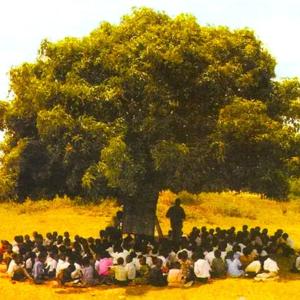
    In this conversation Vandana talks about a lesser known part of her work which relates to questions raised in this podcast series – mainly the role of higher education in reproducing our contemporary crises and the possibilities of other ways of learning. Vandana talks about the struggle against what she calls the monoculture of the mind and the universalisms that are foundational within traditional knowledge curriculum in mainstream universities. Counter to this monoculture of the mind Vandana proposes other ways of learning, practiced in Navdanya, where different knowledges are continuously put into conversation with each other. This has been very much the aspiration of the Ecoversities Alliance too. This interview took place in the mango orchard at Navdanya in 2013 where Kelly Teamey and myself sat with Vandana, amidst the sounds of other creatures who also contributed to the conversation. 
    This podcast was produced and edited by Jack Haskel, music included is composed and performed by Bruce Miller and Jackopotamos. It is part of a series of conversations in the Enlivened Learning project which took place between 2012-2013 and was one of the forerunners igniting the Ecoversities Alliance.

    Hosted by Udi Mandel, LEARNING OTHERWISE is a journey that explores the following question: What might Learning look like if it were at the service of our diverse ecologies, cultures and ways of knowing, economies, spiritualities, in our planetary home?
    LEARNING OTHERWISE makes audible the silent learning revolution happening all around the world offering stories and tools of hope, imagination and possibility that take us beyond this time of multiple crises. Through monthly conversations with practitioners and thinkers re-imagining learning and education, we hear about experiments in learning that are emerging from indigenous communities, social and ecological movements and other sites of innovation, including universities, colleges and schools in all corners of the world.

    For more episodes see
    https://ecoversities.org/podcast/

    32 min
  • E03 - Inspirations 2: A. Thakore in conversation with P.V. Rajgopal
    (Hosted by Abhishek Thakore)

    Inspirations is a series of conversations with iconic masters rooted in Indian local, traditional wisdom and ethos, who spent decades working for social transformation. They share insights and lessons from their ongoing experiences, offering a decolonized perspective on relevant issues of our times.
    40 min
  • E01 - Self-directed Education as Liberation, Remembering and Belonging (with Ché-vanni Davids, Marco Andrade V, Sierra Allen)
    From the bilingual series SEEDS OF FREEDOM.

    In this conversation with Ché-vanni Davids, we begin to explore the essence of Self-Directed Education (SDE) beyond the “brand” and sometimes elitist messaging that accompanies it. What happens when we re-imagine and re-member learning and education through the lens of love and belonging?
    In the second half of the episode we delve into some personal stories that illustrate the ways in which, as facilitators, we are learning to show up with young people in ways that are in alignment with this re-imagining. How do we play with liberating practices, tools, protocols and structures in community without getting trapped by them, re-creating what we wish to move beyond?
    Seeds of Freedom

    Ché-vanni Davids is the founder of Re-imagined Learning Centre, an SDE Community and Ecoversity located in Johannesburg, South Africa.

    Seeds of Freedom is a bilingual collaborative Podcast that amplifies the voices and practical reflections of activists, educators and social innovators that are living the change that they wish to see in the world.

    Produced by EDiT (Education in Transformation), Rebecka Koritz, El Nido Casa Abierta

    For more episodes see
    https://anchor.fm/semillasdelibertad
    1 hr 1 min

About Reclaiming Pedagogies

From the publisher's feed

A plural, multilingual platform exploring radical pedagogies, unlearning strategies, convivial research, co-learning spaces, holistic ecosystems, insurgent field studies, hybrid cosmologies, tactics…