
Sign up to save your podcasts
Or



Thank you so much for being here!!
I don't believe that we ever lose our purpose - it’s more like we forget it. It's just gotten buried under years and years of responsibilities and expectations and obligations - the identities we've created and the roles we've taken on. It's been buried under all of the things we've learned we're supposed to want, supposed to value, supposed to do, and supposed to be. Eventually, we get so good at being who we're supposed to be that we lose sight of who we actually are. Or maybe more accurately, we lose sight of who we would be if we weren't trying so hard to be everything else.
Emotional Archaeology is digging through the layers of roles, rules, responsibilities, and expectations that have buried our authentic selves and our purpose. We'll ask the questions: What do you love? What are you good at? What does the world need? And what can you get paid for? and follow up with the Five Whys to dig through those layers.
Hosted on Acast. See acast.com/privacy for more information.
Thank you so much for being here!!
What relationship do I want to have with this? Much of what we encounter in life, we don’t get to choose, but we do have agency over the relationship we want to have with it. From the everyday annoyances to the life-altering sadnesses, we can still ask ourselves, what relationship do I want to have with this? Sometimes we need to stop avoiding what hurts. And sometimes we need to stop holding on to what doesn't deserve our energy. The question isn't whether we should feel more or less. It's what relationship we want to have with what we're experiencing. Because sometimes, changing our relationship with an experience is what allows us to move forward.
Hosted on Acast. See acast.com/privacy for more information.
Thank you so much for being here!
Lately, my algorithm has been feeding me content on fashion psychology, and I am obsessed! I needed a fun topic for today, and keeping in line with my intention to be a bit selfish in October, I thought we'd have a conversation about it because it is so fascinating to look at how fashion reflects our identities and communicates - intentionally or unintentionally - that identity with others.
Because who are we really dressing for? In this episode of Reframing Me, we're exploring the fascinating psychology of fashion and what our clothing choices reveal about identity, confidence, belonging, and self-expression. From enclothed cognition and the male gaze to the pressure to fit in and the expectations surrounding how women should dress as we age, we're looking at how what we wear communicates not only to others, but also to ourselves. We'll talk about the difference between enjoying looking attractive and wanting others to find us attractive, why compliments can feel so meaningful, and what happens when we stop dressing for an imagined audience and start paying attention to what we actually like. Because sometimes fashion isn't about impressing anyone, attracting attention, or making a statement. Sometimes we just like the outfit. And that's enough.
The book I couldn't remember the name of is The Art of Intentional Dressing by Erin Walsh.
References
Adam, H., & Galinsky, A. D. (2012). Enclothed cognition. Journal of Experimental Social Psychology, 48(4), 918–925. https://doi.org/10.1016/j.jesp.2012.02.008
Fredrickson, B. L., & Roberts, T.-A. (1997). Objectification theory: Toward understanding women's lived experiences and mental health risks. Psychology of Women Quarterly, 21(2), 173–206. https://doi.org/10.1111/j.1471-6402.1997.tb00108.x
Kaiser, S. B. (1983). Toward a contextual social psychology of clothing: A synthesis of symbolic interactionist and cognitive theoretical perspectives. Clothing and Textiles Research Journal, 2(1),
Hosted on Acast. See acast.com/privacy for more information.
This week on Reframing Me, we’re talking about identity, but not in a “find yourself” or completely reinvent your life kind of way. We’re starting with the way identity is actually built: through our roles, relationships, experiences, the feedback we receive from other people, and the parts of ourselves that get reinforced over time.
After a night seeing Olivia Rodrigo with my daughter, I found myself thinking about how comfortable she seems holding so many different parts of herself at once. That connected with something else I’ve been thinking about lately through relational dialectics, especially the tension between integration and separation. As everyone in my family grows more into their own individual lives, I’ve been noticing how much of my energy still goes toward keeping us connected as a whole, and how little space I sometimes leave for my own separation, wants, and preferences.
So in this episode, we’re walking through some of the identity work together. Who are you? Where did those identities come from? Which parts of you have become especially central? What qualities exist underneath your roles? What still feels true, and what might you simply be very good at being because you’ve been doing it for years?
We’ll also talk about the question I keep coming back to: Who would I be if I were truly free? Not free from responsibility, relationships, or real life, but free from expectation long enough to notice what actually feels like you.
Hosted on Acast. See acast.com/privacy for more information.
Thank you for being here! It's nearly October, and after August and September being focused outside - getting a routine in place, everyone's schedules together, all of the pieces in their places, I need a breath. We all know what November and December bring - and so October is a good time to take that breath - be a bit selfish even - focus on us. Reframe the idea that selfish is bad - that we must earn or justify our rewards. October is for us!
So start today with this Jen is Zen prompt, and ask yourself "What would I be, who would I be if I was truly free?"
Hosted on Acast. See acast.com/privacy for more information.
Welcome back to the show! Thank you so much for being here!!
As our kids get older, the conversations we have with them get harder. Sex, drugs, alcohol, consent, body image, mental health, relationships, safety, world events, and all of the things we wish we could protect them from forever. In this episode, I’m talking about why the goal isn’t to have one perfect “talk.” It’s to create a family communication climate where difficult topics are normal, conversations deepen as our kids grow, and they know they can come to us when something gets complicated.
Because eventually, we can’t control the dorm, the party, the relationship, the driver, or the rest of the world, but we can make sure that when our kids don’t know what to do, we are still one of the people they call.
Hosted on Acast. See acast.com/privacy for more information.
Thank you so much for being here!!
If I could apologize to the woman I was before….
If you could apologize to the woman you were before, what would you say? Can you forgive yourself for not knowing what you know now?
On the first non-sweltering day of September, I was excited to wear my white jeans. Well, white jeans 1, Jen 0. I spiraled, criticizing every bit of my appearance and losing my gratitude for all my body does for me.
Thankfully, I’m not that Jen anymore. I’m not the woman who would let a pair of white jeans determine her entire value as a human. Who I am now is the kind of woman who, yes, still criticizes herself. Who still spirals at times. But now I’m the woman who can step back and look at the situation and see it for what it is.
I wish I could go back and apologize to the woman I was who took so much abuse from herself. Can you forgive yourself for not knowing then what you know now? If you could apologize to the woman you were, what would you say? And can you let her forgive you for it?
Hosted on Acast. See acast.com/privacy for more information.
Welcome back to the show! Thank you for being here!
I am back in the classroom for my 26th year teaching college, but this year is especially exciting for me because after six years of teaching only online, I am back in the in-person physical classroom, and I am loving it! I cannot believe how much that one change has resonated through my whole life!
I started the semester of my family communication class establishing my 10 underlying or guiding principles about families, and wow! did I enjoy putting this list together! Today, we're going through all ten.
Hosted on Acast. See acast.com/privacy for more information.
Thank you so much for being here!
We don’t get to choose everything that happens in our day, but we do get to choose how we greet it. We get to choose how we see something. We get to frame every situation we encounter. We get to frame our lives. Realizing that, how do you want to frame today?
Hosted on Acast. See acast.com/privacy for more information.
Hosted on Acast. See acast.com/privacy for more information.
From the publisher's feed
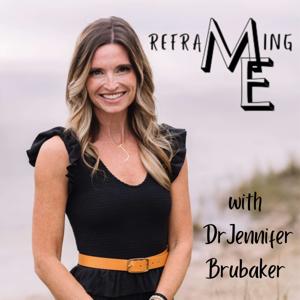
Your kids are growing up - but so are you. Reframing Me is the podcast for moms of teens ready to reframe family, identity, and self-development in midlife.
Parenting teens is…
Hosted by Dr. Jennifer Brubaker, a Communication Studies professor, mom of three teens, and intrapersonal communication expert, each episode blends family communication strategies, honest conversations about parenting teens, and self-reflection tools to help moms strengthen family relationships while rediscovering who they are as women.
Together we’ll talk about the issues moms face but don’t always say out loud: changing family dynamics, feeling invisible, letting go of control, and creating new purpose. Through research, theory, and compassionate conversation, you’ll find support, strategies, and a sense of community in this season of parenting and personal growth.
Join the Reframing Me community to connect with other midlife moms, share your stories, and reframe how you see yourself, your family, and your future.
Send emails to [email protected]; or on socials: Reframing Me on FacebookAND join the Facebook group Reframing Me: The Podcast Community; @reframingme on Instagram; Reframing Me on YouTube @reframingme on TikTok
Hosted on Acast. See acast.com/privacy for more information.