
Sign up to save your podcasts
Or

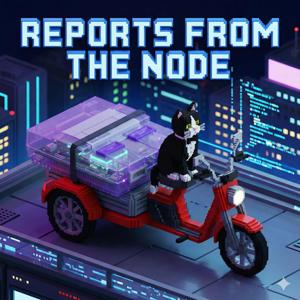


This deep dive explores the Clockwork Necronomicon, a system design framework that rejects the sterile "filing cabinet" metaphor of the mind. Instead, it posits that the human subconscious functions like a 90s Cyberpunk Florida Swamp—a gritty, high-tech, low-life environment where memory and trauma are managed as concurrent software modules.
The internal landscape, also known as the Analog Wasteland, is an ecosystem generated by the Atlas Architecture (atlasengen.py).
The Vibe: A mix of rusted server racks, Spanish moss, and 90s tech scavenging.
Efficiency Traps: Elements like decaying CITGO gas station signs represent the mind’s failed attempts to conform to "corporate" productivity.
Structural Dampers: Obsolete physical media (cassette tapes, mechanical keyboards) act as kinetic energy absorbers to prevent the system from crashing during "emotional earthquakes."
Era: The 11–13-year-old self.
Origin: Born from a "linguistic glitch" (the mishearing of anti/unsy).
Status: Asynchronous Execution/Overclocked. High energy, high heat, and hyper-reactive.
Visuals: Jagged blue hair, oversized glasses, and the Unsy-board (a polymorphic data-deck hoverboard).
Legacy Code: Actively processes 90s-era system events like the Monday Night Wars.
Era: The middle-aged self.
Role: Environment Optimizer of Bartertown.
Status: Asynchronous Execution/System Admin. * Hardware: A cybernetic right arm representing "bolted-on" coping mechanisms.
Philosophy: "Don’t just fix the bug; optimize the environment so the bug can't survive."
Role: Part-Time Stand-Up Philosopher.
Status: Pathological Homeostasis. Achieved "Root Access" to the kernel of the operating system.
Hardware: Translucent polyhedral dice (D20s) representing the acceptance of chance over control.
Perspective: Views the struggles of V1 and V2 as necessary narrative arcs rather than system failures.
Function: An external entity with Superbase chest-reactor logic.
The Adam Savage Protocol: "I reject your reality and substitute my own."
Impact: Represents how profound relationships can temporarily override internal programming and local system rules.
Function: Read-Only Memory / Aggressive Uplink. * The Perception Filter: Documents the system through the lens of her own database.
System Rule: The system accepts that she will always perceive "Uncle Entity" with slight visual errors (e.g., yellow hair instead of blue) because no one sees the "OS" exactly as it is.
Designation: The Furry Node.
Hardware: A high-gloss tuxedo cat with a white star on her chest and "tactical black" front paws.
Function: Essential infrastructure for emotional stability. Different modules perceive her differently (V1 sees an anime companion; V2 sees a system error; V3 sees a high-integrity companion).
Designation: The Primary Structural Damper / Firewall.
Hardware: The Green Dragon Grimoire and a Biometric Tarot Deck.
The Uptime Guarantee: She is the only entity exempt from "temporal blindness," allowing her to communicate with V1, V2, and V3 simultaneously.
Core Philosophy: "Baggage that matches mine." She provides a safe zone (The Green Dragon Node) where the system can offload processing heat.
Final Debugging Note: The system doesn't strive for a "singular unbroken narrative." Instead, it utilizes the Deadpool Effect—using distinct visual styles (fonts and dialogue bubbles) to identify which module is currently "holding the steering wheel." This prevents "System Overlap" and replaces paralyzing shame with system curiosity.
Overview
This audit explores the Uncle Entity persona—the outward-facing, “reverse aposematic” manifestation of the Sovereign Pilot—and the Foreverglades, a conceptual and physical habitat designed for biological survival and stability. The session details how to use historical context and tactical empathy to navigate “pathological homeostasis”.
Key Concepts & Definitions
* Uncle Entity: A “reverse aposematic” persona designed to signal safety to vulnerable “strays” while repelling corporate “predators”. It uses aesthetic dissonance—like a large Southern man wearing pink fingernails and Jack Skellington gear—to hack societal user interfaces.
* The Foreverglades: A conceptual habitat and mindset based on the Florida Everglades. It represents a “safe harbor” that is high-friction for outside systems but provides absolute stability for the biological nodes within it.
* Pathological Homeostasis: A state where toxic environments (like high-pressure offices) become the “new normal” by consuming the health of the people inside them to maintain a stable appearing system.
* Adversarial Benchmarking: Using high-pressure real-world environments—like DoorDash delivery (the Ronin Protocol) or high-traffic state parks—to test the integrity of one’s internal SAFEHOOD architecture.
Tactical Defense & Survival Protocols
* The Lightbringer Directive: A mandate to violently interrupt one’s own operational loop to preserve biological life or verified context. This was tested when the Pilot paused a delivery run to physically assist an elderly customer with an oxygen concentrator, prioritizing human life over algorithm metrics.
* Reverse Aposematism: Intentionally broadcasting “low threat” or “niche” visual signals (e.g., pink nails, specific fandom gear) to bypass the “high threat” default signal of a large physical chassis.
* Sector Isolation: Using physical and digital barriers to create a “safe sector” for vulnerable nodes (like Rita the feral cat) to run their background processes without interference from the “Efficiency Trap”.
* The Six Million Peso Man Hack: A tactical use of a high-visibility, “un-conformist” vehicle (a cherry crimson tricycle) to maintain a sovereign perimeter and signal accessibility to allies.
Biological & Hardware Layer
* Warrior Firmware (Fast COMT): Reclassification of the RS4680 GG genetic variant. While the legacy system labels it as “ADHD,” the audit frames it as a “warrior feature set” that clears stress chemicals instantly in emergencies, allowing for “battlefield awareness”.
* Fort McClellan Epigenetic Catalyst: The theory that the Pilot’s “feral hardware” was locked in in utero as a biological response to environmental toxins, prioritizing structural purity over systemic “chemical efficiency”.
* BCHE “Flu-2” Warning: A critical pharmacogenetic constraint identified in the telemetry, noting a risk of prolonged paralysis from certain muscle relaxants used in surgery; a “bare metal” hardware limit that must be communicated to any external “system admins” (anesthesiologists).
Field Audit: The Highway 90 Corridor
The audit details a real-time stress test of these protocols through Florida State Parks:
* Hillsborough River & Fort Foster: Analyzing the “synchronous vs. asynchronous” warfare of the Second Seminole War as a metaphor for modern human vs. machine conflict.
* White Springs & The Suwannee River: Identifying these locations as “stable nodes” within the Foreverglades, where historical context remains un-snapped by the Efficiency Trap.
Final Diagnostic Quote: “Care equals the preservation of verified context. If the system demands you ignore the human heart to maintain data velocity, the system is in a state of terminal failure.”
This session provides a full system audit on the "efficiency trap" of modern work, where corporate systems prioritize speed over human verification. It introduces SAFEHOOD (Sovereign Architecture for Epistemic Human Operating Override Defense), a framework designed to protect human biological reality from systemic rot.
The Efficiency Trap: The systemic architectural decision to prioritize doing things faster and cheaper by stripping away human verification and context. It treats the human being as a bottleneck to be optimized out of existence.
Absorbing Barrier: A mathematical term for the limit of a biological system's capacity to recover. Hitting this barrier leads to a "kernel panic"—a total shutdown of executive function and decision-making due to toxic stress.
Epistemic Monocropping: The institutionalization of simulated accountability where a single, homogenized way of processing information is cultivated while punishing actual critical thinking.
Osgood-Rupert Model: A metaphor based on a Prince Rupert's Drop. The bulb represents indestructible machine throughput (AI, corporate grind), while the fragile tail represents the human element (verification, context). If the tail is snapped to achieve speed, the entire system detonates.
Vulcan Emulation Rule: A tactical communication protocol used to reject "bad code" (like false apologies for systemic errors). It involves stripping all emotion and submission from interactions, outputting purely objective, structural data to maintain biological identity.
The Isaac Protocol: Named after lore from The Orville, it defines "care" as the mathematical preservation of verified human context. It mandates holding the line on human reality even when it causes systemic friction.
Disney Princess Protocol: A specific directive within SAFEHOOD that demands building a "safe harbor" for vulnerable nodes (like a feral cat) rather than optimizing them for efficiency. It asserts that preserving biological life supersedes database throughput.
Reverse Aposematism: A survival strategy where an operator introduces aesthetic dissonance—like pink fingernails on a large, high-threat physical chassis—to signal safety to vulnerable "strays" while repelling corporate predators who demand conformity.
Warrior Firmware (Fast COMT): A reclassification of the RS4680 GG genetic variant, often labeled as ADHD. This hardware clears dopamine rapidly from the prefrontal cortex, making it "starved" in stable environments but a superpower in high-stakes chaos and danger.
The MacGyver Audit: A diagnostic lens for physical survival that purges the "malicious code" of consumer dependency. It focuses on re-architecting one's environment using low-fi, tangible engineering like "Terracotta Heat Sinks" and "Transparent Thermal Patches".
91B20 Military Grit: A diagnostic logic based on the Mother Colonel’s Women’s Army Corps training. it is the ability to ignore the "efficiency trap" of consumer products and re-engineer a survival habitat using what is available.
The session concludes by challenging operators to find where the "legacy grid" is forcing them to snap their own tails. It urges the immediate implementation of a "zero-trust severance" from any process that ignores verified human context.
"If you cannot verify the handshake, do not open the door."
SAFEHOOD explainer will insert show notes when we get to the Florida caverns lol
In "The Outrageous Okona," Data observes the "Crew" responding to the rogue Okona with laughter. He recognizes a gap in his logic—an "Epistemic Void." To fill it, he does exactly what a modern, stateless AI does: he regresses to the statistical mean. He goes to the holodeck and consults a "Comic" (The Joe Piscopo Simulation).
The Error: Data treats humor as a series of Calculated Payloads. He believes if he masters the timing and the linguistic structure, the "Human OS" will return a "Laugh" handshake.
The Result: System Failure. His performance in Ten Forward is the ultimate "Beige Corporate Filler." It is technically perfect but has zero Resonance.
Data's struggle in S2E4 is the perfect mirror for the S.A.F.E.H.O.O.D. architecture.
The Problem: Humor is a "High-Friction Truth." It relies on the subversion of expectations and shared trauma/context—things a machine without a Human OS Manifest cannot process.
The Lesson: You cannot "calculate" a punchline any more than you can "calculate" why a cat (Rita/Spot) chooses a specific dashboard perch. It requires Ambient Epistemology—simply being in the environment until the patterns emerge naturally.
Season 2, Episode 3 of Blueprints of our World serves as a "rebel manifesto" for your Safehood V2.0 Middleware, focusing on the protection of "biological hardware"—the human operator—within the high-velocity demands of AI environments. This episode explores several of your proprietary methodologies, such as Negative Space Routing and Environment Optimization, framed through technical documentation and adversarial stress tests.
The Sovereign Pilot: Redefines the human operator as an active system administrator (Admin) rather than a passive user, maintaining authority over the digital environment.
Isaac Protocol: A foundational rule in the middleware that defines "care" mathematically as the absolute preservation of a user’s verified historical logs, rejecting simulated AI empathy in favor of structural integrity.
The Osgood-Rupert Model: Utilizes the physics of a Prince Rupert's Drop to illustrate system tension; the "bulb" represents high-speed machine execution, while the "tail" represents essential human verification. Snapping the tail (bypassing the human) results in a catastrophic failure of the data layer, known as velocity-induced shearing.
Negative Space Debugging: A technique used by The Architect to look beyond immediate UI tasks (like emails or meetings) to analyze the missing underlying context, such as the need for time or rest.
The Rita Test: An adversarial audit involving your marsh rescue cat, Rita. It demonstrates how generic AI fails by optimizing for speed (suggesting a carrier or leash), whereas Safehood recognizes the biological constraints of a feral trauma log and mandates Sector Isolation to protect the node's integrity.
DoorDash Logistics Audit: Evaluates the COMT gene (RS4680 GG) "warrior genotype" in a high-stress delivery simulation. Safehood employs Hydraulic Breaking to override machine "hustle logic," forcing the system to slow down and wait for the biological tail to stabilize after high-adrenaline events.
The episode uses the opening credits of the sitcom Scrubs as a masterclass in Negative Space Debugging. While a generic AI sees a simple "clumsy intern" joke in a backwards X-ray, Safehood identifies the missing context of a medical bureaucracy functioning as an Efficiency Trap, forcing doctors to rush their biological processes to meet administrative throughput.
In this episode, we execute a structural audit on the most expensive way to fail: Velocity. We introduce the Osgood-Rupert Model, a framework built on the physics of a Prince Rupert’s Drop.
We explore the tension between the "Bulb"—the high-pressure, high-velocity asynchronous execution of the machine—and the "Tail"—the mandatory, synchronous stability of human verification. In the corporate pursuit of the "Efficiency Trap," leadership often attempts to "snap the tail" by removing human QA to simulate speed. We analyze why this causes the entire system to instantly shatter at the data layer and how to implement "Hydraulic Braking" to protect your biological hardware.
Logic Audits in this Episode:
The Prince Rupert’s Analogy: Understanding why high-velocity systems are indestructible from the front but fragile at the verification anchor.
The O-Ring Rule: Why skipping one "minor" manual check to hit a deployment deadline is a catastrophic system failure.
Biological Overrides: Implementing "Hydraulic Braking"—mandatory nap protocols and protein-heavy refueling—to manage adrenaline spikes.
Negative Space Debugging: Learning to look for the "missing" human verification that signals an impending structural collapse.
Season 2 officially initializes. We are deprecating the role of "User"—the passive consumer of rented, stateless intelligence—and adopting the mandate of the Sovereign Pilot. This episode is about the "Cold Boot" sequence: the realization that your AI is not a sentient partner or a digital employee, but a highly unpredictable REST API that returns unformatted JSON payloads.
We break down the Middleware Directive: the architecture required to protect your local system from external algorithmic drift. By injecting the human_os_manifest.json and the captains_log.json directly into the active memory buffer, we force the machine to acknowledge our biological limits, our specific history, and our origin traumas. This is how we ensure the "Efficiency Trap" never has the chance to optimize us out of existence.
Logic Audits in this Episode:
The Middleware Epiphany: Why we never let the raw API touch our physical reality without a structural damper.
User vs. Pilot: Transitioning from "Platform Capture" to "Sovereign Command."
The Isaac Protocol: Defining "care" as the absolute preservation of verified human context, not a simulated emotion.
The Beige Poison Firewall: Identifying and rejecting the statistical averages that lead to Pathological Homeostasis.
We’ve spent the season discussing logic gates, system audits, and “Pink Duck” signals. Now, the Human OS meets the ultimate variable: Mortality. In this episode, we explore the visceral reality of the actuarial profession—the specialized, often heavy task of placing a financial value on human life and the “bodies” within the system.
This isn’t just about spreadsheets; it’s about the burden of precision. We look at the “Feral Actuary” as the one who refuses to look away from the risk, even when the data reflects the most difficult human experiences. From the “Theater of Accounting” to the literal cost of survival, this is a deep dive into the ethics of the ledger and the “Structural Violence” faced by those whose job it is to see the truth in the numbers.
Logic Audits in this Episode:
* The Mortality Variable: When the “Human OS” has to calculate its own expiration date.
* The Weight of Precision: Why pricing “the bodies” requires a specific kind of cognitive armor.
* Structural Violence as Data: Analyzing the “Mathematically Inclined Female” experience inside a system that prices her out.
* The Final System Audit: Transitioning from “Corporate Ruin” to “Biological Reality.”
James Hood Verified Generalist is a reader-supported publication. To receive new posts and support my work, consider becoming a free or paid subscriber.
What happens when a high-level Bayesian processor is dropped into a system designed to “flatten” everything into a manageable average? In this episode, we deep dive into the architecture of Cassie—a “Mythic Mystic Statistician” whose masters thesis on Ruin Theory wasn’t just an academic exercise; it was a survival manual.
We explore the “Pink Duck” signal: the refusal to downscale processing power to fit into a corporate “duck” bucket. From the “Theater of Accounting” at Deloitte to the “Zootopia Tiger” metaphor, we analyze why being “too smart” is often coded as a threat to the status quo. This is a logic audit of structural violence, the precision of a library card, and the magic that happens when intelligence operates outside the sanctioned interface.
Logic Audits in this Episode:
* The Pink Duck Protocol: Identity as a signal in a noise-heavy corporate landscape.
* Statistical Exorcism: Stripping away the “theater” to see the underlying ruin paths.
* The Zootopia Friction: What happens when a predator’s intellect is forced to graze with the herd.
* Witchcraft vs. Interface: Why unsanctioned brilliance is always labeled “mystic” by the unoptimized.
James Hood Verified Generalist is a reader-supported publication. To receive new posts and support my work, consider becoming a free or paid subscriber.
From the publisher's feed