
Sign up to save your podcasts
Or

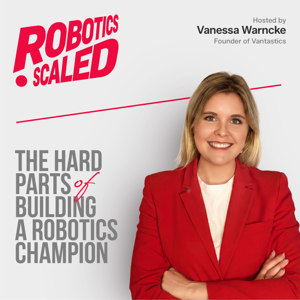


In this episode of Robotics.Scaled, host Vanessa Warncke sits down with Mario Mauerer from Maxon and former CTO Hardware at ANYbotics to discuss why robotics startups fail and the challenges of scaling robotics companies.
Mario shares why successful robot prototypes often struggle in the real world, the biggest mistakes startups make, and how robotics manufacturing, product management, and hardware innovation shape the future of robotics..
The conversation also explores robotics supply chains, China's manufacturing advantage, build vs. buy decisions, industrial automation, and the future of robotics.
Mario explains how AI robotics, autonomous robots, humanoid robotics, and warehouse automation could transform industries, while revealing why manufacturing capacity and supply chain bottlenecks may become some of the biggest challenges for the robotics industry.
Watch the full episode to discover what it takes to scale a robotics startup, avoid costly deployment mistakes, and prepare for the next generation of robotics innovation.
Timestamps
00:00 – Why Robotics Startups Fail When Scaling
01:01 – Introduction to Mario Mauerer and maxon
03:52 – Is Robotics Hardware Becoming a Commodity?
06:06 – China's Advantage in Robotics Manufacturing
08:10 – The Biggest Challenges of Scaling Robotics Companies
11:20 – Why Robots Fail Outside the Lab
14:28 – When Is a Robot Ready for Real-World Deployment?
17:11 – Scaling Hardware, Teams, and Company Culture
21:15 – From Robotics Startup to Scalable Business
22:35 – Why Product Management Matters in Robotics
25:36 – Should Robotics Startups Build or Buy Hardware?
30:42 – How maxon Competes in Global Robotics Manufacturing
33:12 – Lessons From ANYbotics and maxon
37:49 – The Future of Autonomous Robots and Warehouse Automation
40:42 – The Biggest Supply Chain Bottlenecks in Robotics
43:49 – Final Thoughts
Connect with the Host:
Vanessa Warncke
LinkedIn: https://www.linkedin.com/in/vanessawarncke/
Website: https://vantastics.tech/
Connect with the Guest:
Mario Mauerer – Maxon
LinkedIn: https://www.linkedin.com/in/mario-mauerer/
About Maxon:
Website: https://www.maxongroup.com/
#Robotics #RoboticsStartups #ScalingRobotics #RoboticsManufacturing #RoboticsIndustry #FutureOfRobotics #Maxon #ANYbotics #RoboticsTechnology #RoboticsAutomation #RobotDeployment #IndustrialRobotics
What does it really take to go from deploying a few robots to thousands of robots at scale?
In this episode of Robotics.Scaled, Vanessa sits down with a former GM EMEA at Tennant to break down the commercial and operational decisions that separate promising robotics companies from those that actually become global robotics leaders.
The conversation goes beyond hardware and impressive demos. They explore what happens when a robotics company moves from pilots and early customers into large-scale deployments—where customer success, training, service infrastructure, site readiness, reliability, partner strategy, and profitability suddenly become just as important as the robot itself.
One of the biggest lessons: selling the first robot is not the real sale.
The real challenge is making the robot so reliable and valuable that customers want 10, 100, or even 1,000 more.
They discuss how robotics startups should build repeatable deployment systems, standardize customer onboarding, manage expectations, create strong customer success teams, choose the right partners, avoid over-customization, and identify the use cases that can genuinely scale.
The episode also explores why many robotics businesses struggle with profitability even after successfully selling robots—and why service costs, software issues, operator training, and poor deployment processes can quietly destroy margins.
Timestamps
00:00 - 01:03 | Trailer on Scaling Robotics Beyond Pilots
01:03 - 02:10 | Podcast Introduction and Guest Background
02:10 - 03:56 | Designing Robots for Global Deployment
03:56 - 06:25 | Stakeholders, Expectations, and Site Readiness
06:25 - 08:30 | Building a Repeatable Deployment Model
08:30 - 10:15 | Standardization, Data, and Robot Monitoring
10:15 - 13:01 | Selling Peace of Mind, Not Just Robots
13:01 - 15:35 | Business Case, Hidden Costs, and Labor Challenges
15:35 - 18:53 | Customer Success, Training, and Change Management
18:53 - 25:36 | Partner Strategy and Ideal Partner Profile
25:36 - 28:30 | Profitability, Service Burden, and Partner Dependency
28:30 - 31:02 | Scalable Use Cases and Strategic Focus
31:02 - 33:10 | Software Ownership, Outsourcing, and Lock-In Risks
33:10 - 36:59 | Business Model, Deployment Ownership, and Fleet Insights
36:59 - 38:11 | Scaling from Hundreds to Thousands of Robots
38:11 - 40:11 | AI Readiness, Mind Marks, and Closing Thoughts
40:11 - 40:14 | Outro Animation / Podcast End
If you're building, operating, investing in, or selling robotics, this episode offers a practical look at robotics commercialization, go-to-market strategy, deployment, customer success, scaling, and profitability.
Subscribe to Robotics.Scaled for honest conversations with founders, operators, and investors building the next generation of robotics companies.
Watch the latest episode here - https://youtu.be/7-NHsgNT8L8
#Robotics #RoboticsStartup #RoboticsScaling #PhysicalAI #Automation #RoboticsBusiness #IndustrialRobotics #RoboticsDeployment #RoboticsCommercialization #DeepTech #RoboticsPodcast
In this episode of Robotics.Scaled, Vanessa sits down with Kateryna Portmann from ANYbotics to unpack one of the biggest challenges in robotics commercialization: moving from a successful pilot to a real deployment that creates measurable business value.
The surprising part? In many cases, the technology is not the main problem.
Kateryna explains why robotics pilots often fail because companies are not truly ready for deployment. Missing stakeholder alignment, unclear ROI, weak training, legacy systems, poor workflow integration, and a lack of executive buy-in can leave even strong robotics technology stuck in pilot purgatory.
They break down what robotics companies and buyers need to get right before deployment, from identifying the real decision makers and defining clear success metrics to integrating robots with existing ERP systems, APIs, fleet management platforms, and other automation technologies.
The conversation also explores how companies can scale beyond a single robot, improve frontline adoption, create trust with workers, plan for predictive maintenance, navigate compliance, and prepare for a future where robots and physical AI become part of everyday workplaces.
If you're building, buying, investing in, or deploying robotics, this episode offers a practical look at what actually separates a robotics pilot from a scalable robotics business.
In this episode:
Why robotics pilots fail even when the technology works
How to escape pilot purgatory
Technical vs. organizational readiness
Why executive buy-in matters
How to define robotics pilot KPIs and success metrics
Integrating robots with legacy systems, ERP, APIs, and fleet management
How to identify the real robotics buying center
Robot adoption among frontline workers
Predictive maintenance and long-term deployment value
Scaling from one robot to hundreds or thousands
Safety, compliance, and engineering responsibility
The future of robotics, AI, and physical AI
Timestamps
00:00 - Trailer on Robotics Pilots and Readiness
00:56 - Introduction Kateryna Portmann
01:55 - Why Robotics Pilots Fail Beyond Technology
04:14 - Technical Readiness, Training, and Workflow Integration
07:19 - Decision Makers, Stakeholders, and Scaling Beyond Pilots
11:03 - Legacy Systems, APIs, and Multi-Robot Integration
14:05 - Successful Pilot Scaling and Clear Success Metrics
18:56 - Buying Center, Value Drivers, and Predictive Maintenance
24:13 - User Experience, Frontline Workers, and Robot Adoption
28:22 - Cultural Readiness, Safety, and Robot Awareness
31:00 - Scaling Robotics Production and Market Consolidation
34:30 - Compliance, Regulation, and Engineering Responsibility
37:05 - Future of Robotics, Coexistence, and Closing Thoughts
39:38 - End
Robotics.Scaled brings honest conversations with founders, operators, product leaders, and investors about what it really takes to commercialize robotics, find product-market fit, scale deployments, and build global robotics companies.
Check out our location partner DARE Campus: https://darecampus.ch/
and join the DARE Campus Robot Showcase & Community Night - https://luma.com/DAREcampusRobotShowcase?tk=2rch5l
Check out Kateryna's initiative RobotReady - https://robot-ready.co/en/
Check our the episode here - https://youtu.be/39gWdflyadk
Subscribe for more conversations on robotics startups, physical AI, automation, robotics commercialization, product-market fit and go-to-market strategy.
In this episode of Robotics.Scaled, Vanessa sits down with Alessandro Mora, Co-Founder & CEO of Ascento, to unpack the journey from an ETH robotics prototype to a growing security robotics company operating across international markets.
The conversation goes far beyond the robot itself. Alessandro shares how Ascento found its first real use case in outdoor security, identified the right ideal customer profile (ICP), validated product-market fit, and learned to avoid getting trapped in endless pilot projects.
They also explore why some customers are worth pursuing while others aren't, how to define success before launching a pilot, when to say no to customer requests, and why staying focused can be one of the hardest parts of scaling a robotics startup.
The episode also dives into product market fit, robotics business models, international expansion, direct sales vs. partnerships, physical AI, robotics funding, customer adoption, and what founders need to understand before trying to scale globally.
If you're building a robotics startup, drone company, deep tech business, or autonomous systems company, this episode offers practical lessons on commercialization, go-to-market strategy, customer validation, and scaling robotics beyond impressive demos.
What you'll learn:
How to find the right use case for a robotics startup
How Ascento identified security as its target market
What makes a strong robotics ICP
How to avoid pilot purgatory
How to evaluate customer urgency and willingness to pay
Why founders need to stay focused as customers request new features
How to build a Robot-as-a-Service business model
When a robotics startup is ready to expand internationally
Direct sales vs. partnerships in robotics
How physical AI is changing the robotics market
Why customer adoption could be the biggest unlock for robotics
Timestamps
00:00 - Trailer: Robotics ICP & Customer Adoption
00:56 - Podcast Introduction & Ascento Overview
01:33 - From ETH Prototype to Security Robotics
03:49 - First Traction & Early Market Validation
05:44 - Macro Trends Driving Security Robotics
07:19 - Defining the Ideal Customer Profile
11:36 - How to Evaluate Customer Fit
14:26 - Staying Focused & Avoiding Scope Creep
17:40 - Feature Prioritization & Long-Term Vision
20:29 - The Mission: Outdoor Security Robotics
21:27 - Building a Robot-as-a-Service Business
24:40 - Taking a Robotics Company International
28:31 - Robotics Funding & Physical AI
31:06 - Building the Team & Evolving as a Founder
32:14 - Advice for Robotics Founders
33:49 - The Future of Customer Adoption in Robotics
Robotics.Scaled brings honest conversations with the founders, operators, researchers, and investors building and commercializing the next generation of robotics.
Follow and subscribe for more conversations about robotics startups, AI, physical AI, product-market fit, go-to-market strategy, automation, deep tech, robotics commercialization, and scaling globally.
YouTube - https://www.youtube.com/@RoboticsScaled
In this episode of Robotics.Scaled, Vanessa Warncke sits down with Prof. Dr. Yulia Sandamirskaya, Professor at ZHAW and Co-Founder of YuRo, to explore the realities of commercializing cutting-edge robotics technology. From years of AI, neuroscience, and robotics research to launching a robotics startup, Yulia shares how founders can bridge the gap between breakthrough innovation and real-world adoption.
They dive into why healthcare became YuRo's first market, how robotics companies should approach go-to-market strategy, why software may be a smarter bet than building hardware, and what it really takes to achieve product-market fit in robotics. The conversation also covers fundraising, customer validation, early pilots, scaling challenges, robotics business models, and why founders should start with the market, not the technology.
Whether you're building a robotics startup, investing in robotics, working in AI, automation, healthcare technology, or simply interested in the future of intelligent machines, this episode is packed with practical insights from someone building at the frontier.
If you're interested in robotics, AI, autonomous systems, healthcare automation, robotics startups, venture capital, deep tech, or commercializing breakthrough technologies, subscribe to Robotics.Scaled for conversations with the founders, investors, and operators shaping the future of robotics.