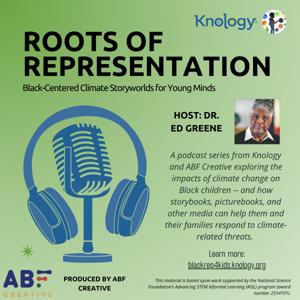
Roots of Representation

Roots of Representation

By Knology ResearchScienceEarth Sciences
Download on the App Store

Roots of Representation episodes

  • Episode 11 – Steps to Building Black-Centered Climate Storyworlds

    Guest Host: Anthony Frasier; Guest: Dr. Ed Greene (Knology)

    In this episode, guest host and project advisor Anthony Frasier talks with project PI Dr. Ed Greene about some of the key building blocks for creating stories that improve the representation of Black voices in children’s climate media. Synthesizing common themes and key takeaways from previous episodes, this podcast showcases what we’ve learned so far about the kinds of storytelling techniques that can support effective Black representation. 

    During this episode, Dr. Greene also mentions several resources that can be leveraged in support of creating child-centered climate change solutions:

    • Outdoor Afro – An organization that celebrates and inspires Black connections and leadership in nature, and that reconnects Black people to our lands, water, and wildlife through outdoor education, recreation, and conservation.
    • The Deep South Center for Environmental Justice – An organization dedicated to improving the lives of community members of all ages who are harmed by pollution and vulnerable to climate change, through research and policy studies, community and student engagement to impact policy change, and health and safety training for environmental careers.
    • Beyond Petrochemicals – A campaign that seeks to halt the rapid expansion of petrochemical and plastic pollution in the United States (particularly in Louisiana, Texas, and the Ohio River Valley), and that works to establish stricter rules for existing plants to safeguard the health of American communities. 
    • The Bullard Center for Environmental and Climate Justice – An organization that works to address long-standing issues of systemic inequality and structural racism that cause disproportionate pain, suffering ,and death in Black and other people of color communities.
    • Zero Hour – A youth-led movement that centers the voices of diverse youth in conversations about climate and environmental justice, and that creates entry points for young activists and organizers looking to take concrete actions around climate change. 
    • 54 min
    • Episode 10 – Building Children’s Storyworlds through Podcasts and Other Audio-Based Content

      In this episode, host and project PI Ed Greene talks with project advisor Anthony Frasier about the role podcasts and other audio-based content can play in improving Black representation in children’s media. Their discussion also touches on ways that audio-centered storyworlds can improve children’s STEM knowledge, boost their mental and emotional wellbeing, and ignite a desire to protect the planet. 

      During this episode, Anthony also mentions several resources that can be leveraged in support of creating child-centered climate change solutions:

      • This is Planet Ed – An Aspen Institute initiative that seeks to mobilize collaborative action across a number of systems (including early childhood, children’s media, K-12 education, and higher education) to engage, prepare, and empower young people to succeed in a changing climate. Among other resources, This is Planet Ed (along with The Nature Conservancy) has created an “Essential Climate Principles” document to encourage the development of innovative climate media for children. 
      • Common Sense Media - An organization whose efforts to identify high-quality media content for children includes a list of “Movies that Teach Kids about Climate Change.”
      • ABF Creative – Anthony’s audio production company, whose multicultural, family-centered podcasts feature vibrant storytelling situated at the intersection of cultural depth and emotional resonance.
      • Nickelodeon – A children’s media production company whose research offers insights into the kinds of character types (for example, “guides” and “mirrors”) that can stimulate youth interest and engagement around climate change. 
      • 53 min
      • Episode 9 - Roots of Representation: Building Environmental Resiliency through Children’s Museums

        In this episode, host and project PI Ed Greene and project team leader Arthur Affleck III, M.Ed., JD., talk about ways the children’s museum sector is helping youth all across the country learn about and respond to various climate-related harms.  

        In this episode, Arthur highlights several museum exhibits and programs that are equipping children with ideas, information, and resources for protecting their natural environments and healing the planet. Some of these include: 

        • Race to Zero Waste – An exhibit at the Discovery Cube (in Los Angeles, CA) that takes a gamified approach to teaching children about the importance of recycling and waste management.
        • Climate Action Heroes – A program at the National Children’s Museum (in Washington, D.C.) that teaches youth eco-friendly practices through monthly missions that help them build their climate superpowers. 
        • Caretakers of Wonder - Led by Madison Children’s Museum, Caretakers of Wonder is a network of cultural organizations working on climate change issues, impacts, and adaptations facing museums and the young children we serve. 
        • Wild Weather – An immersive exhibit (hosted by the Children’s Museum of Indianapolis) that simulated hurricanes, tornadoes, blizzards, and other extreme weather events while teaching children about ways to mitigate the effects of severe weather impacts. 
        • South Florida & Me – A gallery (featured at the Miami Children’s Museum) that teaches children about the Everglades and its role in sustaining various ecosystems in the South Florida region. 
        • Hub for Resilience Education - In partnership with The Community Foundation of Broward, the Museum of Discovery and Science in Fort Lauderdale, FL is addressessing environmental issues relevant to the community and developing solutions to help mitigate the impact of climate change by championing engagement, education and action for environmental sustainability and resilience in Broward.
        • 56 min
        • Episode 8 - Leveraging Black Expertise to Support Solutions-Driven Approaches to Climate Change

          In this episode, host and project PI Ed Greene speaks with Dr. Leah Austin (President & CEO of the National Black Child Development Institute) about ways to bring the knowledge and experiences of Black communities to bear on decision-making processes connected to climate change and other environmental justice concerns. 

          In this episode, Dr. Austin also mentions several groups that are pioneering and modeling this kind of approach:

          • The Power Coalition for Equity and Justice – a coalition of community-based organizations that works to increase civic engagement across Louisiana, with a focus on communities of color.
          • Partnership for Southern Equity – an organization that works to advance equity in metropolitan Atlanta and the US South by addressing the root causes of racial disparities and bringing positive, lasting change to communities that have faced long-standing inequalities. 
          • Council on Black Health – a national research and action network that advances Black health equity by increasing awareness of structural racism’s impact on health and promoting solutions that realize healthy Black communities.
          • 54 min
          • Episode 7 - Creating Early Learning Spaces that Promote, Protect, and Preserve Black Cultures and Histories

            In this episode, host and project PI Ed Greene asks Dr. Iheoma U. Iruka about ways to create STEM- and climate-related children’s media that promotes, protects, and preserves Black cultures and histories. Dr. Iruka also mentions resources that can be leveraged in support of creating child-centered climate change solutions:

            • Effects of Racism on Child Development: Advancing Antiracist Developmental Science – a report describing the Racism + Resilience + Resistance framework (R3ISE) and how it can be used to ensure equity in educational opportunities for racially and ethnically minoritized children. 
            • Impact of Racism on Black Children’s Health: Advancing Protection, Promotion, & Preservation Policies – a presentation on how the R3ISE model can be used to support the healthy development of Black children from birth through childhood.
            • Black Child National Agenda: America Must Deliver on its Promise – an agenda that identifies policies and practices for ensuring that Black children and their families are protected from racism, discrimination, and inhumane material hardships.
            • EmbraceRace – an organization dedicated to creating tools, resources, and discussion spaces that nurture resilience and joy in children of color, and that allow young children of all stripes to think critically about race and racial inequality. 
            • Talking About Race with Children – a research brief that offers practical guidance for helping young children deal with racism, stereotyping, and discrimination.
            • 48 min
            • Episode 6 - Strategies for Supporting Children’s Learning Through Media

              In this episode, host and project PI Ed Greene asks Dr. Fashina Aladé about media creation and production strategies that can help children identify with and learn from the characters and stories they encounter in TV shows and other popular formats. Dr. Aladé also mentions several individuals and organizations that are contributing to child-centered climate change solutions:

              • Common Sense Media – an organization whose efforts to identify high-quality media content for children includes a list of “Movies that Teach Kids about Climate Change.” 
              • “Media and Technology for Our Littlest Learners: Guidance for Educators and Families on Choosing Appropriate High-Quality Content” – An article by Fashina that explores different ways early childhood educators can help shape children’s screen habits and guide them toward healthy media habits and media literacy.
              • The Authentically Inclusive Representation (AIR) Report – A report from the Center for Scholars and Storytellers that identifies methods for producing media content that exhibits “true diversity.”
              • “Who’s Modeling STEM for Kids? A Character Analysis of Children’s STEM-focused Television in the US” – An article of Fashina’s (written with Alexis Lauricella, Yannik Kumar, and Ellen Wartella) that looks at gender and race representation in children’s TV shows featuring educational STEM content.
              • 39 min
              • Episode 5 - Highlighting Diverse Black Experiences of Climate Change through Children’s Literature.

                In this episode, guest host and leadership team member Crystal Allen asks Christine Taylor-Butler about strategies for writing stories that acknowledge the diversity of Black Americans’ experiences of climate change, and about incorporating STEM content into children’s media in ways that promote hope, agency, and a knowledge of how to prepare for and respond to a wide variety of climate-related threats. Taylor-Butler also mentions several resources for broadening the representation of diverse youth in children’s literature, including: 

                • Whoosh! Lonnie Johnson’s Super-Soaking Stream of Inventions  – in this STEM picture book, author Chris Barton and illustrator Don Tate provide a biography of Lonnie Johnson, inventor of the SuperSoaker. 
                • Abby in Orbit – written by Andrea J. Loney, this series tells the story of Abby Baxter, a third-grader whose parents are scientists at the OASIS International Space Station. 
                • NASA – a government agency whose research focuses not only on outer space, but on planet Earth and the various species whose lives are being impacted by climate change. 
                • International Tiger Project – A project launched by Wildlife Conservation International whose work looks at how conservation efforts can help mitigate the effects of climate change. 
                • 48 min
                • Episode 4 – Advocating for Writers of Color in Children’s Book Publishing

                  In this episode, host and project PI Ed Greene asks Jason Low, co-owner of Lee & Low Books about diversity in the children’s publishing industry and ways to support writers of color interested in producing climate-related media. Jason also mentions several individuals and organizations that are contributing to child-centered climate change solutions:

                  • The Diversity Baseline Study – information about how Lee and Low tracks the publishing industry’s progress toward becoming more inclusive.
                  • Our Children’s Trust – a non-profit public interest law firm that represents young people in efforts to secure their rights to a safe climate.
                  • Wangari Maathai: The Woman Who Planted a Million Trees – a book by Franck Prévot and Aurélia Fronty (illus.) that explores the life of Nobel Peace Laureate Wangari Maathai, whose tree-planting campaign helped catalyze climate action across the world.  
                  • Read Banned Books – a website from Penguin Random House dedicated to ensuring that children have access to books offering a wide range of perspectives.
                  • We Need Diverse Books (WNDB) – an organization seeking to diversify the publishing industry and to make bookshelves more equitable. 
                  • 39 min
                  • Episode 3 - Roots of Representation: Promoting Eco-Friendly Living Through Storytelling

                    In this episode, host and project PI Ed Greene asks Tulani Thomas about strategies for creating STEM stories that resonate with and speak to the concerns of Black audiences, and that encourage Black children and families to adopt green living practices. Tulani also mentions several individuals and organizations that are raising awareness about the ways Black children can contribute to climate change solutions:

                    • The HBC Green Fund – which offers financial support for environmentally-themed events and programs geared toward Black youth.
                    • Christine Taylor Butler – an author whose series The Lost Tribes weaves STEM themes and messages into a child-friendly discussion of climate change.
                    • Veronica Chapman – an author and founder of the Black Children’s Book Week, which works to ensure that Black children are represented in children’s media. 
                    • Tutu’s Green World – Tulani’s green lifestyle and education company, which offers resources, tips, and advice for helping children discover creative ways to be eco-friendly. 
                    • 34 min
                    • Episode 2 - Roots of Representation: Climate Change Literature as a Vehicle for Children’s Mental Health

                      In this episode, host and project PI Ed Greene asks Dr. Tresha Gibbs about ways that STEM education can help Black children build the kinds of mental health resilience needed to cope with and respond to climate-related threats. Dr. Gibbs also mentions several individuals and organizations that are raising awareness about the ways Black children can contribute to climate change solutions:

                      • Children’s Health and the Peril of Climate Change – a book by Frederica Perera that documents both the impacts of climate change on youth and the ways young people are engaging this crisis;
                      • West Harlem Environmental Action, Inc. (WE ACT for Environmental Justice) – an organization that “empowers and organizes low-income people of color to build healthy communities for all.”
                      • The Environmental Protection Agency – a governmental organization that regularly reports on the disproportionate impacts of climate on Black and other minoritized communities;
                      • When Good Fruit Goes Bad – a book by Vernon D. Gibbs that teaches children self-confidence through healthy, environmentally friendly eating. 
                      • 32 min

                      About Roots of Representation

                      From the publisher's feed

                      Through engaging, cross-disciplinary discussions, the series delves into the scientific, social, cultural, psychological, emotional, and educational aspects of climate change and its impacts on Black children, while also highlighting the work of Black visionaries and problem-solvers who are devising innovative, effective responses to climate-related threats.