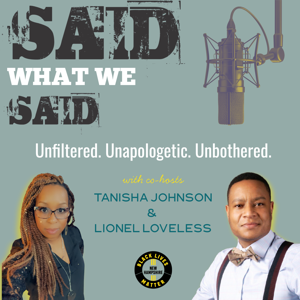
Said What We Said

Said What We Said

Download on the App Store

Said What We Said episodes

  • Who Responds When the Crisis is Not A Crime? Part 2

    In Part 2 of “Who Responds When the Crisis Is Not a Crime?”, we dig deeper into what happens when someone is experiencing a crisis and the response they need isn’t punishment, policing, or incarceration.

    What does real community safety look like when we lead with care? Who should be responding to mental health crises, substance use, housing instability, and other moments of vulnerability? And what would it take to build systems that actually meet people where they are?

    This episode pushes the conversation beyond identifying the problem and toward imagining and demanding something better.

    Because not every crisis is a crime. And our response shouldn’t treat it like one.

    🎙️ Listen to Part 2 now.

    45 min
  • Who Responds When the Crisis is Not a Crime? P. 1

    In this episode, Cohosts Tanisha Johnson and Lionel Loveless cover topics related to public safety, mental health, policing, social work, crisis response, and policy reform.

    It explores the perspectives of various professionals and their experiences in these areas such as Anthony Poore, CEO of the New Hampshire Center for Justice and Equity, Kaitlin Jones, Police Social Worker for the Dover Police Department of NH, and Elliot Moya, Police Chief of a Maine Police Department . For more information, visit blmnh.org.

    Takeaways

    • Public safety is about community security, equitable access to resources, and trust in institutions.
    • Mental health crisis response and de-escalation training for law enforcement are crucial for handling situations effectively and compassionately. Mental health support within police departments is a cost-saving and effective solution.
    • A continuum of care is essential for individuals in crisis, and social work plays a crucial role in providing real solutions.
    • Policy recommendations for law enforcement, including statewide use of force policy and victim witness advocacy, are important for building trust and accountability.

    54 min
  • Gala Theme of 2026: Black Dandyism
    Black Dandyism, style, and the Matter Black Excellence Gala

    This conversation centers on the upcoming Matter Black Excellence Gala on October 3 and the meaning behind its theme, Black Dandyism. The hosts connect fashion, identity, joy, and resistance, showing how style can be both self-expression and a way to push back against stereotypes. They also reflect on community, Black cultural history, and why showing up authentically matters.

    Guests and speakersBLM NH speaks throughout as the host, discussing the gala, style, confidence, Black cultural history, and the organization’s mission.Key topics
    • In this episode: the hosts open with a playful exchange about pumpkin spice, back-to-school season, and feeling older as their children grow up.
    • They introduce the Matter Black Excellence Gala happening on October 3 and explain that the theme is Black Dandyism. The conversation explores dandyism as more than sharp clothing - it is about identity, elegance, intentional self-presentation, and resistance. They discuss how clothing can function as a defense mechanism, a form of code-switching, and a way Black people have historically navigated white spaces.

    • The hosts connect Black fashion to history, including the Harlem Renaissance, zoot suits, and figures like Gladys Bentley ,Janelle Monáe, Billy Porter, Andre 3000, and Dapper Dan.

    • They talk about how style can shift how people are perceived, including the ways the bow tie and tailored clothing helped one speaker reclaim identity and confidence in New Hampshire.
    • In this episode: they reflect on the tension around dress codes, bonnets, do-rags, pajamas, and what schools consider “appropriate” versus how Black students are judged in the world.
    • They emphasize that the gala is meant to be a night of joy, authenticity, and unapologetic Blackness, with room for allies who show up in good faith and with context.
    • The episode closes with a tribute to Denise Oliver Velez, honoring her life, her work, and her impact on New Hampshire.
    39 min

About Said What We Said

From the publisher's feed

Welcome to Said What We Said; a podcast where generations of Black folk gather at the mic to speak our truths, build our power, and say the quiet parts out loud. From kitchen table wisdom to front-line organizing, we’re bringing bold, honest conversations about life, love, justice, and legacy — with no sugarcoating and no holding back.