
Sign up to save your podcasts
Or

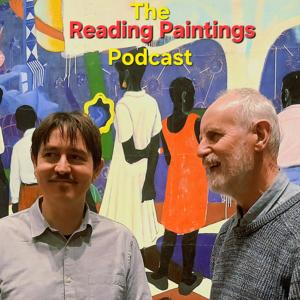

In this second part of three episodes, David and Harry continue to explore the work of Kerry James Marshall at the Royal Academy of Arts . We invite you to view the image while listening. Please click on the paintings title to go to an image of the work.
Kerry James Marshall is best known for large-scale figurative paintings that place Black subjects at the centre of scenes traditionally reserved for white figures in European and American art history. His figures are often painted in a deep, opaque black, a deliberate aesthetic and conceptual choice. By pushing blackness to an extreme, Marshall challenges assumptions about beauty, representation, and visibility, forcing viewers to confront how race operates visually and ideologically within his paintings. Text frequently appears in Marshall’s work, guiding interpretation while complicating meaning. His use of language underscores his belief that images and words together shape historical memory.
Content and creative lead: David Johnson and Harry Baxter
Producer: Ian Rattray
Audio production: Clear Voice Enterprises
Our thanks to the Royal Academy of Arts for allowing the recording of this episode of the Reading Paintings podcast.
It is not always possible to find a commons licenced image. Therefore, any links to external websites are the opinions, views or expressions of the website host or profile holder. Any images on such websites are the property of the website host or profile holder.
 View all episodes
 By Reading Paintings
In this second part of three episodes, David and Harry continue to explore the work of Kerry James Marshall at the Royal Academy of Arts . We invite you to view the image while listening. Please click on the paintings title to go to an image of the work.
Kerry James Marshall is best known for large-scale figurative paintings that place Black subjects at the centre of scenes traditionally reserved for white figures in European and American art history. His figures are often painted in a deep, opaque black, a deliberate aesthetic and conceptual choice. By pushing blackness to an extreme, Marshall challenges assumptions about beauty, representation, and visibility, forcing viewers to confront how race operates visually and ideologically within his paintings. Text frequently appears in Marshall’s work, guiding interpretation while complicating meaning. His use of language underscores his belief that images and words together shape historical memory.
Content and creative lead: David Johnson and Harry Baxter
Producer: Ian Rattray
Audio production: Clear Voice Enterprises
Our thanks to the Royal Academy of Arts for allowing the recording of this episode of the Reading Paintings podcast.
It is not always possible to find a commons licenced image. Therefore, any links to external websites are the opinions, views or expressions of the website host or profile holder. Any images on such websites are the property of the website host or profile holder.