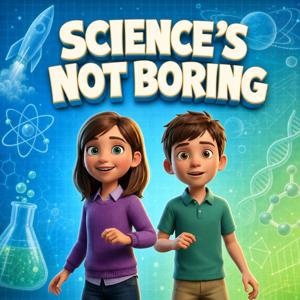
Science for Kids / Science's Not Boring: The Kids Science Podcast

Science for Kids / Science's Not Boring: The Kids Science Podcast

Download on the App Store

Science for Kids / Science's Not Boring: The Kids Science Podcast episodes

  • How do birds fly?
    Have you ever watched a bird swoop through the sky and wondered, how do they stay up there? Gravity wants to pull everything straight down, but birds have amazing natural superpowers to conquer the sky! Join Mira and Finn on Science is Not Boring as they uncover the fantastic physics and wild anatomy of our feathered friends! You will discover how a bird’s special curved wing, called an airfoil, tricks the wind into lifting them up like invisible magic.
    But that is just the beginning of the secret! Did you know birds have hollow bones built like super-strong honeycomb, and giant chest muscles that would make an Olympic weightlifter jealous? Plus, their feathers lock together with microscopic hooks just like velcro! We are exploring the most extreme superheroes of the sky. Learn about a vulture that flies as high as a jumbo jet at 37,000 feet, a tiny hummingbird that beats its wings 80 times a second, and a falcon that dives at a mind-blowing 240 miles per hour! Buckle your seatbelts and get ready for a high-flying adventure!
    16 min
  • What is a shooting star?
    Have you ever looked up at the dark night sky and seen a streak of light flash by? You probably made a wish on a shooting star! But did you know that a shooting star isn't actually a star at all? It's usually a tiny piece of space rock or dust no bigger than a single grain of sand! Join Mira and Finn as they zoom into the amazing science of meteors and meteorites. Discover how these little space crumbs travel at an unbelievable 30,000 miles per hour, squishing the air until they heat up to a glowing 3,000 degrees Fahrenheit!
    You'll also hear the incredible true story of a 26-pound space rock that crash-landed right through the trunk of a red Chevy Malibu, and learn about the massive 60-ton Hoba meteorite that skipped across Earth's atmosphere like a flat stone on a pond. We'll even reveal why some shooting stars glow a spooky alien green! Get ready for a mind-blowing journey through space, history, and science. Buckle up and get ready to catch some falling stars!
    12 min
  • What is camouflage?
    Have you ever wondered how animals play the ultimate game of hide and seek? Welcome to the mind-blowing science of camouflage! In this episode of Science is Not Boring, Mira and Finn explore how creatures use color, pattern, and shape to completely vanish in plain sight. Get ready to meet Chan's Megastick, a massive bug over two feet long that looks exactly like a bamboo shoot and literally dances in the wind to fool hungry birds! Then, dive deep into the ocean to find the Gloomy Octopus, a squishy master of disguise that can change its skin color and texture to perfectly match a bumpy rock in just 200 milliseconds. That is literally faster than you can blink! But it's not just animals who use these clever tricks. Discover how humans borrowed nature's secrets during World War I to create "Dazzle Camouflage," painting giant navy ships with wild, crazy zebra stripes to confuse enemy submarines! Packed with amazing facts, magical color-changing cells, and a fun trivia quiz, this episode will make you look closely at every twig and leaf in your backyard!
    14 min
  • What is Wild Weather and Typhoon Tip?

    Have you ever wondered what it's like inside the wildest weather on Earth? Imagine winds howling faster than a race car and skies turning a spooky green color before a massive twister drops from the clouds! In this thrilling episode of Science is Not Boring, Mira and Finn dive right into the eye of the storm to uncover how Earth's biggest weather monsters are made! Discover the mind-blowing true story of Typhoon Tip, the largest storm ever recorded in history! It was so gigantic that it could have covered almost half of the entire United States! You'll learn how warm ocean water fuels these spinning giants and find out what happened when brave scientists called Hurricane Hunters flew airplanes straight into 190-mile-per-hour winds! We'll also explore the terrifying 2013 El Reno tornado, a roaring beast over two miles wide with winds clocking in at an unbelievable 300 miles per hour! Why does our planet create such extreme and wild weather? Is it actually trying to help us? Grab your windbreakers and get ready for a whirlwind adventure to find out!

    13 min
  • What is physics?
    Did you know that right now, even while you are sitting perfectly still, you are zooming through space at 67,000 miles per hour?! How is that even possible? Welcome to the incredible world of physics! In this episode of Science is Not Boring, Mira and Finn uncover the giant, invisible rulebook that controls how everything in the entire universe moves.
    Travel back to the year 1665 to meet a young scientist named Isaac Newton, who watched an apple fall and asked one brilliant question that changed history forever! Discover the amazing laws of motion, from the "laziness" of inertia that keeps the Voyager 1 spacecraft coasting through deep space forever, to the massive power of the Saturn V rocket blasting humans to the moon. We will even explore why the moon doesn't crash into your backyard, and what happens to astronauts when they float in zero gravity (hint: they actually grow taller!).
    Get ready to learn how a simple kick of a ball connects to the massive forces that run the galaxies. Physics is all around us, and it feels just like magic! Join us to explore the invisible rules of the universe!
    12 min
  • What is a rainbow?
    Have you ever looked up after a rainstorm and spotted a brilliant, glowing rainbow in the sky? It might look like a magical bridge, but it is actually mind-blowing science! Join Mira and Finn on Science is Not Boring as they uncover the incredible secrets hiding inside plain white sunlight. Did you know that rainbows aren't actually arches at all? They are giant, perfect circles! Or that no two people on Earth have EVER seen the exact same rainbow? That's right—you are always standing at the dead-center of your very own personal rainbow! Learn how millions of tiny, squished raindrops act as natural prisms to bend and split light into red, orange, yellow, green, blue, and violet. We'll travel back to the year 1666 to see how a famous scientist named Isaac Newton proved this with a single piece of glass in a pitch-black room! Plus, discover spooky, ghostly Moonbows that appear at night and pure white Fogbows! Grab your garden hose, get ready for an awesome quiz, and learn how to make your very own rainbow on a sunny day!
    13 min
  • Why is the sky blue?

    Have you ever looked up on a clear, sunny day and wondered where all that brilliant color comes from? The air right in front of your face is completely invisible, so why is the sky so wonderfully blue? Get ready to blast off on a mind-blowing scientific adventure! We are traveling 93 million miles to the Sun to uncover the secret hidden inside white sunlight. It turns out, sunlight is actually a sneaky mixture of every single color in the rainbow! When that light hits Earth’s atmosphere, it crashes right into 25 sextillion tiny, invisible air molecules. Discover how the short, energetic blue light waves bounce around like crazy pinballs to paint the sky high above our heads! You will also learn about Isaac Newton’s famous prism experiment, why our eyeballs actually stop us from seeing a purple sky, and how Lord Rayleigh solved this massive mystery. Plus, we will travel all the way to Mars to find out why Martian sunsets glow a magnificent icy blue! Grab your space suit and join Finn and Mira to uncover one of the greatest magical science secrets hiding right in plain sight!

    15 min
  • Why do we have Summers and Winters?

    Did you know you're currently flying through space at 67,000 miles per hour on a giant spaceship called Earth?! Hold on tight as Mira and Finn bust the biggest myth about summer and winter! Most people think we get hot in July because Earth flies closer to the Sun. But guess what? That is completely backwards! In the middle of summer, we are actually 3 million miles FARTHER away! So, why do we sweat in July and freeze in January? It's all thanks to a clever 23.5-degree lean called axial tilt! When your half of the planet leans toward the sun, you get long, hot days and celebrate the summer solstice. When it leans away, you get chilly winter snow! Plus, discover what happens when a planet tilts too far. You won't believe the wild weather on the ice giant Uranus, where it spins completely on its side and a single winter lasts for 21 whole Earth years in pitch-black darkness! Grab your sunglasses and your warmest winter coat, and join us to uncover the amazing science behind our planet's perfectly tilted thermostat!

    12 min
  • Why did the dinosaurs disappear?
    Have you ever wondered what happened to the giant T-Rex and the towering Brachiosaurus? For over one hundred and sixty million years, dinosaurs completely ruled the Earth! But sixty-six million years ago, almost all of them suddenly vanished. Grab your magnifying glass and join Mira and Finn as they solve the ultimate ancient cold case! Discover the mind-blowing story of a giant space rock—an asteroid the size of Mount Everest—that crashed into our planet at forty-five thousand miles per hour! You will learn how scientists found a secret underwater crater and a super rare space metal called iridium hidden deep in the rocks. Find out how this epic crash caused a freezing global blackout that changed history forever! But don't worry, the story has a massive scientific plot twist: not all the dinosaurs died! Find out how tiny, fluffy, seed-eating survivors outlived the giant meat-eaters and evolved into the amazing birds we see today. That's right, a pigeon is a living, breathing dinosaur! Tune in to solve this incredible mystery!
    12 min
  • What is evolution?
    Did you know that the biggest animal on Earth, the giant blue whale, used to walk on four legs like a wolf? Or that you share sixty percent of your DNA with a banana?! Get ready for a mind-bending adventure as Mira and Finn explore the amazing science of evolution! Discover how living things slowly shape-shift over millions and millions of years to survive in their changing environments. We'll travel to a tiny volcanic island to watch bird beaks magically change shape in real-time, dive deep into the past with a twelve-year-old fossil hunter named Mary Anning who uncovered a massive sea-dragon, and learn how a furry land animal transformed into a swimming giant! You'll find out why babies are never exactly like their parents and how those tiny differences add up over "Deep Time" to create brand-new creatures. Plus, uncover the secret leftover body parts hiding inside whales—and even humans! Join the Kidopoly crew to uncover how every animal, from a tiny mouse to a giant whale, is part of one giant family tree of life!
    12 min

About Science for Kids / Science's Not Boring: The Kids Science Podcast

From the publisher's feed

A groundbreaking podcast for curious kids aged 4-12 that proves science is anything but dull.
  

Join our fictional AI hosts Mira, a brilliant 9-year-old, and her younger brother…

Best of Science for Kids / Science's Not Boring: The Kids Science Podcast

Ranked by our users in the last 21 days