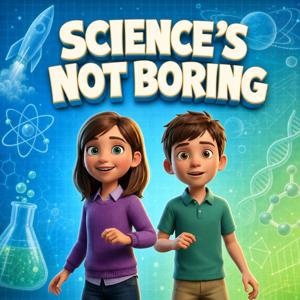
Science for Kids / Science's Not Boring: The Kids Science Podcast

Science for Kids / Science's Not Boring: The Kids Science Podcast

Download on the App Store

Science for Kids / Science's Not Boring: The Kids Science Podcast episodes

  • What is an allergy?
    Have you ever wondered why a yummy peanut butter sandwich is just a snack for you, but super dangerous for someone else? Welcome to the wild world of allergies! Join Mira and Finn as they shrink down to discover what happens when your body's immune system gets totally confused and sounds a giant false alarm! You'll meet the body's microscopic security guards—called mast cells—that are packed full of tiny chemical water balloons just waiting to pop! Find out how an amazing secret military invention from the 1970s transformed into the life-saving EpiPen we know today. Plus, travel all the way to Israel to uncover a mind-blowing medical mystery about baby peanut puffs! Could eating peanuts as a baby actually stop you from being allergic later on? Discover how scientists literally had to rewrite the medical books in this epic, sneeze-tastic episode of Science is Not Boring! Get ready to explore the amazing science inside your own body!
    12 min
  • What is a coral reef?
    Did you know there is a living structure on Earth so massive that astronauts can actually see it all the way from space?! It’s true! The Great Barrier Reef is roughly the size of Japan, but it wasn't built by giant machines. It was built by millions of tiny, squishy animals the size of a grain of rice! In this exciting episode of Science is Not Boring, Mira and Finn dive deep into the ocean to uncover the secrets of coral reefs. You will find out how tiny creatures called coral polyps build colorful underwater cities and team up with amazing microscopic algae roommates called zooxanthellae! But why are so many of these beautiful reefs suddenly turning ghostly white? We will explore the mystery behind coral bleaching and learn exactly how warming ocean temperatures affect these sensitive animals. Don't worry, there is good news, too! Discover how kids and scientists around the world are working together to grow new coral in underwater nurseries to save the rainforests of the sea. Get ready for mind-blowing facts, lightning-fast microscopic harpoons, and a fun trivia quiz to test your ocean knowledge!
    11 min
  • What is the Earth's core?
    Have you ever wondered what would happen if you dug a hole straight down through your backyard? You wouldn't just find dirt! Join Mira and Finn on an epic journey deep underground to discover the amazing, blistering secrets hiding right beneath our feet! First, we’ll explore the bubbling, oozing hot rock called magma, and find out exactly what happens when it blasts out of a volcano and turns into lava. Did you know the deepest hole humans ever dug had to stop because the rock turned into hot, sticky putty? It's true! But the wildest part is right at the very center of the planet. Discover a giant, swirling ocean of liquid metal and a solid iron ball that is literally as hot as the surface of the sun! Plus, find out how a brilliant scientist named Inge Lehmann used cardboard oatmeal boxes and earthquake waves to prove it was all there. You'll even learn how this giant iron center acts like an invisible superhero force field to keep everyone on Earth safe!
    14 min
  • What is an axolotl?
    Have you ever heard of a smiling pink salamander that never grows up? Meet the axolotl, the real-life superhero of the animal kingdom! In this amazing episode of Science is Not Boring, Mira and Finn dive into the chilly canals of Lake Xochimilco near Mexico City to uncover the secrets of the world’s weirdest amphibian.
    Did you know the ancient Aztecs called them "water dogs"? Or that if an axolotl loses a leg, it can completely grow a brand new one in just a few weeks? It is completely true! They use a superpower bump called a blastema to perfectly rebuild their bones and muscles. You will also learn how scientists are studying their giant DNA instruction manual—which is ten times larger than a human's—to learn how they heal without any scars.
    Plus, discover their secret ninja hunting move called the "suction strike" and find out how these fascinating creatures breathe using three different backup systems! Get ready to explore the wild world of the ultimate water dog and find out why we need to protect their natural habitat. Hit play now and test your knowledge in our fun trivia quiz at the end!
    12 min
  • What is blood made of?
    Have you ever scraped your knee and wondered, what is blood actually made of? It is not just red water—it is a microscopic superhero team living inside you! Join Mira and Finn as they shrink down and race through your veins on a 60,000-mile biological superhighway! Did you know your blood vessels are long enough to wrap around the entire Earth twice? Discover the amazing secrets of your body, from millions of squishy red blood cells delivering oxygen, to shape-shifting white blood cells called macrophages that eat dangerous germs whole! Learn how sticky platelets weave superglue nets to plug leaks just like a submarine hatch. You will also find out about the Dutch scientist who first spotted these tiny cells in 1674, and even travel the animal kingdom to uncover bizarre creatures with bright blue and neon green blood! Get ready for a mind-blowing journey inside the human body that proves science is definitely not boring!
    11 min
  • How did rockets reach space?
    Blast off on an unbelievable adventure into the most powerful machines in the entire universe! Have you ever wondered how a spaceship breaks free from Earth’s gravity? Join Mira and Finn on Science is Not Boring as they uncover the mind-blowing secrets of rockets! Discover what Escape Velocity is and why a rocket has to travel a staggering 25,053 miles per hour—50 times faster than a commercial airplane—just to reach the stars.
    You won't believe the wild space facts we have packed inside! Find out how the massive Saturn V rocket burned 20 tons of fuel every single second (that's the weight of four adult elephants!) and created a roaring fire so hot it could easily melt steel. Learn the genius science trick of using freezing cold liquid to stop the engine from melting, and why dropping empty fuel tanks out of the sky is the smartest way to travel. Plus, find out how the International Space Station stays in orbit by literally falling and missing the ground! Fasten your seatbelts, space cadets, because this high-speed episode is guaranteed to send your brain straight into orbit!
    13 min
  • What is the human brain?
    Did you know there is a supercomputer inside your head that runs on less power than a tiny refrigerator lightbulb? It’s true! Your brain is a squishy, grey blob that weighs about three pounds—exactly like a small cantaloupe—but it controls absolutely everything you do! Join Mira and Finn on Science is Not Boring as they uncover the wild secrets of the most complex machine in the known universe. Discover how a scientist made "brain soup" to count an amazing 86 billion tiny cells called neurons! We'll learn how these biological wires shoot electrical sparks at mind-blowing speeds of 270 miles per hour, which is faster than a Formula One race car! Find out why your amygdala (which totally sounds like a dinosaur!) makes your stomach drop on a rollercoaster, and why going to sleep is literally just taking out the brain trash in a magical nightly biological car wash. Your brain even has more connections than there are stars in the entire Milky Way galaxy! So get ready to stretch those neurons and build your brain city in this super-charged, fact-filled episode!
    13 min
  • What is the Mariana Trench?
    Have you ever swallowed a mouthful of seawater at the beach? Blegh! It is super salty! But why don't rivers taste like salt? In this mind-blowing episode of Science is Not Boring, Mira and Finn dive deep to uncover the ocean's biggest mysteries! You won't believe it, but if you magically took all the salt out of the ocean and spread it over the land, it would form a towering white wall 500 feet thick! That is as tall as a 40-story skyscraper!
    Join us as we learn how slightly acidic rain breaks down rocks to make this giant bowl of salty rock soup. Then, strap in as we plunge into the terrifying, pitch-black depths of the sea! We'll travel back to 1934 to ride in a tiny metal ball called the Bathysphere, and then drop all the way down to the Challenger Deep. Discover what it feels like to have the crushing weight of 50 jumbo jets pressing on you, and meet the weirdest, squishiest creature on Earth—the gooey deep-sea snailfish! Get ready to explore the freezing dark where no sunlight ever reaches!
    15 min
  • What is electricity?
    Have you ever wondered what actually happens when you flip a light switch in your bedroom? You might think electricity travels at the speed of light, but the tiny particles that make it up—called electrons—actually move slower than a snail!
    Join Mira and Finn on an epic, high-voltage adventure as they follow a single spark of electricity on its amazing journey from a giant spinning power plant all the way to your morning toaster! Discover how a brilliant scientist named Michael Faraday accidentally invented the very first electric generator using just a simple magnet. Then, travel across the world to discover the tallest electricity pylon in China—it is literally taller than the Eiffel Tower! We will uncover why power lines use lightweight aluminum instead of heavy copper, why birds never get zapped when they sit on high-voltage wires, and how humming metal boxes called transformers shrink the electricity down to a safe size for your home.
    Packed with glowing facts and mind-blowing science, this episode of Science is Not Boring will completely change how you look at the outlets in your wall!
    14 min
  • What are sharks?
    Did you know that sharks are actually older than trees, older than dinosaurs, and even older than the rings of Saturn?! Dive into the deep blue sea with Mira and Finn to uncover the amazing, real-life secrets of the ocean's most misunderstood creatures! Forget what you've seen in scary movies—sharks are ancient survivors with actual superpowers. Discover how they use special jelly-filled pores to literally feel the heartbeat of a fish hidden under the sand!
    Want to hear something totally gross? Find out the crazy (and disgusting!) way a shark cleans out its tummy by throwing its entire stomach out of its mouth! Eww! We'll also meet the biggest fish in the entire world, a massive 60-foot giant that weighs as much as ten elephants but eats some of the tiniest food in the ocean. Plus, learn about a freezing cold, deep-sea shark that can live for over 400 years!
    Join us for this fin-tastic underwater adventure to find out why sharks are actually incredible ocean guardians that need our protection. Don't worry, the only thing you'll catch is some seriously awesome knowledge!
    13 min

About Science for Kids / Science's Not Boring: The Kids Science Podcast

From the publisher's feed

A groundbreaking podcast for curious kids aged 4-12 that proves science is anything but dull.
  

Join our fictional AI hosts Mira, a brilliant 9-year-old, and her younger brother…

Best of Science for Kids / Science's Not Boring: The Kids Science Podcast

Ranked by our users in the last 21 days