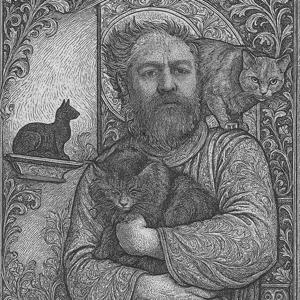
Published in 1910, Ralph Waldo Trine’s The Land of Living Men captures a moment when personal spiritual growth and social responsibility were inseparably intertwined. Trine had first explored some of these ideas three years earlier in In the Fire of the Heart, but as he noted in the foreword, “the whole of the matter has, however, been much altered and amplified, and the present volume is essentially a new book.”
Trine writes for the reader seeking both inner peace and practical guidance: “the attaining to an habitually happy or peaceful state of mind,” “the development of personal power,” and even the “bread and butter problem” that concerns almost everyone. Yet he also calls attention to the larger social stage, warning that a nation indifferent to governance allows “the few…to enrich themselves at public expense.” His vision is both personal and prophetic: spiritual growth cannot be separated from ethical engagement with the world.
Intellectually, Trine blends Emersonian transcendentalism with the Christian socialism of George Herron. The result is a book that guides the reader toward spiritual realization while challenging them to confront the economic and social inequalities of their time. As he observes, “he who is not economically free, is in a slavery of the most haunting and endeavor-crushing type.”
Trine situates himself in the devotional wing of New Thought, focusing on ethical living, heartfelt connection with the Divine, and the cultivation of character, rather than abstract mental formulas. This makes the final chapter—“The Life of the Higher Beauty and Power”—all the more striking. Trine admits its placement might seem unusual, but he trusts that “the reader himself will, in the end, be the best judge of this.” Here, he moves from practical guidance to the transcendent, showing how beauty, virtue, and spiritual power can shape both personal fulfillment and the moral health of society.
From the opening dream-vision of the poor and the weary to glimpses of divine mercy and possibility, Trine’s work fuses social realism with spiritual aspiration. The Land of Living Men remains a remarkable guide for anyone seeking to live fully—ethically, spiritually, and in harmony with the larger world—and its final chapter offers a vision of the higher beauty and power that elevates human life to its fullest potential.
THE LIFE OF THE HIGHER BEAUTY AND POWER — INDIVIDUAL NATIONAL
To be at peace. To be happy. To live in contentment. To have a satisfying and harmonious — a successful life. This echoes the longing of perhaps every normal person. The fact that it so echoes a universal longing, indicates, to me at least, that it should be the natural, the normal life.
In order to live a harmonious life there must be something to be in harmony with; and here it is the great secret of life and its successful and satisfactory fulfilment.
That there is a Spirit of intelligence and of love in the universe, no normally constituted mind, and one that has lived at all near the higher life, however they may have come to it, can for a moment doubt. There is a Power, beneficent if worked in harmony with, that pervades all and through the channel of great systems of law governs the universe and all that is in it. Every decade we are discovering new laws and forces, and the latter seem to be all the finer in their nature. This is perhaps on the part of the process of evolution, so developing, so unfolding us, that we are getting nearer and nearer to the essence, the inner nature — the soul of things.
What was the actual beginning of things no man knows. Nor is it essential or important that we do know. But in the beginning, as now, was Being, self-existent and all-pervading — the Spirit of Infinite Life and Power that is back of all, working in and through all, the source, the life of all. This seems to be a self-evident fact — Infinite Being projecting itself into existence, — therefore the spirit, the substance, the life of all there is.
Various terms or names are used by different minds; but to me this Infinite Being is God. To know this as our source, the very essence of our being, and from which or from whom we cannot be cut off, can separate ourselves, only to our detriment, is to recognize ourselves as spiritual beings; it is to be born into the spiritual life, and the spiritual life is the life eternal. Thus we come to know God in the degree that we realize that in Him we live and move and have our being. In the degree that we live in the realization of this truth, does this spirit of Infinite Life and Power reveal itself to our consciousness more and more, and it is in this way that we grow and unfold in the spiritual life.
It is through great systems of law, definite and immutable, that God or Infinite Being works. To know these laws, and to live, to work in harmony with them brings peace and harmony; wilfully to violate them brings inharmony and struggle and suffering. They all work together for good. To live in harmony with them can bring us only good. To fail to recognize or wilfully to violate them brings necessarily the opposite of good, namely evil. Evil has its origin properly speaking not in God, but from a violation of the laws, shall we say, the ordinances of God.
To realize that in essence, though not in degree, we are one with the life of God, and then to open ourselves, our minds and our hearts, so that a continually increasing degree of the God life can manifest itself to and through us, is to understand more and more and to come into a continually greater harmony with the laws under which we live and which permeate and rule in the universe with an unchangeable precision.
It is through our non-recognition of the life that is in us and the laws by which all things are governed, in other words, living out of harmony with the laws under which it is decreed we must live, that inharmony and evil with its consequent pain and suffering and despair enters into our lives. There are those who have lived so fully in the realization of their essential oneness with the Divine Life, that their lives here have been almost a continual song of peace and thanksgiving.
As individuals — expressions of Being projected into existence — we are given the power of choice. We can choose to open ourselves so fully to the realization of the Source of our life, and open ourselves so fully to its influx, that we will find the attributes of this life manifesting, incarnating themselves more and more in our lives, so that in time we take on more and more the wisdom, the insight and the powers of this Life. In this way we are gradually changed, from the natural to the spiritual, from earth-men to God-men, fulfilling the undoubted purpose of our being — self-realization, and the returning to that from which we came. Coming as babes, returning as fully grown spiritual beings, gaining our experience in contact with the material world — through the agency of the material body, and for some purpose of which we do not yet know, but that shall be revealed to us in due process of time. What it is, cannot concern us materially now, the truth will come when we are ready for it. To know the laws under which we are living and to bring our lives into an ever completer harmony with them, is the main thing. Step by step, in this, as in all things, we learn as we go. There is but one way to learn to do a thing, and that is to do it; to learn to live, and that is to live; not in the past, nor in the future, but in the now. Not in dreaming, not in theorizing, but in living in the great present, in the continual now. To dwell on the life, the truth, as it is today, and live it, is to build for the life of tomorrow; is to lay the foundation for the larger and fuller life that is to follow. All of which is simply working out the process of evolution, of development, of becoming.
We learn to live by living, not by memorizing the dead past, nor by building air-castles for a future that needs our care and our building in the present. And we learn to live in harmony with the laws of life either through choice, gladly, appreciatingly, understandingly, and of our own accord, or we are pushed and taught through suffering. God will have obedience. To know God is to know His laws; for His laws are written in the heart of man.
By dwelling continually in this life of God we come into that condition where we are led more and more by Divine guidance, where the Divine wisdom and power and life so manifest and illumine our being, and through this our understanding, that we know more and more to do the right thing at the right time; and for such, to know is to do.
While the end of life is not attained through intellectual processes alone, the mind, the intellect nevertheless is a means to this end. It is through the mind that the connection is made between the human and the Divine. It is through thought operating through the channel of the mind that we are able to realize and keep our connection with Infinite Being, our source. It is by virtue of the mind, working through the brain, that we are connected with the material, physical universe. The body is material, physical. Every particle of it, through the food we take, is from the earth and the air, and to the earth and the air every particle of it finally returns.
To realize that the body is not the self, but the instrument by which the self is temporarily related to and made able to live in a material world for the purpose of experience, growth, development, is a great aid in arriving at the realities of life. The folly then of giving supreme attention to it, and the things that pertain to it. To give it sufficient attention to enable it to become the clearest, the soundest, the most perfect instrument, that it can be made and kept for the real self to use, is the part of wisdom, for it is the true middle ground.
Now, why this, I hear it asked, in a book of this nature? In order to get a basis in religion, in philosophy, in reality, for life, for the individual life; and as is the individual life so is the national life, never higher, never lower. As Dr. Patton, formerly president of Princeton University, once said to a class of young graduates:
"Religion is the goal of culture, and the educated man must stand in some relation to God. He must have some philosophy of human life, some theory of society." And as Milton has said: "There is nothing that makes men rich and strong but that which they carry inside of them. Wealth is of the heart, not of the hand." And as Mazzini once said: "Where there is no vision the people perish."
The chase for the material has of late years become so great and so absorbing, whether by fair means or foul, that it has become one of the notorious features or characteristics of the time. And while I believe the heart of the people and the heart of the nation is sound, by virtue of the vastly superior numbers of splendid, honest, unpurchasable and high-minded men and women among us, both old and young, a strong materialistic tendency is nevertheless a marked characteristic of the time. As there is perhaps no greater truth in connection with human life than — As a man thinketh in his heart so is he, and also, that we grow into the likeness of those things we most habitually contemplate, also, that all life is from within out, for as is the inner, so always and necessarily will be the outer, it becomes clearly apparent how essential it is that the right centre or basis of life be established.
We hear it often said, and said in the most well-meaning way, that the physical, the material, is the basis of life. Now I would put it in another way, a safer and I think a truer way. The spiritual is the basis and the end of life, and the physical, the material, is the channel through which it manifests and works and unfolds and masters. The latter is not to be despised or slighted, but to be used, to be wisely used, but to be subordinated to its proper place. Thus it becomes a great blessing and helper rather than a hindrance and a curse.
To have an abundance of the world's goods is good if rightly used; but to make the accumulation of material things the chief object of life can end only in disappointment. Such have but a pinched and stunted life which is unsatisfactory and empty of joy to themselves, and, except by way of warning, is of but little if any value to the world.
Each one must find a centre for life from which all radiates, or, putting it in another way, a basis, a foundation upon which all else is built. Such a centre or such a basis, one that is stable and satisfactory, is earnestly longed for by myriads of people. An instinct for the religious life is born in practically every human soul. So many great chunks, as the years have passed, have fallen away from our theological systems, and so many are still continually falling away from them, that it is hard or well-high impossible for an earnest, mentally honest man to find any satisfactory or even acceptable basis for the religious life there. Such in common with all others will find that the uniform teaching of all the most inspired teachers in the world's history, whatever the religion or system of belief has been, is that the essence, the substance of religion is the consciousness of God in the soul of man. A foundational basis for this I have endeavored to give in the early pages of this chapter, that in Him we live and move and have our being. In what an immediate and vital way John Tauler has put it in the following:
"I have a power in my soul that enables me to perceive God; I am as certain as that I live that nothing is so near to me as God. He is nearer to me than I am to myself. It is part of His very essence that He must be present to me."
"Within us, not without, is the presence of God," said St. Augustine. Sin is, in fact, unconsciousness of the presence or working of the Divine Life and Energy.
"This is inseparable from religion," was the keynote to the philosophy of that most spiritual of philosophers, Fichte. "An insight into the absolute unity of the Human Existence with the Divine is certainly the profoundest knowledge that man can attain," said he again.
It was the most inspired who has yet lived among us who said: "Neither shall they say, Lo here! or, Lo there! for, behold the Kingdom of God is within you." And again: "Seek ye first the Kingdom of God, and His righteousness, and all these things shall be added unto you." It was He who gave the substance of the moral law and therefore the essence of religion as — Love to God and love to the fellow-man.
To me, love to God is this dwelling continually in the conscious living realization of the essential oneness of our life with the Divine Life — seeking to have no other will than that the Divine will may manifest to and through us, and may work through us. How significant then — "Thou wilt keep him in perfect peace, whose mind is stayed on Thee," and also, "In all thy ways acknowledge Him and He shall direct thy paths." How truly in the light of this truth does Fichte say that the expression of the constant mind of the truly religious man is this prayer: "Lord! let but Thy will be done, then is mine also done; for I have no other will than this — that Thy will be done." And how thoroughly in keeping with "Thou wilt keep him in perfect peace, whose mind is stayed on Thee," is his thought in the following:
"Whatever comes to pass around him, nothing appears to him strange or unaccountable— he knows assuredly, whether he understand it or not, that it is God's World, and that there nothing can be that does not directly tend to good. In him there is no fear for the future, for the absolute fountain of all blessedness eternally bears him on towards it; no sorrow for the past, for in so far as he was not in God he was nothing, and this is now at an end, and since he has dwelt in God he has been born into light; while in so far as he was in God, that which he has done is assuredly right and good. . . . His whole outward existence flows forth, softly and gently, from his Inward Being, and issues out into Reality without difficulty or hindrance."
Love to the fellow-man is the realization of the fact that we are all parts of the one great whole, that the source and essence of life in each is essentially the same, that love is the established law of life, and that the law will have obedience or it will strike its punishment upon all who do violence to it.
"He that loveth not his brother, abideth in death," said the Master Teacher, and this is simply the enunciation of the law that's written deep in the universe and that is immutable in its workings.
"All beings are the fruits of one tree, the leaves of one branch, the drops of one sea. Honour is for him who loveth men, not for him who loveth his own," says the Persian.
Truly we are all parts of the one great whole, and one cannot suffer or have injustice done him without all sharing in that suffering and none more than the author of that injustice.
It was by virtue of His perceiving so clearly the laws in relation to human life that are so immutable in their workings, that enabled and prompted Jesus to give anew to the world an epitome of the laws relating to all human relations when He said, "And as ye would that men should do to you, do ye also to them likewise."
It is what is ordinarily termed the Golden Rule. I have never seen any wiser or more suggestive commentary upon it than the following, by the late Hon. Samuel Milton Jones*:
"As I view it, the Golden Rule is the supreme law of life. It may be paraphrased this way: As you do unto others, others will do unto you. What I give, I get. If I love you really and truly and actively love you, you are as sure to love me in return as the earth is sure to be warmed by the rays of the sun. If I mistreat you and abuse you, I am equally certain to arouse the same kind of antagonism towards me, unless the Divine nature is so developed that it is dominant in you and you have learned to love your enemies.
"The Golden Rule is the law of cause and effect, of action and reaction in the field of human conduct and human life, just as certain here as the law is definite and certain in the domain of physics.
I think the confusion with respect to the Golden Rule arises from the different conceptions that we have of the word love. I use the word love as synonymous with good will. So when I speak of doing the loving thing, I mean doing the reasonable thing. When I speak of dealing with my fellow-men in an unreasonable way, it is an unloving way. The terms are synonymous, absolutely. The reason why we know so little about the Golden Rule is because we have not practised it.
What we term the Golden Rule is an absolute law of life, and it will have obedience through the joy, and therefore the gain it brings into our lives if we observe it, or it will have obedience by the pain and the blankness it drives into our lives if we violate it. As we give to the world so the world gives back to us. Thoughts are forces, like inspires like and like creates like. If I give love, I inspire and receive love in return. If I give hatred, I inspire and receive hatred. The wise man loves; only the ignorant, the selfish, hate. And the man who loves and serves is he who has solved the riddle of life. For into his life comes the fulness, the satisfaction, the peace and the joy that the Law decrees. He it is who is the wise man.
The man who has no sense of service to his fellow-man, whose idea is primarily gain for himself, whether honourable or dishonourable, is the supreme fool in life, by virtue of his ignorance leading him into the violation of a law that condemns him to a pinched, a stunted, sunless, joyless life.
"If the gatherer gathers too much," says Emerson, "nature takes out of the man what she puts into his chest; swells the state but kills the owner. Nature hates monopolies and exceptions."
We do well when we remember this- — one can never do an injury to another without in some form or another suffering for that injury himself. Why? It is so written in the Law of the Universe, that's all. And we likewise do well to remember — one can never do a real loving, unselfish, kindly act without deriving a benefit from such act himself; and if at any time there are apparent exceptions to this it is, I believe, because our limited vision does not enable us to see the total relationship of human actions.
"No man in the world ever attempted to wrong another without being injured in return,— some way, somehow, sometime. The only weapon of offence that nature seems to recognize is the boomerang. Nature keeps her books admirably; she puts down every item, and closes all accounts finally, but she does not always balance them at the end of the month."**
As the life of a man is of more value to him than the house in which he lives, so the possession and growth of the faculties that enable him to enjoy the things that pertain to and that spring from the inner life, are of more value to him by way of bringing him happiness and contentment than any possible accumulation of material things. Wealth is good — as a means to comfort; good as a servant, never as a master; good as a feature, never as the chief end of life.
One of the most pitiable sights that I know is the way some very rich men die. Let the following serve as the type of many. A man has made gain — money-getting — the chief object of his life. In time, shall we say through nature's abhorrence of abnormalities, the greed for gain becomes his master and dries up his very powers of enjoyment of the finer things in life. He accumulates a hundred million, with all the care and worry that keeping this invested to the best advantage means. He is of but little use to the world, and through the dwarfing of the finer qualities of his life, and the drying up of his powers of enjoyment, he has also become so to himself. He dies. Three months after, he has gone, his name is scarcely ever heard, except perhaps in some long-drawn-out or bitterly fought will contest. His end is like that of a dog. In short, many a dog, faithful and intelligent and useful, has been more genuinely mourned and longer and more gratefully remembered. And then if it is true, as I believe it must be, that we commence in the other form of life exactly where we leave off here, taking with us only what we have gained by way of soul growth, and spiritual unfoldment, but not one cent — not one cent — and having, moreover, no further control over any material possessions, how poor, how pitiably poor is such a life. Contrast it with the following as an ideal and a purpose for a life:
"I am primarily engaged to myself to be a public servant of all the Gods, to demonstrate to all men there is good-will and intelligence at the heart of things and ever higher and yet higher leadings. These are my engagements. If there be power in good intentions, in fidelity, and in toil, the north wind shall be purer, the stars in heaven shall glow with a kindlier beam that I have lived."
And what a life was the life of this man Emerson who deliberately chose this as his part. And what an influence while he lived, and truly for all time to come. Not three months, nor three centuries can forget his name or cease to bless his memory.
Another, in whom success in the sense of excessive gain develops pride and an itchiness for ostentatious show, builds a mansion — a home? — costing four million dollars, thinking also that it will be a sort of monument, a reminder of, himself. Within fifty years, or within even a much shorter period of time, it may be the possession of a Barnum and the home of a good up-to-date circus. Such is the security of a man's hold upon material possessions.
And how few seem to be able to stand success and remain good, healthy, sensible, normal men! It seems strange that so seldom can a man become successful as to either wealth or power without taking on, mentally at least, the strut of the turkey-cock. A really great man, however, is always immune from this affection. It is rather as Pope said:
"Of all the causes which conspire to blind
Man's erring judgment, and mislead the mind,
What the weak head with strongest bias rules,
Is Pride — that never-failing vice of fools."
The law seems to be absolute in that "whosoever shall exalt himself shall be abased; and he that humbleth himself shall be exalted." Nature seems to abhor an abnormally developed pride, snobbery, too marked a consciousness of superiority. And to the — I am holier than thou — feeling, she applies always the brand of Hypocrite, and she burns it deep.
Another makes the accumulation of material things the chief object of his life, rising from humble circumstances, possessing unusual abilities, but giving but an infinitesimal amount of these abilities to his city or his state, both badly in need of such service; but rather conspiring with their enemies to make special privileges for a few greater, to secure acts alienating valuable properties from the people of his city and state, to avoid a just share of taxation, thereby defrauding and throwing greater and unjust burdens upon all of his fellow-men, except upon those equally dishonest and contemptible in this same practice of tax-evasion. His life here closes considerably before a normal and well-rounded life should close, and on quitting he directs that practically the entire results of his life work go to a couple of young grandsons, not yet in their teens, in order that the family name and business may be preserved.
"Every man," said Marcus Aurelius, "is worth just so much as the things are worth about which he busies himself." The business may be preserved or it may tumble into ruin. Nature deals so in mockery when a man fancies he can have a controlling hand in the final actual disposition of his material possessions.
The family name may be preserved and it may be raised even to a higher esteem, or it may be preserved in the records of an inebriate asylum. A man can have an actual say only in regard to his own life, never in regard to the life of any other. Not by ambition and gain alone for self but,
"By labor, incessant and devout, to raise earthy to heaven, to realize, in fact, the good that as yet exists only in idea — that is the end and purpose of life; and in fulfilling it we achieve and maintain our unity each with every other, and all with the One."
Many a rich man's son has found the handicap of great riches too great to allow his making even a decent success of life; the incentive which nature seems to have decreed as a healthy and strength-developing factor has been neutralized by the burden which an over-rich father has dumped upon him.
Many a daughter, also, has found her life sinking into idleness and futility, losing the beauty and the chief charms of womanhood, and a designing or worse than empty marriage has fallen to her portion.
Surely wealth is of the mind and the heart and not of the hand. And the man who makes as his life work only gain for self, and who fails to recognize his inexorable relations with his fellow-men, fails completely in getting from life what he thinks he'll get; for he finds that what he gains turns to a greater or less extent to ashes in his hands, and what he bequeaths to his descendants is far below what it might be, — he or she who is at all worthy of receiving such bequest would rather it be a few millions less and be accompanied with a name of honour and a memory to be revered, than that it come with the tremendous handicap it many times comes with.
As we come to a fuller appreciation of these facts and of the laws of human life and relations that will not be denied, then more and more will "we measure the degree of civilization not by accumulation of the means of living, but by the character and value of the life lived."
Now I have said naught nor would I say aught, against wealth. I believe in wealth — sufficient for all the legitimate comforts of life; and I believe in it so thoroughly that I plead for a state wherein it can become the portion of a much larger number than has ever yet been known. And while I do not share in the belief that our time is necessarily more materialistic than other times have been, I do realize and most keenly that the economic conditions during the past few years have produced a class of men so materialistic in their entire outlook, so insatiate in their greed for ever larger gain, so drunk with opportunity and power, that they would pull the very pillars of the state to the ground, if a united and determined people did not come forward and say, so far, and no farther.
It is against the aggressions of these and the abuses we have permitted them to give birth to and fatten upon, the aggressions of these against the welfare of their fellows, against the economic and political institutions of the nation, that we must battle for some time to come with an alertness, with a determination and a bravery that can know no defeat. With a mind calm and determined and with malice towards none, must these great battles for the redemption of this nation be fought.
And as excessive wealth is of no real value to any man nor to his descendants, but becomes more often a veritable curse, and as it makes its possessors many times a menace to the very welfare of the nation and to the welfare of every man, woman and child in the nation, we will be doing a twofold service through such warfare and subsequent vigilance, in saving its possessors and its would-be possessors from their own folly, as well as conserving our own common interests.
It's the middle ground that carries with it the satisfactory solution of life. Excesses have to be paid for with heavy and sometimes with frightful interest.
Life, the life of everyone has its perplexities, its problems, its struggles and its work to be done. Humanity is brave, and there are but few who do not stand up like men and women, some almost like very Gods, to the end. It certainly should be the aim of each to throw no hindrance in the path of any fellow-being, to make no load heavier; but rather to lend the hand whenever we can.
"Oh the skies are blue and a ribboned road
Shall the pilgrim's heart beguile:
Yet hurry not so fast with your load,
For there is many a mile.
And it's here a friend and there a friend
To bear your hand a while:
But none will go to the journey's end,
And few will stay the mile."
And in connection with the problems and perplexities and apparent losses that come and that must be met as the days hurry away, I believe without the question of a doubt, that the time will come when we will see the part that each thing has had to play in our lives, and we will give thanks that it came just as it came. I believe, moreover, that a sort of an inborn universal feeling of this nature is a reason why humanity is brave.
A hope that never wearies, a faith that defies defeat, an attitude of mind that compels gladness, will help us to stand like men until we realize this glad culmination. And if one would find the easier way, it lies in the ever conscious realization "Thou wilt keep him in perfect peace, whose mind is stayed on Thee."
*Mayor Jones of Toledo was to my mind one of the most significant men politically that our country has yet known. A man who believed in actually adopting the law of life as enunciated in the Golden Rule as a basis for personal action and for the administration of public affairs. A man who used public office only for the highest public good. A man whom the people therefore so trusted that, running as an independent candidate against the candidates of the two dominant political parties, he was able to poll a vote of nearly 17,000 out of a total voting number of 24,000. It is rather significant, is it not? — and this against the combined and determined efforts of the machines of both political parties, both local and State, and in face of the united opposition of all the newspapers and corporations in the city, and not a few of the eminently respectable people. So far as his influence upon the political future is concerned, and it will be, even as it is being already, carried into activity by younger men who are coming into the field of political action, it is unquestionably true that no greater or more valuable man has ever come from or been associated with the State of Ohio.
** From that excellent little booklet "The Majesty of Calmness," by William George Jordan.
Thanks for reading! Subscribe for free to receive new posts and support my work.
This is a public episode. If you'd like to discuss this with other subscribers or get access to bonus episodes, visit mitchellkjones.substack.com/subscribe