
Sign up to save your podcasts
Or



Industrial civilization is about 250 years old. Life on Earth has been adapting and surviving for four billion. Laurie Menoud wants to know what the first can learn from the second.
In this episode of the Scientista Podcast, Sweta and Monica sit down with Laurie, founding partner at At One Ventures, which backs technologies that help humanity become net positive for nature. Her path began with a childhood microscope and led to microbiology research, where she was part of the team behind Mimivirus, the first known giant virus. It also led to a harder question: how does a discovery leave the lab and change anything?
Her answer is blunt. Industries adopt what performs better and costs less, so clean technology has to win on both. Laurie explains why climate companies that raise billions still fail when they scale too fast, why she thinks direct air capture can’t pass the physics test, and why AI is a far more physical industry than it looks.
She closes with what gives her hope, and what worries her: technology moving faster than our institutions can make decisions.
Thank you for listening! Learn more about Scientista here: www.scientista.world
Thank you for listening! Learn more about Scientista here: www.scientista.world
Idaho has sun, wind, geothermal heat, and wide open land. It also has a shrinking aquifer and data center developers who want its power and water.
In this episode of the Scientista Podcast, Monica sits down with Aimée Christensen, founder of the Sun Valley Forum, to talk about the trade-offs that come with that boom. Aimée argues that communities deserve clear information and a real say before projects break ground. She also wants Idaho's water laws to reflect what each use of water is actually worth to the state.
Her career started in the Clinton White House and the Department of Energy. As a Stanford law student, she wrote the first university endowment climate investment policy. At Google, she helped shape the company's early climate strategy and its 2007 commitment to carbon neutrality. Then a Christmas Eve blackout in Sun Valley pushed her to start building resilience close to home.
She closes with advice for anyone who feels alone in the room: trust your gut, ask the question, and the people working on the same problem will find you.
Thank you for listening! Learn more about Scientista here: www.scientista.world
Thank you for listening! Learn more about Scientista here: www.scientista.world
In this episode of the Scientista Podcast, Sweta and Monica sit down with Sally Fouts, who leads The Climate Pledge at Amazon. Sally started out as a journalism major, worked on the Prime Video and Amazon Studios launches, and moved over to the Pledge three days before the world shut down in March 2020. She thought she had ruined her career. Instead, she helped grow the Pledge into a coalition of more than 700 companies committed to 2040.
We talk about what actually changes inside a company once it signs, why Christiana Figueres agreed that 2050 was too slow, and how Amazon put 50,000 electric vans on the road while its data center buildout pushed emissions higher. Sally also makes a pointed argument about criticism: a company doing thirty percent beats a company doing nothing, and hammering the ones who try makes them go quiet.
Thank you for listening! Learn more about Scientista here: www.scientista.world
Thank you for listening! Learn more about Scientista here: www.scientista.world
Kate Marvel spent years studying the entire universe. Her conclusion: most of it is garbage, and Earth is the only good planet. So the astrophysicist became a climate scientist, and in this live conversation from Aspen Ideas Climate in Chicago, she explains why she makes no apologies for being an Earth supremacist.
Sweta and Monica talk with Kate about her new book, Human Nature: Nine Ways to Feel About Our Changing Planet, named a best book of the year by Scientific American. Kate makes the case that scientists who claim to have no feelings about a warming world aren't more credible, they're lying. She walks through what her climate models actually project, why the word is projection rather than prediction, and the finding that surprises nearly everyone: if we stopped emitting carbon dioxide tomorrow, our best estimate of the additional warming already locked in is zero.
Also covered: why Mars is unbearably boring, what Cassandra got right, and why the problems are getting worse while the solutions keep getting better.
Learn more at scientista.world.
Thank you for listening! Learn more about Scientista here: www.scientista.world
Forty-three percent. That's how much research funding Johns Hopkins has lost in the past year, and Dr. Amita Gupta can tell you exactly what disappears with it: HIV treatment programs, clinical trials mid-stream, 600 jobs, and decades of trust built between nations.
Gupta is the Florence Sabin Professor of Infectious Diseases at the Johns Hopkins School of Medicine and founder of the Gupta Klinski India Institute. She joins Sweta and Monica to explain why infectious diseases know no borders, why walking away from global health puts Americans at risk, and what it actually takes to rebuild after funding vanishes overnight.
But this is also a conversation about what comes next. Gupta shares how she's training the next generation through the Women's RISE fellowship, which supports 41 young Indian women scientists across STEM fields, and why she believes the diaspora holds untapped power to fill the gaps. Her advice for young scientists is simple: find your champions, ask boldly, and don't be shy.
Visit scientista.world for more stories, updates, and ways to get involved.
Thank you for listening! Learn more about Scientista here: www.scientista.world
What happens when a lung and critical care physician trades the exam room for the House floor? For Congresswoman Maxine Dexter of Oregon, the answer is a kind of governing most politicians never learn to do: form a hypothesis, act on the evidence, then go back and check whether it actually worked.
In this episode, hosts Dr. Sweta Chakraborty and Monica Medina talk with Dexter about the throughline connecting her most urgent fights — and why she believes science is "a universal equalizer," not a belief system to be argued with.
Dexter traces her path from an economically disadvantaged childhood to Congress, then makes the case that a healthy environment and a strong economy are not opposing choices. She sounds the alarm on a 75% cut to the Forest Service and the wildfire seasons it leaves us unprepared for, the assault on vaccines and reproductive care under RFK Jr., and the children she witnessed held in immigration detention. Her prescription for a party in crisis: say what you'll do, do it, and prove it.
Thank you for listening! Learn more about Scientista here: www.scientista.world
A deadly Ebola outbreak is tearing through the eastern Democratic Republic of Congo — and alongside the virus, something almost as dangerous is spreading: disinformation. False claims that the outbreak was engineered by NGOs chasing funding, that Ebola is a hoax, that doctors are the ones doing harm.
In this Scientista Currents episode, Monica Medina sits down with infectious disease expert Dr. Nikki Romanik to separate fact from fiction, and to explain why the rumors aren't just noise — they're a matter of life and death.
Nikki breaks down why this strain is different, why there's no proven vaccine, and why the most dangerous moment in Ebola transmission is an act of love: burying someone you've lost. Monica, who has worked on the ground in this region, reflects on what America's retreat from global health leadership is costing — in lives, in trust, and in the kind of country we choose to be.
A sobering, clarifying conversation about science, compassion, and the stakes of looking away.
Listen and learn more at scientista.world.
Thank you for listening! Learn more about Scientista here: www.scientista.world
Most people think saving the ocean is about counting fish. Sarah Glaser and Gabby Ahmadia spent years learning it's about something harder: people.
On World Ocean Day, the two WWF vice presidents join Sweta and Monica to unpack what's really threatening the ocean — industrial fishing, marine heat waves, and a warming climate that's pushing fish toward the poles and conflict in their wake.
Sarah, who runs WWF's blue foods and Ocean Futures work, explains why fisheries are now a question of peace and security, and how the same fish that spark disputes off Somalia and in the South China Sea can also bring rival communities to the table. Gabby, who oversees ocean conservation across the Arctic, the Pacific, and the Western Indian Ocean, makes the case against "parachute science" and for putting local experts — especially women — at the center of every solution.
They also get candid about academia's power dynamics, the careers that nearly didn't happen, and why hope is a strategy. A conversation about what the ocean gives us, and what it asks in return.
Thank you for listening! Learn more about Scientista here: www.scientista.world
Nikki Romanik helped build America's pandemic preparedness infrastructure from inside the White House. She's watching it come apart from the outside.
In this episode of the Scientista Podcast, Sweta and Monica sit down with Dr. Nikki Romanik, Former White House Pandemic Preparedness Deputy Director and Chief of Staff, as hantavirus makes global headlines and the systems designed to respond to exactly this kind of outbreak are operating at a fraction of their capacity. Nikki explains what hantavirus is, what the Andes strain means for transmission, and what the public actually needs to know—versus what's driving fear.
Then the harder conversation: 20,000 HHS employees gone, 3,000 CDC staff departed, laboratory testing paused for thirty infectious diseases. Nikki names what's been lost, who is stepping in, and what it would take to stabilize what remains.
Thank you for listening! Learn more about Scientista here: www.scientista.world
Trust in institutions is eroding. Climate action is more polarized than ever. And somewhere along the way, the environmental movement may have lost the plot on how to tell its own story.
In this special live recording of the Scientista Podcast from EarthX 2026, host and behavioral scientist Dr. Sweta Chakraborty is joined by Whitney Strauss, Executive Director of the AdvoCare Foundation, and Dr. Elizabeth Gray, CEO of the National Audubon Society, for a candid conversation about what's broken in science communication — and what's worth rebuilding.
Together, they dig into how polarization is reshaping public understanding of climate and environmental issues, and why the path forward isn't more data — it's better connection. That means meeting people where they actually live: in their children's health, in their local green spaces, in hobbies like birdwatching that quietly build a relationship with the natural world.
Thank you for listening! Learn more about Scientista here: www.scientista.world
From the publisher's feed
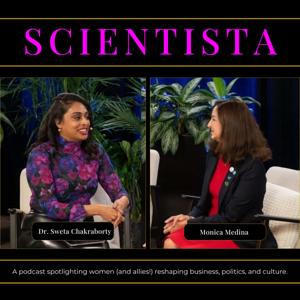
The Scientista Podcast spotlights women (and allies!) reshaping business, politics, and culture.
Hosted by behavioral scientist Dr. Sweta Chakraborty and former Assistant…
Subscribe for behind-the-scenes stories of how some of today’s most inspiring leaders have faced challenges, made tough calls, and turned vision into real-world impact.