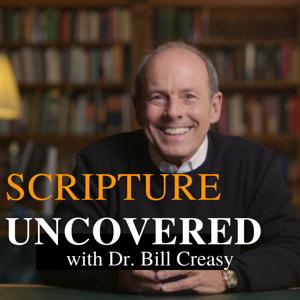
Scripture Uncovered

Scripture Uncovered

By Logos Bible StudyReligion & Spirituality
Download on the App Store

Scripture Uncovered episodes

  • On the Road with Logos: Nazareth and the Annunciation
    Mary lived in Nazareth, a young girl of perhaps 13 or 14 years old. She was betrothed to Joseph, a young man from Bethlehem working in the building trades, perhaps at Sepphoris, a town being newly rebuilt by Herod Antipas, just a few miles away. They looked forward to a wonderful life together.
    And then the angel, Gabriel, appeared to Mary with a remarkable—and very frightening—offer: to become the virgin-mother of the Son of God.
    This is an incredibly dramatic story, and Dr. C. tells it as only he can, on site at the Church of the Annunciation.
    22 min
  • On the Road with Logos: The Mount of Beatitudes and Capernaum
    Early in the morning, Dr. Creasy and his intrepid Logos pilgrims visited the Mount of Beatitudes, a place important place for Jesus, a place where he found solitude, a place where he prayed, and a place where he taught multitudes of people. Here he taught the “Sermon on the Mount,” and Dr. C. tells us how he did it!
    Later in the afternoon, the group moved down the hill to Capernaum, home of Peter and Andrew, and the center of Jesus’ public ministry.
    Dr. C. brings the two stories alive, as only he can do it!
    42 min
  • Pilgrimage: a Journey of the Heart
    As we look forward to 2019, Dr. C. ruminates on the idea of Pilgrimage, of our journey through life, of developing a deeper relationship with Christ and of traveling to the Holy Land to experience uniquely the place and the person of Jesus. Dr. C. will leave for Israel with 55 of his Logos students on January 4th, and he will record his on-site teachings there and post them right here on Scripture Uncovered.
    28 min
  • Joseph: The Quiet Man at the Manger
    In this week’s Christmas Podcast, Dr. C. offers you a reflection on Joseph, “The Quiet Man at the Manger.”
    Featuring Michael Card's "Joseph's Song": https://www.youtube.com/watch?v=KT4VDAIaMwU&t=61s
    31 min
  • “Promise Made and Fulfilled,” an Advent Reflection
    This past Sunday marked the 3rd week of Advent, the month-long run-up to Christmas, the birth of our Lord, Jesus Christ. Advent is from the Latin, adventus, which means “coming”; Advent is the four weeks anticipating the “coming of Christ,” a celebration of his birth in a stable in Bethlehem.
    In liturgical churches the color purple sets the Advent tone. Purple is the color of royalty, welcoming the coming into the world of Christ, the King. It is also the color of fasting, penitence and suffering used during Lent and Holy Week. The dual association is not accidental: Jesus’ birth cannot be separated from his death, burial and resurrection. The purpose of Jesus’ incarnation is to reveal God’s love and grace through Jesus’ life and teaching, of course, but also through his passion: his crucifixion, death, burial and resurrection. Hence, the same color for the two seasons. In fact, in the early church, Advent was a time of fasting and penitence, much as during Lent.
    During Advent, many churches bedeck their sanctuaries in evergreen boughs, evergreen trees and wreaths, symbolizing new and everlasting life brought through Jesus Christ. The Advent wreath takes a prominent place in most churches. It consists of a circular evergreen wreath with five candles, four around the wreath and one in the center. The circular wreath symbolizes God himself who is without beginning or end and who is everlasting. The white candle in the center represents Christ, the light who has come into the world, while the four outer candles represent the four weeks anticipating his coming. Of the four outer candles, three are purple or violet and one is pink or rose. The violet candles represent the royalty of Christ the King, and they link that royalty to his death, burial and resurrection, celebrated during Lent and Easter. The first violet candle is lit on the first Sunday of Advent and the first and second violet candles are lit on the second Sunday of Advent. On the third Sunday, the Rose candle is added to them. The third Sunday—the one that we celebrate this week—is traditionally called Gaudete Sunday (from the Latin gaude, meaning “rejoice,” the first word of the introit of Sunday’s Mass: “Rejoice in the Lord always. Again, I say, rejoice . . .”); it represents an easing of fasting and penitence and segues into rejoicing and celebration. The fourth violet candle rounds out the season.
    It seemed appropriate to me on this 3rd week of Advent, to share with you a reflection on the season. On Saturday, I attended a meeting of the Western Lieutenancy of the Knights of the Holy Sepulchre, a Roman Catholic order of knighthood, founded in 1113—nearly 1,000 years ago—to protect and support Christians in the Holy Land. As you know, I’ve led teaching tours to the Holy Land for years; in fact, our tour coming up on January 4th will be my 59th Israel teaching tour! Many of you listening to the Podcast have traveled to Israel with me. If you haven’t, check out the Travel section on logosbiblestudy.com, and come along with us. Our Israel teaching tours are educational, profoundly spiritual . . . and they’re a whole lot of fun!
    In any case, at our meeting, Msgr. Dennis Mikulanis led us in a morning reflection that he titled, “Promise Made and Fulfilled,” a reflection using Scripture and song. It’s a great way to celebrate Gaudete Sunday.
    So, here goes!

    39 min
  • Meet The Women Of The Bible - Ruth
    Over the past several weeks, Dr. C. has been taking a look at women in the Bible. This week he turns his eyes on Ruth, his favorite woman in the Old Testament. This week’s Podcast will be a real treat!
    31 min
  • Meet the Women of the Bible - Deborah & Jael
    “Meet the Women of the Bible—Deborah and Jael”
    After the conquest of Canaan in Joshua, we settle the “Promised Land” in Judges. The Israelites are little more than a loose confederation of twelve tribes, however, living separate lives, more or less isolated from one another. But when danger encroaches, the tribes coalesce and a leader emerges to deal with the threat. In this profoundly patriarchal culture, the fourth leader to emerge is a woman, Deborah, assisted by another woman, Jael. Together they save Israel from the hands of Jabin, king of Canaan.
    So, what happened to all the men?
    30 min
  • Meet the Women of the Bible - Sarah
    If we’re to understand Scripture within its proper historical and cultural context, we must recognize that the world of the Bible is profoundly patriarchal: men control everything, men are the “head”; but women are the “neck,” and they can turn the head any way they want! In a profoundly patriarchal, tribal culture, women wield power and authority using very different strategies than men.
    In the next few Podcasts, Dr. C. will explore some of the women of the Bible, telling their stories from their point of view. This should be great fun!
    30 min

About Scripture Uncovered

From the publisher's feed

Former UCLA professor Dr. Bill Creasy has been called a “bible teacher extraordinaire.” For over twenty years, Dr. Creasy was consistently ranked among the top 2% of all UCLA teaching faculty. His…