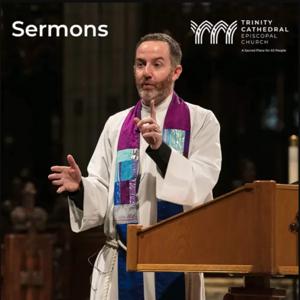
The Fourth Sunday in Advent 2016 – The Very Rev. Tracey Lind, Trinity Cathedral
Today we hear the story of Joseph, who is perhaps the most neglected character in the Christmas saga. We worship the baby Jesus and exalt his mother Mary. We marvel at the angels, search with the shepherds, and stand in awe of the magi. The innkeeper embarrasses us, and we easily hate Herod. However, Joseph rarely gets any attention in the traditional Christmas drama. In fact, he is sometimes presented as an afterthought. Not so, for the Gospel of Matthew; this Christmas story is told from the perspective of Joseph.
According to tradition, Joseph was a young man, probably in his early twenties. He was a skilled carpenter, a craftsman who followed in the footsteps of his father. He came from an old and distinguished family, a descendant of King David. According to the Biblical account, Joseph was a religious man whose daily living was prescribed by religious law, whose understanding of the whole of life was based on the active presence of God.
Joseph was engaged to be married, most likely an arranged marriage, to Mary, a young woman he had known all his life. The wedding date was set; the guest list was finalized; the arrangements had been made; the dowry was in place, and everything was proceeding as planned. Joseph’s life in was in order, good order – until that fateful day.
Can you imagine the scene between Mary and Joseph? “Joseph, I have something to tell you.” “What’s that dear.” “I’m pregnant.” “You’re what?!?” “I’m pregnant, but it’s not what you think.” “What do you mean…it’s not what I think?” “I’m pregnant with the Holy Spirit.” “What are you talking about? “Joseph, I’m serious. Yesterday as I was hanging the laundry out to dry, an angel of the Lord visited me and said, ‘Do not be afraid, Mary, for you have found favor with God. And now you will conceive in your womb and bear a son, and you will name him Jesus.’”
Joseph shook his head and stared at his beloved fiancée in disbelief. Betrayed, embarrassed and angry, Joseph considered his options. By right of law, he could publicly condemn her and divorce her (a betrothal was considered a legal contract); and because a woman who got pregnant out of wedlock was considered an adulterer, he could even call for her death by stoning. However, being a good and righteous man who really loved this woman, Joseph decided on an alternative response, a gentler way. Rather than expose Mary to public humiliation and harsh punishment, he would divorce her quietly and start over.
Joseph went home that night from Mary’s house utterly exhausted. Perhaps, he stopped at a tavern on his way home to ease his sorrows; or maybe, he took a walk along the darkened streets or into the countryside. I wouldn’t be surprised if he had gone into his carpentry shop and sanded a piece of wood for a few hours. Who knows what Joseph did after the break-up?
Eventually, he crawled into bed. For a long time, he tossed and turned. Finally, he fell asleep. That night Joseph had a restless but deep sleep that overtakes us when we’re upset beyond words and tears. And then he dreamed a dream that changed the course of his life and perhaps that of history.
Have you ever noticed how you dream on those nights when you’re really upset? Our dreams are about ourselves – our deepest, most genuine selves. According to Carl Jung, if we listen to our dreams, we can hear the message of God, the holy voice inside ourselves. Sometimes, we hear it dimly and other times loud and clear. I believe that dreaming is one of God’s ways of reaching us when we’ve determined to block God out.
Scripture tells us, “An angel of the Lord appeared to Joseph in a dream.” (Mt 1:20) and invited him not to be afraid to take Mary as his wife, because “the child conceived in her was from the Holy Spirit.” (Mt 1:20) What would you think when you awoke in the morning (or...