
Sign up to save your podcasts
Or



Send us Fan Mail
Today Shelley and Dr Ricky Jones take another look at an interview from 1995 with Ezekwa Abdullah. Ezekwa argues that Blacks still repress themselves and suffer a form of psychological slavery in the collective subconscious psyche because attitudes of repression have been preserved and passed from one generation to the next. The ghost of the plantation exists today because not enough has been done to condemn this point of view.
Background and Imprisonment: Abdullah was formerly incarcerated at Holman Prison in Alabama, an overcrowded facility where 80% of the inmates were Black. He was involved in a murder while under the influence of drugs, a crime he initially did not fully remember.
Prison Rehabilitation and Theater: While incarcerated, Abdullah and other inmates produced a powerful theatrical production titled "Why Kill Me?" to advocate against community violence. Shelly Stewart was instrumental in advocating for their release and bringing them into community outreach.
Self-Education and Articulation: Despite lacking a formal traditional education, Abdullah became a deeply learned individual who championed the philosophy that "education is the key".
The "Plantation Mentality" Concept: In his archival interview discussions (such as the "Plantation Ghost" episode), Abdullah examined how an enduring "plantation mentality" causes many Black individuals to operate under psychological constraints, effectively living as though they still do not realize they are free.
Legacy: Abdullah passed away around 2023, but his recorded insights continue to be used in the podcast archives to discuss systemic barriers, rehabilitation, and the psychological struggles of self-determination.
Support the show
Follow us and continue the conversation on Facebook, Instagram, and LinkedIn.
Send us Fan Mail
In this week's episode, we re-examine an interview with historian Horace Huntley conducted in 1997 by Dr. Shelley Stewart.
The discussion emphasizes that white supremacy operates like a cancer that continuously mutates across generations, and highlights the heavy public criticism Shelley faced for discussing racial issues openly.
We discuss how mainstream networks avoid authentic conversations on race in favor of state-sponsored viewpoints—with independent podcast platforms, which provide essential spaces for honest, uncompromised dialogue.
Support the show
Follow us and continue the conversation on Facebook, Instagram, and LinkedIn.
Send us Fan Mail
As a member of the King's inner circle, Hosea Williams served as the advance man, organizing some of the most important events in the movement. Williams traveled to cities throughout the South, recruiting and organizing volunteers, paving the way for appearances by King, Jesse Jackson, and Andrew Young. Williams and John Lewis led the "Bloody Sunday" march in Selma, Alabama, in 1965.
This episode features an interview from September of 1994 with Shelley Stewart and Hosea Williams. Hosea reveals the dire warning King had for the members of his inner circle.
Ricky reflects on the Black struggle and the unfortunate missteps made by Black leaders after the loss of King.
Support the show
Follow us and continue the conversation on Facebook, Instagram, and LinkedIn.
Send us Fan Mail
In this episode Shelley reflects on his journey from a homeless youth in Birmingham to a pioneering radio personality and successful business consultant.
This episode touches on civil rights history, economic empowerment, education, and the ongoing struggle for equality, offering a powerful look at legacy, fatherhood, and social consciousness.
Support the show
Follow us and continue the conversation on Facebook, Instagram, and LinkedIn.
Send us Fan Mail
In this week's episode, Shelley and Ricky discuss how over-reliance on AI for writing and thinking threatens critical thinking and foundational professional competencies, forcing educators to find new ways to verify comprehension.
The conversation also covered the historical ties between literacy and empowerment, current political pressures on educators (such as the dissolution of the Auburn University faculty senate), and concerns over historical awareness in federal leadership.
What will society suffer due to its reliance on AI?
Support the show
Follow us and continue the conversation on Facebook, Instagram, and LinkedIn.
Send us Fan Mail
In this episode, we explore the sharp decline in educational literacy across the U.S. and the emerging cognitive threats posed by artificial intelligence.
We examine alarming literacy trends, including 25 million American children reading below proficiency, 61% of low-income families lacking age-appropriate books, and only 2% of adults reading to a child on any given day.
As reading for pleasure continues to drop, we discuss how reading and writing serve as essential brain exercises to refine and test ideas.
Finally, we address growing concerns that an over-reliance on AI for writing and thinking will cause critical thinking skills to atrophy, undermine the foundational competency of future professionals like doctors and lawyers, and force educators to turn back to oral exams.
Support the show
Follow us and continue the conversation on Facebook, Instagram, and LinkedIn.
Send us Fan Mail
In this episode, hosts Shelley Stewart, Ricky Jones, and Mark Jamroz explore the persistent challenges of truth-telling in both professional and societal contexts.
Key Topics Discussed:
Join us as we discuss the necessity of individual courage and the critical work required to prevent historical and painful experiences from being ignored.
Support the show
Follow us and continue the conversation on Facebook, Instagram, and LinkedIn.
Send us Fan Mail
Today, we (re)present the most downloaded Plumbline episode of 2025, titled "Racism Today."
In this episode, Shelley, Mark, and Ricky Jones launch into a powerful discussion on the enduring struggle against racism, arguing that while overt segregation is gone, it has transformed, with terms like DEI serving as "code words" for veiled racist policies. They explore the historical context of white supremacy, citing Abraham Lincoln's views on racial inequality, and stress the urgent need for continued, honest conversation about justice. The episode also covers modern dangers to society like greed and anti-intellectualism, and examines intra-racial dynamics and miseducation within the Black community. Listen, learn and share your thoughts.
Support the show
Follow us and continue the conversation on Facebook, Instagram, and LinkedIn.
Send us Fan Mail
This episode of Shelley's Plumbline celebrates the return of Dr. Shelley Stewart to the podcast team!
The discussion centers on the systemic challenges facing black academics and educators, including the mental health toll of targeted media attacks, the lack of representation in higher education (where black professors constitute only 5% of the faculty), and the exclusion of black voices from mainstream media platforms.
The hosts also touch upon conflicts involving high-profile media figures, critique narratives surrounding black tenure-track faculty, and reflect on historical events to contextualize the ongoing struggle for visibility and equality.
Support the show
Follow us and continue the conversation on Facebook, Instagram, and LinkedIn.
Send us Fan Mail
In this episode, we move beyond the headlines to examine the systemic pressures facing higher education—from the dismantling of DEI initiatives to the political influence on university leadership.
We explore the roots of current political polarization, analyze the impact of populist movements on our national discourse, and discuss why critical thinking is under attack. If you’re looking for a substantive, intellectual look at race, power, and the state of American morality, this conversation is for you. We don’t shy away from the hard questions; we pursue the truth that lies between conflicting perspectives.
Support the show
Follow us and continue the conversation on Facebook, Instagram, and LinkedIn.
From the publisher's feed
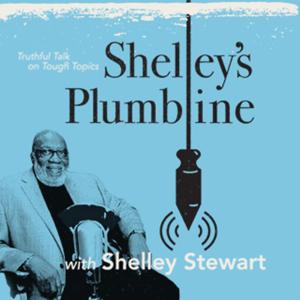
In construction, a plumbline is a weight suspended from a string used as a tool to find the true reference line. A plumbline will always find the vertical axis pointing to the center of gravity,…
Pulling from a library of more than 3,000 shows from his storied career in broadcasting, Shelley's Plumbline leads us in a search for the truth, opening the channels of communication and understanding on tough social topics that are as relevant today as they were 40 years ago.
Join us as we explore the past, compare it to today, and craft a better future.