
Sign up to save your podcasts
Or

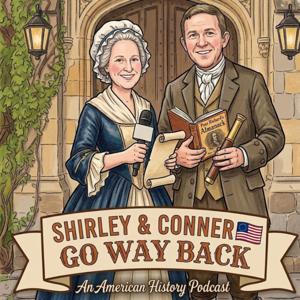


Join us as we discuss one of our favorite presidents, Theodore Roosevelt! We also dive into the overthrow of the Hawaiian monarchy and the United States involvement in World War I. The U.S. is stepping out into the world in this episode.
In Episode 9, we’re joined by a special guest, Mrs. Conboy, our school’s biology and anatomy and physiology teacher. She introduces us to Henrietta Lacks, a Black woman whose cells were taken without her knowledge in 1951 and are still used in medical research today. From there, we explore the eugenics movement and how science and medicine were used to justify discrimination during the Jim Crow era, including Virginia’s forced sterilization program, the Supreme Court case Buck v. Bell, Loving v. Virginia, and the Tuskegee Syphilis Study.
Episode 8: The Abolitionists
Long before the first shots of the Civil War, a small but determined group of Americans was fighting to end slavery, and they weren’t willing to wait. This week, Mrs. Shirley and Mr. Connor dig into the abolitionist movement: who joined it, what they risked, and how a cause supported by only a fraction of the country helped change its course.
We start with the people who resisted slavery from the very beginning: enslaved men and women who broke tools, slowed their work, escaped, and even used music to pass messages. Then we follow the stories of Harriet Tubman, who made repeated trips south on the Underground Railroad and later led a military raid during the Civil War, and Frederick Douglass, whose advice President Lincoln came to value. You’ll also hear lesser-known stories, like Henry “Box” Brown, who mailed himself to freedom in a wooden crate, and Lewis Hayden, who faced down slave catchers at his Boston door with a lit candle and barrels of gunpowder.
Along the way, we cover the Fugitive Slave Act, the violence of “Bleeding Kansas,” John Brown’s raid on Harpers Ferry, and the road to the Emancipation Proclamation and the 13th Amendment. Plus: a run-in with a restaurant door, Sweet Caroline at Fenway, and a strong disagreement about the movie Lincoln.
Grab a cup of whatever keeps you going, and let’s go way back.
In Episode 7, we take on the Trail of Tears, one of the most heartbreaking chapters in American history. You’ll hear how cotton, gold, and the belief in Manifest Destiny drove the United States to push Native nations off their homelands, and how the Cherokee fought back the American way: with a written constitution, a Supreme Court victory, and a speech before the Senate that came within one vote of changing everything. This episode is a powerful example of how having the law on your side doesn’t always mean justice wins.
In Episode 6 we discuss the faults in the problems a young United States faced and what the Founding Fathers came up with as a solution.
In this episode, Mrs. Shirley and Mr. Conner discuss what caused the Boston Massacre, what really (probably) happened during the chaos, and more importantly, what happened after and how these ideals helped shape the writing of the Bill of Rights to the United States Constitution. Quite a big impact for something that started with throwing some snowballs!
In this episode, Mrs. Shirley and Mr. Conner discuss how a young George Washington and a Seneca chief known as the Half King sparked the French and Indian War. A young Washington was eager to learn and advance in the British military prior to becoming the first POTUS.
In this episode, Mrs. Shirley and Mr. Conner discuss the Trans-Atlantic Slave Trade and the Middle Passage, through the autobiography of 18th century enslaved African, Olaudah Equiano. Trigger warning: this episode contains disturbing content about human slavery and abuse.
In this episode, Mrs. Shirley and Mr. Conner dive into the story of Grace Sherwood, the Witch of Pungo in Virginia Beach, Virginia. A comparison of Grace's case and punishment with those of the 20 victims of the Salem Witch Trials in Massachusetts 10 years earlier reveals the deep differences in societies and local governments in Colonial Virginia and New England
In our first podcast episode, we begin with the real story of Pocahontas and discuss the different accounts of her life between English written accounts and Powhatan oral histories. Which one do you believe?