
Sign up to save your podcasts
Or

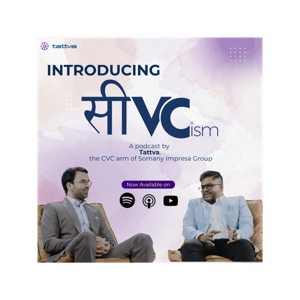


For nine episodes, CVCism happened in a boardroom. This one happened on a factory floor.
Sriharsha Bandaluppi and Shashvat Somany take Vishnu Jayachandran, CEO of Crion Technologies and part of the SIG Tattva portfolio, through Truflo by Hindware — past the extrusion lines, the injection moulding machines, the control room and the tool room — and ask him, at each stop, what a digital twin would actually do there.
Vishnu didn't come from software. He came from oil and gas, where the equipment in front of him gave him nothing he could use, and where getting one decision made meant walking between four departments. Crion grew out of that frustration.
The conversation covers what separates a real digital twin from a 3D model or a dashboard; the two-hour mould changeover and the "golden batch" that could halve it; why data quality decides whether any of it works; what automation can and cannot do, however sophisticated your SCADA; the 10–15 seconds an operator gets to act on an alarm before silencing it; and why the technology isn't the expensive part — the implementation is.
It closes on something Vishnu says about working with a corporate investor: access to a real plant is worth more than the cheque. Chapters 2:15 Why this episode is inside a factory 7:15 From the oil-and-gas shop floor to Crion 10:40 What a digital twin actually is 19:00 Why Tattva invested 24:50 Job change, golden batch and the data behind it 33:16 The control room: what automation can't do 41:00 The tool room and the twin, live 46:34 Cost, partnerships and what comes next
Guest: Vishnuvardhan Jayachandran, CEO, Crion Technologies
Hosts: Sriharsha Bandaluppi and Shashvat Somany
Recorded at Truflo by Hindware.
What happens when someone actually reads the fine print of India's biggest consumer IPO filing?
Jayant Mundhra has built his reputation doing exactly that. In Episode 9 of सीVCism, he joins hosts Sriharsha Bandaluppi and Shashvat Somany for a conversation that starts with Zepto's DRHP and ends with the case for patient capital in India.
The Zepto section is the sharp end of it. Roughly ₹22,600 crore of revenue against losses in the ₹5,000 crore range — and average order value, arguably the metric that decides whether the business works, mentioned just twice in the whole document. Jayant explains why the top line can't be taken at face value, what his own conversations with sellers revealed about the advertising engine beneath the platform, and the question that anchors his whole analysis: if a company is going public, is it really a good company for the public?
Then the conversation opens outward. Whether quick commerce survives the move into vertical categories like steel and construction materials, and why those margins demand a different model altogether. Why a Chinese business will build at 6% return on equity while an Indian one holds out for 16 to 20, and what that gap means for who takes the first risk. Where the PLI scheme excludes the very companies it should be backing, what genuinely works when the government shares risk instead of picking winners, and how clusters from Yiwu to Tirupur to Morbi build advantages that policy can't manufacture on its own.
It ends on corporate venture capital: why the pairing of an anchor customer and an anchor supporter can be a match made in heaven, and how ecosystem investing turned three of Xiaomi's bets into $5 billion companies.
For SIG Tattva, that's the thesis in one line — strategic capital, not tourist capital. Deeply integrated, genuinely patient, and built to help companies grow inside real businesses.
Chapters:
02:58 - Introductions
04:00 - Who is Jayant Mundhra?
13:34 - The Zepto question: top line, losses & the DRHP
18:22 - Channel checks, the ad-credit scheme & the valuation slide
23:51 - Is it a good company for the public? Runway, unit economics & FY29
27:15 - Sustainability, track record & the missing global parallel
31:50 - Quick commerce goes vertical — construction materials & thin margins
38:22 - Macro: how governments help ecosystems thrive
41:22 - Risk-sharing that works — and where policy breaks
51:07 - Ecosystem clusters & the branding gap
58:18 - CVCs in India: the case for patient capital
Hosted by Team Tattva — because at Tattva, the pilot is the product.
What does it take to find alpha in the markets everyone else writes off?
Most investors compete for the same deals in the same few geographies. Varun Rekhi built his career doing the opposite — investing across the emerging economies of the Middle East, Africa, Southeast Asia and Latin America, where returns supposedly don't exist and where reading the context is the whole game. In Episode 8 of CVCism, he joins hosts Shashvat Somany and Sriharsha Bandaluppi for a wide-ranging conversation on how the world's overlooked markets actually work — and what that teaches you about investing anywhere.
From Delhi to New York, Singapore and London, Varun's journey shaped a simple conviction: the edge in venture isn't a better model, it's seeing what others miss. The three of them trace that idea across fintech, crypto, AI and the mechanics of the asset class itself.
The conversation runs from why public fintech rails can become an "inheritance trap" for the founders who build on them, into how stablecoins are rewiring cross-border money and why that shift has been slower to reach India. It moves through the "broken flywheel" that stalls venture when real exits don't come, what India genuinely got right — starting with its diaspora — and the difference between Bitcoin as an asset and Bitcoin as infrastructure. From there it turns to where the next edge is forming in AI and frontier technology, from compute bottlenecks to photonics, before closing on an honest exchange about what it really means to have a corporate VC on your cap table: when it adds value, and when it doesn't.
For SIG Tattva, it all comes back to one idea: we invest as strategic capital, not tourist capital — with the conviction to back what the crowd overlooks, and the integration to help those companies scale inside real businesses. Varun's instinct for finding value where no one else is looking is the same discipline that drives how we build.
Chapters:
0:00 - Introductions
3:06 - Delhi to Emerging Markets: Varun's journey
5:58 - Finding Alpha & Recalibrating Across Markets
8:43 - Fintech, UPI rails & the "Inheritance Trap"
16:08 - The Stablecoins Sandwich
21:00 - IPOs, liquidity & the Underrated Founder
24:20 - Building Acquirable Businesses
28:06 - Closed rooms & the "quiet middle"
32:14 - Reading founders: the 2-2-2 rule
37:26 - The Broken Flywheel: the "tap," exits & LPs
41:37 - What India Got Right
44:20 - Bitcoin: Asset vs. Infrastructure
47:12 - AI, tokens & frontier tech
50:11 - Reading a CVC on the cap table
51:59 - What makes a great CVC
Hosted by Shashvat Somany and Sriharsha Bandaluppi.
Subscribe to सीVCism for conversations at the intersection of startups, industry, and execution.
Follow SIG Tattva
LinkedIn: https://www.linkedin.com/company/sig-tattva/
Instagram: https://www.instagram.com/sig_tattva/
Is conviction something you build with evidence; or something you feel before the evidence arrives?
Because at the earliest stage of a company's life, there's nothing to measure. No traction, no revenue curve, no product-market fit to validate. There's only a founder, an idea, and a decision that has to be made anyway.
But that raises a deeper question- if there's nothing to point to, what exactly are you underwriting?
This episode exists to interrogate that.
Through Ishaan Khosla and Huddle Ventures, we wanted to move past the polished stage-by-stage playbook and get closer to the decision itself. Not what a founder eventually becomes, but how you build belief in them before anyone else does.
At SIG Tattva, this is a question we constantly sit with; from the opposite end. Huddle writes the first institutional cheque, entering at zero-to-one where belief has to do the work data usually does. We come in after validation, when the question is no longer "will this work" but "will this scale inside a live business." Two philosophies that look like opposites. Harsha calls it Batman versus Joker.
Which is why this conversation leans into uncomfortable territory.
If you back a concept on paper, then execution capability; not pedigree, not narrative, becomes the only thing worth underwriting. If the future belongs to smaller, focused funds, then attention, not capital, becomes the real edge. And if conviction is the job, then the hardest discipline isn't finding deals, it's staying high-conviction instead of spraying and praying.
But that's where the friction lies.
Because conviction forces trade-offs. It forces you to separate genuine belief from your own bias. And in a market that rewards activity, saying no is often the hardest thing to do.
So this episode stays inside that contradiction-
Between belief and evidence. Between speed and scrutiny. Between the founder's freedom and the investor's involvement.
If you're building or backing early, don't just ask: "Is this a good idea?"
Ask: "Would I still believe in it if no one else did yet?"
Because conviction that only survives with company isn't conviction; it's consensus.
Chapters -
00:00 – Intro & Welcome
05:51 – What Is Huddle: The First-Cheque Philosophy
13:36 – Batman vs Joker: Why Opposite Philosophies Are Complementary
19:22 – Founders & Strategic Capital: Freedom, Control & Trust
23:11 – Building Conviction on a Concept: Evaluating Pre-Seed
30:56 – The Huddle Name, the Advisor Network & the Anti-Portfolio
38:41 – Small Funds, Narrative & Grooming Founders
48:45 – Tattva's Lens: Strategic Value & Patient Capital
55:03 – Hot Takes: Consumer AI, Deep Tech & "Unsexy Is Sexy"
Hosted by Shashvat Somany and Sriharsha Bandaluppi
Subscribe to सीVCism for conversations at the intersection of startups, industry, and execution.
Follow SIG Tattva
LinkedIn: https://www.linkedin.com/company/sig-tattva
Instagram: https://www.instagram.com/sig_tattva/
#CVCism #VentureCapital #EarlyStage #Startups #Investing #SIGTattva #CorporateVentureCapital #IndiaStartupEcosystem
Is venture investing actually a system; or just intuition dressed up as experience?
Because if you strip away narratives, access, and hindsight bias, most conversations around investing still fall back on instinct. Timing, conviction, “seeing something others don’t.”
But that raises a deeper question- if outcomes can be explained, can they also be repeated?
This episode exists to interrogate that.
Through Raghav Bahl’s journey—across Bessemer, Alibaba, and now Promaft—we wanted to move away from outcomes and get closer to decision-making itself. Not what worked, but how those calls were made, and whether there is a structure behind them.
At SIG Tattva, this is a question we constantly sit with. Because operating as a CVC forces you into a tension: you don’t just allocate capital—you justify it, align it, and deploy it inside a live business environment. That makes instinct insufficient. It demands process, clarity, and repeatability.
Which is why this conversation leans into uncomfortable territory.
If investing is truly cyclical, then conviction should change with cycles; not narratives.
If Product-Market Fit is the most important inflection point in a company’s journey, then it cannot remain a loosely defined idea, it needs to be measurable, comparable, and testable.
And if frameworks exist, then the real edge isn’t access to deals, it’s discipline in applying those frameworks consistently.
But that’s where the friction lies.
Because frameworks create clarity, but they also remove excuses. They force trade-offs. They force you to say no. And in a market driven by activity, saying no is often the hardest thing to do.
So this episode stays inside that contradiction-
Between instinct and structure. Between cycles and conviction. Between opportunity and discipline.
If you’re building or investing, don’t just ask: “Is this a good company?”
Ask: “Would I still invest in this if I had to follow the same process every single time?”
Because if that answer changes, then maybe the decision isn’t a system; it’s a moment.
Chapters -
02:36 – Promaft & Global Learnings
05:06 – Venture Cycles
08:48 – Method Over Gut: Framework Thinking
16:17 – Discipline & Sitting Out
17:52 – Investor vs Operator Mindset
20:22 – India vs China Learnings
26:11 – Product Market Fir: The CURW Framework
32:15 – Value vs Valuation 34:16 – Tier 2/Tier 3 Reality
37:22 – The LP Flywheel
40:49 – Promaft Partners
46:54 – Founder Advice
50:26 – The CVC Perspective
Hosted by Team Tattva — because at Tattva, the pilot is the product.
Subscribe to सीVCism for conversations at the intersection of startups, industry, and execution. Follow SIG Tattva
LinkedIn: https://www.linkedin.com/company/sig-tattva/
Instagram: https://www.instagram.com/sig_tattva/
#CVCism #VentureCapital #ProductMarketFit #Startups #Investing #SIGTattva #CorporateVentureCapital #IndiaStartupEcosystem
Let’s not overcomplicate this—this episode is really about one question:
Are B2B commerce platforms structurally profitable—or just operationally efficient illusions?
MOB enters a category already shaped by Infra.Market, OfBusiness, and Moglix—platforms that have proven scale, but still leave one core question unresolved: where does durable margin actually live?
But this episode isn’t just about the market.
It marks a milestone for CVCism—our first deep dive into a portfolio company we backed at inception. Through Mad Over Buildings, we wanted to open up how Corporate Venture Capital actually works in practice—what it means to build alongside a company, not just invest into it. This is as much about the founder journey as it is about working with SIG Tattva— the expectations, the systems, the friction, and the value created through real collaboration.
And that’s where MOB becomes interesting. Because it’s not just another B2B commerce play—it’s attempting to change the starting point itself:
- A no-bleed model with day-zero positive unit economics
- Built through brand partnerships, not inventory-heavy aggregation
- An anti dark-store approach, where distributors are supplemented—not bypassed
Alongside this, the episode also explores how India’s construction ecosystem is being rethought—through reliability, credit access, and operational design—and the role of players like Hindware and SIG Tattva as active participants, not passive capital.
But these claims come with real tension. Because if you don’t fully control inventory, logistics, or demand— where does pricing power come from? And if you eventually do— how different are you from the incumbents you set out to disrupt?
This conversation deliberately stays inside that contradiction. Because at scale, this isn’t about GMV or growth. It’s about structural control:
- Who influences pricing vs who absorbs volatility
- Who owns the customer vs who services them
- And ultimately—who retains the margin when the system stabilizes
If you’re building or investing in this space, don’t just ask: “Is this more efficient?”
Ask: “What has fundamentally changed—and is it defensible?”
Because if that answer isn’t clear, this isn’t a new model - It’s a temporary advantage.
-------------
Chapters -
02:28 – The Making of a Founder
06:47 – Backpacker Panda to Ground Zero
09:35 – The 65% Problem in Indian Construction
13:30 – MOB Explained: A Marketplace Powered by Credit
16:23 – Udhaari Economics: The Credit Engine Behind Indian Construction
22:58 – Founder–CVC Fit: What Made Us Bet on MOB
30:04 – The Anti–Dark Store Revolution
37:46 – Three Layers of Risk: Cracking the Last‑Mile Credit Chain
41:04 – Why Contractors, Not Homeowners, Control the Market
45:58 – Distribution Isn’t Dying — It’s Evolving
53:17 – India’s Infra Future & MOB’s IPO Path
59:38 – Rapid Fire
---------
Hosted by Team Tattva — because at Tattva, the pilot is the product.
Subscribe to सीVCism for conversations at the intersection of startups, industry, and execution.
Follow SIG Tattva
LinkedIn: https://www.linkedin.com/company/sig-tattva/
Instagram: https://www.instagram.com/sig_tattva/
For our fourth episode, we take a deep dive into the mechanics of building a Corporate Venture Capital arm from the ground up.
Joining the conversation are Sriharsha Bandaluppi and Shashvat Somany, as they unpack the thinking, structure, and realities behind setting up and running a CVC.
Together, they explore:
A grounded look at CVCs — focused less on theory, and more on the systems, decisions, and execution that make them work.
Hosted by Team Tattva — because at Tattva, the pilot is the product.
🎧 Listen & Watch सीVCism
🔗 Follow SIG Tattva
Disclaimer:
The views and opinions expressed in this episode are those of the speakers and do not necessarily reflect the official policy or position of Somany Impresa Group, SIG Tattva, or any affiliated entities. This content is intended for informational purposes only and should not be construed as investment, legal, or financial advice.
For our third episode, we are joined by Nikhil Choudhary, Founder & Partner at Nirman Ventures, a firm known for its operator-first lens and disciplined approach to investing.
Joining him in conversation is Sriharsha Bandaluppi, Head of SIG Tattva. Together, they explore:
A grounded conversation on venture capital — focused less on momentum, and more on judgment, discipline, and building what lasts.
Hosted by Team Tattva — because at Tattva, the pilot is the product.
🎧 Listen & Watch सीVCism
🔗 Follow SIG Tattva
Disclaimer:
The views and opinions expressed in this episode are those of the speakers and do not necessarily reflect the official policy or position of Somany Impresa Group, SIG Tattva, or any affiliated entities. This content is intended for informational purposes only and should not be construed as investment, legal, or financial advice.
In this episode, Inside IvyCap Ventures, we are joined by Dr. Anju Gupta, Partner at IvyCap Ventures, India’s leading homegrown venture capital firm.
Joining her in conversation are Shashvat Somany, Founder of SIG Tattva and Head of Strategy at Somany Impresa Group, and Sriharsha Bandaluppi, Head of SIG Tattva.
Together, they explore:
· What it takes to build a long-term, homegrown venture capital institution
· Why value creation matters more than valuation — and why IvyCap focuses on building “Dragons,” not just Unicorns
· How mentorship, governance, and execution shape successful founders
· The role of academia, industry, capital, and endowments in building India’s innovation ecosystem
· Where India’s next wave of growth will come from — across consumer, deep tech, and India-to-the-world innovation
A thoughtful conversation on venture capital beyond funding — focused on institutions, ecosystems, and outcomes that last.
Hosted by Team Tattva — because at Tattva, the pilot is the product.
🎧 Listen & Watch सीVCism
🔗 Follow SIG Tattva
Disclaimer:
The views and opinions expressed in this episode are those of the speakers and do not necessarily reflect the official policy or position of Somany Impresa Group, SIG Tattva, or any affiliated entities. This content is intended for informational purposes only and should not be construed as investment, legal, or financial advice.
Welcome to सीVCism — a podcast where startups meet industry, and ideas meet execution.
In this first episode, Building Tattva, Shashvat Somany, Founder of SIG Tattva and Head of Strategy at Somany Impresa Group, joins Sriharsha Bandaluppi, Head of SIG Tattva, for an inside look at India’s most forward-looking Corporate Venture Capital platform.
Together, they discuss:
Hosted by Team Tattva — because at Tattva, the pilot is the product.
From the publisher's feed
सीVCism is a podcast series by SIG Tattva, the Corporate Venture Capital arm of Somany Impresa Group, that dives into the evolving world…
Hosted by the Tattva team, the show features candid conversations with founders, CXOs, and ecosystem leaders who are reshaping how corporates and startups collaborate — from pilots and PoCs to scalable ventures.
The podcast explores themes across open innovation, industry–startup partnerships, sustainability, technology, and the future of enterprise growth.
Where startups meet industry, and ideas meet execution.