
Sign up to save your podcasts
Or



Everything is a priority.
The customer. AI. Innovation. Talent. Cost. Growth.
Oh....and that new thing leadership just asked for yesterday.
So…which priority is the priority?
In our final episode on Clarity, we tackle what happens when an organization is moving fast, everyone is working hard and people start losing line of sight between what they're doing and what actually matters.
Because when everything feels urgent, we tend to row harder.
More meetings. More activity. More checkmarks.
But are we moving the work forward?
We get into competing priorities, line of sight, focus time, the one-on-one you should own, and why sometimes the most valuable thing you can do is ask the question everyone else is thinking.
In a world obsessed with artificial intelligence, we're doubling down on human intelligence.
Because AI can help us move faster.
Human intelligence makes sure we're rowing in the right direction.
CTA: Pick the three things taking most of your time this week. Can you draw a straight line from each one to an outcome that actually matters?
If you can't, don't just keep rowing harder. Ask the question.
In a world obsessed with artificial intelligence, we're doubling down on human intelligence.
🎧 Listen now, follow Simple, Not Easy, and send this episode to someone who's trying to figure out which “#1 priority” is actually #1.
Simple, Not Easy
Ever walked into a meeting as a team and realized you weren't actually aligned?
Someone says yes.
Someone else thinks, We absolutely cannot do that!
And now you're trying to recover in front of the client?
This is why we believe in the meeting before the meeting.
Not another hour on the calendar. Five minutes of human intelligence.
What are we trying to accomplish?
What can we give?
What's non-negotiable?
Who plays what role?
And how will we have each other's backs when the conversation changes?
AI can summarize the meeting.
It can build the deck, capture the notes and create the action list.
But it can't own the relationships in the room.
That's our job.
In this episode of Simple, Not Easy, we explore why clarity isn't just communication. It's how humans align, negotiate, read each other, make tradeoffs and move together.
CTA: Before your next critical meeting, try this...Because a group of smart people doesn't automatically make a team and clarity is key.
In a world obsessed with artificial intelligence, we're doubling down on human intelligence.
Have the meeting before the meeting.
Simple. Not easy.
Because a group of smart people doesn't automatically make a team.
We've all been there, too many meetings and not enough time to do the work. When do we say STOP to the madness?
We've normalized calendars packed with meetings, double bookings, competing priorities and work that somehow gets squeezed in around the edges.
Maybe the problem isn't time management.
Maybe it's clarity.
In this episode of Simple, Not Easy, Michelle and Cyndee challenge the way we spend one of our most valuable resources: our time.
Your expected to deliver value to the organization, does this meeting bring that value or is it just filler of hot air and no decisions?
Everytime you click accept to the meeting, you are saying no to preparing, scouting, connecting, you name what you are saying no to.
And are the things consuming your calendar actually connected to the value you're expected to create?
They introduce a simple practice they call calibration—short, intentional conversations that keep priorities, expectations and people aligned before things go off course.
Because effort doesn't equal results.
Busy doesn't equal valuable or important
And a full calendar definitely doesn't equal impact. Maybe it's just easier to accept than get the clarity?
CTA: Look at your calendar for the next two weeks. Which meetings actually move your most important work forward?
In a world obsessed with AI, we're doubling down on human intelligence.
Simple. Not easy.
“No one cares how much you know until they know how much you care.”
Most organizations would say they care about their people.
The values are on the wall and what they stand for on the website, maybe even a “Best Place to Work” award in the lobby.
But what happens when the experience of working there doesn't match the words?
In this episode of Simple, Not Easy, Cyndee and Michelle take compassion to the organizational level—and challenge both organizations and the people inside them to own their part.
Because compassion isn't about creating a workplace filled with rainbows, unicorns, lattes, and warm fuzzy kitty cats.
High performers want to do work that matters. Expectations can be high. Accountability can be real.
The question is how.
Michelle and Cyndee explore the calibration between what we expect from people and how we create the environment for them to deliver it.
They dig into:
And there's an uncomfortable challenge in this conversation:
Staying is a choice, too.
You may not control every decision your organization makes. You probably don't have all the information behind those decisions.
But you can get curious. You can ask questions. You can give feedback. You can understand and accept YOUR non-negotiables. And ultimately, you can decide whether the environment still works for you.
Compassion isn't just something an organization owes you.
It's something we create together.
So this week's experiment is simple:
Look at one value your organization says matters.
Then ask: What behaviors do we actually reward?
In a world obsessed with AI, we're doubling down on human intelligence.
Work is experiential. You choose your role:
Observer. Participant. Impactor.
Simple. Not easy.
Most people think compassion at work means being softer.
Lowering the pressure.
Giving people more time.
Letting missed expectations slide.
What if compassion is actually clarity?
In this episode of Simple, Not Easy, Michelle and Cyndee explore how compassion shows up when the stakes are high, the deadlines are real, and the work still has to get done.
They challenge the idea that demanding environments have no room for care. Instead, they argue that one of the most compassionate things a leader or teammate can do is make expectations visible.
What do you actually need?
Why does it matter?
What does good enough look like?
And what is going to get in the way?
Through stories of public accountability, unreasonable assumptions, perfectionism, fire drills, and competing priorities, Michelle and Cyndee show how a few clear questions can prevent hours of wasted effort, missed deadlines, resentment, and blame.
They explore:
The lesson is simple:
Compassion does not mean doing the work for someone.
It means helping create the conditions for success.
Your experiment this week:
CTA: When you are asked for something urgent, do not fill in the blanks yourself.
Ask: “What does good enough look like?”
Then clarify what will not get done so the new priority can.
In a world obsessed with AI, we are doubling down on human intelligence.
Every day, you choose your role:
Observer. Participant. Impactor.
Simple. Not easy.
Most people think compassion means being nice.
It doesn't.
Compassion isn't lowering expectations.
It's something much more powerful.
In this episode of Simple, Not Easy, Cyndee and Michelle unpack one of leadership's most misunderstood skills.
They explore why compassion is empathy in action, not taking over someone else's journey and stealing their moment, but choosing to walk beside them while still holding them accountable.
Through stories about coaching, leadership, missed deadlines, difficult conversations, and even a new puppy, they reveal why our first instinct is often to solve the problem when what people really need is to feel heard.
In this episode you'll discover:
One of the biggest myths they challenge?
You don't have to lower standards to be compassionate.
In fact, holding people accountable, while helping them succeed, can be the most compassionate thing a leader can do.
CTA: The next time someone shares a struggle...Don't jump in with your story.
Pause.....Listen.....Ask one simple question: "How can I help?"
Compassion isn't about having the answers.
It's about creating the space for someone else to discover THEIRS.
In a world obsessed with AI, we're doubling down on human intelligence.
Work is experiential.
Every day you choose your role:
Observer. Participant. Impactor.
Simple. Not easy.
Most people wait for someone else to fix the organization.
The best leaders don't. They step forward.
In this episode of Simple, Not Easy, Michelle and Cyndee explore what organizational courage really looks like and it's not what you think.
It's not having the biggest title, but the courage to ask hard questions, build relationships across the business, challenge assumptions, and volunteer before you are ready.
In this episode you'll discover:
Perhaps the biggest takeaway?
The people who influence organizations aren't always the ones with the most authority.
They're the ones who consistently raise their hand.
CTA: Find one initiative your organization is moving toward. Instead of watching from the sidelines...Raise your hand.
Careers aren't built on invitations. They are built on opportunities that arise, regardless of your readiness.
In a world obsessed with AI, we're doubling down on human intelligence.
Work is experiential.
Every day you choose your role:
Observer. Participant. Impactor.
Simple. Not easy.
Team dynamic that erodes trust...
The conversation everyone knows needs to happen...
...but no one wants to have.
So we wait.
We hope the problem fixes itself.
Until one small crack becomes a gap that threatens the entire team.
In this episode of Simple, Not Easy, Michelle and Cyndee explore what courage really looks like inside high-performing teams. It's not about confrontation. It's about caring enough to tell the truth while there's still time to make a difference.
Together they unpack:
Cyndee and Michelle share practical tools you can use immediately.
Healthy teams don't avoid difficult conversations. It's part of their norm.
CTA: What's one conversation you've been postponing. Instead of waiting for the perfect moment...Create it.
Because courage isn't about having difficult conversations.
It's about caring enough to have them while they still matter.
In a world obsessed with AI, we're doubling down on human intelligence.
Work is experiential, and every day you choose your role:
Simple. Not easy.
Most people think courage feels like confidence.
It doesn't.
More often, courage looks like sweaty palms before a presentation.
In this episode of Simple, Not Easy, Michelle and Cyndee unpack what courage really looks like in the flow of work.
Through personal stories....from leading one of the largest construction projects in the United States to walking away from a successful career that no longer aligned with personal values, they explore why courage is less about fearlessness and more about choosing to act when the outcome isn't guaranteed.
Together they discuss:
Most importantly, they challenge listeners to stop waiting for confidence before taking action.
Confidence isn't the prerequisite.
It's often the result.
Your challenge this week?
Find one place you've been waiting...
Waiting to speak.
Then choose courage instead.
Because every meaningful shift begins with one uncomfortable step.
In a world obsessed with AI, we're doubling down on human intelligence.
Work is experiential, and every day you choose your role:
Simple. Not easy.
"It's just the culture."
"It's what leadership wants."
"They don't really want feedback."
We've all heard it.
But what if we are the "they" we've been waiting on?
In this episode of Simple, Not Easy, Michelle and Cyndee take curiosity beyond the individual and the team to explore how it shapes an entire organization.
They challenge one of the biggest myths in business...culture is something someone else creates.
Instead, they argue that curiosity is a choice every one of us makes, regardless of our title.
Together they discuss:
Whether you're an individual contributor, a manager, or a CEO, this episode will challenge you to rethink your role in shaping the environment around you.
Because organizations don't change because someone announces a new initiative.
They change because people choose to engage differently.
CTA: The next time you catch yourself saying, "They should..."
Stop.
Ask yourself...
"What can I do?"
Because in the end...
We are the they.
In a world obsessed with AI, we're doubling down on human intelligence.
Work is experiential, and every day you choose your role:
Simple. Not easy.
From the publisher's feed
Simple, Not Easy is not about pretending work is simple.
It is about making work more understandable, more intentional, and more actionable, especially when it's NOT easy.
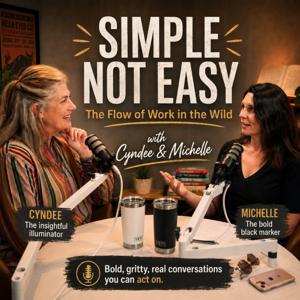
Cyndee, the insightful illuminator, helps listeners see what is really going on with compassion and accountability. Michelle, the bold black marker, calls it like it is and challenges listeners to own their role in the outcome.
Together, they create a conversation that is practical, honest, and rooted in real experience.
So grab your coffee. Get intentional. Listen for the idea, the tool, the question, or the push that meets you where you are.
Then try something.
Because in a world obsessed with artificial intelligence, we are doubling down on human intelligence. Your human intelligence that may be the very thing that changes the room.