
Sign up to save your podcasts
Or



They hired her to be visible. Then they told her to stop posting.
Carrie Corcoran has spent more than a decade helping organizations build talent brands people believe. In her first week in a new nonprofit role, she shared a free job search webinar on LinkedIn for the people she served. She got called into the office. Then it happened again. And again. The leash kept getting shorter on the one person whose job was to be seen.
Jackye Clayton and Carrie talk about what psychological safety looks like, why handcuffing people's voices backfires, an application that asked for her age range and nationality, and the LIGHT framework Carrie built after surviving a brain aneurysm: love, ignite, give, heal, transform. Plus Bennie, her retired French bulldog, who only eats breakfast if she lays a trail of kibble to the bowl.
Jackye closes with the season her own leash got shorter, the dog she lost, and the foster in a cast who showed up where the empty spot was.
If you hire someone for their gift and punish them for using it, you didn't find a problem employee. You built a problem environment.
A tighter leash on the wrong dog doesn't create control. It creates an exit.
Your own energy is part of the behavior you're trying to fix.
Your homework: with your dog, pick the one thing they keep refusing and make the path smaller. With your team, find the person you hired for a gift and loosen one notch this week.
00:00 - Cold open: called into the office for a LinkedIn post
01:05 - Jackye: why I stopped the tape
01:21 - Meet Carrie, Cosmo and Bennie
04:32 - Hired to be visible
09:17 - Three paw slaps
11:40 - Then I looked at the leash
14:37 - The kibble trail
15:47 - What psychological safety really means
17:45 - Pain into gold: the LIGHT framework
19:34 - Not optional: candidate experience
21:35 - My energy was right on top of hers
22:26 - Carrie's last word
22:58 - The leash was the problem
26:05 - Dakota, and the foster in the cast
27:07 - Your homework
28:53 - Three things to keep
Find Carrie at unbreakablelight.com and on LinkedIn.
Dog training in Waco: keepwacowagging.com/training. Hiring help: TA Lab, jackyeclayton.com/talentlab.
Music: "All Day Long" by Eva Hummingbird and "Unfinished Stories" by Lennon Hutton, via Epidemic Sound. Intro and outro: the Sit. Stay. Hire. theme.
The performance review was accurate. It just wasn’t written for the person reading it. Jackye Clayton talks with Katee Van Horn, global HR executive, founder of VH Included Consulting and her Inclusive AF co-host, about Penelope, the pit mix who guards her yard and falls apart past the end of the street, and Ceirin, the 109-pound lab who needs a job or he’ll invent one. They get into why behavior is information but not the full explanation, why slowing down isn’t lowering the bar, the manager who used AI to write a hard conversation, how to coach a leader who wants someone gone today, and why you can’t be honest about AI and jobs if you never built trust before you needed it. And Jackye on the season she was showing up without being in it, and the foster dog who noticed.
You can’t build trust on the day you need it.
00:00 - Cold open: the content was right
This week’s Trainer’s Take. With your dog: find your dog’s threshold. Notice the exact spot on a walk where your dog stops taking treats, back up to where they can eat, and train there. With your team: when someone’s work slips, don’t name it. Describe it, ask what’s going on, and slow the reps down.
Find Katee on LinkedIn (linkedin.com/in/katee-van-horn) and on the Inclusive AF podcast. Dog training in Waco: keepwacowagging.com/training. Hiring help: TA Lab by Jackye Clayton, jackyeclayton.com/talentlab.
They said they could swim in the interview. Nobody asked if they could swim in this pool. Jackye Clayton talks with Dr. Akilah Bradford, HR executive consultant and founder of The HR DOC Consulting, about Temper, the family Rottweiler raised by a whole household, and Scruffy, the poodle mix who would do anything for chicken. They get into why the same command does not work on every dog or every employee, why what motivates someone changes over time, the "difficult" new hire who never got onboarding, and the manager who wants a rule enforced on everyone except their favorite. The pack shapes the behavior. Before you label someone the problem, look at the system that made them.
People who seem checked out are often people nobody trained.
What motivates someone changes over time, so the reward has to change too.
A new hire learns the job from the team around them, good habits and bad.
You cannot hold someone accountable for an expectation nobody set.
Rules that apply to everyone except the favorite break trust across the team.
Before calling someone difficult, look at their onboarding, their manager and their team.
00:00 - Cold open: did you teach them to swim?
00:48 - Temper and Scruffy
04:27 - What motivates changes over time
06:13 - Thrown in the pool
10:29 - The pack shapes behavior
14:59 - Your favorite employee
17:39 - Difficult employees
19:59 - The heel
24:28 - Before you label someone
27:01 - Close and next time
Find Dr. Akilah at hr-doc.com, on LinkedIn, and on Instagram @HR_DOC.
Dog training in Waco: keepwacowagging.com. Hiring help: jackyeclayton.com/talentlab
Most management advice is about control. Jackye Clayton talks with John Sumser, principal analyst at HR Examiner, about Carlos, his labradoodle, and why the only thing a leader can actually change is themselves. They talk about respect before obedience, why correction and public humiliation push people away, what it means to remove the obstacles in someone's way instead of managing them like property, and why people, like dogs, come back to the leaders they want to come back to.
Respect has to come before obedience, with dogs and with people.
The only behavior a manager can fully control is their own.
Correction without respect teaches people to avoid you, not to improve.
Public humiliation damages trust across the whole team, not just with one person.
Good managers remove obstacles instead of adding rules.
Treating people like property leads to compliance, not commitment.
People come back to leaders who make them want to come back.
Leaving people alone to do their work is often the most useful thing a manager can do.
00:00 - Cold open: the only thing I can change
00:35 - Meet Carlos
04:38 - Respect before obedience
07:25 - The pronoun story
12:36 - Why public humiliation backfires
16:15 - When to leave people alone
19:57 - Who is in your pack today
21:23 - Why people and dogs come back
22:32 - The dog in my lap
management style, respect at work, control vs trust, leadership lessons from dogs, employee engagement, public criticism at work, manager behavior, HR leadership, retention, positive reinforcement
When a dog reacts, people ask whether it is a rescue. When a person reacts at work, they usually get written up. Jackye Clayton talks with Katrina Collier, author of The Damage of Words, about Lance, the dog who taught her she was worthy of love, and what that taught her about defensive, prickly behavior at work. They talk about learning to receive kindness, how old wounds show up in meetings, why documenting beats defending when someone turns a team against you, and why trust takes much longer than a two-week onboarding.
People who seem difficult at work are often protecting themselves from something that happened before.
Giving people the same patience we give a rescue dog changes how they respond.
Learning to accept kindness is a skill, and some people have to learn it as adults.
When someone turns a team against you, write down facts instead of defending yourself in the moment.
Rewards and recognition only work when they match what the person values.
Yelling and pressure stop learning, for dogs and for people.
Trust is built over months, not during a two-week onboarding.
Hiding at work is often a sign that someone does not feel safe yet.
00:00 - Cold open: is that a rescue?
00:27 - The soul dog
04:22 - Learning to receive love
10:12 - Bringing wounds and scars to work
13:04 - Document, do not defend
16:12 - Finding the reward that works
17:34 - What a shaking dog taught about yelling
18:33 - Hiding in plain sight
trauma informed leadership, difficult employees, psychological safety, workplace conflict, rescue dog lessons, employee trust, toxic coworkers, documentation at work, recognition and rewards, leadership and empathy
A dog that lunges on a leash is not always aggressive. Sometimes it just wants to play and has no other way to say it. Jackye Clayton, a talent acquisition leader and certified dog trainer, talks with Steven Rothberg, founder of College Recruiter, about what happens when managers judge behavior without looking at the leash, the environment and the history behind it. They cover why a star performer can fail in a new role, why the same person can thrive in one team and struggle in another, and how leaders can tell the difference between a bad hire and a bad fit. Jackye also shares the leash in her own story: an unexpected surgery, losing her job, and having to figure out what she does for a living.
Behavior that looks hostile is often a signal that a need is not being met.
A person who succeeds in one environment can struggle in another without anything changing about who they are.
Managers should look at the environment and the incentives before deciding someone is the problem.
Restrictions people did not choose often create the behavior leaders complain about.
Fit is not permanent. It changes as people, roles and companies change.
Good hiring asks what a person needs to succeed, not only what they have done before.
Different people, like different dogs, need different kinds of leadership.
Labeling someone a bad hire too early can cost a team a strong contributor.
00:00 - Cold open: when play looks like hostility
01:08 - The dog on the leash
03:24 - What a first dog teaches about patience
08:29 - When the rules at home do not match the rules at work
10:53 - Why star performers sometimes fail in new roles
13:22 - Choosing your own constraints at work
20:29 - Jackye's story: surgery, job loss and starting over
24:25 - What to do when the fit changes
26:54 - Leading different people differently
30:15 - What to take back to your team
hiring fit, reactive dog behavior, employee performance, management and leadership, bad hire vs bad fit, talent acquisition, workplace behavior, career change, manager coaching, dog training lessons for leaders
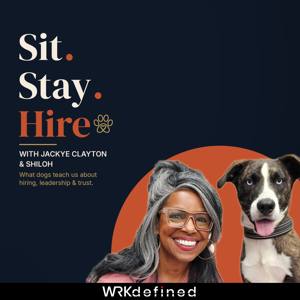
She set out to write a leadership book about what dogs could teach us. Then life changed the story. Recovering from surgery and facing the possibility of never walking without help, host Jackye Clayton brought home Shiloh, an injured foster dog facing his own uncertain future. As they learned to walk again, she began questioning what she thought she knew about leadership, belonging, and herself.
Sit Stay Hire brings together personal storytelling and conversations with people whose careers revolve around who gets hired, who advances, and who gets left behind. What emerges challenges how we lead—and what we’re willing to change about ourselves. Ten episodes. Lots of dogs. Starting November 3. Listen to the trailer and follow "Sit. Stay. Hire." so you don’t miss the first episode.