
Sign up to save your podcasts
Or

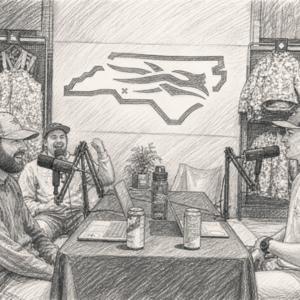


North Carolina has a wild pig problem. In Episode 24, we sit down with NC Wildlife Resources Commission District 6 Wildlife Conservation Biologist Greg Queen and NC State graduate student William Mayfield to talk about wild pigs in North Carolina, feral hog hunting, pig behavior, wildlife impacts, current research and how hunters can actually find and hunt them.William is currently studying feral pigs using GPS tracking collars and trail cameras to better understand their movement and estimate population density. As he explains in the episode, one of the challenges is that nobody really knows exactly how many wild pigs are currently living across North Carolina.We get into just how widespread pigs have become, why they're so difficult to control, how they affect deer and turkey habitat, and why recreational hunting alone may not be enough to significantly reduce pig populations.Then Greg walks us through how he actually hunts wild pigs—including how to find public-land opportunities, what pig sign looks like, wallows, rooting, tracks, scouting techniques, wind direction, still-hunting tactics, shot placement and broadhead selection.Greg also explains that NCWRC personnel familiar with local game lands may be able to point hunters toward general areas with known pig populations—though, as he jokes, they're probably not going to tell you which tree the pigs are standing under.One of the biggest questions we tackle is simple:Can hunters actually control the wild pig population?Near the end of the conversation, William explains that roughly 70% of a population would need to be removed just to keep that population stable, while also pointing out the obvious problem: managers don't necessarily know the total population they're taking 70% of. The discussion ultimately turns to whole-sounder removal as a management strategy.Whether you're searching for wild pigs in North Carolina, NC hog hunting, public land hog hunting, feral pigs, wild boar hunting, NC game lands with pigs, how to hunt wild hogs, pig hunting tactics, or North Carolina wildlife management, this episode covers the problem from both the research and hunting perspectives.North Carolina has a pig problem.Now the question is what hunters and wildlife managers can actually do about it.Discount Codes: In Store Purchases - Podcast15Speed Broadheads - SSEP10Upcoiming Events:Waterfowl Expo - 10/10Veteran's Day Workout Event - 11/14
North Carolina is getting an elk hunt in 2027. In this episode, we break down the North Carolina elk hunt, NC elk tags, the NC elk population, how the 2027 elk permit process will work, and the future of elk hunting in North Carolina with NC Wildlife Resources Commission biologist Justin McVey and Eric Stroup of the Rocky Mountain Elk Foundation.North Carolina spent decades restoring its elk herd. Now, for the first time in generations, hunters are preparing for an opportunity to hunt elk in NC.But why are wildlife managers ready to hunt a population they've spent roughly 25 years rebuilding?We sit down with Justin McVey of the North Carolina Wildlife Resources Commission (NCWRC) and Eric Stroup of the Rocky Mountain Elk Foundation (RMEF) to tell the story of North Carolina's elk herd—from restoration and population research to the limited 2027 North Carolina elk hunt.If you've been searching for information about the 2027 North Carolina elk hunt, how to apply for an NC elk tag, North Carolina elk population numbers, NC elk hunting regulations, Cataloochee elk, NCWRC elk management, or RMEF's work in North Carolina, this episode dives deep into how we got here and what could happen next.North Carolina lost its elk.Then we brought them back.Now we're finally going to hunt them.The bigger question is: what happens next?🎙️ SITKA Southeast Podcast — Episode 23Guests:Justin McVey — North Carolina Wildlife Resources CommissionEric Stroup — Rocky Mountain Elk Foundation, Charlotte Regional Chair
Where did all the ducks go?It's a question waterfowl hunters across the Southeast seem to ask every season.In Episode 22, Jay and I sit down with Chuck McDonald, Chairman of the Lee County Ducks Unlimited Chapter, to talk about what is actually happening with waterfowl habitat, duck migration, conservation, and the future of duck hunting.Chuck breaks down how Ducks Unlimited works, why conserving habitat hundreds or even thousands of miles away can still directly benefit a North Carolina duck hunter, and why DU money isn't always supposed to stay in the county where it was raised. As Chuck puts it: ducks don't stay in one county either.We also get into one of the most controversial parts of modern waterfowl hunting: game-farm mallards. Chuck discusses large-scale releases of farm-raised mallards, their potential impact on wild birds and migration, and research using “Duck DNA” to distinguish wild mallards from game-farm lineage.Then the conversation gets even bigger.Are ducks actually migrating as far south as they used to?Is warmer weather keeping birds farther north?Has habitat loss changed where ducks stop?Has duck hunting become a rich man's game?Does hunting pressure meaningfully change overall duck populations?And when hunters complain that conservation organizations raise millions of dollars but they still aren't seeing more birds…how much responsibility belongs to the hunters themselves?Chuck also shares the story of growing the Lee County chapter from just two people to 44, largely through community involvement and school outreach.If you hunt ducks, care about wetland habitat, or simply want to understand why waterfowl hunting looks different today than it did 20 or 30 years ago, this episode is for you.Discount Codes:Sitka Charlotte - Podcast15Speed Broadheads - SSEP10Upcoming Store Events:Saturday 9/26 - Save Tuckertown EventSaturday 10/10 - Waterfowl Expo
Most hunters spend a lot of time thinking about what's on their bow, in their pack, or layered on their body—but how much do we actually understand about what's on our feet?In Episode 21, Jake sits down with Mike Ekstrom, Senior Product Line Manager for SITKA Gear's footwear division, to break down how hunting footwear actually works—and some of the things hunters may be getting completely wrong.We dive into hunting boot insulation, waterproofing, fit and sizing, GORE-TEX, trail runners, cold feet, blisters, product testing, and how SITKA develops footwear for hunters and anglers.Mike explains why 1600 grams of insulation doesn't automatically mean a warmer boot, why compression matters, and why moisture inside your boot can make you colder even when the boot itself isn't leaking. He also explains how SITKA and Gore use lab testing to measure thermal performance and why some of that testing goes beyond what Mike experienced earlier in his footwear career at Nike.We also get into one statistic that surprised me: during 3D foot scans with athletes, Mike says 80% of people believed they wore a different size than they actually did—and incorrect sizing can contribute to everything from heel blisters to poor boot performance.Mike takes us behind the scenes of SITKA footwear development, including its relationship with Gore, products that “fail catastrophically” during testing, why mountain boots eventually leak, and why SITKA deliberately gives prototypes to people who will beat the crap out of them instead of simply telling the company what it wants to hear.We even get into why trail runners feel so good but can have limitations once hunters leave the trail and start sidehilling, climbing over blowdowns and moving through brush.If you've ever dealt with cold feet, wet feet, blisters, leaking hunting boots, confusing insulation ratings, or wondered whether you actually bought the right boot, this episode is for you.Discount Codes:Sitka Charlotte Store - Podcast15Speed Broadheads - SSEP10 Upcoming Events:9/26 - Save Tuckertown Event10/10 - Waterfowl Expo
Everybody knows the Ranch Fairy for heavy arrows and fixed-blade broadheads—but that's not really what this conversation is about.In Episode 20, Jake sits down with Troy Fowler, aka the Ranch Fairy, to break down what actually makes a hunting arrow perform.And according to Troy, simply adding weight isn't the answer.We dive into arrow flight, bare-shaft tuning, arrow spine, FOC, fletching, mechanical vs. fixed-blade broadheads, broadhead sharpness, penetration, shot angles, and building a hunting-arrow system that gives you the greatest possible margin for error.Troy also tells the story of why he started experimenting in the first place. At one point, despite hunting mature pigs from controlled distances, he says he was only recovering around half of the animals he shot. That failure sent him down the rabbit hole of arrow construction, penetration, and eventually Dr. Ed Ashby's research.We even get into the ridiculous 1,035-grain arrow Troy once hunted pigs with—and why he eventually moved away from that extreme.But the biggest lesson from this episode is surprisingly simple:Before you argue about arrow weight, broadhead design, or FOC, make sure the arrow is actually flying straight.Because, as Troy puts it:“Sideways doesn't work.”If you're a bowhunter who has ever wondered whether your arrows are actually tuned, how much arrow weight you need, whether FOC really matters, or why your broadheads don't behave like your field points, this episode is for you.
Discount Codes:Sitka Charlotte In Store Purchases - Podcast15Speed Broadheads - SSEP10Upcoming Store Events:- Save Tucker Town - 9/26- Watefowl Expo - 10/10
What can an Olympic archery coach teach a bowhunter?Quite a bit.In Episode 19, Landon and I sit down with Chris Webster, who served as head coach leading into the 2024 Paris Olympics and now works with elite-level U.S. archers.We talk about what separates good shooters from great shooters, why archers constantly try to solve execution problems with new equipment, how elite athletes train for pressure, and why the best-looking shot isn't always the most effective shot.Chris breaks down target panic, shot process, torque, form, draw weight, mental performance, repeatability, and what happens when tiny mistakes at the bow get magnified downrange.We also dive into Chris's path through the U.S. Army's World Class Athlete Program, the sacrifices involved in chasing an Olympic dream, and what coaching athletes at the highest level actually looks like.And eventually, Chris gives Landon and me a challenge:70 meters. Approximately 77 yards. Olympic target face. Match play.That should go well.Probably.If you're a bowhunter who has ever blamed your bow, fought target panic, struggled under pressure, chased more draw weight, or wondered whether your form is “correct,” this episode is for you.Discount Codes:In Store Purchase at Sitka Gear Charlotte - Podcast15Speed Broadheads - SSEP10
How much of what bowhunters believe today was built around equipment from 20 or 30 years ago?In Episode 18, Jake is joined by Dale Perry, owner of Evolution Outdoors, and Jeff Corderro, owner of Barefoot Archery, for a deep dive into broadheads, arrow setup, bow technology, tuning, and some of the biggest debates in modern archery.We talk about why mechanical broadheads developed a bad reputation, how today's bows and broadheads have changed the equation, what the recent arrow-ballistics data actually tells hunters, and why shooters can sometimes use the exact same study to confirm completely opposite opinions.Dale also explains the philosophy behind Evolution Outdoors, why he tells people not to blindly trust product owners, how a hunting problem led him into broadhead design, and why some conventional assumptions about broadhead sharpness, penetration, and deployment may deserve another look.Jeff brings the bow-shop perspective—what he sees from new shooters, what actually matters when setting up equipment, why modern bows have become easier to tune, and what archery shops need to do to stay relevant as customers become increasingly educated online.We cover:Mechanical vs. fixed broadheads, arrow weight, FOC, broadhead flight, penetration, draw weight, paper tuning, bare-shaft tuning, bow efficiency, hunting ethics, shot recovery, the future of archery shops, and why the best answer is often somewhere in the middle.If you're the type of bowhunter who likes to understand why your equipment works instead of simply being told what to shoot, this episode is for you.
In Episode 17, we're joined by Brian Souza, founder and owner of Bizz Baits, to hear the story behind one of North Carolina's homegrown fishing brands.Bizz Baits didn't begin with investors, a factory, or some master business plan.It started as a college marketing assignment.From making baits in apartments and garages to working other jobs just to keep the dream alive, Brian walks us through the years of sacrifice behind building Bizz Baits—and the moments when he genuinely wondered whether he'd wasted his 20s chasing something that might never work.We also dive deep into the fishing side of the business: how new baits are designed, what makes a product stand out in a crowded market, how forward-facing sonar has changed lure development, the economics behind a $5 fishing lure, bait color, salt and scent, manufacturing, and what Bizz Baits is building next.But the biggest lesson from this episode might not be about fishing at all.It's about what happens when the thing you started becomes bigger than you.
Discount Codes:Sitka Charlotte Store 15% off - Podcast15Speed Broadheads 10% off - SSEP10
Speed Broadheads entered an industry dominated by the same fixed-blade-versus-mechanical debate—but their founders believe bowhunters are asking the wrong questions.In Episode 16 of the Sitka Southeast Podcast, we sit down with the team behind Speed Broadheads to break down the engineering, testing, and hunting philosophy behind their unique broadhead design.We discuss why some mechanical broadheads can lose significant energy during blade deployment, how broadheads may deflect on quartering shots, why fixed blades can become difficult to tune, and why perfect penetration means nothing if the broadhead does not hit where you are aiming.The Speed team also explains how they use high-speed cameras, shooting machines, ballistic gel, plywood, angled-impact testing, low-poundage bows, and crossbows to evaluate broadhead performance.We also cover:Fixed blades versus mechanical broadheads.Why deployment force matters.The difference between a bullet-hole entrance and immediate blade deployment.How wound shape affects blood trails.Broadhead flight and tuning.Heavy arrows versus lighter arrow setups.Why there is no single perfect arrow build.How practice broadheads can produce misleading results.Ethical shot placement and shoulder impacts.The future of Speed Broadheads.Whether you shoot a fixed blade, mechanical broadhead, heavy arrow, or lighter high-speed setup, this conversation will make you reconsider what really matters when choosing your hunting equipment.As always, mention the podcast in the store and recieve 15% off your purchase at check out!! Also, use code SSEP10 at checkout to get 10% off your Speed Broadheead purchase!
In Episode 15, we're joined by Steven Lucius and Chuck McDonald of Wildrose Carolinas, one of the premier retriever training programs in the country. Whether you're raising your first hunting puppy or have hunted over dogs for years, this episode is packed with practical advice that can help you build a calmer, more confident, and more capable hunting companion.We dive into the Wildrose philosophy of developing the "Gentleman's Gundog"—a retriever that excels in the field while remaining a trusted family companion at home. Steven and Chuck explain why they intentionally challenge many traditional retriever training methods, what they look for when evaluating young puppies, and the common mistakes that create long-term problems for hunting dogs.We also break down the progression from an 8-week-old puppy to a finished hunting dog, discussing obedience, steadiness, marking, water work, upland and waterfowl introductions, and how one dog can confidently hunt ducks, geese, doves, quail, and more. Finally, we cover summer training strategies, keeping your dog safe in the heat, and how to continue making progress during the off-season.Whether you own a Labrador, are thinking about getting your first hunting dog, or simply want to become a better handler, this conversation is full of timeless advice that every hunter can benefit from.In this episode:The Wildrose philosophy and the "Gentleman's Gundog"What separates Wildrose from traditional retriever programsHow to choose the right hunting puppyThe biggest mistakes owners make during the first 90 daysWhy temperament often matters more than driveBuilding confidence and trainabilityThe complete progression from puppy to hunting companionHow one dog can excel at ducks, geese, doves, quail, and upland huntingSummer training and heat safety tips for gun dogsAs always, mention the podcast in the store and recieve 15% off your purchase at check out!!
From the publisher's feed