
Sign up to save your podcasts
Or

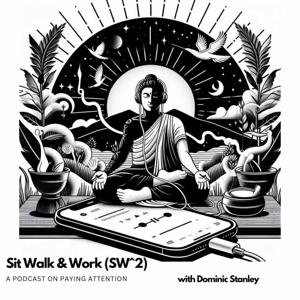


The Beauty of Silence is a guided meditation devoted to one simple practice: paying attention.
This episode opens with a brief orientation and then moves into extended silence, allowing space for direct experience without instruction, analysis, or effort. There’s nothing to fix and nothing to achieve. Just an invitation to notice what’s already here.
Ideal for moments of stress, transition, or when life feels loud, this practice trains the same awareness we bring into traffic, work, relationships, and rest.
Settle in, listen deeply, and let silence do the teaching.
Follow me on all the socials
* Substack
* Website
* YouTube
As we step into 2026, I pause to reflect on the Sit, Walk, Work episodes from 2025 that listeners returned to most—meditations that offered grounding, equanimity, and practical ways to work with attention both on and off the cushion.
Top 5 Most Downloaded Sit, Walk, Work Episodes of 2025
1. Guided Meditation on Equilibrium and Heart Awareness
A meditation on integrating head and heart through breath awareness, conscious sighing, and heart-centered attention to cultivate clarity and self-compassion.
2. Finding Your Middle Way
A practice focused on balance, kindness, and sustainability—inviting listeners to begin again without extremes, especially at the start of a new year.
3. Start Here: Your First Meditation
A beginner-friendly meditation that reframes distraction as part of the practice, using the Three A’s: Arrive, Attend, and Allow.
4. One Step to Equanimity
An exploration of how breath, body, and thought interact, including practical ways to recognize thinking patterns and consciously choose where attention rests.
5. Take 10: A Breath and Body Awareness Meditation
A short Vipassana-inspired body scan designed for busy days, reminding us that even ten minutes of presence can be grounding and transformative.
Across all five episodes, the invitation remains the same: pay attention with kindness. Meditation isn’t about fixing yourself—it’s about learning how to stay with your experience as it is.
If 2025 taught us anything, it’s this: meditation isn’t about becoming someone else. It’s about learning how to be with who you already are.
Thank you for practicing with me and for giving your attention to this work. I look forward to continuing the journey together in the year ahead.
May you be well.
May you be safe.
May you keep returning.
Follow me on all the socials
* Substack
* Website
* YouTube
How often do we judge our meditation—or our lives—against an invisible standard we never chose?
In this guided meditation, Dominic Stanley explores the habit of comparison and how it pulls us out of the present moment. Inspired by a story from Tara Brach’s Radical Acceptance, this practice invites you to ask a simple question: As compared to what?
Through breath awareness, a full-body scan, and a gentle breath-moving visualization, you’ll practice letting go of internal measuring and meeting your experience with more curiosity and compassion.
Best enjoyed seated or lying down.
⏱️ Episode Breakdown
00:00 – Welcome & Orientation Setting the tone for a practice of paying attention.
01:16 – Theme Introduction: Comparison Exploring how comparison shows up in meditation and daily life.
04:16 – Story: The Biscuit Standard A Zen teaching on unconscious comparison and unrealistic standards.
07:21 – Anchoring in the Breath Noticing inhale and exhale without trying to change them.
11:12 – Body Scan: Sensation & Space Scanning from head to toe while noticing both sensation and inner spaciousness.
19:02 – Grounding Through the Lower Body Connecting with the legs, feet, and the body’s support.
26:25 – Breath Moving Through the Body: Imagining the breath traveling up the front and down the back of the body.
30:22 – Gratitude & Closing Reflection: Acknowledging the act of showing up and practicing.
🌱 Key Themes
* Comparison vs. presence
* Letting go of internal measuring
* Breath as an anchor
* Sensation, space, and awareness
* Meeting the body as it is
* Compassionate attention
📚 Mentioned
Radical Acceptance by Tara Brach
💬 Let’s Reflect Together
* Where do you notice comparison showing up most in your daily life?
* What changes when you ask, as compared to what?
* What would it be like to acknowledge effort instead of outcomes?
Share your reflections in the comments—I’d love to hear how impermance is alive in your practice.
Follow me on all the socials
* Substack
* Website
* YouTube
Lately, I’ve been noticing how narrow my attention can become.
When I’m stressed, overwhelmed, or rushing from one obligation to the next, my awareness collapses around whatever feels most urgent. A thought. A problem. A sensation. A feeling that says, fix this now.
Today’s meditation grew out of a practice I’ve been returning to again and again: open focus.
Open focus is a way of paying attention that doesn’t lock onto a single object. Instead of gripping the breath or wrestling with a thought, we let attention widen. We allow the body, the breath, the thoughts, and the environment to all exist at once—moving, changing, coming, and going.
I notice how helpful this is in everyday life.
In traffic, for example, when someone cuts me off and irritation spikes. The mind zooms in: They shouldn’t have done that. But when attention widens, there’s suddenly more room. I feel my hands on the steering wheel. I hear the hum of the road. The breath is still moving. The irritation hasn’t disappeared—but it’s no longer the whole story.
That’s what this practice invites.
We begin by settling the body into a posture that feels alert and at ease. Not collapsed. Not rigid. Just supported enough to stay present. You can feel this immediately in the breath—whether it can move freely or feels restricted.
As attention turns inward, the moment starts to reveal itself more subtly. Sounds arrive and fade. Sensations pulse and dissolve. The breath expands and contracts the body from the inside out. None of this requires effort. It’s already happening.
In open focus, we aren’t trying to improve the experience. We’re learning how to witness it.
We explore the space around the body—the air touching the skin, the distance between us and the room. Then the space within the body: the breath moving through the nostrils, throat, chest, and belly. Even the pauses between inhales and exhales become noticeable. These spaces are easy to miss in the busyness of daily life, yet they’re always there.
This becomes especially powerful when thoughts arise.
Instead of getting pulled into the content of thinking—planning, replaying, judging—we start to notice the space between thoughts. Maybe just a brief gap. Maybe a soft pause after a thought passes. And in that space, there’s often relief.
I see this show up in relationships all the time. When a difficult conversation triggers a familiar story, the urge is to react immediately. But if there’s even a little space—one breath, one pause—the reaction doesn’t have to run the show. There’s choice again.
As the practice continues, awareness widens further. The whole body becomes sensation. Tension isn’t isolated or fought—it’s held in context, surrounded by space. Even emotions like anxiety, sadness, or restlessness are allowed to rise and fall like waves, held by something larger than themselves.
This is one of the quiet lessons of the practice:
There is room.
Room for discomfort.
Room for change.
Room to start again.
Toward the end, we gently narrow attention back to the breath—not as a restriction, but as an anchor. And when the mind wanders (because it will), we practice returning with patience rather than judgment.
We finish by acknowledging the simple fact of showing up.
Gratitude for the breath.
For the body as it is.
For a moment that may not be perfect—but is okay.
Open focus isn’t something we do once and master. It’s a way of remembering, again and again, that life is larger than whatever feels most pressing right now.
And sometimes, that remembering is enough.
Follow me on all the socials
* Substack
* Website
* YouTube
This practice began the way so many moments in life do: with the eyes open.
I’ve been paying closer attention to vision lately—not just what I’m looking at, but how I’m looking. Our vision shapes how we take in information, which shapes how we think, which shapes how we react. When my attention feels scattered or overwhelmed, it’s often because my field of awareness has collapsed down to a single problem, a single thought, a single irritation.
So we began this meditation by resting the eyes on one simple point in front of us. A wall. A picture. A patch of light. And then, without losing that focal point, we gently widened the view—allowing peripheral vision to come online.
This is the same skill we need in traffic when someone cuts us off. We can stay focused on the road and aware of the wider field. We don’t have to collapse into the moment or harden around it.
When the eyes closed, we carried that same principle inward.
The breath became our anchor. In and out. Rhythm. Pace. And then—space. Not just the movement of breathing, but the room the breath moves through. The space in the nose, the throat, behind the eyes, and the crown of the head. Breathing becomes less of a task and more of a relationship with the body.
At work, when deadlines stack up or emails keep arriving, this practice shows us another option: you can stay engaged without being clenched. You can focus without losing your sense of space.
As we stayed with the breath, thoughts naturally appeared. Planning thoughts. Old memories. Emotional reactions. Instead of trying to push them away, we practiced meeting them the same way we met the breath—with patience, curiosity, and compassion.
This is especially useful in relationships. When a familiar argument starts looping in your head, you don’t have to solve it right away. You can notice it. Feel how it shows up in the body. And remember: thoughts arise, change, and pass.
This is where impermanence reveals itself.
Every breath dissolves and recreates the moment. Every sensation shifts. Even tension, when met with space and attention, begins to change. In parenting, in caregiving, in moments of physical discomfort—this truth can soften our resistance. Nothing is frozen. Nothing stays the same.
As the practice widened, attention opened to the body as a whole. Sensations blurred at the edges. The body breathed itself. The system took care of itself.
Meditation isn’t about clearing anything out. It’s about becoming a better steward of what’s already here.
We closed by welcoming gratitude—not as something to manufacture, but as something to notice. Gratitude for breathing. For showing up. For the quiet effort it takes to care for yourself.
Eyes open or eyes closed, it turns out we’re always practicing. The same rules apply. And that’s the beauty of it.
💬 Let’s Reflect Together
* Where in your life do you notice your attention becoming narrow or rigid?
* What changes when you allow space around uncomfortable sensations?
* How do your thoughts behave when you meet them with curiosity instead of control?
* Where could impermanence offer relief rather than uncertainty?
* What does it feel like to care for yourself without trying to fix anything?
Share your reflections in the comments—I’d love to hear how impermance is alive in your practice.
Follow me on all the socials
* Substack
* Website
* YouTube
When I guide this practice, I’m always struck by how quickly the mind can spiral — and how quickly the breath can interrupt that spiral. Most of us don’t need more advice or more willpower. We need a small wedge of space inside the moment where everything feels tight, urgent, or overwhelming.
Today’s meditation is that wedge.
In this episode, I lead you through a breath sequence called 20 Connected Breaths. It’s simple: inhale, exhale, inhale, exhale — four times — followed by one big inhale and a soft release. That’s one round. We repeat the cycle so you can feel layers of tension dissolve without forcing anything.
But the real practice isn’t just breathing.
It’s learning to interrupt your body’s momentum.
Because spirals don’t just happen in the mind — they happen in the chest, the jaw, the shoulders, the nervous system. And when you learn to regulate the breath, you regulate the spiral.
I see this every day, not just on the cushion:
* Traffic: That flash of irritation when someone doesn’t move at a green light. One connected breath creates room for patience instead of frustration.
* Work stress: Before the email sends you spinning, the breath grounds you enough to answer instead of react.
* Parenting: When your kid refuses to put on their shoes, breath becomes the difference between snapping and staying steady.
* Relationships: When someone says something sharp, breath turns defensiveness into curiosity.
* Body discomfort: When tension rises, connected breathing keeps you from bracing, gripping, or shutting down.
Through each round of the practice, you’ll hear me invite you to soften the effort. That’s intentional. Spirals thrive on force — on trying harder, pushing more, doing something. This breathwork teaches the opposite: presence over performance.
Some rounds will feel smooth.
Some will feel clunky.
Some will energize you.
Some may challenge you.
All of that is part of the practice.
As the meditation closes, we return to simple nasal breathing and relaxed shoulders — the embodied reminder that you can come back to yourself at any moment. You can interrupt the spiral. You can choose your next move.
Thank you for practicing with me.
May these breaths find you in the moments you need them most. Repeat as needed.
May you be well.
💬 Let’s Reflect Together
* What situations most often trigger your spirals — and what do you feel in your body first?
* Which round of the breathing practice felt the easiest or the hardest for you?
* Where could you use more emotional space in your everyday life?
* Think of a recent moment when you reacted quickly — how might one slow breath have changed the outcome?
* How does your body tell you it’s time to pause?
* What part of the spiral do you want to interrupt this week?
Share your reflections in the comments—I’d love to hear how impermance is alive in your practice.
Follow me on all the socials
* Substack
* Website
* YouTube
Lately, I’ve been thinking a lot about how noisy the inner world can get. There’s so much happening out there—globally, collectively, personally—that by the time we sit down, the mind is already in motion. Buzzing. Planning. Replaying. Solving. Trying to help, even if it sometimes feels like too much help.
In this week’s guided practice, I wanted to focus on something simple and powerful: the quality of our thinking mind and how breath becomes the anchor that steadies the whole system. When life gets fast, we forget that our breath is right there—always available, always adjusting, always influencing our nervous system.
So I opened the practice by inviting listeners to watch the breath, not just observe it passively. We worked with coherent breathing—matching the inhale and the exhale—which is one of the quickest ways to remind the body that it’s safe. I see this all the time in real life:
* When I’m stuck in traffic, trying not to escalate with the guy who cuts me off,
* When a tense conversation with a partner brings heat into the chest,
* When a work deadline starts tightening my shoulders,
* or even when parenting demands stack up, and the breath feels shallow and rushed.
Coherent breathing is a reset button. Not for the world, but for your body’s ability to meet the world.
Then we turned toward the thoughts themselves. Not to stop them or fix them, but to notice their tone. Were they helpful? Judgmental? Anxious? Hopeful? Time traveling to the past or sprinting to the future?
I think about this often when my mind leaps ahead to all the things I still need to do, or replays something I should’ve handled differently. Meditation reminds me that both are just mental places—useful sometimes, unhelpful other times, and definitely not the moment happening right now.
We moved from thoughts into the body, noticing how thinking lands physically—tightness, temperature, pressure. Because thoughts aren’t just ideas; they’re sensations that ripple through space. The moment you feel your chest soften or your jaw unclench, you realize the body has been carrying the story the mind was telling.
And then, maybe my favorite part of this practice: spaciousness.
Not the dramatic, cosmic kind. Just the simple space that’s always already here—between inhale and exhale, between thoughts, between sensations. The space that reminds you you’re allowed to step back from whatever feels overwhelming.
It’s like when stress builds up at work, or a relationship feels tight; the moment you widen your perspective even a little, the pressure changes. You remember what’s possible.
We closed the session by gently transitioning back into the world—because meditation isn’t an escape. It’s training. It’s practice for re-entering your life with a little more clarity, a little more grounding, and a lot more compassion for yourself.
If anything stood out for you during the session, I encourage you to explore it. Sometimes the smallest moment becomes the most important insight.
Until next time—may you be well, may your breath be steady, and may your mind feel just a little more spacious.
Let’s Reflect Together
* What kind of thoughts showed up most often during the practice—supportive, anxious, critical, hopeful?
* Where did you notice spaciousness in your experience: the breath, the silence, the body, or somewhere unexpected?
* How do you usually respond when you get distracted—can you practice “starting over” with compassion?
Share your reflections in the comments—I’d love to hear how impermance is alive in your practice.
Follow me on all the socials
* Substack
* Website
* YouTube
There are days when my mind feels like it’s sprinting while my body is still back at the starting line. On those days, I return to this simple practice — moving attention slowly through the body, sensation by sensation, breath by breath. Not to fix anything. Not to force calm. But simply to notice what’s here.
When I guide this practice, I always begin with the reminder that there’s no ideal state waiting for us. We’re not doing meditation “right” or doing it “wrong.” We’re just meeting the moment as it unfolds — breath to breath, sensation to sensation, sometimes softer, sometimes louder.
So today, I invite you to feel the weight of your own body. Right now, something is holding you — the chair, the floor, the bed. Most of us go an entire day without recognizing that. When I finally pause long enough to notice the support beneath me, something inside unclenches. It’s like the difference between gripping the steering wheel in traffic and suddenly remembering I can drop my shoulders.
As I move attention from the head to the toes, I like to imagine I’m turning up the dimmer switch on each part of the body. In the jaw, maybe I’m clenching after a hard conversation. In the belly, maybe I’m bracing for an email I haven’t answered yet. In the eyes, maybe I’m carrying the fatigue of too much time on screens.
These aren’t problems to solve — they’re just places to feel.
And what I love about this body-scan practice is how each sensation gives me a chance to reconnect with real life.
In the shoulders, I might notice tension from holding my kid all day.
In the hands, maybe the buzz of sending off a big project at work.
In the legs, maybe the residue of being stuck in traffic or standing in line.
The body remembers everything, even when we don’t.
As I continue down the body, there’s always this moment where the practice widens — when I begin to feel the difference between the left and right sides. A little more warmth here, a little more aliveness there. Sometimes it feels like the sensations are shifting too quickly to keep track of. Other times everything feels still. Either way is okay. Either way is new.
And if the mind wanders — because of course it will — I just come back to whatever part of the body is calling for attention. Sometimes that’s the belly rising and falling. Sometimes it’s the heavy warmth of the thighs. Sometimes it’s that tiny ache in the lower back that I’ve been ignoring all week.
Breathing into those places isn’t about making the discomfort vanish. It’s about giving myself the space to feel without rushing to escape. When I practice this consistently, it changes the way I move through stress outside of meditation. A tense meeting becomes a place to notice my breath. A difficult conversation becomes a moment to soften my shoulders. Even an argument at home becomes a chance to feel my feet again.
As we close practice, I always offer a moment of gratitude — not the performative kind, not the kind that bypasses difficulty, but the quiet acknowledgment that you showed up. Whether it’s your first time or your 50th, each practice is new. Each moment is new. And the only requirement is that you’re here.
As you come back into your space, you might notice what carries over — a little more softness, a little more breath, a little more room to be with what’s here.
Thank you for practicing with me.
If you’d like to go deeper into this work of paying attention, we’re building a community over on Substack where these conversations continue to unfold.
May you be well.
And may this moment — just as it is — be enough.
Let’s Reflect Together
* Which part of your body is the easiest — or hardest — for you to feel during meditation?
* When you’re stressed, where does tension show up first?
* What everyday situation (traffic, a meeting, parenting, chores) could benefit from slowing down and noticing sensations?
* Did breathing into discomfort shift anything for you emotionally or physically?
Share your reflections in the comments—I’d love to hear how impermance is alive in your practice.
Follow me on all the socials
* Substack
* Website
* YouTube
I’ve been thinking a lot about what it means to show up for ourselves—not in the self-optimisation way we’re usually sold, but in the quiet, ordinary sense. The way we show up when we sit down, close our eyes, and let ourselves be a person again. Not a task list. Not an identity. Just… a person.
In today’s practice, I invite you into a gentle reset. We begin with intention—an honest look at what brings you here. Sometimes the intention is clear (“I’m overwhelmed and I need help”). Sometimes it’s soft, more like a whisper beneath the noise of the day. Whatever rises is welcome.
From there, we move into the body. A simple body scan, head to toe. Not to perfect anything, not to fix anything—just to feel what’s already happening. I think of it like arriving home and walking through the rooms, turning on the lights. “Oh, this is what’s here today.”
This kind of presence shows up everywhere in real life:
* When you’re stuck in traffic and your jaw is clenched so tightly you don’t realise you’re rehearsing an argument with someone who isn’t even there.
* When your kid is melting down and you feel your shoulders creeping up toward your ears.
* When a coworker sends that email and your breath shortens before you even read the whole thing.
* When your body hurts, and the story you tell yourself about that pain is louder than the pain itself.
The scan teaches us to feel without panicking, to notice without narrating. To recognise: “Oh, this is tension,” instead of, “Everything is wrong.”
After the scan, we transition to the breath—this quiet metronome you’ve been carrying your entire life. I guide you to lay a simple mantra across the exhale: I am here for you.
This phrase can be surprisingly uncomfortable. Sometimes the body doesn’t believe it. Sometimes the mind argues back. But that’s why we practice it. It’s a way of training ourselves to meet each moment the way a good friend would meet us—steady, warm, unhurried.
When life throws something at you—an unexpected bill, a breakup, a mistake, an ache—you can remember this moment. This breath. This phrase. You can feel yourself re-entering the body instead of spiralling into the story.
To close, we open the attention back up. Not forcing stillness. Not demanding peace. Just witnessing. Watching how sensations, thoughts, and emotions all rise and fall like the weather. And then offering yourself a little gratitude for showing up at all.
That’s the heart of this practice:
You must be here to benefit from it.
And you made it.
I’m grateful you’re here.
I hope you’re grateful, too.
Timestamp Breakdown
00:00–00:01:06 — Opening & Intention
00:01:06–00:03:19 — Posture, Breathing, and Settling In
00:03:19–00:07:05 — Orienting to the Moment & Emotional Tone
00:07:05–00:15:03 — Full Body Scan: Head to Belly
00:15:03–00:20:04 — Lower Body Scan & Grounding
00:20:04–00:23:45 — Attuning to the Breath
00:23:45–00:26:21 — Mantra Practice: “I Am Here For You”
00:26:21–00:30:21 — Open Awareness & Witnessing
00:30:21–00:31:42 — Closing & Gratitude
💬 Let’s Reflect Together
* Where in your body do you tend to hold tension during stressful moments?
* How did the mantra I am here for you land for you—welcoming, resistant, or something in between?
* What real-life situation this week could benefit from a 10-second body scan?
* When you slow down and pay attention, what shifts first: your breath, your posture, or your thoughts?
* Which part of the practice helped you feel most grounded?
* How does witnessing your experience differ from reacting to it?
Share your reflections in the comments—I’d love to hear how impermance is alive in your practice.
Follow me on all the socials
* Substack
* Website
* YouTube
In this week’s Q&A episode of Sit, Walk, Work, someone asked a question I hear all the time:
“When my practice extends beyond 15 or 20 minutes, my body starts hurting. Is that normal?”
Short answer: yes.
Long answer: It’s an invitation.
When we sit still longer than we’re used to, the body does exactly what a child does when we suddenly give them our undivided attention—it dumps everything it’s been holding. A little ache behind the knee, a pull in the low back, a buzzing in the hands… suddenly all of it wants to be heard.
For years, I thought this meant I was “doing it wrong.” But now I see it as part of the practice. When the body gets loud, it’s not punishing us—it’s communicating.
The Three-Times Rule
I shared a simple guideline I learned from Jack Kornfield:
When discomfort arises, don’t move immediately. Notice it. Breathe. See if it settles.
If it pulls your attention again, stay with it a second time.
If it returns a third time, that’s your cue—you adjust. You shift. You offer relief.
This approach allows us to honor the body without reacting reflexively.
It teaches us the difference between pain and discomfort, between harm and habit.
Where This Shows Up Beyond the Cushion
The beauty of practice is that it never stays on the cushion.
That tightness you feel in meditation?
It’s the same tightness you feel gripping the wheel in traffic when someone cuts you off.
The same flinch in your chest when your partner says something sharp.
The same restlessness you feel at your desk at 3 p.m., when your focus evaporates and everything in you wants to escape.
The three-times rule works there, too.
When irritation spikes in traffic:
* Notice the flare.
* See if it settles with a breath.
* If it returns, adjust—relax your shoulders, soften your jaw, widen your view.
When a conversation gets tense:
* Feel the contraction.
* Stay with it.
* If it persists, shift—slow the breath, ask for a pause, step away kindly.
When your body aches during work:
* Observe the discomfort.
* Give it a moment.
* If it keeps returning, stand, stretch, reset.
Our practice doesn’t make life painless.
It makes us capable of responding with precision rather than panic.
A Body That Speaks Is a Body That Trusts You
Something tender happens when we stop treating discomfort as an enemy.
The body stops shouting.
The tantrums soften.
The mind steadies.
Even after years of practice, I still have days where I can’t sit still—hands fidgeting, legs bouncing, attention slipping. I remind myself: nothing is wrong. This is just another stage of paying attention.
Thanks for being here for this Q&A episode.
Thanks for listening deeply—to my words, to your body, to your life.
With Metta, may you be well.
Let’s Reflect Together
* What part of your body gets loud first when you sit longer than usual?
* Where in your daily life (traffic, work, relationships) do you notice “discomfort signals” appear repeatedly?
* How do you usually respond to physical or emotional discomfort—reactively or with curiosity?
Share your reflections in the comments—I’d love to hear how impermance is alive in your practice.
Follow me on all the socials
* Substack
* Website
* YouTube
From the publisher's feed