
Sign up to save your podcasts
Or



Simon Rumley directed the Crowhurst movie about Donald Crowhurst, who pretended to sail around the world in the 1968 Sunday Times Golden Globe Race. In that race roughly a dozen men competed for two prizes to be the first man to circumnavigate the globe solo and non-stop and the fastest man to sail solo non-stop around the world. He discusses the strange story of Donald Crowhurst who filed false position reports after he believed his boat was not seaworthy enough to sail around the world solo, non-stop in the Southern Ocean and around Cape Horn.
The Crowhurst movie is distributed by StudioCanal UK which is also distributing The Mercy (2018) starring Rachel Weisz and Colin Firth premiering in the UK on February 9, 2018. The Crowhurst Movie is likely to become available in March 2018 in the UK and later worldwide.
StudioCanal UK's production notes for The Mercy (2018) describe the story of Donald Crowhurst below:
Donald Crowhurst was born near Delhi in British colonial India in 1932 to John and Alice Crowhurst. At the age of eight he was sent to an Indian boarding school where he would spend nine months of the year. Two years later, his parents moved to Western Pakistan. After the Second World War, aged fourteen, Donald was sent back to England to board at Loughborough College. His parents returned to England in 1947 when India gained Independence from Britain and the Partition took place. His father ploughed all of his retirement savings into an ill-fated business deal in the new territory of Pakistan. The Crowhurst’s life in post-war England was a far cry from colonial life. The lack of funds forced Donald to leave Loughborough College at the age of sixteen once he passed his School Certificate, and sadly John Crowhurst died in March 1948.
After starting as an apprentice in electronic engineering at the Royal Aircraft Establishment Technical College in Farnborough, Donald went on to join the RAF in 1953; he learned to fly and was commissioned. He enjoyed the life of a young officer and was described by many as charming, warm, wild, brave and a compulsive risk-taker who defied authority and possessed a madcap sense of humour. After he was asked to leave the RAF, he promptly enlisted in the army, was commissioned and took a course in electronic control equipment. He resigned from the army in 1956 and went on to carry out research work at Reading University aged twenty-four.
Crowhurst is remembered as being quite dashing and he caught the attention of his future wife Clare at a party in Reading in 1957. Clare was from Ireland and had been in England for 3 years. Apparently he told her that she would “marry an impossible man”. He said he would never leave her side and took her out the very next evening. Theirs was a romantic, whirlwind courtship that took place over the spring and summer of 1957. They married on 5th October and their first son, James was born the following year. It was at this time that Crowhurst began sailing seriously.
He secured a job with an electronics firm called Mullards but left after a year and aged twenty-six, he became Chief Design Engineer with another electronics company in Bridgwater, Somerset. His real dream was to invent his own electronic devices and he would spend hours of his spare time tinkering with wires and transistors creating gadgets. He also found solace in sailing his small, blue, 20-foot boat, Pot of Gold.
Crowhurst designed the Navicator, a radio direction-finding device for yachting and set up his company Electron Utilisation to manufacture and market the gadget. Donald and Clare’s family expanded with the arrival of Simon in 1960, Roger in 1961 and Rachel in 1962 and they lived happily in the Somerset countryside.
When Electron Utilisation hit financial difficulty, Crowhurst was introduced to Taunton businessman, Stanley Best, who agreed to back the company and Best eventually
With the Empire gone, in 1960s Britain there developed a phenomenon where men sought adventure, recognition and heroism. Sending men to the moon was something Britain couldn’t afford, so instead, heroes came in the form of people like Francis Chichester who was the first person to tackle a single-handed circumnavigation of the world, starting and finishing in England with one stop in Sydney. Upon his return in 1967, Chichester was knighted by Queen Elizabeth II and instantly became a national hero.
Capitalising on this wave of interest in individual round the world voyages, The Sunday Times sponsored the Golden Globe race, a non-stop, single-handed round the world yacht race. No qualifications were required for entrants but the rule was that they had to depart between 1st June and 31st October 1968 in order to pass through the Southern Ocean in summer. The trophy would be awarded to the first person to complete the race unassisted via the old clipper route, of the great Capes: Good Hope, Leeuwin and Horn. The newspaper also offered a cash prize of £5000 for the fastest single-handed navigation.
Nine sailors started the race, four retired before leaving the Atlantic Ocean. Chay Blyth who had no previous sailing experience, retired after passing the Cape of Good Hope. Nigel Tetley was leading the race but sank with 1,100 nautical miles to go. Frenchman Bernard Moitessier rejected the commercial nature of the race, so abandoned it but continued sailing, completing the circumnavigation and carried on half way around the globe again.
Donald Crowhurst’s Teignmouth Electron was discovered mid-Atlantic, 1,800 miles from England at 7.50am on 10th July 1969 by the Royal Mail vessel, Picardy that was en route from London to the Caribbean. On inspection, the trimaran was deserted and a subsequent US Air Force search for Crowhurst followed to no avail.
British sailor Robin Knox-Johnston was the only entrant to complete the race. He was awarded both prizes and subsequently donated his £5000 prize money to Clare Crowhurst and the Crowhurst children.
Director James Marsh carried out painstaking research and delved deep into the heart and soul of what made Donald Crowhurst tick: “If I can speculate on Crowhurst’s background and his experience, he seemed to have a series of failures, if you like, and he escaped the failure by rolling the dice bigger on the next adventure. He was a man of enormous energy and charm and that energy and charm led him into decisions like the ones he made in joining the race, for example. He had enormous self-belief as well, and people around him substantiated that. He managed to fund and build that boat, so there’s a danger of overlooking what he achieved in this story as well as what he didn’t achieve. He achieved enormous amounts”.
“He was a fairly inexperienced sailor but he wasn’t as inexperienced as some people think he was. He hadn’t sailed the ocean properly, yet he built this very fast trimaran, but the boat wasn’t fully tested and finished. He made a pretty good go at sailing round the world – he stayed out in the ocean for the best part of seven months so all in all, he achieved much more than people ever thought he could, he just didn’t achieve what his objective was. It was a case of over-reach, it was hubris and that is what caused the tragedy of his demise”, concludes Marsh.
The research materials available on Crowhurst were “endless” says James Marsh, “there are quite a few books out there and great raw materials that he left behind, his logbooks, his diaries and letters he wrote to his wife”.
In the course of the research, Marsh also read a lot about psychology and about isolation, “You can read about what happens to prisoners who are on their own for six months and what that does to their minds. I made a documentary about a chimpanzee and he went mad within three days. There’s something about us as animals that are entirely social”.
Marsh found Crowhurst’s logbooks to be one of the most fascinating elements of research “because they’re the real thing when they’re not the real thing, he’s disguising the real thing. You can perceive the real story through the disguise”.
“I would drive around the country looking at locations listening to Crowhurst’s tapes” recalls Marsh, “He sings on the tapes, mostly sea shanties and he speculates about the state of the world, about politics, about his own life. It’s extraordinary really, some of that is a persona but some of it also is the truth. That’s the great joy of this kind of film – you get a chance to research and the more you know the more you want to know”.
The public persona Donald Crowhurst created through his tape recordings and the way he talks to his family and people on dry land were, according to James Marsh, “increasingly divorced from what he was feeling and experiencing. In our portrayal, he becomes primitive essentially. He’s stripped of civilisation and becomes much more elemental and that’s shown in his physicality, he loses weight, doesn’t wear as many clothes and starts to look like a vagabond on the boat. The mental journey is much more interesting than the physicality and we just had to bring that to the character”.
“There are entries in the logbooks and in the tape recordings that he became aware of the cosmic reality of where he was.” comments Marsh. “No-one behaved rationally after a certain point in that race. Moitessier lost his mind a bit too – he went round again! Robin Knox-Johnston was perhaps the exception but his boat was in a very strange state when he came back to the British coastline. All in all, no-one was spared by this journey”.
“The sea is like a desert. It’s also mercurial, it has moods, it changes, and it threatens you. But, all you’re seeing is a horizon and a sky. The sea changes colour, it can be stormy and it has this sort of personality that can destroy you,” muses Marsh. “The isolation is a huge part of what goes wrong in Crowhurst’s mind. Your brain chemistry changes when you don’t speak to people”.
When a real-life character is portrayed on screen, there comes a certain responsibility to the memory of the person and to the feelings of loved ones. James Marsh doesn’t think there is any ‘definitive’ version of any true story, “that’s the great virtue of true stories, you can interpret them this way or that way, endlessly”. He says The Mercy is “a version of a story that we think has some truth to it. There’s no definitive version apart from the reality of what actually happened. You capture and distil it somehow into a dramatic form or a documentary form. There is a duty to respect that character and to be sympathetic. Colin and I both respect that – we both really liked Crowhurst, we felt we knew enough about him to go on with this story and get to the truth of it. Colin plays him with such sympathy and such careful precise emotional progression, which is totally profound”.
“A lot of artists became quite obsessed with Donald Crowhurst” notes Rachel Weisz who plays his wife Clare in The Mercy, “I actually think this story is a very loving portrait of him and his ambitions. There’s a kind of Donald Crowhurst in all of us, we all dream of some kind of glory. I think in the culture we live in now, we’re encouraged to reach beyond our lot or our station. Crowhurst could have made it and it would be a very different story. At the time, there was perhaps this notion that he’d cheated and lied, but I don’t really feel the story’s about that. It’s about somebody who is a dreamer and he gets caught up in a kind of white lie. Everybody exaggerates a little bit now and then to suit his or her story but obviously, this is a very extreme version of it, therefore it makes good drama. I think Donald Crowhurst is immensely human and relatable. He’s not a strange, un-understandable being. I think he’s very understandable. I think the essence of the film is celebrating him as a kind of romantic hero. I hope his family might feel that too, because that’s my feeling about the film” concludes Weisz.
Here are some blogs that Linus Wilson has written about the strange last voyage of the SV Sea Nymph, a 45-foot sailboat owned by Jennifer Appel, which were mentioned in the podcast:
https://slowboatsailing.wordpress.com/2018/01/10/breaking-news-hawaii-sailors-gps-track-does-not-prove-we-were-no-where-near-tahiti-as-asserted-by-jennifer-appel-the-today-show/
https://slowboatsailing.wordpress.com/2017/12/08/exclusive-the-last-voyage-of-the-sv-sea-nymph-as-reported-to-the-uscg/
We use a Mantus Anchor and swivel on our boat. Get all your Mantus gear at
Ryan and Nicole Levinson left San Diego threw off the dock lines in San Diego and sailed to Mexico and French Polynesia. Ryan is an accomplished athlete and trained for the special olympics in sailing. Despite being in his mid forties his FSH Muscular Dystrophy is eating away at his muscle mass and limiting many activities which he used to be an expert in like surfing. Ryan and Nicole have been cruising French Polynesia for three years and Linus Wilson spoke to them in Tahiti in January 2017. You can see Ryan in our lates round the world vlog S2E6 available right now:
⛵️ Sailing La Vagabonde's Inspiration, Two Afloat Sailing in Tahiti, S2E6
https://www.youtube.com/watch?v=_NHYCEK7hIs&feature=youtu.be
Linus leaves the Slow Boat in Atuona, Hiva Oa in the Marquesas and flies to Tahiti where he meets up with the crew of Two Afloat Sailing, Ryan and Nicole Levinson in Papeete Marina. Ryan Levinson was a guest on the Sailing La Vagabonde YouTube channel where he also talked about his FSH Muscular Dystrophy and how his illness encouraged he and his wife to cross the Pacific in a small sailboat. Ryan tells how he copes with his illness while at sea and how he keeps sailing the South Pacific. Ryan and Nicole talk about a bad experience while anchoring with short scope and on a weedy bottom.
Linus gives you the low down on the Papeete, Tahiti (PPT) airport, and the Tahiti Airport Hotel, before he flies back to the USA by way of LAX airport. Linus searches for data SIM cards and propane adapters while he is in the capital of French Polynesia.
Check out their appearance of Sailing La Vagabonde's video entitled "A Truly Inspiring Story (Sailing La Vagabonde) Ep. 47"
Check out the Two Afloat Sailing channel at
Subscribe to get season 2 in the crossing the Pacific and sail the Marquesas.
We talk to Pacific Crossing Notes author about cruising the Society Islands of French Polynesia. We talk about the paradise islands of Maupiti, Bora Bora, Tahaa, Raiatea, and Huahine. The Slow Boat crew plans to cruise these Islands in May 2018.
https://www.amazon.com/Pacific-Crossing-Notes-Sailors-Coconut-ebook/dp/B00RAD0W30
Linus reads his blog at
https://slowboatsailing.wordpress.com/2017/12/08/exclusive-the-last-voyage-of-the-sv-sea-nymph-as-reported-to-the-uscg/
Exclusive: The Last Voyage of the SV Sea Nymph as Reported to the USCG
by Linus Wilson
Position reports tell the story that the doomed SV Sea Nymph made good less than one nautical mile per hour for a period of 97 days downwind between June 26, 2017, and October 1, 2017. This contradicts the assertion by Jennifer Appel to reporters that her boat could sail four-to-five miles per hour. Ms. Appel submitted these position reports to the US Coast Guard (USCG) on October 27, 2017, in a satellite phone call obtained by Slow Boat Sailing through a Freedom of Information Act Request (FOIA). There are approximately 2,200 nautical miles between position 18 and 19 on the figure above. According to Ms. Appel, it took her 45-foot sailboat with an upright mast and working rudder 97 days to go that distance. The 31-foot Slow Boatfor example covered 3,500 nautical miles in just 27 days. You can see that trip here.
You can hear the USCG interview of Ms. Appel by being a patron and downloading the bonus episode at https://www.patreon.com/posts/15921160
FLUID + FORM, Eagle 4K, action camera is the Star and Executive Producer of this podcast.
We use a Mantus Anchor and swivel on our boat. Get all your Mantus gear at
Jennifer Appel talks about her ten years of sailing prior to her rescue by the USS Ashland on October 25, 2017, about 900 miles from Japan. She confirms that her boat was a Charlie Morgan designed Starratt and Jenks 45 sailboat despite her assertions to the media it was 50 feet long. She talks about the wreck of her Coranado 34 sailboat in 2012 and the hull modifications that she made to the SV Sea Nymph which she abandoned on October 25, 2017. This skype interview was conducted while Appel and Tasha Fuiava were in Long Island, New York just after Thanksgiving 2017.
In the patron-only bonus interview Ms. Appel tells Slow Boat Sailing that her boat lacked charts which would allow her to see the depths in the anchorages in Christmas Island, Kiribati, the northern Cook Islands, and Wake Islands. She has said they passed close to all three places after their spreader was damaged without stopping. See
https://www.patreon.com/posts/ep-42-patron-of-15571072
https://slowboatsailing.wordpress.com/2017/11/28/rescued-hawaii-sailor-left-for-tahiti-without-charts-for-islands-on-the-way/
We use a Mantus Anchor and swivel on our boat. Get all your Mantus gear at
Mantus Anchors is a corporate sponsor of this episode.
Get $5 off your wind speed indicator at
http://www.SailTimerWind.com/SlowBoatSailing
The SailTimer Wind Instrument™ is a wireless, solar-powered masthead anemometer. There are no wires to install down the mast. It is the first anemometer designed for sailboats, with wind cup blades that maintain equal accuracy when sailing along heeled over. It is submersible, so even works great on sailing dinghies, since it does not require a 12-volt battery. But on boats large and small, it works with a range of apps, and continues to gain new features as more apps support it and add new functions. This means that it is not a one-time purchase; you can wake up tomorrow, and it can do things that it did not do today. There is also an accessory that can receive the wireless transmissions and wire in to your NMEA network, for displaying the wind speed and direction on wired marine electronics. This also happens to be the only masthead anemometer that you can raise even if your boat is already in the water, without needing to lower or climb the mast. It is also the first masthead anemometer that has a digital compass built right in to the wind directoin arrow. No calibration required; it knows which way it is pointing. This is also a connected device, allowing you to share wind conditions and location online. That is a handy safety feature like a float plan, but can also let you be at home and check live wind conditions on your boat.
SailTimer Wind Instrument™ is a corporate sponsor of Slow Boat Sailing.
Support this channel for great rewards:
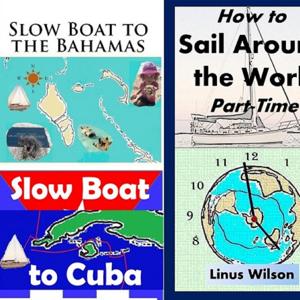
Patrons of the round the world vlog and podcast get bonus podcast episodes and free audiobooks of How to Sail Around the World Part-Time and Slow Boat to Cuba. They get never before released audiobook chapters of Slow Boat to the Bahamas. You can also get access to many podcasts and videos early as a patron.
Slow Boat to Cuba
and
have been #1 sailing bestseller on Amazon.
https://www.patreon.com/slowboatsailing
Check out our latest video about "How to make a sailing video that does not stink!!!"
https://www.youtube.com/watch?v=YDQxpUtNSfs
(c) Linus Wilson, 2017
Two Hawaiian sailors rescued off Japan by the US Navy told some tall tales about their ordeal at sea in stories covered by all the major news networks.
The youtube video of this discussion is at
https://youtu.be/vYQLT4jxAcM
They said they sailed through a force 11 storm and saw 50-foot sharks in the "Devils Triangle," but those tales were false. The U.S. Navy rescued two Hawaiian women and two dogs off at 50-foot (or 37-foot) sailboat 900 miles from Japan. Jennifer Appel (the captain and owner of SV Sea Nymph) and Natash "Tasha" Fuiava were rescued 900 miles southeast of Japan and thousands of miles off course from their destination in Tahiti. They said they set off 10 flares, waved a white flag, and made VHF distress calls for 98 days before they were towed by the Taiwanese fishing vessel the Fong Chun No. 66 and then Ms. Appel swam over and used the fishing boat's satellite phone to call for rescue. Why did they not use their EPIRB to signal for rescue 99 days earlier?
We look at the NOAA weather data, tiger shark tale,(which resembles the book and movie Jaws), the decision to not use the EPIRB, the failure to stop at the excellent anchorage in Kiritimati, Kiribati, Christmas Island, the non-lying explanations for the 10-knot current, and GPS and communications gear on the sailboat. Ms. Appel has been made the most famous sailor in the USA by sloppy reporting and poor coordination by the US Navy and the USCG investigating this case. Was this a mayday hoax, which is a felony under federal law? The United States Coast Guard district 14 in Honolulu is not at the time of investigating what led to the expensive US Navy rescue despite many inconsistencies and fabrications in the story.
USS Ashland
We use a Mantus Anchor and swivel on our boat. Get all your Mantus gear at
This story of disaster at sea has a lot of unanswered questions.
You’ll see extensive interviews of the two women rescued 5 months at sea on a 50-foot sailboat adrift in the Pacific Ocean. On May 23, 2017, Jennifer Appel and Natasha Fuiva and the dogs Valentine and Zues departed Oahu, Hawaii in the sailing vessel Sea Nymph bound for Tahiti. On October 25, 2017, they were rescued by the US Navy and Marines of the USS Ashland 900 miles from Japan. Listen to their harrowing story of survival at Sea. Captain Linus Wilson, OUPV-Inland the creator of the Slow Boat Sailing brings up unanswered questions in this deep dive into the disaster with extensive interviews with the survivors. They survived attacks from 50-foot whale sharks.
This work, Interview with rescued mariners and Navy personnel, must comply with the restrictions shown on https://www.dvidshub.net/about/copyright.
Appears in this episode.
Subscribe to get season 2 in the crossing the Pacific and sail the Marquesas, Fakarava, and Tahiti.
Capt. Mark J. Reinhardt lost his moored boat in Key West to Hurricane Irma. Capt. Mark J. Reinhardt estimated that 80 percent of the boats in the mooring field of Garrison Bite of Key West were wrecked in his interview on the Slow Boat Sailing podcast episode 39. The Slow Boat was moored in that same mooring field in 2015. Capt. Reinhardt sold everything and fixed up his Ericson 39 sailboat which he cruised the Bahamas in before settling in Key West. He rode out Hurricane Irma on a powerboat that he delivered to Fort Lauderdale. He then had a harrowing journey by sea getting back to his boat in Key West only to find his boat a total loss.
The Virgin Islands, Florida Keys, and Puerto Rico have been ravaged by the category 5 hurricanes Maria and Irma. We survey their path of destruction and weigh the costs of these monster hurricanes. The Slow Boat Sailing podcast host Linus Wilson tells how Sailing Doodle's boat Ruff Seas was dismasted in San Juan Puerto Rico during Hurricane Maria. Check out Sailing Doodles' episodes 34 on the Slow Boat Sailing Podcast on apple podcasts, stitcher, or Google play for Android.
Check out Captain Mark J. Reinhardt's book Off the Grid on Amazon
or
his Facebook page at
Contact Captain Mark J. Reinhardt about deliveries via facebook messanger or the e-mail address on his book.
Bobby White from Sailing Doodles explains the dismasting of his sailboat at
The reporting on 2/3 of the boats in Boot Key Harbor in Marathon, Florida being destroyed is from
The Economist estimated that French and Dutch Saint Martin and the also the BVIs sustained damage from Irma in excess of their annual GDP at
Subscribe to Slow Boat Sailing on YouTube to get season 2 in the crossing the Pacific and sail the Marquesas. The Slow Boat is struck by a whale in S2E3 premiering at 5PM NYC time on October 5, 2017.
We use a Mantus Anchor and swivel on our boat. Get all your Mantus gear at
Subscribe to the podcast for free and write a rating or review on apple podcasts.
Sign up for our free newsletter for access to free books and other promotions at www.slowboatsailing.com
Linus Wilson talks about his book How to Sail Around the World Part-Time in a seminar at the Southwestern International Boat Show in League City, Texas in April 2017. This show too place at the South Shore Marina off of Clear Lake near the Kemah Boardwalk area. Linus, Janna, and Sophie visited the boardwalk as well as participated in the seminar. You can hear and see the slides from this seminar in this YouTube video below:
https://www.youtube.com/watch?v=ZK9pCIZD77A
How to Sail Around the World Part-Time is a former Amazon sailing bestseller. It's description says:
"Do you dream of sailing around the world in a sailboat?
Associate Producer, Anders Colbenson
Support the Slow Boat Sailing vlog and podcast at
A few weeks ago the crew of the Tanda Malaika crashed onto a reef near the southern tip of Huahine in the Society Islands of French Polynesia. The family of six was rescued by helicopter and their 46-foot Leopard sailing catamaran was a total loss. Indeed, they are required to pay to tow their wrecked boat out to sea. Linus, Janna, and Sophie met the Tanda Malaika crew days before the wreck in Papeete, Tahiti. Linus Wilson talks to the skipper and dad Dan Govatos about the accident.
Linus outlines three decisions that he believed contributed to the wreck.
Many cruisers in French Polynesia make the first mistake according to Linus, but few pay as steep a price as Mr. Govatos and his family. This is a sad story and our hearts go out to the Govatos family in this difficult time. The podcast's episode 37 Patreon revenues are being donated to the GoFundMe campaign to help the Govatos/Willis family pay for the sinking of their boat and their flights back to the USA.
[gallery ids="1504,1505,1506" type="rectangular"]
Pictures are reproduced with the permission of Dan Govatos, Adventuresofatribe.com
When they were salvaging the wreck the Tanda Mailaka was on the reef at 16 degrees 49'41" South and 150 degrees 59"41" West on the southern tip of the reef of Huahine.
Below is a video with Dan and his children filmed just before the shipwreck:
https://www.youtube.com/watch?v=9zXu40G-Ru0
Catch my boat show seminar mentioned in the podcast about my book How to Sail Around the World Part-Time.
https://www.youtube.com/watch?v=ZK9pCIZD77A&t=25s
Our boat has a heavy duty Mantus anchor swivel, Mantus anchor, and a Mantus chain grabber. Get all your Mantus gear at
Mantus Anchors is our first corporate sponsor on www.Patreon.com/slowboatsailing
We will be running contest where our most loyal Patreon supporters can become part of our crew literally as we explore the paradise islands of the South Pacific.
and
have been #1 sailing bestseller on Amazon.
Support the Slow Boat Sailing vlog and podcast at
On the Slow Boat Sailing Podcast Linus Wilson has interviewed the crew of Sailing SV Delos, WhiteSpotPirates (Untie the Lines), Chase the Story Sailing, Sailing Doodles, SV Prism, Sailing Miss Lone Star, and many others.
Copyright Linus Wilson, 2017
The crew Sailing Zatara, Mom, Dad, and four kids bought their first sailboat in 2016 and left the dock in November 2016. Now they have sailed past Tahiti headed west around the world. Check out their YouTube channel! Linus speaks with Dad, Keith, skipper of SV Zatara.
Linus Wilson, podcasting from Tahiti, talks about his cruise in the Marquesas and visits to Tahuata, Hiva Oa, and Ua Huka.
Our boat has a heavy duty Mantus anchor swivel, Mantus anchor, and a Mantus chain grabber. Get all your Mantus gear at
Mantus Anchors is our first corporate sponsor on www.Patreon.com/slowboatsailing
We will be running contest where our most loyal Patreon supporters can become part of our crew literally as we explore the paradise islands of the South Pacific.
and
have been #1 sailing bestseller on Amazon.
Support the Slow Boat Sailing vlog and podcast at
On the Slow Boat Sailing Podcast Linus Wilson has interviewed the crew of Sailing SV Delos, WhiteSpotPirates (Untie the Lines), Chase the Story Sailing, Sailing Doodles, SV Prism, Sailing Miss Lone Star, and many others.
Copyright Linus Wilson, 2017
From the publisher's feed