
Sign up to save your podcasts
Or



In this episode, I talk to Kari Kakkonen about his Act 2 Lead model and why testing leadership is often missing in software testing. We unpack the reality that while grassroots testing within teams works well, the higher levels of organizations often lack a real understanding and leadership around quality. Kari lays out his model, a memorable eight-letter heuristic, as both a guide and a checklist for leaders at any level. It made me reflect on how companies approach testing - sometimes leaving it solely to autonomous teams but missing the big picture. I found myself wondering: is strong leadership the missing link for better quality software?
"I think there is not enough leadership in testing." - Kari Kakkonen
Kari Kakkonen has worked in software testing for almost 30 years. He is the Service Owner of Customer Expertise Development at Gofore, the author of Dragons Out software testing book and co-author of ACT 2 LEAD Software Testing Leadership Handbook. He’s won awards, e.g. 2021 EuroSTAR Testing Excellence Award. He works mostly with agile testing, lean, test automation, DevOps and AI. He’s active in ISTQB,
Highlights:
📘 Tool migration ahead? Teamscale playbook: migrate only 20% of tests, keep nearly all bug detection. Download for free
In this episode, I talk with Rik Marselis about the world of test design techniques. We go into why many testers struggle to apply the methods they learn, despite their potential to enhance quality assurance. Rik shares insights on how to select the right technique for different testing scenarios, emphasizing the need for a balanced approach that combines structured methods with experience-based testing. He introduces four key groups of test design techniques and illustrates how templates and real-life examples can make these concepts more applicable. I hope this conversation inspires you to integrate effective testing techniques into your practice, reminding us that quality is ultimately a deliberate choice.
"You should always combine experience-based techniques with test design techniques." - Rik Marselis
Rik Marselis is principal quality consultant at Sogeti in the Netherlands. He is a highly regarded presenter, trainer, author, consultant and coach who supported many organizations and people in improving their quality engineering & testing practice by providing useful tools & checklists, practical support and having in-depth discussions. His presentations are always appreciated for their liveliness, his ability to keep the talks serious but light, and his use of practical examples with humorous comparisons.
Highlights:
📘 Tool migration ahead? Teamscale playbook: migrate only 20% of tests, keep nearly all bug detection. Download for free
In this episode, I talk with Isabel Evans about breaking stereotypes in the IT and testing industries. We go into the common misconceptions about testers, like the idea that they are mostly quiet, socially awkward individuals. Isabel shares her research findings, revealing that testers come from a wide array of backgrounds, including acting and arts. We discuss how this diversity enriches the field and challenges current hiring practices. The conversation opens up new perspectives on creating more inclusive environments in tech, prompting us to rethink who we see as a good fit for these roles.
"Only six percent of testers met that IT stereotype." - Isabel Evans
After over 30 years in industry, software quality and testing practitioner Isabel Evans is now a PhD student at the University of Malta. Her research takes a human-centered approach to the development of testing tools. This arose from real experiences in industry and led to the academic papers: 'Stuck in Limbo with Magical Solutions', 'Scared, Frustrated and Quietly Proud', and 'Test tools: An illusion of usability'. Research continues with modeling and testing a framework of heuristics to help teams develop and evaluate testing tools. Isabel is the author of the book "Achieving Software Quality Through Teamwork" and has chaired EuroSTAR (2019) and HUSTEF (2018). Her tutorials and storytelling keynotes are very popular at conferences worldwide. She is a Fellow of the British Computer Society and was awarded the EuroSTAR Testing Excellence Award in 2017.
Highlights:
More Links with Insights:
📘 Tool migration ahead? Teamscale playbook: migrate only 20% of tests, keep nearly all bug detection. Download for free
In this episode, I talk with Kevlin Henney, author and speaker, about what software engineering will actually look like in 2034. Kevlin challenges the hype around AI code generation testing and explains why most developers using generative AI are actually removing the fun parts of their job while creating legacy code faster. We explore why programming languages won't change as radically as people think, why your testing skills will become your most valuable asset, and what recent data already shows about declining code quality on GitHub.
"The world runs on software; that is not going anywhere." - Kevlin Henney
Kevlin Henney is an independent consultant, speaker, writer and trainer who has contributed to the current development of programming techniques, software architecture and unit testing. He has been a columnist for numerous magazines and websites and has served on many committees. He is also co-author of "A Pattern Language for Distributed Computing" and "On Patterns and Pattern Languages" from the "Pattern-Oriented Software Architecture" series, as well as editor of "97 Things Every Programmer Should Know" and co-editor of "97 Things Every Java Programmer Should Know".
Highlights:
📘 Tool migration ahead? Teamscale playbook: migrate only 20% of tests, keep nearly all bug detection. Download for free
In this episode, I speak with Szilárd Széll about the transformative role of AI in software testing and business processes. Szilárd, a notable figure in the testing community, shares valuable insights on the challenges and opportunities that come with integrating AI agents into our workflows. We explore the pressing questions surrounding trust in AI, how it can enhance business agility, and the necessity for testers to adapt their strategies in this evolving landscape. With the rise of AI, we need to rethink our approaches to quality assurance, balancing innovation with caution. As Szilárd suggests, engaging closely with AI can amplify our capabilities and drive progress.
"AI is our new workforce. We need to have a hiring process for AI." - Szilárd Széll
Szilárd Széll is a DevOps Transformation Lead, Test Coach, and SAFe 6.0 SPC at Eficode. He has years of experience with DevOps transformation, especially in the telco industry. He has also worked as an assessor, trainer, facilitator, and coach in test automation and testing process improvement.
Szilard is very involved in the testing community that brought him the Tester of the Year in Finland AWARD 2024 by Tieturi. He runs the Finnish Testing Meetup Group with friends, is active in International Software Testing Qualifications Board (ISTQB) working groups, and is a member of the Hungarian Software Testing Board (HTB). For many years, Szilard has been working on and supporting conferences like HUSTEF, UCAAT, EuroSTAR as PC member or reviewer.
In his personal life, he enjoys kayaking on the sea, playing with LEGO, and being tested by his teenage daughter :-)
Highlights:
More Links with Insights:
📘 Tool migration ahead? Teamscale playbook: migrate only 20% of tests, keep nearly all bug detection. Download for free
In this first episode, I talk about the concept of “Quality as an Attitude”. I strongly believe that quality is critical in all our software development processes. Since the introduction of Agile 25 years ago, we must not only consider quality at the end of the process, but integrate it continuously. In times of AI and DevOps, it is becoming increasingly important to think how we work as testers and quality people. Quality is not just a task for testers, it affects everyone in the team. Let's work together for a better software future.
"The rise of AI in software development democratize creating software, but it raises questions about how to maintain quality." - Richard Seidl
Richard Seidl is a Software Testing Expert, Agile Quality Coach, and Podcast Host. Over the past 25 years, he has encountered a vast array of software throughout his professional journey: from the good to the bad, the large to the small, the new to the old. He's experienced software so magnificent it could bring one to tears, and others that make one cringe.
Highlights:
📘 Tool migration ahead? Teamscale playbook: migrate only 20% of tests, keep nearly all bug detection. Download for free
Hey – and welcome to Software Testing Unleashed!
This is your podcast for upskilling, learning, and transforming the way you work in software development and testing.
Every week, I bring you real stories, sharp minds, and practical ideas from the frontlines of software quality.
Whether you're a tester, developer, or team lead – you’ll walk away with insights you can actually use.
Why?
Because better teams build better software.
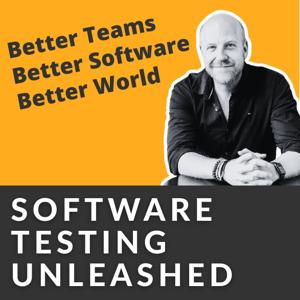
So this is the claim for this podcast: Better Teams. Better Software. Better World.
And who’s talking here?
I’m Richie – developer, lifelong tester, keynote speaker, author, and coach.
I’ve been helping teams build quality software for over 25 years – now it’s your turn:
Hit follow and check out the first episode!
And if you’ve got a hot topic or a guest I should talk to, head over to www.testing-unleashed.fm or write me: [email protected]
Let’s unleash some testing magic.
From the publisher's feed