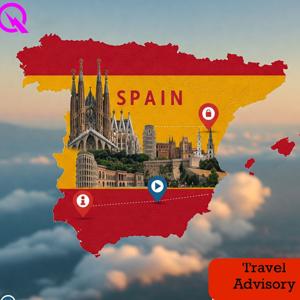
Spain continues to be one of the safest and most rewarding destinations in Europe, but listeners planning a trip should be aware of several current advisories, security considerations, and practical travel precautions drawn from official sources and recent reporting.
The U.S. Department of State currently classifies Spain under a Level 2 advisory, which means “exercise increased caution” rather than “reconsider travel” or “do not travel.” CBS News reports that Spain, along with other major European destinations like France, Italy, the United Kingdom, and Germany, is in this Level 2 category because of heightened risks linked mainly to terrorism and occasional civil unrest, not because tourism is broadly unsafe. According to the State Department’s own explanation of its advisory system, Level 2 destinations are generally safe but require travelers to be more alert to their surroundings than they might be at home.
On top of country-specific advisories, there is also a global layer of caution that affects travel to Spain. The U.S. Department of State has issued a worldwide caution urging all Americans abroad to exercise increased vigilance, with particular emphasis on the Middle East but with implications for transatlantic travel as well. The worldwide caution note explains that periodic airspace closures and route adjustments tied to international tensions can lead to delays or disruptions on routes between North America and Europe. A travel-warning monitoring site summarizing this guidance reports that these intermittent airspace restrictions have already been causing delays of several hours on some transatlantic flights. For listeners flying to Spain from the United States or Canada, this means allowing extra time for connections and being prepared for schedule changes at relatively short notice.
Security concerns that drive the Level 2 advisory for Spain are broadly similar to those across Western Europe. CBS News notes that popular European tourist destinations under Level 2 advisories are assessed for risks such as terrorism, crime, and civil unrest, even though the actual likelihood of a serious incident for any individual visitor remains low. Official guidance for Level 2 countries emphasizes situational awareness in crowded public places, especially transport hubs, major tourist attractions, festivals, and large public events. While Spain has experienced isolated terror incidents in the past, there is no current advisory suggesting that visitors cancel trips; instead, the message is to travel but to stay aware and to follow local security instructions if an incident occurs.
Travelers should also factor in global security posture, not just Spain-specific conditions. The State Department’s worldwide caution explains that U.S. diplomatic facilities have faced increased targeting and that groups hostile to U.S. interests may look for soft targets, including places associated with Americans well beyond active conflict zones. The U.S. Embassy in Spain has echoed this caution in security alerts tied to the global notice, reminding Americans in Spain to stay informed of local developments, monitor embassy messages, and be ready to adjust plans if security conditions change.
There are also public-health–related elements within the worldwide caution that can affect itineraries involving Spain. The State Department’s global notice states that travelers who have recently been in countries affected by specific outbreaks, such as Ebola in parts of central and east Africa, may face enhanced health screening and designated-entry requirements when heading to or transiting through the United States. While this is not about health risks in Spain itself, it is relevant to listeners combining a trip to Spain with travel to higher-risk regions or returning to the U.S. from multi-country itineraries.
In practical terms, travelers headed to Spain right now should build in extra resilience and preparation. The U.S. government’s travel advisory hub, summarized by USA.gov, encourages all Americans going abroad to check the current advisory level for their destination shortly before departure, because levels can change in response to new intelligence or events. Travel-advisory guides such as the one published by Squaremouth explain that advisories are dynamic and can be updated at any time, and they recommend securing travel insurance that covers delays, trip interruption, and emergency evacuation, especially in an environment where airspace closures and security alerts may trigger last-minute changes.
For personal safety inside Spain, the same travel-warning site that tracks global cautions offers general guidance that applies well to Spanish cities: avoid displaying expensive electronics, jewelry, or large amounts of cash; keep copies of passports and important documents separate from the originals; and stay alert to pickpocketing and petty theft in crowded areas. Tourist police and regular police presence in major Spanish destinations such as Madrid, Barcelona, Seville, and Valencia are generally strong, and authorities are experienced in handling large volumes of foreign visitors. Nonetheless, listeners should be particularly careful in busy transport hubs, metro systems, and around major sites like La Sagrada Família, Las Ramblas, Puerta del Sol, and popular beaches, where opportunistic theft is more common than violent crime.
Official U.S. resources repeatedly highlight one concrete step that can greatly improve safety and access to help: enrolling in the Smart Traveler Enrollment Program, or STEP. USA.gov describes STEP as a free service that allows U.S. citizens to register their trip with the nearest embassy or consulate. By enrolling, travelers to Spain can receive security updates specific to their region and make it easier for embassy staff to contact them in an emergency, whether that involves a natural disaster, a major incident, or a family emergency back home. Recent coverage on ABC News and other U.S. outlets has underlined that STEP, along with following the State Department’s @TravelGov alerts on social media, is one of the most effective ways to stay informed in a rapidly changing security environment.
Listeners should also recognize that not all high-profile travel warnings apply equally to Spain. Separate security alerts and Level 4 “do not travel” warnings currently focus on parts of the Middle East and several other conflict-affected countries. The U.S. Embassy in Saudi Arabia, for example, recently reminded Americans that Iran, Iraq, Lebanon, Syria, Gaza, and Yemen remain at Level 4 due to potential hostilities and instability. These severe advisories sit at the top of the four-tier system explained by both the State Department and outlets like CBS News and Squaremouth, where Level 4 is reserved for destinations with war, widespread violent crime, or extreme risks such as kidnapping or wrongful detention. Spain is not in that category; its Level 2 status places it among the mainstream of European tourist destinations where normal tourism continues but with a recommendation for increased awareness.
Travel experts focused on Europe are broadly aligned with this message. A 2026 Europe travel briefing by Rick Steves’ team emphasizes that visitors should not overreact to sensational headlines about Europe being unsafe; instead, they argue, travelers should understand the real risks, follow official advisories, and adopt smart habits such as avoiding demonstrations, keeping an eye on belongings, and knowing basic emergency numbers. They stress that, for the vast majority of visitors, trips to Spain and neighboring countries proceed without any serious security issues.
For listeners planning Spain specifically, practical precautions now include checking airline communications more frequently than in the past, arriving early for international flights to buffer against enhanced security screening and potential congestion, and keeping flexible plans on arrival in case of local disruptions such as strikes, protests, or weather-related transport issues. The worldwide caution and travel-warning monitoring summaries both note that heightened airport security and occasional airspace restrictions can lengthen processing and flight times, which can cascade into missed connections if itineraries are too tight.
At the same time, Spain’s tourism infrastructure remains robust and well prepared to support international visitors. Major airports such as Madrid-Barajas and Barcelona-El Prat are accustomed to high passenger volumes and coordinate with European and international security agencies. Hotels, tour operators, and local authorities are familiar with handling everything from heat waves and wildfires in summer to large-scale festivals like Semana Santa and La Mercè that bring big crowds. Spain continues to welcome millions of visitors each year, and there is no broad call from major governments or international organizations for tourists to avoid the country.
Taken together, the current picture for travel to Spain is one of normal but vigilant tourism. Official advisories describe Spain as a place where listeners can enjoy rich culture, food, and landscapes while exercising increased caution appropriate to today’s global security climate. That means checking up-to-date advisories just before traveling, enrolling in STEP or similar embassy-notification services, allowing extra time for flights and border formalities, taking sensible precautions against petty theft, and staying alert in crowded or symbolic locations. With these measures in place, most travelers can expect their journeys to Spain to be both safe and deeply rewarding, even in a year when global events have made travel planning more complex than usual.