
Sign up to save your podcasts
Or

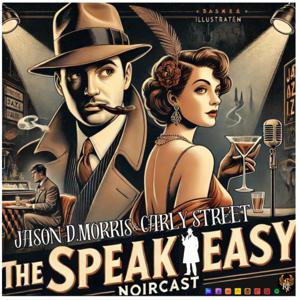


Epic showdown between Lady Street and Lord Morris on this week's battle of AmeriBrit as we discuss the 1946 film The Blue Dahlia, be forewarned Lady Street is incorrect in her assessment.
The Blue Dahlia is a 1946 American crime film and film noir, directed by George Marshall based on an original screenplay by Raymond Chandler.[3][4] The film stars Alan Ladd and Veronica Lake.[5] It was Chandler's first original screenplay.
Directed by George Marshall
Produced by John Houseman
Screenplay by Raymond Chandler
Starring: Alan Ladd, Veronica Lake, William Bendix
Cinematography Lionel Lindon
Edited by Arthur P. Schmidt
Production company Paramount Pictures
Distributed by Paramount Pictures
Release date
Running time: 100 minutes
Box office $2,750,000 (US rentals)[1]
Support us by subscribing and leaving a review!
https://anchor.fm/speakeasy-noircast
Call us at:
(818) 643-1441
Facebook:
https://www.facebook.com/speakeasynoircast
Twitter:
https://twitter.com/SpeakEasyNoir
Website:
http://resurrectionfilms.co.uk/home/index.php/speakeasy/
We take a deep dive into the FBI this week with the 1945 film The House on 92nd Street.
The House on 92nd Street is a 1945 black-and-white American spy film directed by Henry Hathaway. The movie, shot mostly in New York City, was released shortly after the end of World War II. The House on 92nd Street was made with the full cooperation of the Federal Bureau of Investigation (FBI), whose director, J. Edgar Hoover, appears during the introductory montage. Also, the FBI agents shown in Washington, D.C. were played by actual agents. The film's semidocumentary style inspired other films, including The Naked City and Boomerang.[2]
Support us by subscribing and leaving a review!
https://anchor.fm/speakeasy-noircast
Call us at:
(818) 643-1441
Facebook:
https://www.facebook.com/speakeasynoircast
Twitter:
https://twitter.com/SpeakEasyNoir
Website:
http://resurrectionfilms.co.uk/home/index.php/speakeasy/
On this week's Speakeasy we discuss the psychedelic 1967 film Point Blank.
Point Blank is a 1967 American crime film directed by John Boorman, starring Lee Marvin, co-starring Angie Dickinson, Keenan Wynn and Carroll O'Connor, and adapted from the 1963 crime noir pulp novel The Hunter by Donald E. Westlake, writing as Richard Stark.[3] Boorman directed the film at Marvin's request and Marvin played a central role in the film's development. The film was not a box-office success in 1967, but has since gone on to become a cult classic, eliciting praise from such critics as film historian David Thomson.
In 2016, Point Blank was deemed "culturally, historically, or aesthetically significant" by the United States Library of Congress, and selected for preservation in its National Film Registry.[4]
Support us by subscribing and leaving a review!
https://anchor.fm/speakeasy-noircast
Call us at:
(818) 643-1441
Facebook:
https://www.facebook.com/speakeasynoircast
Twitter:
https://twitter.com/SpeakEasyNoir
Website:
http://resurrectionfilms.co.uk/home/index.php/speakeasy/
On today's episode we delve into the classic British film The Thirty Nine Steps
The Thirty Nine Steps is a British 1978 thriller film directed by Don Sharp, with screenplay by British playwright Michael Robson, based on the novel The Thirty-Nine Steps by John Buchan. It was the third film version of the 1915 novel.
This version of Buchan's tale starred Robert Powell as Richard Hannay, Karen Dotrice as Alex, John Mills as Colonel Scudder, and a host of other well-known British actors in smaller parts. It is generally regarded as the closest to the novel, being set before the Great War. The early events and overall feel of the film bear much resemblance to Buchan's original story, albeit with a few changes such as the re-casting of Scudder as a more immediately sympathetic character and the introduction of a love interest. It also introduces a different meaning for the "thirty-nine steps", although unlike its filmed predecessors it returns to Buchan's original notion of being an actual staircase. It is known for the Big Ben sequence near the end, inspired by the film My Learned Friend (1943), starring Will Hay, although this is its most fundamental deviation from Buchan's original story, which reaches its culmination in a coastal location in Kent.
Powell later reprised the role in the ITV series Hannay which ran for 13 episodes from 1988 to 1989.
Support us by subscribing and leaving a review!
https://anchor.fm/speakeasy-noircast
Call us at:
(818) 643-1441
Facebook:
https://www.facebook.com/speakeasynoircast
Twitter:
https://twitter.com/SpeakEasyNoir
Website:
http://resurrectionfilms.co.uk/home/index.php/speakeasy/
This week we bring you the audio dramatized version of our short film The Curious Case of the Murder that Wasn't!
We know switching things up isn't always a good thing but we are excited to present to you one of our own creations in audio form.
If you would like to check out the live action version you can view it here:
https://youtu.be/130DChCNS5s
Support us by subscribing and leaving a review!
https://anchor.fm/speakeasy-noircast
Call us at:
(818) 643-1441
Facebook:
https://www.facebook.com/speakeasynoircast
Twitter:
https://twitter.com/SpeakEasyNoir
Website:
http://resurrectionfilms.co.uk/home/index.php/speakeasy/
Today we discuss Night Editor (1946) and we speak to our guest Tom Walker (filmmaker) about his new and upcoming project.
Night Editor is a 1946 B-movie film noir directed by Henry Levin and based on a popular radio program of the same name. The script for the film was based on a previous radio program episode "Inside Story."[1]
The movie was to be the first in a series of films featuring stories about the graveyard-shift police beat reporters at a fictional newspaper, the New York Star, but no other Night Editor films were made.
Tom Walker:
Tom owns Medusa Video that specializes in Music video / commercial productions.
https://bit.ly/TomWalkerYT
Facebook:
https://bit.ly/TomWalkerFB
https://bit.ly/TomWalkerInsta
Special mid-season DOUBLE episode!
You are in for an extended treat to pleasure your ear holes today, join us while we discuss two films, the 1952 original film The Narrow Margin and the 1990 remake Narrow Margin. Also stick around as hints are dropped to an amazing gift that Lady Carly bestoweths (is that a word? I dunno, you decide!) unto peasant Jason.
The Narrow Margin - 1952
The Narrow Margin is a 1952 American film noir directed by Richard Fleischer and written by Earl Felton, based on an unpublished story written by Martin Goldsmith and Jack Leonard. The screenplay by Earl Felton was nominated for an Academy Award.[4]
The picture stars Charles McGraw, Marie Windsor, and Jacqueline White. It was released by RKO Radio Pictures. A police detective plays a deadly game of cat-and-mouse aboard a train with mob assassins out to stop a slain gangster's widow before she can testify before a grand jury.
Narrow Margin - 1990
Narrow Margin is a 1990 American crime thriller film directed by Peter Hyams and released by TriStar Pictures, loosely based on the 1952 film noir The Narrow Margin. It tells the story of a Los Angeles deputy district attorney who attempts to keep a murder witness safe from hit men while traveling through the Canadian wilderness aboard a train. The film stars Gene Hackman and Anne Archer.
Support us by subscribing and leaving a review!
https://anchor.fm/speakeasy-noircast
Call us at:
(818) 643-1441
Facebook:
https://www.facebook.com/speakeasynoircast
Twitter:
https://twitter.com/SpeakEasyNoir
Website:
http://resurrectionfilms.co.uk/home/index.php/speakeasy/
On today's Speakeasy Noir Cast....
The Desperate Hours is a 1955 film noir starring Humphrey Bogart and Fredric March. It was produced and directed by William Wyler and based on a novel and a play of the same name, written by Joseph Hayes, which were loosely built on actual events.
The original Broadway production had actor Paul Newman in the Bogart role but he was passed over for the movie because Bogart was a much bigger star. The character was made older in the script so Bogart could play the part. Bogart said he viewed the story as "Duke Mantee grown up," Mantee having been Bogart's breakthrough movie role in The Petrified Forest. Spencer Tracy was originally cast in the film with Bogart. Although the two actors were very good friends, both insisted on top billing, and Tracy eventually withdrew from the picture. Fredric March assumed Tracy's role as Daniel Hilliard .[2] The role of Glenn Griffin was Bogart's last as a villain.
The Desperate Hours was the first black-and-white film in VistaVision, Paramount's wide-screen process. The house used in the final seasons of the television series Leave It to Beaver was used for exterior shots of the Hilliards' home. In 1956, Joseph Hayes won an Edgar Award from the Mystery Writers of America for Best Motion Picture Screenplay.
Support us by subscribing and leaving a review!
https://anchor.fm/speakeasy-noircast
Call us at:
(818) 643-1441
Facebook:
https://www.facebook.com/speakeasynoircast
Twitter:
https://twitter.com/SpeakEasyNoir
Website:
http://resurrectionfilms.co.uk/home/index.php/speakeasy/
**WARNING**
We take full responsibility for this ridiculousness.
This is a bonus episode that is...well we don't really know what it is...we attempted a reading of a short story from our book The Dark Side of Acting Up, that doesn't go well...Carly tries her hand at multiple accents, you decide if she pulls it off..and then we decide to rip off one of our favorite podcasts (we hope you don't mind! We did change it enough). In short what you are about to hear is absurdity.
Support us by subscribing and leaving a review!
https://anchor.fm/speakeasy-noircast
Call us at:
(818) 643-1441
Facebook:
https://www.facebook.com/speakeasynoircast
Twitter:
https://twitter.com/SpeakEasyNoir
Website:
http://resurrectionfilms.co.uk/home/index.php/speakeasy/
From the publisher's feed