
Sign up to save your podcasts
Or



Why Great Ideas Fail: The Secret to Perfect Market Timing. Starting Up
In 2004, Mark Zuckerberg introduced a new era of social media from his Harvard University dorm room. This platform quickly became a pivotal piece of technology, reshaping how we connect. The rapid spread across campuses felt like a real-time glimpse into the future of Silicon Valley innovation.
Have you ever wondered why brilliant startup ideas completely flop while mediocre ones skyrocket into multi-million dollar companies? The secret isn’t just execution, it’s market timing.
In Episode 9 of Starting Up, host Jay Sensi breaks down the exact framework for evaluating if the market is ready for your business idea. Drawing from Mark Zuckerberg's 2004 launch of Facebook from a Harvard dorm room to his own decade-long journey launching My College Roomie (Campus Kaizen), Jay explains how to find the sweet spot for your product launch.
If you launch too early, you end up building for a market that doesn’t exist yet (like trying to stream video in 2001). Launch too late, and you’ll get crushed by insurmountable network effects and market incumbents.
In this video, you will learn the 4 major market timing signals:
1️⃣ Convergence of Trends: How intersecting industries (like AI, remote work, or SaaS) signal a massive market shift.
2️⃣ Infrastructure Readiness: Is the technology accessible enough for you to build and scale affordably right now?
3️⃣ Customer Awareness: Do your target customers actually know they have a problem, or will you waste time and money trying to educate them?
4️⃣ Competitive Activity: Why entering a validated market with weak competitors is the ultimate sweet spot for a startup founder.
Don't let bad timing guarantee your startup's failure. Use this framework to grade your business idea and hit the market at the perfect time.
If you're getting value from Starting Up, make sure to SUBSCRIBE! New episodes drop weekly. Get ready for next week's episode, where we dive into market research and break down how to calculate your TAM, SAM, and SOM.
Jay's full entrepreneurial story is coming soon in his upcoming book, Starting Up. Subscribers get exclusive early access when it launches!
⏱️ Timestamps
0:00 - The Launch of Facebook in 2004
0:42 - Why Market Timing is Everything
1:26 - The Wild Wild West of Early Social Media
2:46 - Realizing Social Media Wasn’t a Fad
4:06 - What is a Business Timing Window?
4:30 - Too Early: Video Streaming in 2001
5:10 - Too Late: Competing with Facebook in 2015
5:38 - The Sweet Spot for New Startups
6:06 - The 10-Year Delay: My College Roomie Story
7:40 - How to Capitalize on Weak Competitors
9:08 - 4 Signals to Evaluate Your Market Timing
9:55 - Signal 1: Convergence of Trends
10:19 - Signal 2: Infrastructure & Tech Readiness
11:50 - Signal 3: Customer Awareness of the Problem
12:56 - Signal 4: Competitive Activity & Validation
14:16 - Homework: Evaluate Your Business Idea Today
15:21 - Preview: TAM, SAM, SOM & Market Research
#StartupStrategy #MarketTiming #Entrepreneurship #BusinessTips #StartingUp #FounderLife #ProductMarketFit #BusinessGrowth #TechStartups #BusinessFramework #SaaS #FirstMover #ValidateYourIdea
Stop trying to build the next Facebook. Stop trying to create a unicorn. Start trying to solve one problem really well, for people willing to pay you money to solve it.
In Episode 8 of Starting Up, Jay Sensi takes on the most destructive myth in entrepreneurship: the belief that your idea needs to be world-changing to be worth pursuing.
The reality nobody talks about? The vast majority of successful exits — the ones where founders actually make life-changing money — are companies you've never heard of. Quiet acquisitions between $5M and $50M that never make headlines. Campus Kaizen matched college roommates. That's it. A niche solution to a specific problem. And it made Jay a millionaire.
Jay breaks down why unicorn thinking creates paralysis, and why "small" ideas are often the biggest opportunities. You'll learn the four compounding advantages of solving one problem really well: becoming the undisputed expert, building a tighter product, simplifying your marketing, and deepening customer relationships.
Then Jay revisits the Coffee Shop vs. Franchise framework and reveals how My College Roomie's "small" roommate matching idea became an eight-figure exit — not by chasing a bigger idea, but by expanding into more products for the same customer base. The roommate matching idea was the foot in the door. Everything else followed.
This episode ends with a challenge: pay attention to every frustration you encounter this week. Ask "how could this be better?" and "would people pay for that?" Your million-dollar idea might be hiding in something ordinary.
🎧 Jay Sensi: no tech skills, no investors, never quit his job. Built Campus Kaizen. Sold to PE. Retired at 40.
🔔 New episodes every Monday.
📘 Book: Starting Up — coming soon.
#StartingUp #Entrepreneur #StartupIdeas #FounderStory #CampusKaizen #Bootstrapped #Podcast #BusinessOriginStory #NonTechnicalFounder #CollegeRoommate #SoftwareCompany #PrivateEquity #JaySensi #SmallBusiness #SideHustle #Founder #founders #founderlife #startup #startups #startupsuccess #startupstory
What if the worst thing that ever happened to you was actually the best thing?
In Episode 7 of Starting Up, Jay Sensi tells the full story of the rejection that created everything. As a kid from Scranton, Pennsylvania, Jay built his entire life plan around MIT — inspired by Good Will Hunting, fueled by his Dad's belief, mapped out to the last detail: MIT, electrical engineering, millionaire, retire at 40, buy Dad a Rolls Royce.
Then his Dad died in September 2003. Then MIT put him on the waitlist. Then the waitlist became a rejection. In a matter of months, Jay lost his hero and his dream.
He chose Lafayette College instead. And that single redirection — the different housing system, the frustrating roommate questionnaire, the bad match with a Dallas Cowboys fan — created the exact sequence of events that led to Campus Kaizen. The multi-million dollar company, the private equity sale, the retirement at 40. All of it exists because a housing office in Easton, PA matched him poorly with a roommate in 2004.
If MIT had said yes, none of it would have happened.
Jay breaks down the domino effect in detail, then expands the lens: why nearly every successful entrepreneur he's met has a "rejection that saved them" story, and why you can never see the redirection while you're in it. This is the episode about trusting the detour — and realizing the closed door wasn't a dead end.
🎧 Jay Sensi built Campus Kaizen to multimillion-dollar ARR — no technical skills, no investors, never quit his job. Sold to PE. Retired at 40.
🔔 New episodes every week.
📘 Book: Starting Up — coming soon.
#StartingUp #Entrepreneur #StartupIdeas #FounderStory #CampusKaizen #Bootstrapped #Podcast #BusinessOriginStory #NonTechnicalFounder #CollegeRoommate #SoftwareCompany #PrivateEquity #JaySensi #SmallBusiness #SideHustle #Founder #founders #founderlife #startup #startups #startupsuccess #startupstory
I had a million-dollar idea in 2004. I didn't do a single thing about it until 2014. That's a full decade where this idea sat in the back of my head, gathering dust, while I worked a regular job and told myself "someday."
In Episode 6 of Starting Up, Jay Sensi gets brutally honest about the three reasons he sat on the Campus Kaizen idea for ten years — and what each one really was: an excuse disguised as logic.
The comfortable trap of a steady paycheck. The "I can't code" excuse that felt like an insurmountable barrier. The lack of a mentor or founder network that made entrepreneurship feel like a club he didn't have the membership card for.
Then Jay tells the real story of what finally made him snap. After years of busting his ass at Lockheed Martin — graduating from their selective Leadership Development Program, bringing data to performance reviews, outperforming his peers — he kept getting passed over for promotions that went to average performers with longer tenure. The realization hit: effort doesn't equal reward in the corporate world. And if he was going to go above and beyond, it was going to be for himself.
You'll also hear Jay lay out the true cost of waiting: competitors entering the space, a decade of lost revenue and network-building, and the first-mover advantage he gave away. Then he gives you the framework for recognizing when it's YOUR time — and a 90-day action challenge to take your first real step. This is the cautionary tale every aspiring founder needs to hear before "someday" turns into "never."
🎧 Jay Sensi built Campus Kaizen to multimillion-dollar ARR with no technical skills, no outside investment, and without quitting his job. Sold to private equity. Retired at 40. Starting Up is where we prove the conventional wisdom wrong.
🔔 New episodes every week.
📘 Book: Starting Up — coming soon.
#StartingUp #Entrepreneur #StartupIdeas #FounderStory #CampusKaizen #Bootstrapped #Podcast #BusinessOriginStory #NonTechnicalFounder #CollegeRoommate #SoftwareCompany #PrivateEquity #JaySensi #SmallBusiness #SideHustle #Founder #founders #founderlife #startup #startups #startupsuccess #startupstory
What actually makes a great founder? Is it nature — some innate wiring you're either born with or you're not? Or is it nurture — the experiences that shape and sharpen you into the person who can build, sell, scale, and win?
In this special bonus episode of Starting Up, Jay Sensi steps out of the linear arc of the show to answer the question underneath every other question listeners ask him: "Do I have what it takes?" Jay's answer comes in the form of a recipe — six ingredients he believes made him the founder he became, plus one secret ingredient that he thinks matters more than all the others combined. It's the one almost nobody talks about, and once you see it, you'll start spotting it in every entrepreneur you admire.
The six ingredients:
🔹 Work ethic — built in school, the slow daily grind of learning that effort actually works
🔹 Fearlessness — born from losing his Dad at 17 and realizing he'd already survived the worst
🔹 Mental toughness — forged in a no-AC, one-mirror gym under his high school principal Moe
🔹 Consistency and discipline — earned on the physique competition stage, where you cannot fake it, cram for it, or talk your way into being ready
🔹 Intelligence — the one ingredient that's mostly nature, and why it matters less than you think
🔹 Problem-solving — the operating system that ties everything together And then the secret ingredient: the chip on the shoulder.
The fuel that doesn't run out. Jay traces his back to "Boy of the Year," the first time he learned life isn't fair, and the lesson his Dad taught him in that moment that he still carries today. This is the most personal and vulnerable episode Jay has recorded — part origin story, part honest accounting of where toughness actually comes from, and part open challenge to anyone who's been through something hard and hasn't yet realized it gave them a gift. If you've ever wondered whether you're built for this — listen to this one twice.
🎧 Jay Sensi built Campus Kaizen to multimillion-dollar ARR with no technical skills, no outside investment, and without quitting his full-time job. Sold to private equity. Retired at 40.
🔔 New episodes every Monday.
📘 Book: Starting Up — coming soon.
💬 What would YOU add to the list? DM Jay on social.
00:00 Intro
00:02:05 Ingredients 1-3 - Built in Childhood
00:11:16 Ingredients 4-6 - The Adult Layer
00:16:38 The Secret Ingredient
00:22:30 The Recipe
00:24:45 Outro + Next Episode Tease
#StartingUp #Entrepreneur #StartupIdeas #FounderStory #CampusKaizen #Bootstrapped #Podcast #BusinessOriginStory #NonTechnicalFounder #CollegeRoommate #SoftwareCompany #PrivateEquity #JaySensi #SmallBusiness #SideHustle
Most startups don't fail because the founder wasn't smart enough or didn't work hard enough. They fail because the idea was flawed from the start.
In Episode 4 of Starting Up, Jay Sensi shares the simple 3-question framework that can save you years of wasted effort — and thousands of dollars — before you ever write a line of code or sign a lease. It's the same framework Jay wishes he'd had on day one of building My College Roomie, the company that eventually became Campus Kaizen.
Here's the test every idea has to pass:
1️⃣ Is it achievable — for YOU, with your actual resources, skills, and timeline?
2️⃣ Will people actually PAY for it? (Not "think it's cool." Not "say they'd buy." Actually pay.)
3️⃣ Does it have the potential to deliver the lifestyle or exit you want?
Jay walks through each criterion in plain language, then makes it concrete with the Coffee Shop Example — an idea that passes criteria one and two with flying colors but quietly fails the third for most founders who dream of a life-changing exit. You'll also hear Jay get honest about his own mistake: he never ran My College Roomie through criteria three before he launched. By the time he realized the answer was "no," he was already deep in.
He'll tell you exactly how he course-corrected — and how you can convert a "no" into a "yes" with creativity, smart risk, and the willingness to expand the idea. Then comes the challenge: write down your current idea. Answer all three questions honestly. If they're all yes, you're ready for market validation (coming in the next episode). If any are no, don't quit — rework. This is the episode that separates hobbies from businesses, and dreamers from founders.
🎧 About the host: Jay Sensi built Campus Kaizen to multimillion-dollar ARR with no technical skills, no outside investment, and without quitting his full-time job. He sold to private equity and retired at 40. Starting Up is where we prove the conventional wisdom wrong.
🔔 Subscribe for new episodes every week.
📘 Book: Starting Up — coming soon.
00:00 Intro
00:01:35 The 3 Criteria Explained
00:06:42 The Coffee Shop Example
00:10:17 What is Criteria 3 is a "No"?
00:12:39 How to Apply the 3 Criteria
00:14:33 Outro + Next Episode Tease
#StartingUp #Entrepreneurship #StartupIdeas #Bootstrapped #FounderMindset #JaySensi
Jay Sensi tells the origin story of Campus Kaizen in Episode 3 of Starting Up — and it all started with a five-question roommate questionnaire and a Dallas Cowboys fan. In the spring of 2004, Lafayette College mailed Jay a paper form asking his name, major, sleep schedule, activities, and music preferences. Behind the scenes, staff manually matched 1,400 incoming students into roommate pairs by laying paper forms around desks and hand-pairing them over several days.
The result? Jay got matched with a roommate who had zero in common with him — including being a Cowboys fan in Eagles country. But it wasn't just Jay. Almost every freshman he knew hated their roommate situation. Around that same time, "The Facebook" was rolling out across college campuses, and social media was changing the internet forever. Two things collided: everyone hated their roommates, and social networking technology was emerging.
The lightbulb moment hit — what if there was a platform where students could find compatible roommates BEFORE moving to campus? The idea for My College Roomie was born, which eventually became Campus Kaizen, a bootstrapped software company sold to private equity for a life-changing exit. Jay also shares one of the most important lessons for aspiring founders: the best startup ideas aren't brainstormed — they come from real pain, real frustration, and a keen eye for how broken processes can be improved.
In This Episode, You'll Learn:
-The full origin story of Campus Kaizen — from a paper roommate questionnaire to a multi-million dollar software company
-How Lafayette College manually matched 1,400 students using handwritten paper forms -Why Jay's MIT rejection led directly to the idea that changed his life
-How the rise of Facebook and social media collided with a broken roommate matching process
-Why the best business ideas come from pain and frustration, not brainstorming sessions
-The 3-question framework for evaluating any startup idea (preview for Episode 4)
Key Quotes:
"They matched me with a Dallas Cowboys fan. I'm a diehard Eagles fan. That mismatch became a multi-million dollar idea."
"The best ideas are NOT sought after. They are inspired by experience — notably pain, frustration, or poor outcomes."
"I got my idea in 2004. I didn't do anything about it until 2014. I absolutely do not recommend that."
00:00 Intro
00:01:32 The MIT Dream
00:05:23 The Roommate Questionnaire
00:09:42 The Lightbulb Moment
00:12:50 The Lesson for Aspiring Founders
00:15:05 Outro + Next Episode Tease
#StartingUp #Entrepreneur #StartupIdeas #FounderStory #CampusKaizen #Bootstrapped #Podcast #BusinessOriginStory #NonTechnicalFounder #CollegeRoommate #SoftwareCompany #PrivateEquity #JaySensi #SmallBusiness #SideHustle
Jay Sensi gets deeply personal in Episode 2 of Starting Up, sharing the origin of his entrepreneurial self-belief. Through the powerful lighthouse metaphor — where the tower represents resolve and the light represents self-belief — Jay explains what every founder needs to survive the relentless waves of rejection, failure, and criticism that come with building a business. He then opens up about his father, Jerry Sensi, a lifelong entrepreneur who owned a bar, ran an air cleaning business, and became a land developer — all without ever having a boss.
Jay tells the unforgettable story of the Ash Street Express, his dad's bar built from actual railroad train cars in Scranton, Pennsylvania, when everyone thought he was crazy. And then comes the moment that changed everything: at 17 years old, Jay made a promise to his dying father — a promise to go to MIT and become a millionaire. He didn't get into MIT. But he kept his promise. This is the episode that reveals the emotional foundation behind Campus Kaizen, a bootstrapped software company grown to millions in ARR and sold to private equity — built entirely on the self-belief his parents instilled in him.
In This Episode, You'll Learn:
-The lighthouse metaphor for entrepreneurial mindset: tower as resolve, light as self-belief
-How Jay's father modeled entrepreneurship, hard work, and relationship selling
-The Ash Street Express story — a bar built from railroad train cars in Scranton, PA
-The bedside promise Jay made at 17 that fueled his entire entrepreneurial journey
-Why self-belief must be bulletproof to survive the startup grind
-How rejection from MIT led directly to Lafayette College and the idea for Campus Kaizen
Key Quotes:
"I'm going to make it, Dad. I'm going to go to MIT and I'm going to be a millionaire. I promise."
"When you get knocked down, you've got two options. Stay down — or get the fuck up."
"Thank you Mom. Thank you Dad. For giving me the greatest gift possible: self-belief."
00:00 Intro 00:02:13 The Lighthouse Metaphor
00:05:25 My Dad's Story
00:12:48 The Choice
00:15:26 Where Does Your Belief Come From?
00:16:45 Outro + Next Episode Tease
#StartingUp #Entrepreneur #SelfBelief #FounderStory #Bootstrapped #Podcast #Motivation #StartupMindset #NonTechnicalFounder #PrivateEquity #CampusKaizen #JaySensi #SmallBusiness #EntrepreneurLife #NeverQuit
Jay Sensi launches Starting Up with a raw look at startup statistics: 90% of startups fail, and only 1% achieve a meaningful business exit. As a non-technical founder who bootstrapped a software business to a life-changing private equity acquisition,
Jay shares the data, puts it in perspective with some humor, and introduces the entrepreneurship mindset that carried him through a decade of building Campus Kaizen — all as a side hustle with no investors and no funding.
In This Episode, You'll Learn:
Key Quotes:
00:00 Intro
00:01:36 Episode Overview
00:02:27 The Brutal Truth
00:06:58 The Unexpected Perspective
00:10:18 The Reframe
00:13:58 My Story Teaser
From the publisher's feed
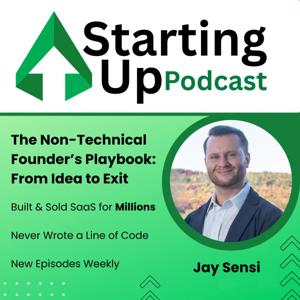
I built and sold a software company for millions. I've never written a line of code.
Starting Up is the definitive playbook for non-technical founders who want to build, scale, and exit…
I'm Jay Sensi. In 2012, I had an idea for My College Roomie (later Campus Kaizen)—a college roommate matching platform. The problem? I had zero coding skills, no technical co-founder, a full-time job I couldn't quit, and limited capital.
Everyone said I needed to be technical to build a software company. Everyone was wrong.
Over the next 10 years, I validated the market, learned to spec software without technical knowledge, built strategic partnerships that created 10x growth, scaled to multi-million dollar ARR while working full-time, sold to a private equity firm, and retired at 40.
Now I'm documenting the entire journey—the strategies that worked, the mistakes that cost six figures, and the exact roadmap from idea to exit.
WHAT YOU'LL LEARN:
- How to build software as a non-technical founder
- Validating SaaS ideas before heavy investment
- Hiring and managing developers when you can't code
- Writing product specs without technical knowledge
- Partnership strategies that drive exponential growth
- Scaling a business nights and weekends while working full-time
- How to know when to sell (and how to actually do it)
- What private equity acquisition and due diligence really look like
- Real mistakes, real numbers, real lessons from building Campus Kaizen
WHO THIS IS FOR:
Aspiring SaaS founders who aren't technical and think they can't do this. Entrepreneurs with software ideas who don't know where to start. Business owners looking to add software to their offerings. Anyone building a startup while working a day job.
You don't need to code. You need the roadmap. That's what Starting Up delivers.
I'm also writing a book about this journey.
New episodes weekly. Subscribe to prove that coding isn't a prerequisite for building a successful software company.
TOPICS: Entrepreneurship, SaaS, Startups, Software Development, Non-Technical Founders, Business Exit, Private Equity, M&A, Side Hustles, Business Building, Tech Startups, Founder Stories
Connect:
Hosted by Jay Sensi