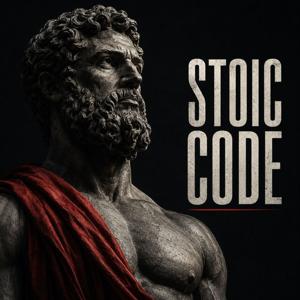
Stoic Code

Stoic Code

By Creator at ObomediaEducationSelf-Improvement
Download on the App Store

Stoic Code episodes

  • When the World Goes Quiet: Stoic Lessons for Your Return
    When the World Goes Quiet: Stoic Lessons for Your Return

    You promised yourself change, but by Friday, you're back in the quiet shame of knowing what you should do but can't. This isn't a motivation problem; it's about the three seconds before you react to anything. What if the most powerful man of his era deliberately chose discomfort, not as a ritual, but as a practice to avoid dependency?

    In this episode, we explore ten Stoic practices designed not as inspiration, but as tools to break the cycle of self-sabotage. Discover how these ancient insights offer a daily training system for people under pressure, revealing what happens in the critical moments before you respond.

    Topic: Self-Sabotage
    Author: Marcus Aurelius
    Period: Ancient Rome
    Key Concept: The gap between stimulus and response
    Number of Practices: 10

    - Marcus Aurelius, the most powerful man of his time, regularly chose to sleep on the ground.
    - He wrote in his private journal: "Your life is what your thoughts make it."
    - The Stoics called governing inner speech the first and most fundamental discipline.
    - Within forty seconds of waking, an untrained person can react to a reality that only exists in their head.
    - The fifth Stoic practice is described as the foundation everything else rests on.

    To listen to this podcast ad-free and access premium episodes, try our subscription with a 30-day free trial at obomedia.com.

    © 2026 OBOMEDIA. All rights reserved.
    This episode and its content (audio, text, and related materials) are the exclusive property of OBOMEDIA and are protected by applicable copyright laws. Reproduction, distribution, editing, or commercial use, in whole or in part, without prior written permission from OBOMEDIA is prohibited. For permissions, licensing, and business inquiries: [email protected].

    27 min
  • Betrayal: The Unbreakable Lesson You Didn't Ask For
    Betrayal: The Unbreakable Lesson You Didn't Ask For

    You've felt the quiet exhaustion, the jaw tight from smiling when there was nothing left to give, the chest heavy not from grief but from carrying a version of yourself you no longer recognize. This isn't just stress; it's chronic emotional suppression, a self-abandonment dressed as responsibility. How do you find your way back to yourself when everything has gone quiet inside?

    In this episode, we explore what the Stoics actually said about this internal state, not the motivational poster versions. We uncover the distinction between what is up to us and what is not, and why understanding this difference changes everything about how you navigate life's challenges.

    Topic: Stoic Philosophy
    Author: Marcus Aurelius
    Philosopher: Epictetus
    Concept: Emotional Suppression
    Text: Meditations

    - Marcus Aurelius wrote his private journals, the Meditations, not to inspire others but to remind himself.
    - Epictetus, a former slave, taught that it is not events themselves that disturb us, but our interpretation of them.
    - Seneca wrote that even the smallest ember can reignite if it finds the right breath of air.
    - The Stoics had a name for the internal state that creates the trap of waiting for external conditions to shift: confusion between what is up to us and what is not.
    - This episode presents ten lessons, with the final one offering a practice the Stoics valued more than inspiration for starting again.

    To listen to this podcast ad-free and access premium episodes, try our subscription with a 30-day free trial at obomedia.com.

    © 2026 OBOMEDIA. All rights reserved.
    This episode and its content (audio, text, and related materials) are the exclusive property of OBOMEDIA and are protected by applicable copyright laws. Reproduction, distribution, editing, or commercial use, in whole or in part, without prior written permission from OBOMEDIA is prohibited. For permissions, licensing, and business inquiries: [email protected].
    22 min
  • The Lie You Tell Yourself at Midnight
    The Lie You Tell Yourself at Midnight

    In this episode, we explore the profound impact of betrayal, distinguishing between the actual loss and the self-blame that often follows. We delve into Stoic wisdom to understand how ancient philosophers like Marcus Aurelius and Epictetus approached human failure, offering a path to stability and self-worth in the face of unexpected pain.

    Topic: Betrayal
    Philosophers: Marcus Aurelius, Epictetus
    Concept: Dichotomy of Control
    Source: Stoicism
    Psychologist: Carl Jung

    - The episode begins in the specific silence that arrives after a betrayal, not before.
    - Most people carry two weights after betrayal: the actual loss and the corrosive story they tell themselves about what it means about them.
    - Brian Tracy stated that some burdens feel heavy only when you forget whose they were to begin with.
    - Epictetus, a former slave, precisely defined the line between what is yours and what is not.
    - Marcus Aurelius wrote that other people will act badly, framing it as a feature of human life, not a tragedy.

    To listen to this podcast ad-free and access premium episodes, try our subscription with a 30-day free trial at obomedia.com.

    © 2026 OBOMEDIA. All rights reserved.
    This episode and its content (audio, text, and related materials) are the exclusive property of OBOMEDIA and are protected by applicable copyright laws. Reproduction, distribution, editing, or commercial use, in whole or in part, without prior written permission from OBOMEDIA is prohibited. For permissions, licensing, and business inquiries: [email protected].
    23 min
  • Quit Waiting: Seneca's Hard Question That Exposes Your Silence
    Quit Waiting: Seneca's Hard Question That Exposes Your Silence

    How long have you been living a life that feels like someone else's, marked by a quiet resignation that you've come to call "life"? Seneca, writing two thousand years ago, called this biggest lie not a tragedy, but a waste. If the problem is never time, what are you doing with the time you already have?

    In this episode, we explore the specific moment when you stop waiting for the right circumstances and start working with the only material you actually control. We delve into the Stoic distinction between what is within your power and what is outside it, and how confronting the parts of your current situation that you chose can lead to profound change.

    Author: Seneca
    Topic: Self-governance
    Period: Ancient Rome
    Philosopher: Epictetus
    Concept: Stoic clarity

    - Seneca wrote, "It is not that life is short; it is that we squander it."
    - Epictetus, who began life as a slave, became one of the most studied philosophers in Roman history.
    - The Stoic tradition distinguishes between things within your power and things outside your power.
    - Marcus Aurelius, a Roman emperor, wrote that the mind becomes the color of its thoughts.
    - The episode discusses ten principles that sound simple until applied to one's own life.

    To listen to this podcast ad-free and access premium episodes, try our subscription with a 30-day free trial at obomedia.com.

    © 2026 OBOMEDIA. All rights reserved.
    This episode and its content (audio, text, and related materials) are the exclusive property of OBOMEDIA and are protected by applicable copyright laws. Reproduction, distribution, editing, or commercial use, in whole or in part, without prior written permission from OBOMEDIA is prohibited. For permissions, licensing, and business inquiries: [email protected].

    24 min
  • Silence Your Mind: Marcus Aurelius' 12 Unspoken Truths
    Silence Your Mind: Marcus Aurelius' 12 Unspoken Truths

    There is a voice inside your head that has never stopped talking, replaying lost conversations and rehearsing arguments that will never happen. Marcus Aurelius, the Roman Emperor, spent a decade writing private journals about how to silence this voice, not through willpower, but through something older and more practical. What did he discover about the quality of our thoughts?

    In this episode, we explore twelve of Marcus Aurelius's lessons on how to manage the internal monologue, including his most difficult teaching that asks us to confront what we've been avoiding our entire lives. We delve into how his philosophy, written privately in Greek during a period of plague and war, offers a survival strategy for navigating genuine hurt and the challenges of existence.

    Person: Marcus Aurelius
    Period: 161 CE - 180 CE
    Work: Meditations (originally "To Himself")
    Topic: Stoic philosophy

    - Marcus Aurelius became emperor of Rome in 161 CE at thirty-nine, ruling for nearly two decades.
    - He wrote his private journals, now known as "Meditations," amidst plague, wars, and political conspiracies.
    - The first lesson he emphasized was: "the happiness of your life depends on the quality of your thoughts."
    - His second lesson states: "If something external disturbs you, the problem is not the thing itself. It is your judgment about it."
    - Lesson five, "Amor fati," asks us to "Accept the things to which fate has bound you, and love the people with whom fate has united you."

    To listen to this podcast ad-free and access premium episodes, try our subscription with a 30-day free trial at obomedia.com.

    © 2026 OBOMEDIA. All rights reserved.
    This episode and its content (audio, text, and related materials) are the exclusive property of OBOMEDIA and are protected by applicable copyright laws. Reproduction, distribution, editing, or commercial use, in whole or in part, without prior written permission from OBOMEDIA is prohibited. For permissions, licensing, and business inquiries: [email protected].

    25 min
  • When Carrying Breaks: 9 Stoic Keys to Transform Quiet Suffering
    When Carrying Breaks: 9 Stoic Keys to Transform Quiet Suffering

    You wake up, go through the motions, and smile at the right moments, but underneath, a quiet scream has been building for months. This feeling of a clenched jaw and heavy shoulders is often mistaken for resilience, but what if it's actually a slow fracture? What is the true difference between a person who carries difficulty and transforms, and one who carries difficulty and breaks?

    In this episode, we explore nine answers to this crucial question, drawing insights from Stoic philosophy. Discover how figures like Marcus Aurelius, who governed an empire amidst plague and personal loss, found stability not by waiting for better conditions, but by training his interior world. This episode challenges the common understanding of endurance and reveals how our interpretation of events shapes our inner life.

    Author: Marcus Aurelius
    Text: Meditations
    Philosopher: Seneca
    Concept: Stoicism
    Focus: Mental discipline

    - Marcus Aurelius wrote his private notes, now known as Meditations, in military camps between battles.
    - Seneca stated, "It is not life that disturbs us, but the opinion we hold of it."
    - The episode explores nine lessons on how to move through difficulty, not just outlast it.
    - The first lesson addresses the common misunderstanding of the word "resist."
    - Marcus Aurelius faced back-to-back military campaigns, the death of several children, and betrayals.

    To listen to this podcast ad-free and access premium episodes, try our subscription with a 30-day free trial at obomedia.com.

    © 2026 OBOMEDIA. All rights reserved.
    This episode and its content (audio, text, and related materials) are the exclusive property of OBOMEDIA and are protected by applicable copyright laws. Reproduction, distribution, editing, or commercial use, in whole or in part, without prior written permission from OBOMEDIA is prohibited. For permissions, licensing, and business inquiries: [email protected].
    22 min
  • The 10-Second Habit That Steals Your Peace
    The 10-Second Habit That Steals Your Peace

    In this episode, we explore what happens when you stop waiting for external change and instead embrace eight specific habits drawn from Stoic history, designed to work in seven days. Discover how action, not motivation, is the true catalyst for change, and why understanding this sequence is key to breaking free from the loop of dissatisfaction.

    Topic: Living with Intention
    Period: Ancient Stoicism
    Author: Epictetus
    Author: Marcus Aurelius
    Author: Seneca

    - Epictetus, born into slavery, concluded that freedom is about controlling impulses, not circumstances.
    - The human brain rewards prediction, running familiar behaviors on minimal energy, leading to an "autopilot" state.
    - Most people wait for motivation to arrive, but Stoics understood that action precedes the feeling of readiness.
    - Marcus Aurelius wrote daily, whether inspired or not, demonstrating that the act precedes the desired state.
    - The episode introduces eight specific habits to interrupt the "autopilot" loop, starting before the day begins.

    To listen to this podcast ad-free and access premium episodes, try our subscription with a 30-day free trial at obomedia.com.

    © 2026 OBOMEDIA. All rights reserved.
    This episode and its content (audio, text, and related materials) are the exclusive property of OBOMEDIA and are protected by applicable copyright laws. Reproduction, distribution, editing, or commercial use, in whole or in part, without prior written permission from OBOMEDIA is prohibited. For permissions, licensing, and business inquiries: [email protected].
    22 min
  • The 2 AM Mind: Stoic Secrets to Unclench Your Life
    The 2 AM Mind: Stoic Secrets to Unclench Your Life

    Most people perform one habit before a conscious breath, shaping their entire day's emotional tone in less than ten seconds. This quick action, which you already know, floods your brain with anxiety and urgency, setting a negative tone that saturates everything that follows. What if this seemingly harmless habit is actually surrendering your morning to external chaos?

    In this episode, we explore how a simple, almost automatic morning routine can hijack your peace and set your nervous system into a low-grade fight mode for hours. Discover how ancient Stoic wisdom, from figures like Marcus Aurelius and Epictetus, offers a powerful alternative to reclaim your mind and intentionally prime your day.

    Topic: Stoic Philosophy
    Key Concept: Intentional Priming
    Author: Marcus Aurelius
    Author: Epictetus
    Period: Ancient Rome

    - The brain reacts to anxious digital information like a real threat, releasing cortisol.
    - Marcus Aurelius, the most powerful man in his world, turned his attention inward first each morning.
    - Epictetus stated, "Every dawn is an opportunity to rewrite your mind before the world begins writing for you."
    - Neuroscience now calls the Stoic practice of examining emotions "intentional priming."
    - The first key to reclaiming your morning is to name three things you are grateful for before touching your phone.

    To listen to this podcast ad-free and access premium episodes, try our subscription with a 30-day free trial at obomedia.com.

    © 2026 OBOMEDIA. All rights reserved.
    This episode and its content (audio, text, and related materials) are the exclusive property of OBOMEDIA and are protected by applicable copyright laws. Reproduction, distribution, editing, or commercial use, in whole or in part, without prior written permission from OBOMEDIA is prohibited. For permissions, licensing, and business inquiries: [email protected].
    22 min
  • Your Mind's Unguarded Door: 10 Habits to Close It
    Your Mind's Unguarded Door: 10 Habits to Close It

    It's 2 AM, your mind is racing through every potential disaster, and your jaw has been clenched since morning. You're not in danger, yet your chest is tight and your breathing shallow, caught in a loop of worry even though past fears never materialized. What if this relentless anxiety isn't a signal of danger, but a habit your body has learned?

    In this episode, we explore the gap between what we know we should feel and what we actually feel, a gap the Stoics mapped with uncomfortable precision two thousand years ago. Discover how figures like Marcus Aurelius, facing plague, war, and betrayal, found calm not by waiting for circumstances to improve, but by building it within themselves.

    Person: Marcus Aurelius
    Period: Roman Empire
    Topic: Stoicism
    Concept: Illusion of control
    Problem: Anxiety

    - Marcus Aurelius commanded the largest empire on earth during plague and war.
    - He kept a private journal, not for publication, but for personal discipline.
    - The Stoics distinguished between what is in your hands and what you are merely rehearsing.
    - Worry is described as suffering twice: once in imagination, once if the event occurs.
    - Seneca stated that nobody can learn what they think they already know.

    To listen to this podcast ad-free and access premium episodes, try our subscription with a 30-day free trial at obomedia.com.

    © 2026 OBOMEDIA. All rights reserved.
    This episode and its content (audio, text, and related materials) are the exclusive property of OBOMEDIA and are protected by applicable copyright laws. Reproduction, distribution, editing, or commercial use, in whole or in part, without prior written permission from OBOMEDIA is prohibited. For permissions, licensing, and business inquiries: [email protected].
    22 min
  • : The Unspoken Stoic Lesson That Changes Everything
    : The Unspoken Stoic Lesson That Changes Everything

    Before your day even begins, your mind is already racing, replaying conversations and tightening your jaw. This isn't a dramatic crisis, but an ordinary morning when your nervous system switches to a purely reactive mode, leaving you drained by 9 AM. What if the exit from this loop doesn't require a heroic reinvention, but something far smaller and more demanding?

    In this episode, we explore the Stoic concept of an "untrained mind" and how to widen the space between stimulus and response. Discover how to build this crucial gap before the storm arrives, starting with 10 practical habits that can transform your daily experience.

    Topic: Stoic Philosophy
    Focus: Mind Training
    Concept: Reactive Loop
    Goal: Deliberate Action
    Method: 10 Habits

    - The mind often starts running before the alarm, replaying unresolved conversations and tightening the jaw.
    - Stoics focused on the moment before conscious decision, when the nervous system switches to reactive mode.
    - An "untrained mind" is the Stoic term for the collapse of space between stimulus and response.
    - The average Monday morning can involve processing 17 pieces of information in 90 seconds, none chosen.
    - The 10 habits discussed are designed to widen the gap between impulse and action, starting in the morning.

    To listen to this podcast ad-free and access premium episodes, try our subscription with a 30-day free trial at obomedia.com.

    © 2026 OBOMEDIA. All rights reserved.
    This episode and its content (audio, text, and related materials) are the exclusive property of OBOMEDIA and are protected by applicable copyright laws. Reproduction, distribution, editing, or commercial use, in whole or in part, without prior written permission from OBOMEDIA is prohibited. For permissions, licensing, and business inquiries: [email protected].
    22 min

About Stoic Code

From the publisher's feed

Unlock ancient wisdom for modern challenges with Stoic Code. Discover practical philosophy that transforms everyday life.

Stoic Code is your daily guide to mastering self-control, resilience,…