Strachey Lectures

Strachey Lectures

By Oxford UniversityEducation
Download on the App Store

Strachey Lectures episodes

  • Advances in Garbled Circuits
    MT25 Strachey Lecture - Professor Rafail Ostrovsky: Advances in Garbled Circuits Nearly 40 years ago, Andy Yao proposed the construction of “Garbled Circuits,” which had an enormous impact on the field of secure computation -- both in theory and in practice. In Garbled Circuits, two parties agree on a Boolean circuit that they want to evaluate, where both parties have partial, disjoint inputs to the circuit, and neither party is willing to disclose to the other party anything but the output. In this talk, I will survey the state of the art for garbling schemes, including computing with Garbled Random Access Memory, the so-called GRAM constructions that were invented by Lu and Ostrovsky in 2013, as well as more recent progress, including the GRAM paper by Heath, Kolesnikov and Ostrovsky, which received the best paper award in Eurocrypt 2022. I will also discuss Garbled Circuits in the malicious setting, where parties try to deviate arbitrarily from the prescribed protocol execution to gain additional information, and will review some of the latest advances in this area. The talk will be self-contained and accessible to the general audience.
    49 min
  • Will Computers prove theorems?
    Kevin Buzzard: Will Computers prove theorems? Will computers one day replace human mathematicians? Is this just around the corner, or decades away? Can neural networks spot patterns which humans have missed? Currently language models are great for brainstorming big ideas but are very poor when it comes to details. Can integrating a language model with a theorem prover like Lean solve these problems? Is the modern mathematical literature riddled with errors, and is it feasible to hope that a machine might find and even fix them? Is it possible to teach a computer the proof of Fermat's Last Theorem? And what do mathematicians make of all this? I'll talk about how modern developments in AI and theorem provers are beginning to affect mathematics.
    47 min
  • Formalizing the Future: Lean’s Impact on Mathematics, Programming, and AI
    Leo De Moura: Formalizing the Future: Lean’s Impact on Mathematics, Programming, and AI How can mathematicians, software developers, and AI systems work together with complete confidence in each other’s contributions? The open-source Lean proof assistant and programming language provides an answer, offering a rigorous framework where proofs and programs are machine-checkable, shared, and extended by a broad community of collaborators. By removing the traditional reliance on trust-based verification and manual oversight, Lean not only accelerates research and development but also redefines how we collaborate.
    In this talk, I will highlight how Lean is being used to tackle challenging problems in mathematics, software verification, and AI research that depends on formally sound reasoning. I will also introduce the Lean Focused Research Organization (FRO), a non-profit dedicated to expanding Lean’s capabilities and community. By showcasing real-world examples, ranging from advanced research projects to industry-driven applications, I illustrate how Lean empowers us to innovate in a more reliable, transparent, and truly collective manner.
    48 min
  • Privacy, Verification, Robustness: A Cryptographer's perspective on ML
    Strachey Lecture: Privacy, Verification, Robustness: A Cryptographer's perspective on ML Cryptographic tools enable the safe use of technology platforms controlled by worst case computationally bounded adversaries.In this talk I will show how cryptographic paradigms and tools can be used to address trust issues in various phases of the machine learning pipeline. We will touch on approaches for achieving privacy, correctness, and robustness in presence of adversaries.
    1 hr 5 min
  • From probabilistic bisimulation to representation learning via metrics
    Strachey Lecture: From probabilistic bisimulation to representation learning via metrics - Professor Prakash Panangaden Bisimulation is a fundamental equivalence relation in process theory invented by Robin Milner and with an elegant fixed-point definition due to David Park. In this talk I will review the concept of bisimulation and then discuss its probabilistic analogue. This was extended to systems with continuous state spaces. Despite its origin in theoretical work, it has proved to be useful in fields like machine learning, especially reinforcement learning. Surprisingly, it turned out that one could prove a striking theorem: a theorem that pins down exactly what differences one can "see" in process behaviours when two systems are not bisimilar.
    However, it is questionable whether a concept like equivalence is the right one for quantitative systems. If two systems are almost, but not quite, the same, bisimulation would just say that they are not equivalent. One would like to say in some way that they are "almost" the same. Metric analogues of bisimulation were developed to capture a notion of behavioral similarity rather than outright equivalence. These ideas have been adopted by the machine learning community and a bisimulation-style metric was developed for Markov decision processes. Recent work has shown that variants of these bisimulation metrics can be useful in representation learning. I will tell the tale of this arc of ideas in as accessible a way as possible.
    56 min
  • Strachey Lecture: The Computer in the Sky
    The talk will emphasize the diversity of mathematical tools necessary for understanding blockchain protocols and their applications The talk will emphasize the diversity of mathematical tools necessary for understanding blockchain protocols and their applications (e.g., distributed computing, game theory, mechanism design, and continuous-time stochastic processes) and the immediate practical impact that mathematical work on this topic has had (e.g., Ethereum's EIP-1559 and LVR for automated market makers).
    1 hr 3 min
  • Strachey Lecture: From classical to non-classical stochastic shortest path problems
    Professor Christel Baier delivers the Hillary Term 2024 Strachey Lecture Abstract: The classical stochastic shortest path (SSP) problems asks to find a policy for traversing a weighted stochastic graph until reaching a distinguished goal state that minimizes the expected accumulated weight. SSP problems have numerous applications in, e.g., operations research, artificial intelligence, robotics and verification of probabilistic systems. The underlying graph model is a finite-state Markov decision process (MDP) with integer weights for its state-action pairs. Prominent results are the existence of optimal memoryless deterministic policies together with linear programming techniques and value and policy iteration to compute such policies and their values. These results rely on the assumption that the minimum under all proper policies that reach the goal state almost surely exists. Early work on the SSP problems goes back to the 1960s-1990s and makes additional assumptions. Complete algorithms that only require the existence of proper policies combine these techniques with a pre-analysis of end components, an elegant graph-theoretic concept for MDPs that has been introduced by de Alfaro in the late 1990s. The talk will start with a summary of these results. The second part of the talk presents more recent results for variants of the classical SSP. The conditional and partial SSP drop the assumption that the goal state must be reached almost surely and ask to minimize the expected accumulated weight under the condition that the goal will be reached (conditional SSP) resp. assign value 0 to all paths that do not reach the goal state (partial SSP). Other variants take into account aspects of risk-awareness, e.g., by studying the conditional value-at-risk or the variance-penalized expected accumulated weight. While the classical SSP problem is solvable in polynomial time, such non-classical SSP problems are computationally much harder. For the general case, the decidability status of such non-classical SSP problems is unknown, but they have been shown to be at least as hard as the Skolem problem (and even as the positivity problem). However, for non-positive weights, the conditional, partial and variance-penalized SSP problem are solvable in exponential time with a PSPACE lower bounds for acyclic MDPs
    Speaker bio:
    Christel Baier is a full professor and head of the chair for Algebraic and Logic Foundations of Computer Science at the Faculty of Computer Science of the Technische Universität Dresden since 2006. Since 2022 she holds an honorary doctorate (Dr. rer. nat. h.c.) from RWTH Aachen. From the University of Mannheim she received her Diploma in Mathematics in 1990, her Ph.D. in Computer Science in 1994 and her Habilitation in 1999. She was an associate professor for Theoretical Computer Science at the University of Bonn from 1999 to 2006. She was member of the DFG (German Research Foundation) review board for computer science from 2012 to 2019, and is a member of the DFG senate commission on Research Training Groups since 2020. Since 2011 she is a member of Academia Europaea. Her research focuses on modeling, specification and verification of reactive systems, quantitative analysis of stochastic systems, probabilistic model checking, temporal and modal logics and automata theory.
    58 min
  • Strachey Lecture: How Can Algorithms Help to Protect our Privacy
    In this term's Strachey lecture, Professor Monika Henzinger gives an introduction to differential privacy with an emphasis on differential private algorithms that can handle changing input data. Decisions are increasingly automated using rules that were learnt from personal data. Thus, it is important to guarantee that the privacy of the data is protected during the learning process. To formalize the notion of an algorithm that protects the privacy of its data, differential privacy was introduced. It is a rigorous mathematical definition to analyze the privacy properties of an algorithm – or the lack thereof. In this talk I will give an introduction to differential privacy with an emphasis on differential private algorithms that can handle changing input data.
    Monika Henzinger is a professor of Computer Science at the Institute of Science and Technology Austria (ISTA). She holds a PhD in computer science from Princeton University (New Jersey, USA), and has been the head of research at Google and a professor of computer science at EPFL and the University of Vienna.
    Monika Henzinger is an ACM and EATCS Fellow and a member of the Austrian Academy of Sciences and the German National Academy of Sciences Leopoldina. She has received several awards, including an honorary doctorate from TU Dortmund University, Two ERC Advanced Grant, the Leopoldina Carus Medal, and the Wittgensteinpreis, the highest science award of Austria.
    The Strachey Lectures are generously supported by OxFORD Asset Management
    55 min
  • Strachey Lecture: Use or Be Used - Regaining Control of AI
    It’s said that Henry Ford’s customers wanted “a faster horse”. If Henry Ford was selling us artificial intelligence today, what would the customer call for, “a smarter human”? That’s certainly the picture of machine intelligence we find in science fiction narratives, but the reality of what we’ve developed is far more mundane.
    Car engines produce prodigious power from petrol. Machine intelligences deliver decisions derived from data. In both cases the scale of consumption enables a speed of operation that is far beyond the capabilities of their natural counterparts. Unfettered energy consumption has consequences in the form of climate change. Does unbridled data consumption also have consequences for us?
    If we devolve decision making to machines, we depend on those machines to accommodate our needs. If we don’t understand how those machines operate, we lose control over our destiny. Much of the debate around AI makes the mistake of seeing machine intelligence as a reflection of our intelligence. In this talk we argue that to control the machine we need to understand the machine, but to understand the machine we first need to understand ourselves.
    Neil Lawrence is the inaugural DeepMind Professor of Machine Learning at the University of Cambridge where he leads the University’s flagship mission on AI, AI@Cam. He has been working on machine learning models for over 20 years. He recently returned to academia after three years as Director of Machine Learning at Amazon. His main interest is the interaction of machine learning with the physical world. This interest was triggered by deploying machine learning in the African context, where ‘end-to-end’ solutions are normally required. This has inspired new research directions at the interface of machine learning and systems research, this work is funded by a Senior AI Fellowship from the Alan Turing Institute. He is interim chair of the advisory board of the UK’s Centre for Data Ethics and Innovation and a member of the UK’s AI Council. Neil is also visiting Professor at the University of Sheffield and the co-host of Talking Machines.
    THE STRACHEY LECTURES ARE GENEROUSLY SUPPORTED BY OxFORD ASSET MANAGEMENT

    51 min
  • Strachey Lecture - Use or Be Used: Regaining Control of AI
    It’s said that Henry Ford’s customers wanted a “a faster horse”. If Henry Ford was selling us artificial intelligence today, what would the customer call for, “a smarter human”? That’s certainly the picture of machine intelligence we find in science fiction narratives, but the reality of what we’ve developed is far more mundane.
    Car engines produce prodigious power from petrol. Machine intelligences deliver decisions derived from data. In both cases the scale of consumption enables a speed of operation that is far beyond the capabilities of their natural counterparts. Unfettered energy consumption has consequences in the form of climate change. Does unbridled data consumption also have consequences for us?
    If we devolve decision making to machines, we depend on those machines to accommodate our needs. If we don’t understand how those machines operate, we lose control over our destiny. Much of the debate around AI makes the mistake of seeing machine intelligence as a reflection of our intelligence. In this talk we argue that to control the machine we need to understand the machine, but to understand the machine we first need to understand ourselves.
    Neil Lawrence is the inaugural DeepMind Professor of Machine Learning at the University of Cambridge where he leads the University’s flagship mission on AI, AI@Cam. He has been working on machine learning models for over 20 years. He recently returned to academia after three years as Director of Machine Learning at Amazon. His main interest is the interaction of machine learning with the physical world. This interest was triggered by deploying machine learning in the African context, where ‘end-to-end’ solutions are normally required. This has inspired new research directions at the interface of machine learning and systems research, this work is funded by a Senior AI Fellowship from the Alan Turing Institute. He is interim chair of the advisory board of the UK’s Centre for Data Ethics and Innovation and a member of the UK’s AI Council. Neil is also visiting Professor at the University of Sheffield and the co-host of Talking Machines.
    THE STRACHEY LECTURES ARE GENEROUSLY SUPPORTED BY OxFORD ASSET MANAGEMENT
    51 min

About Strachey Lectures

From the publisher's feed

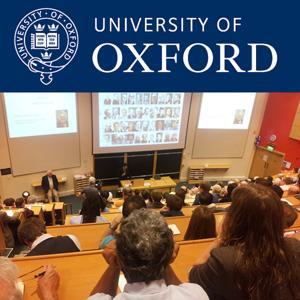
This series covers the Strachey Lectures, a series of termly computer science lectures named after Christopher Strachey, the first Professor of Computation at the University of Oxford.

More shows like Strachey Lectures

Philosophy for Beginners by Oxford University

Philosophy for Beginners

330 Listeners

Approaching Shakespeare by Oxford University

Approaching Shakespeare

329 Listeners

General Philosophy by Oxford University

General Philosophy

70 Listeners

Anthropology by Oxford University

Anthropology

73 Listeners

Aesthetics and Philosophy of Art lectures by Oxford University

Aesthetics and Philosophy of Art lectures

77 Listeners

Theoretical Physics - From Outer Space to Plasma by Oxford University

Theoretical Physics - From Outer Space to Plasma

59 Listeners

The Secrets of Mathematics by Oxford University

The Secrets of Mathematics

41 Listeners

Critical Reasoning for Beginners by Oxford University

Critical Reasoning for Beginners

30 Listeners

Kant's Critique of Pure Reason by Oxford University

Kant's Critique of Pure Reason

77 Listeners

Oxford Physics Public Lectures by Oxford University

Oxford Physics Public Lectures

12 Listeners