
Sign up to save your podcasts
Or

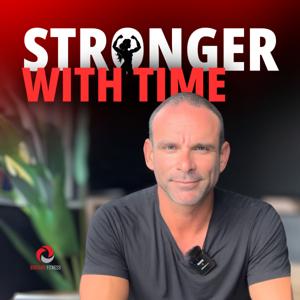


If you train for hypertrophy, you are probably not short on advice.
The harder part is knowing which advice is worth trusting.
In this episode of Stronger With Time, Tony speaks with Dr Gerard McMahon, a muscle physiology and biomechanics researcher and applied practitioner who has worked with elite athletes across Olympic, Para Games and Commonwealth Games environments.
Gerard brings together research and applied practice: what drives muscle growth, and what that means when you are programming for real people over months and years.
Together, Tony and Gerard work through some of the most common claims in hypertrophy training, from mechanical tension and effective reps to volume, activation drills, lengthened partials, periodisation and tendon training.
In this episode, they discuss:
Why research and real-world coaching both matter
What actually triggers muscle hypertrophy
Mechanical tension, muscle damage and metabolic stress
Why “effective reps” and “stimulating reps” are often misunderstood
How training volume should change with training status
Why more sets in one session are not always better
What muscle activation drills can and cannot do
Lengthened partials, lengthened range and where they may be useful
Why lengthened training does not apply equally to every muscle
Social media echo chambers in hypertrophy advice
Periodisation and long-term programming for muscle and strength
Tendon training, tendon stiffness and high mechanical loading
This conversation is for coaches, personal trainers and experienced lifters who want to think more clearly about hypertrophy training and build programs from principles rather than trends.
Timestamps
00:00 Introduction and the social media problem in hypertrophy advice
00:55 Dr Gerard McMahon’s background in sport science, research and elite sport
04:00 Research, coaching and how to judge training advice
06:00 Short-term hypertrophy studies versus long-term programming
08:35 Training volume claims and real-world constraints
10:10 What actually triggers muscle hypertrophy?
13:40 Mechanical tension, load and training to failure
15:30 Proximity to failure and motor unit recruitment
17:20 Effective reps and stimulating reps
21:20 Training volume and training status
23:40 Beginner versus advanced weekly volume
25:10 Signs you may be doing too much volume
26:40 Frequency and dividing weekly training volume
29:40 Muscle activation drills and warm-ups
33:30 Glute activation drills and warm-up specificity
35:20 Habitual movement patterns and activation drills
37:45 Lengthened partials and lengthened range
40:30 Which muscles benefit from lengthened range?
44:30 Quads, hamstrings, calves and lengthened work
47:45 Glutes and the best range for hip thrusts
48:45 Social media echo chambers in hypertrophy
51:00 Neuromechanical matching and exercise selection
53:30 Drop sets, supersets and overload techniques
56:10 Periodisation for hypertrophy and strength
58:25 How long to stay on a program
59:30 Tendon training, tendon stiffness and high mechanical loading
01:02:45 How to learn more from Dr Gerard McMahon
Resources:
Dr Gerard McMahon research and publications https://scholar.google.com/scholar?q=%22Gerard+McMahon%22+hypertrophy
Dr Gerard McMahon on PubMed https://pubmed.ncbi.nlm.nih.gov/?term=%22Gerard%20McMahon%22%20hypertrophy
Lengthened partials and hypertrophy research https://scholar.google.com/scholar?q=lengthened+partials+hypertrophy+McMahon
No Strain, No Gain tendon research search https://scholar.google.com/scholar?q=%22No+Strain%2C+No+Gain%22+tendon+McMahon
Neuromechanical matching review search https://scholar.google.com/scholar?q=Hudson+Gandevia+Butler+2019+neuromechanical+matching
Tony’s website https://tonyboutagy.com/
Tony on Instagram https://www.instagram.com/tonyboutagy/
Subscribe to Stronger With Time for more evidence-informed conversations on training, health and performance.
All content is for general educational purposes only and is not intended as medical advice.
Training hard may have built your fitness.
But should you keep training the same way as you age?
In this episode of Stronger With Time, Tony speaks with Dr Peter Reaburn, a researcher, author and lifelong masters athlete who has spent decades studying performance and ageing.
Peter is a retired Professor and former Head of Exercise and Sport Science at Bond University. He has authored and edited multiple books on masters athletes, published peer-reviewed research on masters athletes, and continues to work closely with the masters sporting community.
He also practises what he teaches. Peter was the Australian Ironman Triathlon Champion in the 50–54 age group in 2005 and is the current Australian Masters Swimming Champion in the 70–74 years 400m individual medley.
At 71, Peter brings both the research and lived experience to the question of how to keep training for strength, power and endurance as recovery and physical capacities begin to change.
In this episode:
Which aspects of fitness decline fastest with age
Why older endurance athletes still need resistance and sprint training
The role of fast-twitch muscle fibres in later-life performance
How to balance hard sessions with lower-intensity work
The hard-easy principle and the 80/20 approach
Atrial fibrillation risk in lifelong endurance athletes
Protein and recovery needs as we age
Menopause and the research gap in female masters athletes
When to replace a planned hard session with active recovery
The physical, cognitive, psychological and social sides of successful ageing
This conversation is for coaches, masters athletes and active adults who still care about performance, but recognise that training harder is not always the same as training better.
Timestamps
00:00 What fitness means across the lifespan
01:45 How strength, power and endurance decline with age 04:00 What masters athletes teach us about ageing
06:20 Why older athletes need resistance training
09:45 Fast-twitch muscle fibres and endurance performance 11:20 What we know about hybrid masters athletes
12:35 Menopause, muscle mass and performance
16:00 The research gap in female masters athletes
18:40 Continuous athletes, rekindlers and late bloomers
20:20 The hard-easy principle
22:00 Atrial fibrillation and endurance training
24:15 Why high-intensity-only training lacks nuance
27:10 The 80/20 approach to endurance training
30:10 Muscle protein synthesis as we age
31:50 How much protein older athletes may need
35:10 Why recovery changes with age
39:40 High-intensity training and neural fatigue
41:10 Listening to your body and changing the session
43:20 Active recovery versus complete rest
44:20 Flexibility and maintaining range of motion
46:30 The four domains of successful ageing
51:30 Peter’s books and work on masters athletes
Resources
The Masters Athlete by Dr Peter Reaburn https://books.google.com/books?q=%22The+Masters+Athlete%22+%22Peter+Reaburn%22
Nutrition and Performance in Masters Athletes, edited by Dr Peter Reaburn https://www.routledge.com/search?kw=Nutrition%20and%20Performance%20in%20Masters%20Athletes
Peter Reaburn’s research and publications https://scholar.google.com/scholar?q=%22Peter+Reaburn%22
Tony’s website https://tonyboutagy.com/
Tony’s courses https://tonyboutagy.com/explore-the-courses-page
Tony on Instagram https://www.instagram.com/tonyboutagy/
Stronger With Time on Apple Podcasts https://podcasts.apple.com/us/podcast/stronger-with-time/id1815428150
Stronger With Time on Spotify https://open.spotify.com/show/5Yydg6y3dA8OiA8hyHcJON
Subscribe to Stronger With Time for more conversations on evidence-informed training, health and performance.
All content is for general educational purposes only and is not intended as medical advice.
🌐 Visit → tonyboutagy.com
📲 Follow us on Instagram → @tonyboutagy
The principles that drive adaptation in the world's best endurance athletes are the same principles that drive adaptation in people who train seriously but are not competing. The application changes. The fundamentals do not.
Dr Dan Plews is an applied sports scientist, coach and world-class endurance athlete. He holds a doctorate in applied heart rate variability from Auckland University of Technology, has coached athletes to more than 30 world and Olympic titles, and has set records at both the Ironman World Championship and in HYROX.
In this episode, we discuss:
Why the gap between elite endurance science and everyday training is smaller than most people think. The framework Dr Plews uses with Olympic athletes, identifying the gap between current capacity and the target and then designing training to close it, applies equally to someone training six hours a week for health and longevity.
Whether the concurrent training interference effect actually matters for non-athletes. Dr Plews explains that while the interference effect is real, it primarily matters at the highest levels of performance. For most people training six or fewer hours a week, getting the work done in a recovered state matters more than the sequencing of strength and endurance sessions.
What zone two training actually is and where the common misconceptions come from. Zone two is defined by physiological markers, not by feel or a percentage of maximum heart rate, and most people who think they are training in zone two are working considerably harder than the research supports.
How heart rate variability reflects the state of the autonomic nervous system and why it is one of the most useful tools available for managing training load and recovery. Dr Plews explains how to interpret HRV trends over time, what a suppressed morning reading actually tells you, and how to use it to make better daily training decisions.
How low carbohydrate approaches and fueling strategies affect endurance adaptation, why metabolic flexibility matters for both performance and long-term health, and what the evidence shows about carbohydrate availability during training and competition.
Why Dr Plews shifted his focus from long-course triathlon to HYROX, and what that shift reflects about building a broader fitness base for longevity rather than optimising for a single performance output.
Key insight:
Elite endurance athletes succeed by applying the right stimulus at the right time and recovering properly between sessions. That principle does not change when you have six hours a week instead of thirty. The gap between what the best coaches in the world know and what everyday people apply is smaller than it looks, and this episode closes it.
Topics: zone two training, concurrent training, interference effect, heart rate variability, HRV, endurance training, polarised training, low carbohydrate training, metabolic flexibility, fueling for endurance, HYROX, triathlon, longevity and exercise, training load management, strength and endurance, applied sports science
Female athlete health is often discussed in extremes: either physiology is underplayed, or every difference gets turned into a rule.
This conversation sits in the middle, where evidence, clinical context and nuance matter.
In this episode of Stronger With Time, Tony speaks with Dr Kathryn “Kate” Ackerman, a former elite rower, sports medicine physician, endocrinologist and leading researcher in female athlete health.
Kate’s work sits at the intersection of sport, medicine, endocrinology and performance. She explains how her own experience as an athlete shaped her career, why the data gap in female athletes still matters, and how better research can improve both health and performance.
Tony and Kate discuss RED-S, low energy availability, menstrual dysfunction, bone stress injuries, fueling, carbohydrate availability, hormone therapy, menopause, and how to think about female athlete health without turning every difference into a rule.
They also explore the nuance often missing from online discussions: not every calorie deficit is RED-S, not every female athlete needs a bespoke training plan based on physiology alone, and the goal is not to create fear, but to understand what the evidence can and cannot tell us.
In this episode, they cover:
The evolution from the Female Athlete Triad to RED-S
What low energy availability means, and when it becomes a problem
Why RED-S requires clinical nuance, not just symptom counting
Screening tools, clinical markers and medical context
Bone stress injuries, DEXA, HR-pQCT and delayed bone recovery
Transdermal estrogen, oral contraceptives and bone health in amenorrheic athletes
Adolescent athletes, loading, fueling, calcium, vitamin D and stress injury risk
Carbohydrate availability, meal timing and recovery
Menopause, HRT and the gaps still left in women’s health research
Why female physiology matters, without turning everything into a sex-specific rule
This conversation is for coaches, clinicians, female athletes, parents of young athletes, and active women who want a clearer, evidence-informed understanding of female athlete health.
Resources:
WHSP Institute: https://whspinstitute.org/WHSP Medical: https://www.whspmedical.com/Dr Kate Ackerman bio: https://www.whspmedical.com/dr-kate-ackermanIOC REDs CAT2 / BJSM article: https://bjsm.bmj.com/content/57/17/1068Dr Kate Ackerman Instagram: https://www.instagram.com/drkateackerman/WHSP Institute Instagram: https://www.instagram.com/whsp_institute/
Tony’s website: https://tonyboutagy.com/Tony Instagram: https://www.instagram.com/tonyboutagy/
All content is for general educational purposes only and is not intended as medical advice.
If you train for hypertrophy, you are probably not short on advice.
The harder part is knowing which advice is worth trusting.
In this episode of Stronger With Time, Tony speaks with Dr Gerard McMahon, a muscle physiology and biomechanics researcher and applied practitioner who has worked with elite athletes across Olympic, Para Games and Commonwealth Games environments.
Gerard brings together research and applied practice: what drives muscle growth, and what that means when you are programming for real people over months and years.
Together, Tony and Gerard work through some of the most common claims in hypertrophy training, from mechanical tension and effective reps to volume, activation drills, lengthened partials, periodisation and tendon training.
In this episode, they discuss:
Why research and real-world coaching both matter
What actually triggers muscle hypertrophy
Mechanical tension, muscle damage and metabolic stress
Why “effective reps” and “stimulating reps” are often misunderstood
How training volume should change with training status
Why more sets in one session are not always better
What muscle activation drills can and cannot do
Lengthened partials, lengthened range and where they may be useful
Why lengthened training does not apply equally to every muscle
Social media echo chambers in hypertrophy advice
Drop sets, supersets and high-fatigue methods
Periodisation and long-term programming for muscle and strength
This conversation is for coaches, personal trainers and experienced lifters who want to think more clearly about hypertrophy training and build programs from principles rather than trends.
Timestamps
00:00 Introduction and the social media problem in hypertrophy advice
00:55 Dr Gerard McMahon’s background in sport science, research and elite sport
04:00 Research, coaching and how to judge training advice
06:00 Short-term hypertrophy studies versus long-term programming
08:35 Training volume claims and real-world constraints
10:10 What actually triggers muscle hypertrophy?
13:40 Mechanical tension, load and training to failure
15:30 Proximity to failure and motor unit recruitment
17:20 Effective reps and stimulating reps
21:20 Training volume and training status
23:40 Beginner versus advanced weekly volume
25:10 Signs you may be doing too much volume
26:40 Frequency and dividing weekly training volume
29:40 Muscle activation drills and warm-ups
33:30 Glute activation drills and warm-up specificity
35:20 Habitual movement patterns and activation drills
37:45 Lengthened partials and lengthened range
40:30 Which muscles benefit from lengthened range?
44:30 Quads, hamstrings, calves and lengthened work
47:45 Glutes and the best range for hip thrusts
48:45 Social media echo chambers in hypertrophy
51:00 Neuromechanical matching and exercise selection
53:30 Drop sets, supersets and overload techniques
56:10 Periodisation for hypertrophy and strength
58:25 How long to stay on a program
59:30 Tendon training, tendon stiffness and high mechanical loading
01:02:45 How to learn more from Dr Gerard McMahon
Resources:
Dr Gerard McMahon research and publications https://scholar.google.com/scholar?q=%22Gerard+McMahon%22+hypertrophy
Dr Gerard McMahon on PubMed https://pubmed.ncbi.nlm.nih.gov/?term=%22Gerard%20McMahon%22%20hypertrophy
Lengthened partials and hypertrophy research https://scholar.google.com/scholar?q=lengthened+partials+hypertrophy+McMahon
No Strain, No Gain tendon research search https://scholar.google.com/scholar?q=%22No+Strain%2C+No+Gain%22+tendon+McMahon
Neuromechanical matching review search https://scholar.google.com/scholar?q=Hudson+Gandevia+Butler+2019+neuromechanical+matching
Tony’s website https://tonyboutagy.com/
Tony on Instagram https://www.instagram.com/tonyboutagy/
Subscribe to Stronger With Time for more evidence-informed conversations on training, health and performance.
All content is for general educational purposes only and is not intended as medical advice.
Hypertrophy advice can become confusing fast.
Different studies, different coaches, different physiological models and different claims online can point to slightly different answers. Sets, reps, frequency, failure, soreness, exercise selection and periodisation are all debated, often with more certainty than the evidence allows.
In this episode of Stronger With Time, Tony brings together close to four hours of conversations with leading hypertrophy researchers and turns them into a practical framework for coaches and serious lifters.
Across the series, Tony explored muscle hypertrophy through three lenses: the history of strength and hypertrophy training with Professor William Kraemer, the molecular and mechanistic side of muscle growth with Professor Michael Roberts, and practical programming decisions with Dr Eric Helms.
This episode is the synthesis.
Tony distills the key takeaways into what current evidence suggests about how muscle grows, which variables deserve the most attention, and how that translates into real-world program design.
In this episode, we discuss:
The three main worldviews coaches use to program hypertrophy
Why outcome-based research can be difficult to apply directly to long-term training
What muscle hypertrophy is, including radial and longitudinal growth
Why mechanical tension sits at the centre of current hypertrophy thinking
Where DOMS, “the burn” and acute hormonal spikes fit in
Minimalist vs maximalist approaches to training volume
Why no single exercise can train every fibre within a complex muscle group
Practical implications for pec, delt and glute exercise selection
Training frequency, weekly sets and proximity to failure
How to think about drop sets, supersets, rest intervals and rep ranges
Periodisation, fatigue management and training at longer muscle lengths
Who this is for:
Coaches, PTs and S&C coaches programming hypertrophy for clients or athletes
Serious lifters who want their training aligned with current evidence, not trends
Practitioners who care about long-term strength, muscle and joint health
Gym owners who want clear hypertrophy principles their teams can apply consistently
About Dr Tony Boutagy:
Dr Tony Boutagy is an exercise scientist and strength coach with over 30 years of in-the-trenches experience. He is known for bridging hypertrophy and strength research with real-world programming for athletes, general population clients and serious lifters, with a focus on sustainable strength, hypertrophy and conditioning grounded in solid science.
About Stronger With Time:
Stronger With Time is Tony’s podcast on evidence-informed strength, hypertrophy and conditioning across the lifespan, helping coaches and lifters turn complex research into practical training decisions.
Resources:
Advanced Program MasteryTony’s course on long-term program design, periodisation and building training systems that get clients results across years, not weeks: https://tonyboutagy.com/advanced-program-mastery-course-page
Fat Loss FundamentalsTony’s course on designing fat loss phases that preserve muscle, manage energy availability and produce results that hold: https://tonyboutagy.com/fat-loss-fundamentals-course-page
Follow Tony on Instagram: @tonyboutagy
All content is for general educational purposes only and is not intended as medical advice.
Hypertrophy programming comes back to a few practical decisions: how close to failure, how much volume, how often, and how much variety.
In this episode, I speak with Dr Eric Helms about how to make those decisions with better judgment, and where popular models claim more than the evidence supports.
Dr Helms is a PhD researcher in strength and hypertrophy, a coach of physique and strength athletes, and a high-level natural bodybuilder.
In Part 1, we discussed how to think about training advice when coaches, research, and physiology models do not point in the same direction. In this episode, we apply that thinking to programming.
Some of what we discuss:
How close to failure you actually need to train, and when it matters more or less
Why “only the last 5 reps count” doesn’t hold up
Why estimating reps in reserve gets harder at higher reps
How much volume to use, and how frequency changes that decision
Why fatigue matters, but may be overweighted in programming decisions
Variety vs variation, and why hypertrophy may not need strength-style periodisation
Where drop sets, rest-pause, and myo-reps actually fit, as time-saving tools rather than superior methods
Who this is for:
Coaches programming hypertrophy for general population or athletes, and experienced lifters trying to make defensible decisions about failure, volume, frequency, and exercise selection without chasing every new trend.
Guest and Resources
Dr Eric Helms3D Muscle Journey: https://www.3dmusclejourney.com/about/The Muscle and Strength Pyramids: https://muscleandstrengthpyramids.com/Research profile: https://www.researchgate.net/profile/Eric-Helms-2MASS Research Review: https://massresearchreview.com/about-us-2/
Host: Dr Tony Boutagy
Exercise scientist and coach translating exercise science into practical training and programming decisions.Instagram: @tonyboutagyCourses, seminars, and resources: https://tonyboutagy.com/
If you coach or train seriously, you have probably had to weigh different sources of training advice against each other.
A successful coach recommends one approach. A research paper seems to suggest another. A physiology-based explanation points somewhere else.
In this episode, I speak with Dr Eric Helms about how to think through those conflicts without becoming dogmatic about any one source.
Dr Helms is a PhD researcher in strength and hypertrophy, a coach of physique and strength athletes, and a high-level natural bodybuilder.
Some of what we discuss:
Why success leaves clues, not answers
What we can and can’t learn from successful athletes and coaches
Why individual hypertrophy studies can seem to conflict
How to use reviews and position stands without outsourcing your judgement
When physiology-based explanations sound more certain than the evidence allows
This is the first part of a longer conversation with Eric. The second part moves further into the practical programming questions.
Guest and Resources
Dr Eric Helms
3D Muscle Journey: https://www.3dmusclejourney.com/about/
The Muscle and Strength Pyramids: https://muscleandstrengthpyramids.com/
Research profile: https://www.researchgate.net/profile/Eric-Helms-2
Resources mentioned:
Stark Center for Physical Culture and Sports: https://starkcenter.org/
Iron Game History journal: https://starkcenter.org/research/iron-game-history
Host:
Dr Tony BoutagyExercise scientist and coach translating exercise science into practical training and programming decisions.Instagram: @tonyboutagyCourses, seminars, and resources: https://tonyboutagy.com/
Every programme rests on some idea of what drives muscle growth. This episode looks at where the molecular and applied research supports that thinking - and where it does not.
Professor Michael Roberts is a professor at Auburn University and one of the world's leading researchers on skeletal muscle hypertrophy, with a laboratory spanning cell culture, rodent models, and applied human research.
In this episode, you will learn:
What is happening inside a muscle cell when it grows
Why mechanical tension appears to be central to hypertrophy
What the evidence shows about testosterone and the androgen receptor in muscle
Why women with much lower testosterone than men can still make similar relative gains with resistance training
Where the evidence lands on rep ranges and weekly set volume
Why drop sets are unlikely to add much once sufficient tension and volume are already in place
What sarcoplasmic hypertrophy is, and when it may occur
Why recent research suggests muscle fibres may grow by adding more myofibrils, not just by making existing ones bigger
Key insight:
Consistent mechanical tension, applied through a moderate rep range and sufficient weekly volume, appears to be a central driver of hypertrophy. The more complex the technique, the less likely it is to add much on top of that foundation.
Resources & Links
Dr. Tony Boutagy - https://tonyboutagy.com Follow on Instagram - https://www.instagram.com/tonyboutagy/ Professor Michael Roberts - https://education.auburn.edu/directory/profile.php?id=mdr0024Molecular and Applied Sciences Laboratory - https://education.auburn.edu/kinesiology/research/molecular-applied-sciences/index.phpRoberts Lab eLife paper on myofibril adaptations - https://elifesciences.org/articles/92674
After more than five decades of resistance training research, Professor William Kraemer returns to Stronger With Time to deliver a masterclass in what drives muscle growth, what the training protocols actually need to look like, and what has remained constant across every decade of evidence.
Professor Kraemer has published over 600 peer reviewed papers and 15 books on resistance training, held professorships at four major universities, and been ranked the number one sports scientist in his field. His career spans both deep laboratory science and applied coaching with elite athletes across dozens of sports.
In this episode, you will learn:
Why the size principle remains the governing factor for muscle hypertrophy, and why fibres that are not recruited cannot grow
How the anabolic hormonal response to resistance training actually works, and why testosterone does not act until it hits a receptor
Why excessive cortisol from poorly designed training may inhibit the very anabolic processes it was meant to stimulate
Why the eight to ten rep range at shorter rest periods of two to three minutes creates the most significant physiological stressor
Why 4×10 at moderate loads is often a bigger recovery demand than 3×3–5 heavy, and what that means for your week
Why normative exercises form the foundation of any complete programme, and why angle variation is a necessary strategy for complete motor unit coverage
What the evidence suggests for women navigating the menopause transition, and why the distinction between muscle function and muscle mass may be less meaningful than it appears
Key insight: After 50 years and over 600 papers, Professor Kraemer keeps returning to the same ground: load the muscle, recruit the fibres, manage the recovery. Everything else is context.
Resources & Links
Dr. Tony Boutagy → https://tonyboutagy.comFollow on Instagram → https://www.instagram.com/tonyboutagy/Professor William J. Kraemer Google Scholar → https://scholar.google.com/citations?hl=en&user=-HjoaV8AAAAJ
From the publisher's feed

431 Listeners

3,605 Listeners

775 Listeners

2,602 Listeners

4,872 Listeners

3,422 Listeners

9,165 Listeners
3,789 Listeners

7,997 Listeners

133 Listeners

617 Listeners

735 Listeners

412 Listeners

1,190 Listeners

98 Listeners